
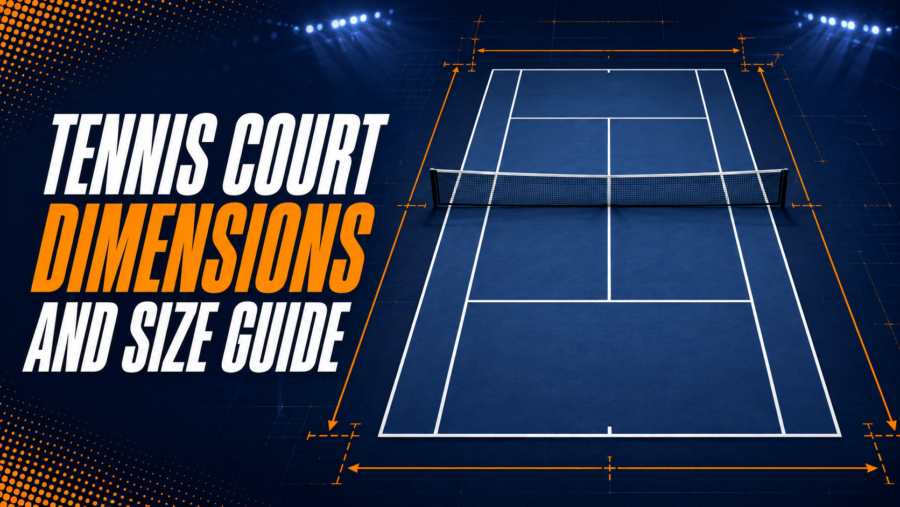
A regulation tennis court is 78ft (23.77m) long. It measures 27ft (8.23m) wide for singles and 36ft (10.97m) wide for doubles.
Those figures describe the marked playing area, not the total space required around the court. Once the recommended clearances behind the baselines and outside the sidelines are included, an international competition court occupies approximately 120ft × 60ft.
This guide focuses exclusively on tennis court dimensions, line markings, net measurements, playing zones and surrounding clearances. Site preparation, drainage, surface installation and other construction topics are covered separately in the Complete Guide to Building a Tennis Court.
Tennis Court Dimensions at a Glance
The following measurements come from the 2026 ITF Rules of Tennis.
| Court measurement | Feet | Meters |
|---|---|---|
| Court length | 78ft | 23.77m |
| Singles court width | 27ft | 8.23m |
| Doubles court width | 36ft | 10.97m |
| Net to baseline | 39ft | 11.89m |
| Net to service line | 21ft | 6.40m |
| Service line to baseline | 18ft | 5.49m |
| Individual service box | 21ft × 13.5ft | 6.40m × 4.12m |
| Width of each doubles alley | 4.5ft | 1.37m |
| Net height at the center | 3ft | 0.914m |
| Net height at the posts | 3ft 6in | 1.07m |
All official court measurements are taken to the outside edge of the relevant lines. This is important because the lines form part of the areas they define.
Standard Tennis Court Size
Every regulation tennis court is 78ft long, regardless of whether it is used for singles or doubles. The net divides that length into two equal 39ft halves.
The width changes depending on the match format. Singles uses the inner sidelines, producing a 27ft-wide court, while doubles includes the two outer alleys and expands the legal playing area to 36ft.
Singles Tennis Court Dimensions
A singles tennis court measures 78ft × 27ft, giving it a marked playing area of 2,106sq ft, or approximately 195.7m².
The singles sidelines are the inner sidelines running from one baseline to the other. Balls that land between a singles sideline and the outer doubles sideline are out during a singles point.
Doubles Tennis Court Dimensions
A doubles tennis court measures 78ft × 36ft and covers 2,808sq ft, or approximately 260.9m².
The additional 702sq ft comes from the two doubles alleys. Each alley is 4.5ft wide and runs the full 78ft length of the court.
Most public and club courts have both singles and doubles lines. This allows the same court to accommodate either match format without changing its physical layout.
Singles vs Doubles Court Dimensions
| Measurement | Singles | Doubles |
|---|---|---|
| Length | 78ft | 78ft |
| Width | 27ft | 36ft |
| Marked playing area | 2,106sq ft | 2,808sq ft |
| Doubles alleys in play | No | Yes |
| Service box width | 13.5ft | 13.5ft |
The service boxes do not become wider during doubles. Although the alleys are legal during the rally, a serve must still land inside the singles sideline and cannot land in the doubles alley.
This is one of the most commonly misunderstood parts of tennis court dimensions. Doubles expands the area available after the serve has landed, but it does not change the target area for serving.
Tennis Court Lines and Playing Zones
Each line on a tennis court defines a specific part of the playing area. Understanding these measurements makes it easier to interpret serving rules, court positioning and whether a ball is in or out.
Baselines
The baselines form the two short ends of the court and are 36ft long on a combined singles and doubles court. Each baseline is 39ft from the net.
Players must begin the service motion behind the baseline. During a singles serve, the server must also remain between the imaginary extensions of the center mark and the singles sideline.
Singles Sidelines
The singles sidelines are 27ft apart. Each line runs for the full 78ft length of the court and forms the side boundary during singles matches.
The distance from the court’s center line to either singles sideline is 13.5ft. That same measurement determines the width of each service box.
Doubles Sidelines and Alleys
The doubles sidelines are 36ft apart. The space between each singles sideline and doubles sideline is called the doubles alley or tramline.
Each alley is 4.5ft wide. With one alley on each side, doubles adds a total of 9ft to the width of the legal playing area.
Service Lines
The service lines run parallel to the net and are positioned 21ft from it on each side. Because each baseline is 39ft from the net, there is an 18ft space between the service line and baseline.
The service lines only extend between the singles sidelines. They do not continue across the doubles alleys.
Center Service Line
The center service line divides the space between the net and service line into two equal service boxes. It runs parallel to the sidelines and sits halfway between the singles sidelines.
Each service box therefore measures 21ft long and 13.5ft wide, covering 283.5sq ft. There are four service boxes across the complete court.
Center Mark
The center mark is the short line at the midpoint of each baseline. It extends 4in into the court and is positioned parallel to the sidelines.
Its main purpose is to divide the baseline into the deuce and advantage serving sides. The server cannot touch the imaginary extension of the center mark during the service motion.
The Backcourt
The backcourt is the 18ft section between the service line and baseline. It is sometimes informally called the baseline area because this is where many groundstroke rallies take place.
The term “no man’s land” is also commonly used for the area around the service line. It is not an official court marking, but a tactical term for a position where players can be vulnerable to shots landing at their feet.
Tennis Net Dimensions and Height
A regulation tennis net is 3ft (0.914m) high at the center and 3ft 6in (1.07m) high at the net posts. A white center strap holds the middle of the net at the correct height.
On a doubles court, the centers of the net posts must be 3ft outside each doubles sideline. This creates a distance of 42ft between the centers of the posts.
A dedicated singles net uses posts positioned 3ft outside each singles sideline, resulting in a 33ft post-to-post span. However, most facilities use a doubles net for both formats.
When singles is played with a doubles net, two singles sticks should support the net at 3ft 6in. Each stick is positioned 3ft outside the relevant singles sideline, restoring the correct net height and shape for singles play.
How Wide Are Tennis Court Lines?
Line width is included in the official court dimensions. A ball that touches any part of the correct boundary line is considered in.
The ITF specifies the following line widths:
| Court line | Regulation width |
|---|---|
| Center service line | 2in (5cm) |
| Center mark | 2in (5cm) |
| Baseline | 1in to 4in (2.5cm to 10cm) |
| All other court lines | 1in to 2in (2.5cm to 5cm) |
All lines must be the same color and clearly contrast with the playing surface. White is the most common choice, although the rules define visibility and consistency rather than requiring one specific color.
Measurements are taken to the outside edge of the lines. For example, the 78ft court length runs from the outside edge of one baseline to the outside edge of the opposite baseline.
How Much Total Space Does a Tennis Court Need?
The marked doubles court is only 78ft × 36ft, but players need additional room to chase deep and wide shots. A fence, wall or backstop placed directly next to the lines would make normal play unsafe and impractical.
The ITF provides different clearance recommendations for recreational courts and international competition. These are measured from the baselines to the backstops and from the doubles sidelines to the sidestops.
| Court area | Overall dimensions | Approximate area |
|---|---|---|
| Marked singles court | 78ft × 27ft | 2,106sq ft |
| Marked doubles court | 78ft × 36ft | 2,808sq ft |
| Club and recreational playing area | 114ft × 56ft | 6,384sq ft |
| International competition playing area | 120ft × 60ft | 7,200sq ft |
Club and Recreational Clearances
For club and recreational play, the ITF recommends at least 18ft between each baseline and backstop. It also recommends 10ft between each doubles sideline and sidestop.
Adding those clearances to the marked court produces an overall playing area of 114ft × 56ft, or approximately 34.75m × 17.07m.
International Competition Clearances
For international competition, the recommended minimum clearance increases to 21ft behind each baseline and 12ft outside each doubles sideline.
That creates a total area of 120ft × 60ft, or approximately 36.58m × 18.29m. The complete space covers 7,200sq ft, equivalent to about 668.9m² or 0.165 acres.
Some professional stadium courts provide more space than this, particularly behind the baselines. Tournament requirements, camera positions, officiating equipment and player seating can all affect the final layout without changing the regulation court lines.
Indoor Tennis Court Height
For indoor tennis, the ITF recommends a minimum ceiling height of 29.6ft (9m), measured above the net. A greater height may be preferable for high-level play because defensive lobs can travel considerably higher.
Ceiling height does not change the court’s marked dimensions. It determines how much vertical space is available before the ball contacts a permanent fixture.
Junior Tennis Court Dimensions
Junior tennis often uses smaller courts and slower balls so children can cover the space and develop complete strokes more comfortably. The court becomes progressively larger as the player moves from red to orange and then green-ball tennis.
The USTA youth tennis pathway uses these common court sizes:
| Junior format | Court size | Net height at center |
|---|---|---|
| Red ball | 36ft × 18ft | 2ft 9in |
| Orange ball singles | 60ft × 21ft | 3ft |
| Orange ball doubles | 60ft × 27ft | 3ft |
| Green ball singles | 78ft × 27ft | 3ft |
| Green ball doubles | 78ft × 36ft | 3ft |
The ITF permits some variation within the red and orange formats. A red court can be 36ft to 42ft long and 14ft to 20ft wide, while an orange court can be 58ft to 60ft long and 20ft to 27ft wide.
Green-ball tennis uses the full regulation court. The lower-compression green ball slows the game slightly, but the court dimensions are identical to those used with a standard yellow ball.
Do Court Dimensions Change by Surface?
Grass, clay and hard courts all use the same regulation dimensions. The surface affects ball speed, bounce height, movement and tactics, but it does not change the position of the baselines, sidelines, service lines or net.
A singles court at Wimbledon has the same marked dimensions as a singles court at Roland Garros, the Australian Open or the US Open. Visual differences in television coverage usually come from camera angles, court colors and the amount of surrounding run-off space.
Are Men’s and Women’s Tennis Courts the Same Size?
Men and women compete on courts with identical dimensions. The same measurements also apply at recreational, college and professional levels.
Match format and tournament regulations can affect scoring, balls and other playing conditions, but there is no separate men’s or women’s tennis court size.
Are Wheelchair Tennis Courts a Different Size?
Wheelchair tennis uses the same court dimensions, lines and net height as able-bodied tennis. The primary difference is that a wheelchair player may allow the ball to bounce twice before returning it, with the second bounce permitted inside or outside the court boundaries, as explained in the ITF Rules of Wheelchair Tennis.
Facilities may choose to provide more surrounding space for accessibility and movement. However, the regulation playing rectangle remains 78ft long and either 27ft or 36ft wide.
Final Summary
A standard tennis court is always 78ft long. Singles uses a width of 27ft, while doubles expands the playing area to 36ft by including two 4.5ft alleys.
The service lines sit 21ft from the net, each service box measures 21ft × 13.5ft and the net stands 3ft high at the center. When surrounding clearance is included, the recommended total area is 114ft × 56ft for club play or 120ft × 60ft for international competition.
FAQ
How big is a tennis court in feet?
A regulation tennis court is 78ft long. It is 27ft wide for singles and 36ft wide for doubles.
How big is a tennis court in square feet?
The marked singles area covers 2,106sq ft, while the marked doubles area covers 2,808sq ft. An international-size playing area with recommended run-off space covers approximately 7,200sq ft.
What is the distance from the baseline to the net?
Each baseline is 39ft from the net. The net divides the 78ft court into two equal halves.
How far is the service line from the net?
The service line is 21ft from the net. The remaining distance between the service line and baseline is 18ft.
What size is a tennis service box?
Each service box measures 21ft long and 13.5ft wide. Its total area is 283.5sq ft.
Are the service boxes wider in doubles?
No. Singles and doubles use the same 13.5ft-wide service boxes. The doubles alleys become active only after the serve lands.
Is a 78ft × 36ft space large enough for tennis?
It is large enough to contain the marked doubles court, but it does not provide room for players to move beyond the boundaries. Recommended overall dimensions are approximately 114ft × 56ft for recreational play and 120ft × 60ft for international competition.
How high is a tennis net?
A regulation tennis net is 3ft high at the center and 3ft 6in high at the posts. Singles sticks, when required, also support the net at 3ft 6in.