
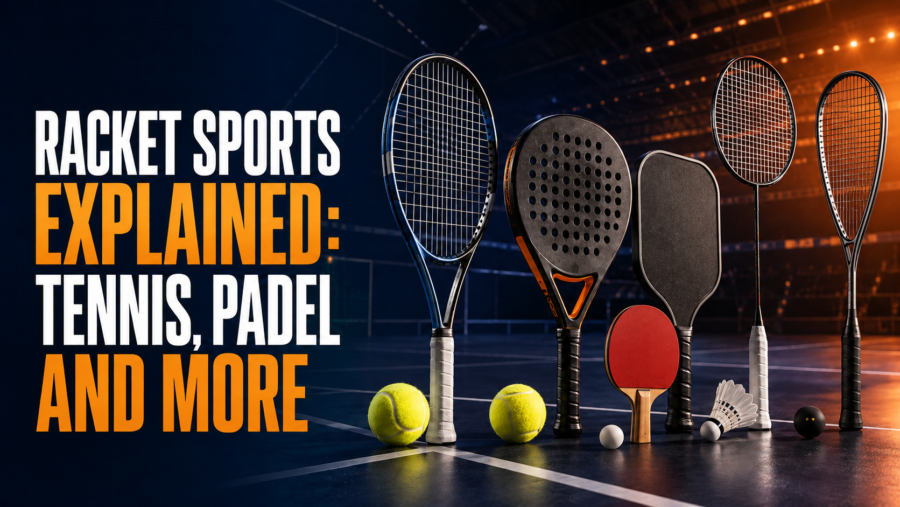
Racket sports are games in which players use a handheld racket, paddle or bat to strike a ball or shuttle across a net, against a wall or around an enclosed court. Tennis, padel and pickleball share visible similarities, but their court sizes, equipment, bounce rules and movement demands produce very different experiences.
This guide compares the main families at a high level so a new player can choose where to start. It does not replace the dedicated rules and technique guides for each sport.
Racket Sports at a Glance
| Sport | Implement and object | Playing area | Typical format | Defining feature |
|---|---|---|---|---|
| Tennis | Strung racket and felt-covered ball | Open rectangular court with a net | Singles or doubles | Ball may bounce once before return |
| Padel | Solid perforated racket and pressurized ball | Enclosed 20m × 10m court | Usually doubles | Walls remain part of play after a legal bounce |
| Pickleball | Solid paddle and perforated plastic ball | 20ft × 44ft court | Singles or doubles | Non-volley zone and two-bounce rule shape the rally |
| Badminton | Strung racket and shuttlecock | Netted indoor or outdoor court | Singles or doubles | Shuttle must be struck before touching the floor |
| Table tennis | Solid bat and lightweight plastic ball | Divided table | Singles or doubles | Compact space and very short reaction time |
| Squash | Strung racket and rubber ball | Enclosed four-wall court | Primarily singles | Players alternate shots using the front and side walls |
| Racquetball | Strung racket and rubber ball | Enclosed court | Singles or doubles | Multiple walls can be used in a fast rally |
| Beach tennis | Solid paddle and low-compression ball | Sand court with a high net | Primarily doubles | The ball is volleyed and cannot bounce |
The label “racket sport” is an umbrella term rather than a rule that every implement must be strung. Pickleball, padel, table tennis and beach tennis use solid hitting surfaces but still belong in the same practical family.
Tennis
Tennis is played on a 23.77m-long court that is 8.23m wide for singles and 10.97m wide for doubles. Players use a strung racket to send the ball over a net, and the ball can bounce once before it must be returned.
It offers the largest range of common surfaces in this group, including hard, clay and grass courts. Surface, ball, spin and court position can all change the pace and tactical shape of a point.
What Makes Tennis Distinct
- A large court and substantial serving distance
- Separate singles and doubles sidelines
- A second serve after a first-service fault
- Point, game and set scoring
- Broad variation in spin, trajectory and surface response
Tennis is a strong fit for someone who enjoys a combination of athletic movement, individual problem-solving and long-term technical development. What Is Tennis? An Intro to the Sport gives new players the fuller orientation.
Padel
Padel is normally played as doubles on a 20m × 10m enclosed court. The racket is solid and perforated, the serve is underarm after a bounce, and a ball that first lands legally can rebound from the surrounding walls and remain in play.
The smaller enclosed court brings all four players into frequent contact with the point. Positioning with a partner, defending from the back glass and winning the net are central parts of the game.
What Makes Padel Distinct
- Walls are functional playing surfaces, not just boundaries
- Doubles is the standard format
- The serve begins underarm after a bounce
- Solid rackets have no stringbed
- Lobs, rebounds and coordinated net movement are fundamental
Padel often appeals to players who want a social doubles sport with tactical wall use and less open-court coverage than tennis. What Is Padel? An Intro to the Sport explains the equipment, scoring and first steps, while Differences Between Tennis and Padel owns the detailed two-sport comparison.
Pickleball
Pickleball uses a solid paddle and a perforated plastic ball on a 20ft × 44ft court. The same court dimensions apply to singles and doubles, and the non-volley zone extends 7ft from each side of the net.
After the serve, the receiving side must let the ball bounce, and the serving side must also let the return bounce before either side may volley. This two-bounce rule creates the transition from the baseline toward the non-volley line.
What Makes Pickleball Distinct
- Compact court shared by singles and doubles
- Perforated plastic ball with a different flight from a tennis ball
- Underhand or drop-serve options under the applicable rules
- Seven-foot non-volley zone, commonly called the kitchen
- Two-bounce sequence at the start of every rally
Pickleball suits players who enjoy quick exchanges, accessible social play and tactical control near the non-volley line. Pickleball the fastest growing sport you need to try provides the dedicated beginner overview, and Tennis vs Pickleball: A Complete Comparison handles that exact head-to-head decision.
Badminton
Badminton uses a lightweight strung racket and a shuttlecock. Unlike a ball, the shuttle slows sharply after being struck, but high-level exchanges can still demand explosive movement and very fast reactions.
The shuttle cannot bounce. A rally ends when it touches the floor, travels out or a fault occurs, so players must intercept every legal shot in the air.
What Makes Badminton Distinct
- A shuttlecock rather than a ball
- No ground bounce during a rally
- Overhead clears, drops and smashes are major shot families
- A high net relative to the trajectory used in tennis
- Indoor conditions are preferred for consistent shuttle flight
Badminton can be attractive to someone who likes rapid changes of direction, overhead play and a light projectile. The technique does not transfer directly from tennis because the grip changes, swing timing and shuttle behavior are different.
Table Tennis
Table tennis compresses a net game onto a table 2.74m long and 1.525m wide. Players use solid bats and a 40mm ball, creating short travel times and a strong emphasis on spin recognition.
The playing space is small, but the technical demands are not. Serve variation, racket angle and reading rotation can change the ball’s path dramatically after it contacts the table or bat.
What Makes Table Tennis Distinct
- A table replaces the court surface
- A small, light ball can carry substantial spin
- Compact strokes and rapid recovery matter
- Games are played to 11 points under international rules
- The serve must bounce on the server’s side before crossing to the receiver’s side
Table tennis is convenient where full court space is unavailable. It rewards fine touch and anticipation more than long-distance court coverage.
Squash
Squash is played in an enclosed court with a small rubber ball and a strung racket. Both players share the same floor area and alternate striking the ball so it reaches the front wall legally.
Side and back walls can be used to change angle and depth. Because players occupy the same space, safe clearing, awareness and access to the ball are part of both tactics and rules.
What Makes Squash Distinct
- Shared enclosed court rather than opponents on opposite sides of a net
- Front, side and back walls shape the rally
- Rubber ball behavior changes as it warms
- Continuous movement in a compact area
- Interference and safe access rules matter
Squash suits players who enjoy sustained movement, wall geometry and close-range decision-making. Beginners benefit from instruction because swing safety and court sharing are less intuitive than they appear.
Racquetball
Racquetball also takes place in an enclosed court, but its equipment, service rules and legal wall combinations differ from squash. The larger, bouncier ball and racket design create a distinct pace and rebound pattern.
It is a poor idea to treat squash and racquetball as interchangeable simply because both use walls. The court markings, ball behavior, protective-equipment expectations and rules should be learned for the exact sport.
Beach Tennis
Beach tennis combines a net game with movement on sand. Players use solid paddles and a low-compression ball, and the ball must be struck before it lands.
The International Tennis Federation’s standard doubles court is 16m × 8m. The sport uses tennis-influenced scoring with its own serving and no-bounce format, so it is closer to a continuous volley game than ordinary tennis on sand.
Tennis vs Padel vs Pickleball
| Decision factor | Tennis | Padel | Pickleball |
|---|---|---|---|
| Common social format | Singles and doubles | Doubles | Doubles, with singles also common |
| Space to cover | Largest open court | Smaller enclosed court shared with partner | Compact court |
| Hitting surface | Strung racket | Solid perforated racket | Solid paddle |
| Ball behavior | Pressurized or approved tennis ball with one permitted bounce | Tennis-like ball plus wall rebounds after bounce | Perforated plastic ball with lower speed and distinct wind response |
| Serve | Overarm or underarm, usually overarm in regular play | Underarm after a bounce | Underhand or drop-serve process under current rules |
| Central tactical feature | Depth, spin, court position and surface | Net control, teamwork and wall defense | Non-volley-line control, drops and transition |
| Typical learning challenge | Serve and full-court consistency | Reading glass rebounds and moving as a pair | Kitchen positioning and controlling a light ball |
No column identifies an objectively easiest sport. A smaller court can reduce running distance while still demanding fast reactions, balance and precise positioning.
For a focused comparison between the two enclosed or compact alternatives, use Padel vs Pickleball: A Complete Comparison rather than turning this overview into another full head-to-head article.
Which Racket Sport Is Best for Beginners?
The best choice is the sport with accessible facilities, suitable instruction and people to play with. A perfectly matched game on paper is not useful if the nearest court is too far away or local sessions do not welcome new players.
Modified equipment can make several sports more approachable. Tennis can use red, orange or green balls and smaller courts; badminton can begin with cooperative short-court exchanges; table tennis can start with simple control rallies; and pickleball or padel lessons can introduce court positioning before full matches.
Try a beginner session before buying specialist equipment. The handle, ball, movement and impact response differ enough that owning a tennis racket does not solve the equipment needs of every related sport.
Which Sport Gives the Most Exercise?
Intensity depends on format, level, rally length, rest and the individual player. Singles tennis can require larger court coverage, while squash can create sustained movement in a smaller space and doubles sports can range from relaxed social play to vigorous competition.
Court size alone is not an energy-expenditure ranking. Use the sport that can be played consistently and scaled safely to current fitness.
Which Skills Transfer Between Racket Sports?
Some broad abilities transfer:
- Tracking a moving object
- Recovering to a useful position
- Reading an opponent’s preparation
- Controlling direction and height
- Coordinating movement with a partner
- Changing between attack and defense
Exact technique often does not. A tennis groundstroke, padel rebound, badminton overhead and table-tennis loop use different grips, contact points, swing lengths and timing.
New players should transfer principles rather than copy a complete stroke. Previous experience can accelerate learning, but it can also create habits that need adjustment.
How to Choose the Right Racket Sport
Ask these questions:
- Which facilities are available within a realistic travel distance?
- Is the preferred format singles, doubles or either?
- Are social sessions or beginner lessons available?
- Is an open court, enclosed court, table or sand environment more appealing?
- How much equipment and booking access are required?
- Does the player enjoy long rallies, rapid exchanges, walls, overheads or spin?
- Can the activity be adapted to current mobility and fitness?
Choose access and enjoyment before status. Regular participation in a suitable local game is more valuable than selecting a sport because it appears fashionable or technically prestigious.
Final Comparison
Tennis offers the broadest familiar court-and-surface game, padel centers on doubles and wall tactics, and pickleball creates compact net play around the non-volley zone. Badminton, table tennis, squash, racquetball and beach tennis take the same strike-and-recover idea in very different directions.
The practical next step is to try an introductory session at a local facility. Court access, compatible partners and genuine enjoyment will usually predict long-term participation better than choosing from a feature table alone.
Frequently Asked Questions
Is padel the same as paddle tennis?
No. Padel has its own court, wall rules, equipment and governing structure. Several sports have used “paddle” in their names, so the exact ruleset matters.
Can a tennis racket be used for pickleball or padel?
No. Pickleball and padel use solid sport-specific paddles or rackets, and sanctioned equipment must meet the applicable rules.
Is pickleball played on a badminton court?
The court has the same 20ft × 44ft overall dimensions often associated with badminton doubles, but pickleball has its own net height, line layout and non-volley zones. A space must be marked and equipped for the intended sport.
Why do padel players use the walls but tennis players do not?
Padel rules make the enclosure part of play after a legal bounce. In tennis, fences and surrounding structures are outside the playable court and normally end the point when contacted by the ball.
Do all racket sports allow the ball to bounce?
No. Badminton uses a shuttle that cannot touch the floor, and beach tennis is played without a bounce. Tennis, padel, pickleball, table tennis and wall sports each apply different bounce rules.