
Affiliate disclosure: This page contains affiliate links. If you make a purchase through one of these links, Tennis Overload may earn a commission at no additional cost to you.
Tennis vibration dampeners work if your goal is to reduce the high-pitched sound and some of the vibration produced by the strings. They do not meaningfully alter a racket’s power, spin, control, or sweet spot, and current evidence does not support using one as protection against tennis elbow.
That makes a dampener a preference item, not a performance necessity. Use one if the quieter, more muted response feels better to you. Leave it off if you prefer a sharper sound and more direct feedback.
What a Tennis Vibration Dampener Does
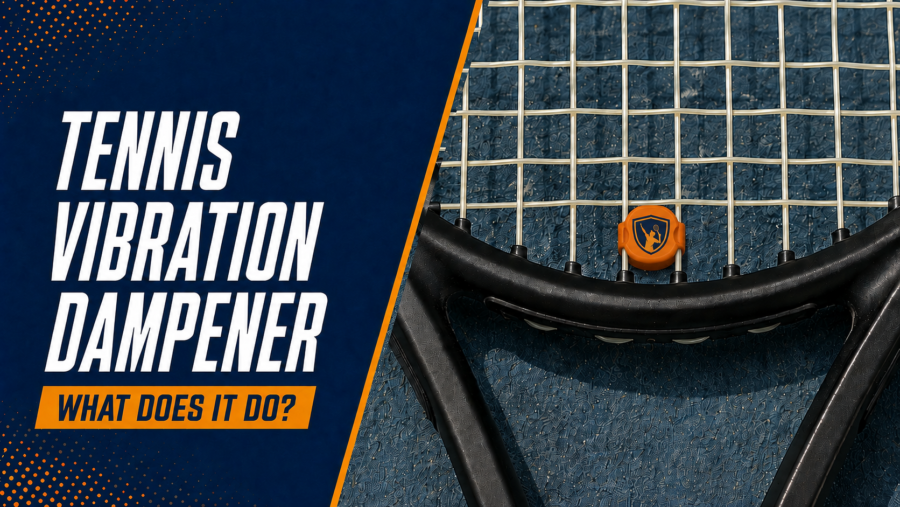
A vibration dampener is a small rubber, silicone, or similar elastic device attached to the string bed. It absorbs part of the higher-frequency vibration in the strings after impact, which changes the sound from a bright ping to a lower, shorter thud.
The perceived change can be noticeable even though the device is tiny. Sound contributes to how a hit feels, so a quieter response may seem softer or more solid to one player and less connected to another.
That sensory preference should not be confused with a major change to the ball’s launch. String material, gauge, tension, and the racket itself have much more influence on how the string bed plays. The guide to tennis string types explains those larger equipment differences.
What Dampeners Do Not Do
A standard string dampener does not turn a firm setup into a soft one. It also does not create extra power, enlarge the sweet spot, add spin, or correct off-center contact.
Laboratory work generally finds that small string dampeners reduce string vibration and alter sound without substantially reducing the lower-frequency frame vibration transmitted toward the hand and forearm. Research findings vary with the test setup and device, but there is not good evidence that a conventional string dampener prevents or treats an overuse injury.
If the string bed feels harsh, examine the complete setup instead. A different string material, a suitable tension adjustment, fresh strings, a stable racket you can swing comfortably, workload, and stroke mechanics are more meaningful variables. Start with the complete guide to choosing tennis strings rather than expecting a small accessory to solve the problem.
Do Dampeners Help Tennis Elbow?
There is no reliable basis for treating a vibration dampener as protection against tennis elbow. Lateral elbow pain is commonly associated with repeated loading of the forearm tendons, and many factors can contribute, including training volume, technique, grip demands, and equipment fit.
A dampener may make impact sound less harsh, but comfort is not the same as injury protection. If pain persists, worsens, affects daily activities, or changes your swing, stop treating it as an equipment experiment and seek advice from a qualified medical professional.
For equipment changes that can be tested more systematically, see how to choose an arm-friendly tennis racket for comfort and compare tennis strings designed with comfort in mind. Neither is a substitute for diagnosis or treatment.
Are Tennis Vibration Dampeners Legal?
Yes, provided they are placed outside the pattern of crossed strings. Under the tennis rules, a dampening device cannot sit inside the area where the main strings and cross strings intersect.
The most common legal position is below the lowest cross string, between two center main strings. A longer strip or worm-style dampener may span several main strings, but every part of it must remain outside the crossed-string pattern.
There is no requirement to use a dampener. Playing without one is completely legal.
Button vs Worm Dampeners
Button Dampeners
Button dampeners are small pieces that sit between two main strings. They are light, simple to install, and create a modest change in sound.
Their main drawback is retention. A loose fit, worn material, or very open string pattern can allow a button to pop out after an off-center hit.
Worm and Strip Dampeners
Worm dampeners weave across or clip onto several strings below the bottom cross. Because they contact more string length, they often produce a more muted sound than a small button.
They may take longer to install and can feel overly dead to players who like audible feedback. The choice between the two styles is about sensation and security, not a proven performance advantage.
Built-In and Alternative Devices
Some products use bands, clips, or other shapes, but the same placement rule applies. Rubber bands are also used by some players as simple dampeners. Whatever the design, it should be secure, undamaged, and entirely outside the crossed-string pattern.
Current Dampeners Worth Comparing
These are current examples of the main formats, not performance rankings. Choose by sound, amount of string contact, installation, and retention. None should be treated as injury protection.
| Current option | Style | What makes it different |
|---|---|---|
| Wilson Pro Feel Dampener 2 Pack | Compact button | A simple two-pack for players who want minimal string coverage and a conventional centered installation. |
| Babolat Custom Damp x2 | Adjustable button | A removable clear center piece lets the user choose between more dampening and more direct ball feel. |
| GAMMA Shockbuster | Worm | The long gel-filled tube contacts most main strings, creating a broader-contact alternative to a button. Expect a more muted sound in many setups, but the result depends on the racket and strings. |
| ADV Multi-Feel Dampeners | Locking multi-size set | Grooved channels lock onto the strings, and the pack includes designs spanning two, four, and six strings. It is the most relevant option here if button dampeners repeatedly pop out. |
Check that any wide or locking design still sits completely outside the crossed-string pattern. Product names, colors, and availability can change, so confirm that you are buying the exact current design described here.
How to Install a Vibration Dampener
- Find the lowest cross string in the racket head.
- Choose a centered gap between two main strings below that cross.
- Press a button dampener into place, or attach a strip according to its design.
- Check that no part enters the crossed-string area.
- Tap the string bed and gently move the device to confirm it is secure.
Do not force an oversized device between strings or use a damaged one that can split. If it repeatedly falls out, try a design that locks around the strings more securely.
Does Placement Change the Effect?
A dampener must remain outside the crossed-string pattern, which limits placement choices. Within the legal area below the bottom cross, a centered position is common because it is easy to install and unlikely to interfere with the frame.
Moving a small device one main string to the side is unlikely to transform its effect. The design, amount of string contact, and how securely it fits matter more to the audible result.
Dampener vs String and Tension Changes
These adjustments solve different problems:
| Adjustment | Main effect |
|---|---|
| Vibration dampener | Changes string vibration, sound, and perceived feedback |
| Softer or more elastic string | Changes string-bed stiffness, energy return, and feel |
| Lower tension within the racket and string limits | Generally creates a softer, higher-launching response |
| Fresh strings | Restores more predictable response when old strings have lost playability |
| Different racket specifications | Changes mass, balance, stability, power, and overall impact response |
Use the string tension calculator as a starting reference, then stay within the ranges recommended for your racket and string. Make one change at a time so you can tell what actually helped.
Should You Use a Dampener?
Try one if you dislike string ping, want a more muted sound, or simply enjoy the sensation. The accessory is inexpensive, reversible, and legal when installed correctly.
Skip it if you like crisp feedback or expect it to fix power, control, or pain. For those issues, assess the racket, strings, tension, technique, and playing load instead of treating the dampener as a cure.
Tennis Dampener FAQ
Do professional players use vibration dampeners?
Some do and some do not. Their choices show that dampeners are optional and personal, not essential equipment.
Can a dampener make a racket more powerful?
No meaningful increase in power should be expected. Its main effect is on string vibration and sound after impact.
Can I put two dampeners on a racket?
The rules refer to vibration-damping devices in the plural, but every device must remain outside the crossed-string pattern. Adding more devices may change sound and feel, not core performance.
Why does my dampener keep falling out?
It may not fit the string spacing, the material may be worn, or off-center contact may dislodge it. Reinstall it securely below the bottom cross or try a locking or strip-style design.