
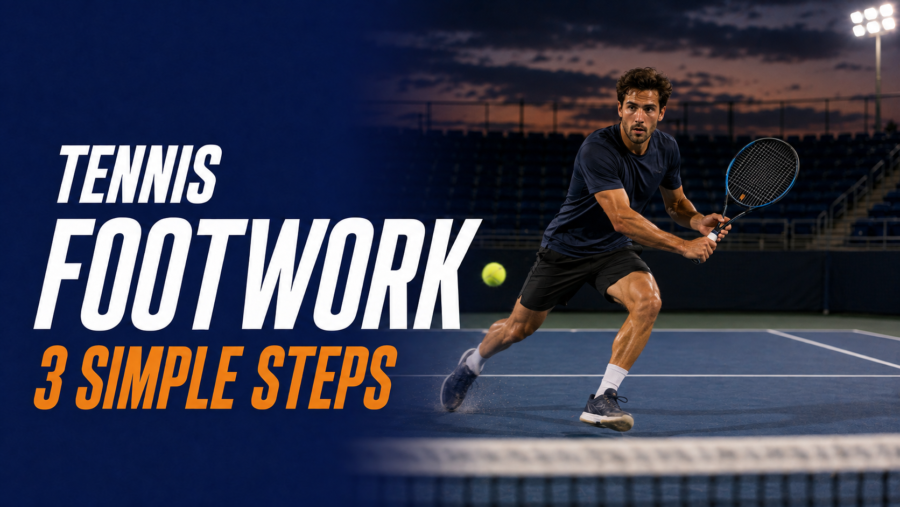
Footwork is important in tennis because it determines whether you reach the ball early enough, create suitable spacing and remain balanced through contact. Even excellent stroke mechanics become unreliable when you arrive late, stand too close to the ball or hit while falling away.
Good footwork is not simply about running faster or taking as many steps as possible. It is a repeating three-step cycle: read and split, move and adjust, then recover and reset.
Step 1: Split, Read and Turn
Begin in a balanced ready position with your feet comfortably apart, your knees and hips slightly flexed and your racket in front. Keep your heels light without standing rigidly on your toes.
As your opponent prepares to strike, perform a small split step. Start the movement around their contact so that you land ready to push in either direction as the ball’s path becomes clear.
The split step should be quick and low. Jumping too high keeps you in the air for too long, while splitting too early can leave you stationary again before the opponent hits.
There is no single perfect split-step timing for every shot. The correct timing changes with your court position, the opponent’s swing and the speed of the incoming ball. Returning a fast first serve requires a smaller and more precisely timed movement than responding to a slower baseline shot, which is explained further in this guide to returning a serve in tennis.
Once you identify the direction, push toward the ball and begin turning your shoulders. Do not wait until the ball bounces before starting your preparation.
The first movement should happen as you read the opponent’s contact. Early preparation creates more time to reach the ball, control your spacing and choose a suitable stance.
Step 2: Move Quickly, Then Create Space
Use the most efficient movement pattern for the distance you need to cover. Short shuffle steps work well for small lateral adjustments, while crossover or running steps are faster when chasing a wider ball.
Trying to shuffle all the way to a distant shot wastes time. However, taking one large running step when you are already close to the ball can make it difficult to control your momentum.
Think of the movement in two phases. Use larger steps to cover the main distance, then transition into smaller adjustment steps as you approach the ball.
These final steps help you avoid three common problems:
- Standing too close to the ball
- Reaching because you stopped too far away
- Making contact while your body is still moving uncontrollably
Correct spacing depends on the stroke, grip, ball height and direction of movement. The objective is to place your body at a distance that allows contact in a comfortable hitting zone.
This positioning is an essential part of groundstroke preparation and recovery. The feet create the foundation that allows the hips, torso and racket to work together.
Whenever possible, arrive early enough to control your momentum before contact. This does not mean becoming completely stationary for every shot. When defending a difficult wide ball, you may need to hit while moving, but you should still control your upper body and avoid unnecessary reaching.
Choose the Stance That Fits the Ball
There is no single stance that should be used for every groundstroke.
An open stance is often effective when moving laterally along the baseline or when there is limited time. It allows you to load the outside leg, strike the ball and push back toward the court.
A neutral or more closed stance may be appropriate when you have additional time, are moving forward or want to transfer your weight through the shot. Good forehand technique includes several stance options rather than one position that must be forced onto every ball.
The same principle applies to backhand footwork and stances. The ball’s height, direction and available time should influence how you position your feet.
Movement also changes between court surfaces. Experienced clay-court players may use controlled slides, while hard courts generally require earlier braking. Beginners should learn to stop and balance before deliberately attempting to slide.
Step 3: Recover, Reset and Repeat
Footwork does not end when you hit the ball. Once your follow-through is under control, begin recovering toward a position that covers your opponent’s most likely reply.
For a wider recovery, use a crossover step to cover the initial distance quickly. Transition into smaller shuffle steps as you approach your recovery position so you can face the court and prepare for the next split step.
Returning to the center is a useful beginner cue, but the center mark is not always the correct destination. Your recovery position depends on where you hit the ball, its depth, your opponent’s location and the angles available to them.
If you hit from a wide position, recover far enough to cover the most likely reply without blindly sprinting past the best balanced position. In doubles, recovery also depends on your partner’s position and the formation your team is using.
Recovery is equally important when approaching the net. Avoid running continuously through the opponent’s shot. Move forward, slow down and split as the opponent makes contact so you can react to either side.
A Simple Footwork Drill
Place one marker near the center of the baseline and one toward each singles sideline. Start at the center marker in your ready position.
Have a partner point or feed toward either side. Split as the feed begins, move toward the ball, use adjustment steps to establish your spacing, shadow or hit the stroke and then recover to begin again.
Start with predictable directions so you can learn the movement cycle. Once it feels comfortable, ask the feeder to vary the direction, depth and timing.
Without a partner, perform the same pattern as a shadow drill or add it to other ways to practice tennis alone. Live feeds and point-based exercises can then be incorporated into more complete singles practice drills.
Common Footwork Mistakes
Watch for these common problems:
- Waiting flat-footed for the opponent to hit
- Making an unnecessarily high split step
- Beginning to move only after the ball bounces
- Using tiny shuffle steps to chase a wide ball
- Taking one large final lunge instead of adjustment steps
- Forcing every forehand into the same stance
- Watching your shot instead of beginning recovery
- Returning automatically to the center without reading the court
The most useful footwork cue is simple: split, move and recover. Repeating that cycle after every shot creates the balance, spacing and preparation needed to execute your existing strokes more consistently.