
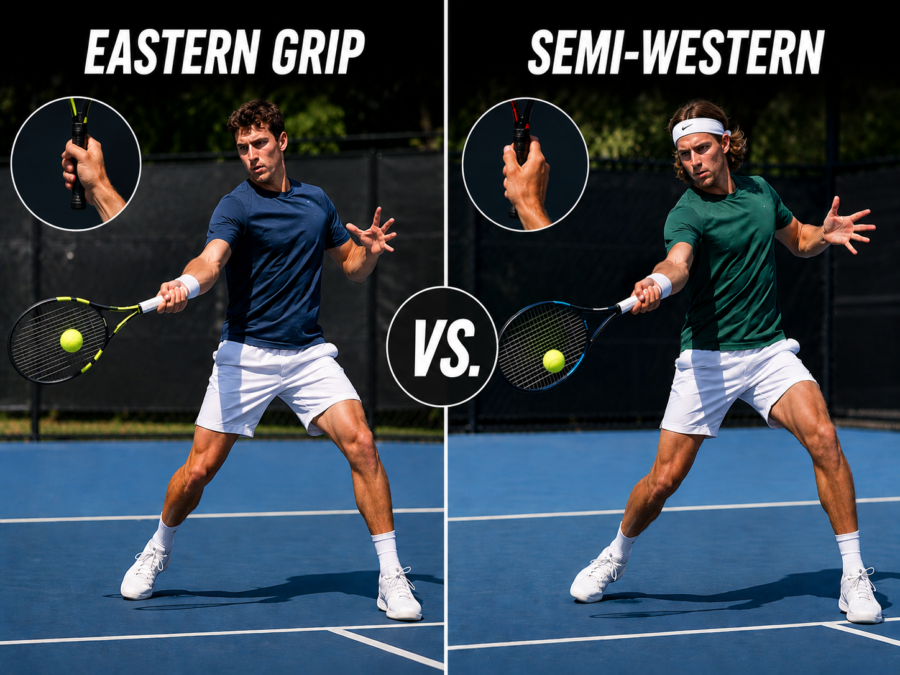
The forehand is the most important shot in modern tennis, and one of the biggest factors shaping a player’s forehand is grip choice. The grip influences everything from topspin and power to contact point, net clearance, timing, and overall shot mechanics.
For most players, the debate eventually comes down to two grips: the Eastern forehand grip and the Semi-Western forehand grip.
Both grips are used at the highest levels of tennis, yet they produce very different styles of play. The Eastern grip is often associated with flatter hitting, simpler mechanics, and all-court versatility, while the Semi-Western grip dominates modern baseline tennis because of its ability to generate heavy topspin and handle high-bouncing balls more effectively.
This has led to years of debate among coaches, players, and tennis fans. Some believe the Semi-Western grip is essential in modern tennis because of slower courts and topspin-heavy rallies. Others argue that the Eastern grip still provides advantages in timing, simplicity, and attacking tennis.
For a complete forehand fix check out The Tennis Forehand Fix.
Understanding Tennis Forehand Grips
Before comparing the Eastern and Semi-Western forehand grips, it’s important to understand what a tennis grip actually is and why it matters so much.
A forehand grip is not just where you place your hand on the racket. It directly changes the angle of the racket face, the swing path you naturally produce, the height of your ideal contact point, and the amount of topspin you can generate comfortably.
Even small grip changes can completely alter how a forehand feels and performs. This is why two players using similar swings can still hit very different forehands simply because of their grip choice.
What Is a Tennis Grip?
A tennis grip refers to how your hand is positioned on the racket handle. Tennis rackets are designed with eight bevels, or flat sides, around the handle. These bevels help players identify and maintain consistent hand placement.
The bevel you place your index knuckle and heel pad on determines your grip.
Different grips change the angle of the racket face naturally during the swing. Some grips position the racket face in a way that encourages flatter ball striking, while others naturally close the racket face and promote heavier topspin.
This is why grip choice influences nearly every aspect of the forehand, including:
- Spin production
- Net clearance
- Contact point
- Swing path
- Ball trajectory
- Power generation
- Comfort on different ball heights
For example, more extreme grips like the Semi-Western naturally encourage an upward brushing motion that creates topspin. More conservative grips like the Eastern allow flatter contact and easier forward ball penetration.
The grip essentially acts as the foundation of the forehand. It shapes how the racket approaches the ball before the swing even begins.
How to Identify Your Grip
Many recreational players are unsure exactly which grip they use. Some players believe they use an Eastern grip when they are actually closer to Semi-Western, while others unintentionally switch grips during rallies without realizing it.
The easiest way to identify your grip is by using the Continental grip as a reference point.
The Continental grip is often called the “hammer grip” because it resembles holding a hammer. From there, players rotate the hand slightly underneath the handle to move toward Eastern or Semi-Western positions.
For an Eastern forehand grip, the base knuckle of the index finger typically rests on bevel 3. This creates a relatively natural racket face position and is often described as a “handshake grip.”
The Eastern grip allows players to contact the ball farther in front and hit through the court more easily.
For a Semi-Western forehand grip, the hand rotates farther underneath the racket handle, usually placing the base knuckle on bevel 4. This closes the racket face more naturally and encourages a stronger upward swing path.
The Semi-Western grip helps players generate heavier topspin and handle higher balls more comfortably.
A simple way to check your grip is:
- Hold the racket in front of you
- Identify the bevel your index knuckle rests on
- Compare the hand position to standard grip references
Another easy method is shadow swinging:
- If the racket face naturally wants to stay more vertical, you are likely closer to Eastern
- If the racket face naturally closes downward during preparation, you are likely closer to Semi-Western
Small differences matter. Even slight grip adjustments can noticeably change forehand mechanics and ball flight.
For more information read Tennis Grips Explained: How To Hold The Racket.
Why Grip Choice Matters
Grip choice affects much more than spin alone. It changes how the entire forehand operates biomechanically.
One of the biggest differences is swing path. Eastern grips generally encourage a more forward and flatter swing, while Semi-Western grips naturally promote a steeper low-to-high motion that creates heavier topspin.
Contact point is another major difference. Eastern grips usually work best when the ball is contacted farther in front of the body and slightly lower. Semi-Western grips prefer slightly later and higher contact points.
This becomes especially important against modern topspin-heavy players. High-bouncing balls are generally easier to manage with Semi-Western mechanics because the grip naturally handles shoulder-height contact more comfortably.
Spin production is also heavily influenced by grip. Semi-Western grips allow players to brush up the back of the ball more aggressively while still keeping shots inside the court. This creates greater net clearance and more margin for error during aggressive rallies.
Comfort and timing vary between players as well. Some players feel naturally connected to an Eastern grip because it resembles a more intuitive hand position. Others feel more secure with Semi-Western mechanics because the topspin provides additional control and confidence.
Neither grip is automatically correct for everyone. The ideal grip is the one that matches:
- Your natural swing mechanics
- Preferred contact point
- Playing style
- Physical comfort
- Tactical approach
Understanding these differences is essential before deciding which forehand grip suits your game best.
Read also Topspin Forehand vs. Flat Forehand in Tennis.
What Is an Eastern Forehand Grip?
The Eastern forehand grip is one of the most traditional and versatile grips in tennis history. Before the rise of extreme topspin-heavy baseline tennis, it was the dominant forehand grip used by many professional players because of its simplicity, versatility, and ability to hit through the court effectively.
Even today, the Eastern grip remains highly respected because it allows players to strike flatter, more penetrating forehands while maintaining excellent feel and natural timing.
Although modern tennis has shifted increasingly toward Semi-Western mechanics, the Eastern grip still offers several important advantages, especially for players who value aggressive court positioning, attacking tennis, and all-court versatility.
Eastern Grip Explained
The Eastern forehand grip is created by placing the base knuckle of the index finger on bevel 3 of the racket handle.
Many coaches describe it as a “handshake grip” because the hand position feels natural and intuitive, almost like shaking hands with the racket. Compared to more extreme grips, the hand sits less underneath the handle and more behind the racket.
This positioning creates a relatively neutral racket face angle. The racket face naturally stays more vertical during preparation, which makes it easier to drive through the ball and hit flatter shots.
Because the racket face is not heavily closed, the Eastern grip encourages:
- Forward ball penetration
- Direct contact
- Earlier ball striking
- Flatter trajectories
- Simpler mechanics
The ideal contact point for an Eastern forehand is usually slightly farther in front of the body compared to Semi-Western grips. Players using Eastern mechanics often prefer stepping forward into the court and taking the ball earlier.
This grip became especially popular during eras dominated by faster court surfaces because it allowed players to attack low balls efficiently and transition smoothly toward the net.
Advantages of the Eastern Grip
One of the biggest advantages of the Eastern grip is how naturally it allows players to hit flatter forehands.
Because the racket face remains relatively neutral, players can drive through the ball aggressively without needing an exaggerated upward swing path. This creates penetrating shots that stay low and move quickly through the court.
Many players feel the Eastern grip produces:
- Cleaner ball striking
- Easier depth penetration
- Faster ball speed
- Simpler timing
- Better directional control
The mechanics also tend to feel more natural for beginners initially. Since the grip resembles a more neutral hand position, players often find it easier to understand basic forehand fundamentals without immediately learning extreme topspin mechanics.
Another major advantage is ball trajectory. Eastern forehands generally produce lower and flatter shots that move quickly through the court. On fast surfaces such as grass or quicker hard courts, this can be extremely effective because opponents have less time to react.
The Eastern grip also handles low balls very well. Since the racket face stays more open naturally, players can deal with slices and skidding shots more comfortably than with more extreme grips.
Transitioning to net play is another strength. The grip changes required for volleys are smaller and more natural compared to Semi-Western mechanics. This makes the Eastern grip especially attractive for:
- All-court players
- Serve-and-volley players
- Aggressive attackers
- Players who move forward frequently
Historically, many attacking players preferred Eastern mechanics because they supported aggressive court positioning and quick transitions between baseline and net play.
Disadvantages of the Eastern Grip
Despite its strengths, the Eastern grip also has limitations, especially in modern baseline tennis.
The biggest drawback is topspin production. While players can absolutely generate topspin with an Eastern grip, producing heavy modern RPM levels is generally harder compared to Semi-Western mechanics.
Because the racket face is less closed naturally, players have less margin for aggressive upward acceleration. This means flatter shots require more precise timing and contact to consistently stay inside the court.
High balls are another challenge. Modern tennis features heavy topspin rallies with balls frequently bouncing above shoulder height. Eastern grips can become uncomfortable in these situations because the contact point often feels awkward when dealing with extreme bounce.
Players using Eastern mechanics may struggle when:
- Balls jump high above the shoulders
- Opponents generate extreme topspin
- Rallies become highly physical from deep behind the baseline
The flatter trajectory also creates less margin over the net. Semi-Western players can swing aggressively while relying on topspin to bring the ball down safely. Eastern players often need cleaner timing and more precise contact because their shots travel on lower trajectories.
This can make consistency more difficult during long modern baseline rallies, particularly on slower clay courts where topspin dominates.
While the Eastern grip still works at the highest level, it generally requires:
- Excellent timing
- Precise footwork
- Strong contact consistency
- Efficient ball striking
In today’s heavy-spin era, many players eventually transition toward Semi-Western mechanics because the added topspin provides greater safety and adaptability during high-bouncing rallies.
What Is a Semi-Western Forehand Grip?
The Semi-Western forehand grip is the most common forehand grip in modern professional tennis. It dominates today’s baseline-heavy game because it allows players to generate heavy topspin, handle high-bouncing balls effectively, and swing aggressively with greater margin for error.
As court speeds slowed and topspin became increasingly important, more players gradually moved away from traditional Eastern mechanics and toward Semi-Western grips. Today, the majority of elite baseliners use some variation of the Semi-Western because it fits the demands of modern tennis so well.
The grip is especially effective for players who build their game around heavy rallies, aggressive topspin, and physical baseline exchanges.
Semi-Western Grip Explained
The Semi-Western forehand grip is created by rotating the hand farther underneath the racket handle compared to an Eastern grip. The base knuckle of the index finger usually rests on bevel 4.
This hand position naturally closes the racket face more during preparation. Because the racket face points downward slightly, players must swing upward more aggressively to bring the ball safely over the net.
That upward brushing motion is what allows the Semi-Western grip to generate so much topspin.
Compared to Eastern mechanics, the Semi-Western grip:
- Encourages a steeper low-to-high swing path
- Creates heavier topspin naturally
- Prefers slightly later contact points
- Handles higher contact comfortably
- Produces greater net clearance
The grip became the standard for modern baseline tennis because it allows players to hit aggressively while still maintaining control through spin.
Many of today’s top players use Semi-Western mechanics because the grip works exceptionally well against heavy topspin and high-bouncing balls on slower surfaces.
Advantages of the Semi-Western Grip
The biggest advantage of the Semi-Western grip is topspin production.
Because the racket face starts more closed naturally, players can swing upward aggressively and brush the back of the ball more easily. This creates heavier RPMs, greater net clearance, and more margin for error during rallies.
Modern tennis heavily rewards this type of forehand because topspin allows players to:
- Swing faster safely
- Hit with more consistency
- Push opponents back
- Control aggressive rallies
- Create heavy jumping shots
Higher net clearance is another major benefit. Semi-Western players can hit several feet above the net while still bringing the ball down into the court through spin. This added safety makes aggressive baseline hitting far more consistent.
The grip also handles high balls extremely well. Heavy topspin exchanges are common in modern tennis, especially on clay and slower hard courts. Semi-Western mechanics naturally adapt to shoulder-height contact points much more comfortably than Eastern grips.
This is one reason why Semi-Western grips dominate modern professional tennis. Players can rally aggressively from deep behind the baseline without constantly struggling against high-bouncing balls.
Aggressive baseline play becomes easier overall because the grip supports explosive racket head acceleration while maintaining control through spin.
Many players feel more confident swinging aggressively with a Semi-Western because the topspin acts as a safety mechanism. Even fast swings can still produce controlled ball trajectories.
The grip is especially effective for:
- Heavy topspin baseliners
- Modern rally-focused players
- Clay court specialists
- Aggressive counterpunchers
- Players facing high-bouncing opponents regularly
Disadvantages of the Semi-Western Grip
Despite its advantages, the Semi-Western grip also comes with several trade-offs.
One of the biggest weaknesses is handling low balls. Because the racket face starts more closed naturally, players often need to drop lower physically to manage skidding slices and low-bouncing shots effectively.
This can become difficult on:
- Fast hard courts
- Grass courts
- Against slice-heavy opponents
- When taking balls very early
Low contact points simply feel more natural with Eastern mechanics.
The Semi-Western grip can also feel harder for beginners initially. The extreme upward swing path required for topspin generation is less intuitive for many new players compared to the simpler forward mechanics of the Eastern grip.
Beginners often struggle with:
- Timing
- Contact point
- Framing balls
- Excessive brushing without penetration
- Generating depth consistently
The grip generally requires stronger mechanics and better racket acceleration to function properly. Players who swing too slowly may produce weak, spinny shots without enough penetration through the court.
Net play can feel slightly awkward as well. Since volleys are typically hit with more neutral grip positions, Semi-Western players must adjust their hand position more dramatically when transitioning forward.
This is one reason why classic serve-and-volley players historically preferred Eastern grips.
The Semi-Western grip is incredibly effective in modern baseline tennis, but it is not perfect for every player or every style. While it provides enormous topspin advantages, it also demands:
- Good footwork
- Strong timing
- Proper swing mechanics
- Comfortable handling of grip transitions
For players who build points around heavy topspin and aggressive baseline play, however, the Semi-Western grip remains one of the most powerful tools in modern tennis.
Final Thoughts
The Eastern vs Semi-Western forehand debate has existed for decades, and the reality is that neither grip is universally better than the other. Both grips can produce world-class forehands, and both have proven successful at the highest levels of professional tennis.
What matters most is how well the grip matches your natural mechanics, playing style, physical comfort, and tactical approach to the game.
The Semi-Western grip dominates modern tennis for a reason. Today’s game revolves around heavy topspin, aggressive baseline rallies, and handling high-bouncing balls on slower court surfaces. The Semi-Western allows players to swing faster, generate more spin, and create greater margin for error during powerful exchanges. For many modern baseliners, it is simply the most practical grip for contemporary tennis.
At the same time, the Eastern grip still works exceptionally well when used correctly. Players like Roger Federer showed that flatter forehands, early ball striking, and all-court attacking tennis can still succeed against modern competition. The Eastern grip continues to offer advantages in timing, versatility, low-ball handling, and transitioning toward the net.
One of the biggest mistakes players make is obsessing over copying professionals instead of developing sound technique. Grip matters, but technique, footwork, timing, and contact quality matter even more. A technically solid Eastern forehand will almost always outperform a poorly executed Semi-Western forehand, and vice versa.
It is also important to understand that grip changes take time. Switching grips alters contact point, swing path, racket face orientation, and overall forehand timing. Players who experiment with new grips should do so gradually and patiently rather than expecting immediate results.
The best grip is ultimately the one that allows you to:
- Make clean contact consistently
- Swing confidently under pressure
- Generate the type of ball you want
- Feel comfortable during rallies
- Play your natural style of tennis
Some players feel most natural flattening out forehands with an Eastern grip. Others feel more secure generating heavy topspin with a Semi-Western. Neither approach is wrong.
The goal is not to use the “modern” grip or the “classic” grip. The goal is to find the grip that helps you play your best tennis consistently and confidently.