
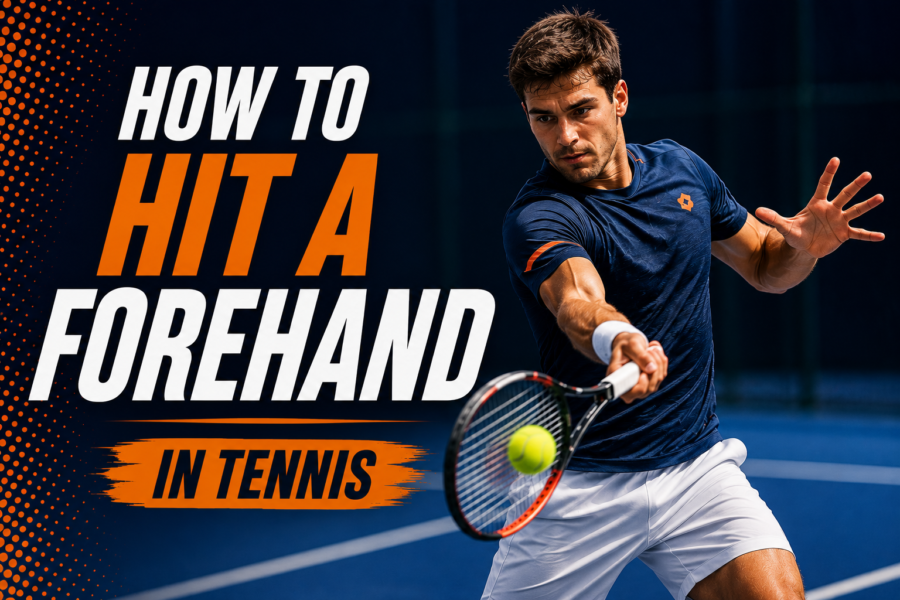
The forehand is one of the most important and commonly used strokes in tennis. It is a groundstroke played after the ball bounces, usually from the dominant side of the body. Right-handed players normally hit the forehand on the right side, while left-handed players hit it on the left.
For most players, the forehand becomes their strongest and most aggressive shot. It can be used to rally consistently, create angles, attack short balls, generate topspin, and finish points. However, developing a reliable forehand requires more than simply swinging the racket forward. Grip, preparation, footwork, contact point, rotation, and follow-through must all work together.
For a complete forehand fix check out The Tennis Forehand Fix.
Forehand Grip
The grip affects the racket-face angle, contact point, spin potential, and height of the ball that feels most comfortable to strike. The three most common forehand grips are the Eastern, Semi-Western, and Western grips.
The Eastern forehand grip is a strong option for beginners because it makes it easier to hit through the ball while maintaining a relatively natural racket-face position. It works well for flatter shots, moderate topspin, and balls around waist height.
The Semi-Western forehand grip is widely used in modern tennis because it provides a good balance of topspin, control, and power. It makes it easier to handle higher balls and produce a low-to-high swing path without closing the racket face excessively.
For a comparison of the two, read: Eastern vs Semi-Western Forehand Grip in Tennis.
The Western grip creates even more topspin but can make low balls more difficult to manage. It is generally better suited to experienced players who are comfortable using an aggressive upward swing.
The Continental grip is useful for serves, volleys, overheads, slices, and some defensive shots, but it is not normally recommended as the main grip for a modern forehand.
Forehand Ready Position
Every forehand begins from a balanced tennis ready position. Stand with your feet slightly wider than shoulder-width apart, keep your knees bent, and place your weight toward the front of your feet. Hold the racket in front of your body with both hands so that you can react quickly in either direction.
As soon as you recognize that the ball is coming to your forehand side, turn your shoulders and hips rather than immediately pulling the racket back with your arm. This movement is called the unit turn. The shoulders, torso, arms, and racket should begin rotating together.
Early preparation gives you more time to move into position and prevents the swing from becoming rushed. Waiting until the ball is close often leads to late contact, poor balance, and a shortened follow-through.
Forehand Stances
There are several stances that can be used when hitting a forehand. The correct choice depends on how much time you have, where the ball is located, and whether you are attacking or defending.
Neutral Stance
In a neutral stance, the front foot is positioned slightly ahead of the back foot. A right-handed player steps forward with the left foot, while a left-handed player steps forward with the right foot.
This stance makes forward weight transfer easier and is useful when approaching a shorter ball. It can also help beginners understand how to move through the shot while maintaining balance.
Semi-Open Stance
The semi-open stance places the feet at an angle rather than completely sideways or parallel to the baseline. It combines rotational power with enough forward movement to attack the ball.
This is one of the most practical forehand stances because it can be used in many rally situations. It allows players to recover efficiently while still rotating the hips and shoulders through contact.
Open Stance
In an open stance, the feet remain mostly parallel to the baseline. The player loads the outside leg and generates power through hip and torso rotation rather than stepping forward.
The open stance is especially useful when there is limited time or when the ball pushes the player wide. It is common in modern baseline tennis because it allows faster recovery after the shot.
No single stance should be used for every forehand. Players should learn to adjust their footwork according to the incoming ball instead of forcing themselves into the same position each time.
Forehand Backswing
After completing the unit turn, the racket moves into the backswing. The racket head should remain controlled while the non-dominant hand helps guide the turn and create shoulder rotation.
The backswing does not need to be extremely large. Taking the racket too far behind the body can make timing more difficult and cause the player to contact the ball late. A compact and relaxed preparation usually provides enough time to accelerate toward the ball.
As the racket begins to drop below the expected contact point, the body should remain balanced and loaded through the legs. This racket drop helps create the low-to-high swing path needed for topspin.
The non-dominant arm should extend across the body during preparation. This helps with balance, spacing, and shoulder rotation, but it should remain relaxed rather than pointing rigidly at the ball.
Forehand Contact Point
The ideal contact point is in front of the body and slightly to the side. The exact position changes depending on the grip. An Eastern grip normally contacts the ball farther forward than a Semi-Western or Western grip.
At contact, the player should have enough space between the body and the ball to swing freely. Allowing the ball to get too close can restrict the arm, reduce power, and cause the racket face to become unstable.
The racket face should be controlled and directed toward the intended target. The wrist should remain stable through contact rather than actively flicking at the ball. Most of the racket speed should come from the legs, torso rotation, shoulder, and arm working together.
The ball is usually struck around waist height, although players must learn to adjust to lower and higher contact points. Good tennis footwork helps create the correct distance from the ball before the swing begins.
Low-to-High Swing Path
A modern forehand usually follows a low-to-high swing path. The racket drops below the ball during preparation and then travels upward and forward through contact.
This motion allows the strings to brush up the back of the ball and create topspin. Topspin makes the ball dip back into the court after crossing the net, allowing players to hit with greater height and racket speed while maintaining control.
However, the forehand should not move only upward. Players must also drive through the ball toward the target. Swinging too vertically can produce a weak shot with plenty of spin but little depth or penetration.
The best swing path combines forward extension with upward movement. The exact balance between the two depends on whether the player is hitting a flatter attacking ball, a neutral rally shot, or a high defensive forehand.
Body Rotation and Weight Transfer
Forehand power should not come only from the arm. The legs, hips, torso, shoulder, and arm should contribute to the stroke in sequence.
When using a neutral stance, weight can transfer from the back leg toward the front leg. In an open stance, the player pushes against the outside leg and rotates the hips and torso through the shot.
The upper body should remain controlled during this movement. Excessive leaning, falling backward, or rotating too early can reduce accuracy and make recovery more difficult.
Keeping the head relatively still through contact can also improve consistency. Lifting the head early to watch the ball travel often causes the shoulders to open too soon and changes the racket path.
Forehand Follow-Through
After contact, the racket continues forward and upward rather than stopping suddenly. A complete follow-through allows the body to decelerate naturally and helps maintain a smooth swing.
For a traditional forehand, the racket commonly finishes around the opposite shoulder. A right-handed player finishes toward the left side, while a left-handed player finishes toward the right.
Many modern players also use a windshield-wiper finish. In this variation, the forearm rotates after contact and the racket travels across the body. This can help produce topspin, but the rotation should happen naturally as part of the swing rather than through a forced wrist movement.
The non-dominant hand may catch the racket near the throat at the end of the stroke. This can help beginners complete the rotation and return to a balanced position.
Recovering After the Forehand
The stroke is not finished when the follow-through ends. The player must recover toward an appropriate court position and prepare for the opponent’s next shot.
Use a crossover step or quick side steps to return toward the center of the available court. The ideal recovery position depends on where you hit the ball and where your opponent is likely to respond.
Bring the racket back in front of the body and return to the ready position before the opponent makes contact. Players who admire their shot or remain turned sideways often react late to the next ball.
Common Forehand Mistakes
One of the most common mistakes is preparing too late. Begin the unit turn as soon as you identify the ball coming to the forehand side.
Another common problem is standing too close to the ball. Create enough space for the arm and racket to move freely through contact.
Players also frequently rely too much on the arm. Use the legs and torso to generate power while keeping the arm relaxed. A tense grip and rigid swing usually reduce racket-head speed.
Other common mistakes include taking an oversized backswing, contacting the ball behind the body, opening the shoulders too early, flicking the wrist, and stopping the follow-through immediately after contact.
How to Practice the Tennis Forehand
Beginners can start by shadow swinging without a ball. Focus on the grip, unit turn, racket drop, contact position, and balanced follow-through.
The next step is hitting gentle hand-fed balls from a stationary position. Once the motion becomes comfortable, introduce movement by alternating feeds to different areas of the forehand side.
Wall practice can help improve repetition and control, while cooperative rallies develop timing and consistency. Players should initially aim for height, depth, and reliable contact before trying to hit at maximum speed.
Recording the stroke from the side and behind can also reveal preparation, spacing, and balance problems that may be difficult to notice while playing.
Final Thoughts
The tennis forehand is a groundstroke hit from the dominant side of the body and is often the main attacking weapon for both beginners and advanced players. A strong forehand combines the correct grip, early preparation, efficient footwork, a contact point in front of the body, controlled rotation, and a complete follow-through.
There is no single forehand technique that works for every player or every ball. Stance, swing path, and finish will change according to the player’s grip, position, timing, and tactical intention. Focus on creating a smooth and repeatable motion before trying to add more speed and power.