
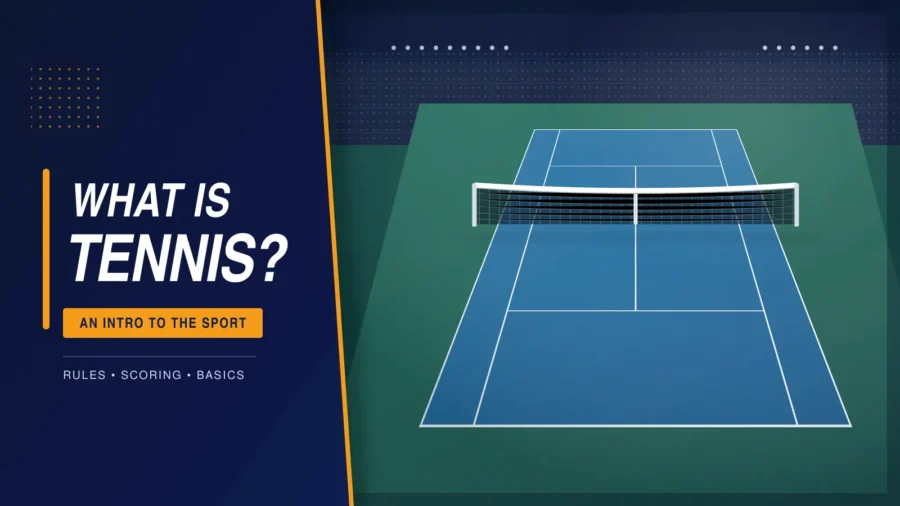
Tennis is a racket sport in which one player competes against one opponent in singles, or two teams of two compete in doubles. Players strike a ball over a net and into the opponent’s court, trying to win the rally by producing a legal shot the opponent cannot return.
A tennis match is organized into points, games, and sets. The sport can be played on hard, clay, grass, carpet, and other approved surfaces, but the standard court dimensions and core rules remain consistent.
Tennis at a Glance
- Singles uses one player on each side; doubles uses two.
- A full court is 78ft long and 27ft wide for singles or 36ft wide for doubles.
- The server starts each point and has two attempts to reach the diagonal service court.
- A ball on a line is in.
- A player may return the ball after one bounce or volley it before it bounces, except that a serve must first land in the correct service court.
- Standard games use love, 15, 30, 40, deuce, and advantage.
- Matches are commonly best of three sets, with some events using best of five.
The complete tennis rules guide covers edge cases and approved alternative formats. This article focuses on the beginner’s map of the sport.
The Tennis Court
A regulation tennis court is 78ft, or 23.77m, long. The singles court is 27ft, or 8.23m, wide. Doubles includes the alleys and expands the width to 36ft, or 10.97m.
The net is 3ft high at the center and 3ft 6in at the posts. Service lines sit 21ft from the net, and the center service line divides each side into deuce and ad service courts.
All measurements are taken to the outside edge of the lines. Because a line forms part of the court it defines, a ball that touches any part of the correct line is in. The tennis court dimensions guide includes every line and net-post position.
Tennis Equipment
Racket
A tennis racket has a handle, frame, and flat pattern of crossed strings. Adult rackets are commonly 27in long, but legal equipment varies in head size, mass, balance, swingweight, stiffness, string pattern, and grip size.
Beginners do not need the heaviest professional-style frame or the most powerful oversized model. A manageable, correctly fitted racket that allows controlled contact is a better starting point. The beginner tennis equipment checklist explains the essentials, while the ultimate tennis racket buying guide covers head size, mass, balance, strings, and grip fit.
Ball
Standard tennis balls have a rubber core and fabric cover. Approved balls fall into specified size, mass, rebound, and deformation categories, including types for different court speeds and high altitude.
Beginners and children may use slower red, orange, or green balls on appropriately sized courts. These reduce pace and can make it easier to learn a complete swing and rally shape.
Shoes and Clothing
Tennis shoes are designed for repeated lateral movement, starts, and stops. Select an outsole suited to the court surface and a fit that holds the heel without crushing the toes.
Wear clothing that permits movement and follow any club or competition dress rules. Bring water, sun protection for outdoor play, and a second grip or overgrip if conditions are hot.
How a Tennis Point Starts
The server stands behind the baseline between the imaginary extensions of the center mark and the correct sideline. Every standard game begins with a serve from the right, or deuce, side. The server then alternates sides after each point.
The ball is released by hand and struck before it touches the ground. It must cross the net and land in the diagonal service court. A first fault gives the server a second attempt; a second fault loses the point.
A serve that touches the net and otherwise lands correctly is a let under standard rules and is replayed. Some approved formats use a no-let rule, so the stated event procedure controls. The complete tennis serving guide explains stance, toss, swing, and recovery.
Basic Rally Rules
After a legal serve lands, the receiver returns the ball over the net. Players then alternate hitting it until the point ends.
A return is legal when it crosses the net and lands inside the correct court. The ball may touch the net on the way and remain playable if it lands in. A player may hit after one bounce or volley before a bounce.
A player loses the point by:
- allowing the ball to bounce twice;
- hitting the ball outside the correct court;
- failing to send the ball over the net;
- touching the net or opponent’s court while the ball is live;
- deliberately carrying or catching the ball on the strings;
- touching the live ball with the body or clothing; or
- hitting the ball twice deliberately.
The ball remains live until it bounces out, a player fails to make a legal return, an official calls a fault or let, or another rule ends the point.
How Tennis Scoring Works
Tennis scoring has three layers:
- Points win a game.
- Games win a set.
- Sets win the match.
A standard game progresses from love to 15, 30, 40, and game. If both sides reach 40, the score is deuce. One side must then win two consecutive points, first earning advantage and then the game.
A tie-break set is normally won by the first player or team to reach six games with a two-game lead. At 6-6, a tie-break is played, usually to seven points with a two-point margin. Alternative formats include no-ad games, short sets, advantage sets, and match tie-breaks.
The complete explanation of points, games, sets, and tie-breaks shows how to call every score and distinguish a set tie-break from a match tie-break.
Singles vs Doubles
Singles uses the narrower sidelines and gives one player responsibility for the entire side of the court. The server stands inside the imaginary extension of the singles sideline.
Doubles includes the alleys, making the court 36ft wide. Partners alternate service games in an order chosen at the start of each set, and the receiving team selects a return order for that set. After the return, either partner may play the next ball.
Doubles is not simply singles with two extra people. Court coverage, communication, net positioning, and serve location change the patterns. Use the tennis doubles rules guide for rotations and positioning exceptions.
Essential Tennis Strokes
Forehand
The forehand is played on the same side as the hitting hand. Players use different grips and swing paths to produce flatter drives, topspin, angles, and defensive height.
Backhand
The backhand is played on the opposite side of the hitting hand. It can be hit with one hand or two, and it can be driven, rolled with topspin, or sliced.
Serve
The serve starts the point. It can be flat, sliced, or hit with topspin or kick, but placement and reliability matter before speed.
Return
The return is the receiver’s first shot. Because the ball can arrive quickly, return swings are often shorter than rally swings.
Volley
A volley is struck before the ball bounces. It is commonly played near the net with compact preparation, although a volley can legally be hit from elsewhere.
Overhead
The overhead is used against a high ball, often a lob. Players should turn sideways and move to the ball rather than backing up while facing the net.
Approach shots, passing shots, lobs, drop shots, and slices build on these six fundamentals and add tactical options as control improves.
Basic Tennis Strategy
Early strategy should reduce unnecessary risk. Aim high enough over the net, choose large targets, recover after each shot, and make the opponent play another ball.
In singles, crosscourt shots travel over a lower part of the net and provide more court length. Changing direction can be effective when the ball is short or the player is balanced, but forcing line changes from a defensive position increases error risk.
In doubles, the net player can pressure the middle while the server or returner controls the first groundstroke. Partners should communicate over lobs and avoid both covering the same narrow lane.
Tennis Court Surfaces
Hard Court
Hard courts provide a firm, relatively consistent bounce, but speed varies with the coating and surface condition. They are widely used for public, club, and tournament tennis.
Clay
Clay generally produces a higher, slower bounce and allows controlled sliding when the surface is maintained and the player has learned the movement. Point construction often rewards patience and shape.
Grass
Grass commonly produces a lower, faster, less uniform bounce. Players often use compact preparation and value the serve, return, and first few shots.
Surface labels describe tendencies, not guarantees. Weather, altitude, ball type, maintenance, and the specific court can change pace considerably.
A Brief History of Tennis
Modern lawn tennis developed in Britain during the 19th century from earlier racket-and-ball games. Walter Clopton Wingfield patented and began marketing a boxed version of the game in 1874, helping spread it.
The Marylebone Cricket Club revised important rules in 1876, including the use of deuce and advantage and two serve attempts. The first Wimbledon Championships were held in 1877.
As national associations and international competition expanded, 12 associations met in Paris on March 1, 1913, to found the International Lawn Tennis Federation, later known as the International Tennis Federation and now branded World Tennis.
How to Start Playing Tennis
- Find a public court, club beginner session, or qualified coach.
- Borrow or rent a manageable racket before buying.
- Choose standard or slower balls that fit your age and level.
- Learn a ready position, forehand, backhand, and simple serve.
- Rally cooperatively from inside the baseline before using the full court.
- Add scoring only after you can start points safely.
- Play short sets or tie-breaks before attempting a long match.
New players often improve faster when the court and ball are scaled to their current control. Starting close to the net and moving back gradually is more productive than swinging harder from the baseline. Build the progression around repeatable contact, safe movement, and increasingly realistic points.
Tennis and Exercise
Tennis can contribute to aerobic activity, repeated short efforts, coordination, balance, and social participation. The actual training load depends on singles or doubles, rally length, intensity, court conditions, and session duration.
Increase playing time gradually, especially after a layoff. Warm up for the movements you will use, take breaks in heat, and stop if you develop chest pain, faintness, or an acute injury. People with medical concerns should seek individualized advice before beginning a demanding program.
Tennis FAQ
What is the goal of tennis?
The goal is to win points by hitting legal shots the opponent cannot return. Points accumulate into games, games into sets, and sets into the match.
How many players are in tennis?
Singles has two players in total. Doubles has four, with two partners on each side.
How long is a tennis match?
There is no fixed duration. Match format, player level, rally length, deuce games, and tie-breaks can make matches vary widely.
Can a serve touch the net?
Under standard rules, a serve that touches the net and lands in the correct service court is a let and is replayed. A serve that touches the net and lands outside the correct court is a fault.
Why is zero called love?
The exact historical origin is not certain. In modern scoring, love simply means zero. The tennis terminology glossary explains other common terms.
Is a line in or out?
A ball touching any part of the correct line is in because the line is part of the court it marks.