
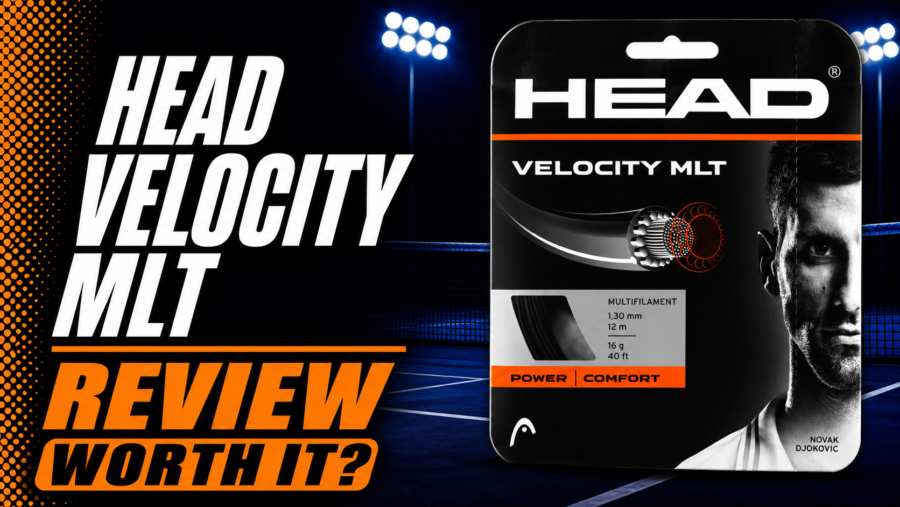
HEAD Velocity MLT is a round multifilament tennis string designed to balance power, comfort and control at an accessible price. It is firmer and less explosive than Velocity MLT Power, making it the more versatile family option for players who want a predictable full bed.
HEAD builds the string from thousands of synthetic microfilaments inside a resin matrix and finishes it with a smooth, low-friction exterior. This construction provides more elasticity than polyester while supporting useful snapback for a multifilament.
Velocity MLT targets club and tournament players with moderate swing speed, as well as polyester users seeking a controlled transition to a softer string. The Tennis String Finder can help compare it with premium multifilaments.
HEAD Velocity MLT Rating
| Category | Rating |
|---|---|
| Power | 7.5/10 |
| Spin | 7.5/10 |
| Comfort | 8.5/10 |
| Control | 8/10 |
These ratings place Velocity MLT across the full string market. It is controlled for a multifilament but remains more powerful and comfortable than firm polyester.
HEAD Velocity MLT Specifications
| Specification | Details |
|---|---|
| String type | Multifilament |
| Construction | Thousands of microfilaments in a resin matrix |
| Profile | Round |
| Surface | Smooth, low-friction exterior |
| Gauges | 16 / 1.30mm and 17 / 1.25mm |
| Colors | Black, Natural, Blue, Yellow and Pink, depending on market |
| Set length | Approximately 12m |
| Reel length | Approximately 200m |
Color availability varies by market and may produce small perceived feel differences. The official core specification remains the same two-gauge multifilament family.
Material and Construction
Velocity MLT uses a dense bundle of synthetic microfilaments bound within a resin matrix. HEAD describes thousands of fibers, while independent retailer material often summarizes the count as approximately 1,000.
The flexible fibers stretch and recover together, creating pocketing and easier depth than a solid polyester monofilament. The resin gives the bundle cohesion and affects its controlled feel.
The string has a round profile and low-friction exterior. This finish helps the mains slide and return while fresh, improving spin access relative to many sticky multifilaments.
It does not use geometric edges. As the surface wears and the fibers notch, movement can decline and the strings may remain displaced.
HEAD Velocity MLT Performance
Power
Velocity MLT provides medium-high power. It gives club players easier depth than polyester without reaching the extreme rebound of Velocity MLT Power or natural gut.
The response works well for compact and moderate swings. Faster hitters can still manage the launch because the string is firmer and more controlled than many soft multis.
The 1.25mm version is livelier, while 1.30mm provides a calmer trajectory and greater resistance.
Power rating: 7.5/10
Spin
Velocity MLT offers strong spin for a multifilament. Its smooth low-friction surface supports movement, and independent comparisons regularly highlight above-average category spin.
It cannot match the long-term snapback or sharp bite of a shaped polyester. The surface eventually notches, allowing the mains to remain out of position.
Players with moderate topspin should find sufficient rotation. Heavy-spin breakers may still need polyester or a hybrid.
Spin rating: 7.5/10
Control
Control is a major reason to choose standard Velocity MLT over the Power version. Its firmer response and lower rebound create a more predictable trajectory for medium and moderately fast swings.
The string works well for all-court play, including flat drives, slices, volleys and touch shots. It does not provide the low-powered freedom of a control polyester on repeated maximum-speed swings.
Control can decline as tension drops and the mains stop returning. The 1.30mm version is the more stable choice for open patterns.
Control rating: 8/10
Comfort and Feel
Velocity MLT is highly comfortable across the market, although it feels firmer and less plush than NRG2, Xcel or Reflex MLT.
That slightly crisper character can help former polyester users feel connected to the ball without accepting monofilament stiffness. Off-center contact remains more forgiving than with polyester.
Comfort does not mean injury prevention. Persistent elbow, wrist or shoulder symptoms require qualified assessment rather than only an equipment change.
Comfort rating: 8.5/10
Durability and Tension Maintenance
Physical durability is good for a value multifilament. The low-friction coating helps resist abrasion, and 1.30mm provides more material for frequent play.
Player experience varies widely because heavy topspin can cause early fraying or breakage. Non-breakers may receive a long practical life.
Tension maintenance is generally respectable. String movement and loss of snapback can appear before the fibers break, so useful playability should be judged through launch and feel.
Choosing the Right Gauge
| Gauge | General characteristics |
|---|---|
| 16 / 1.30mm | Greater control, stability and physical resistance |
| 17 / 1.25mm | More power, feel and spin access with faster wear |
The 16 / 1.30mm version is the best general starting point. The 17 / 1.25mm option suits dense patterns and players who prioritize response over durability.
Full Bed or Hybrid Setup
Full Bed
A full bed maximizes comfort and provides a balanced combination of depth, touch and control. It is appropriate for beginners through advanced club players who do not break multifilaments too quickly.
The 1.30mm gauge is the most stable full-bed choice.
HEAD Velocity MLT in the Mains With Polyester Crosses
Velocity MLT mains preserve much of the soft response. A smooth polyester cross reduces launch and supports movement.
The cross can notch the mains, and the setup becomes firmer than a complete multifilament bed.
Polyester Mains With HEAD Velocity MLT Crosses
Polyester mains dominate spin and control, while Velocity MLT crosses add pocketing. This is useful for polyester players wanting a less rigid response.
Shaped mains may saw through the cross quickly. A round polyester produces less edge-related abrasion.
General Tension Guidance
Velocity MLT can begin near a player’s established nylon or multifilament reference. Players replacing polyester should account for its greater elasticity and higher launch.
Lower tension adds power and pocketing. Higher tension increases control but can reduce the forgiveness that makes the string attractive.
Use the racket manufacturer’s range and account for pattern, head size and gauge. The Tennis String Tension Calculator provides broad guidance.
Who Should Use HEAD Velocity MLT?
Velocity MLT is best suited to:
- Club players with moderate swing speed
- Beginners and intermediates wanting a quality full bed
- Polyester users seeking more comfort
- Players wanting controlled multifilament power
- All-court and doubles players
- Value-focused non-breakers
Who Should Avoid HEAD Velocity MLT?
Velocity MLT is less suitable for:
- Frequent multifilament breakers
- Advanced hitters needing maximum polyester control
- Heavy topspin players relying on long-lasting snapback
- Users wanting the plushest premium feel
- Players seeking the absolute most free power
- Anyone expecting a string to prevent injury
Pros and Cons
| Pros | Cons |
|---|---|
| Excellent value | Less plush than premium multifilaments |
| Strong control for a multifilament | Lower break resistance than polyester |
| Above-average category spin | Surface eventually notches and locks |
| High comfort | Only two gauges |
| Several colors | Color availability varies |
| Useful full-bed and hybrid roles | Not low powered enough for every advanced hitter |
HEAD Velocity MLT Compared With Other Strings
Velocity MLT vs HEAD Velocity MLT Power
HEAD Velocity MLT Power is livelier, plusher and easier to launch. Standard Velocity MLT provides more control and spin balance.
Velocity MLT vs HEAD Reflex MLT
HEAD Reflex MLT is a more premium, plush multifilament with stronger power and comfort. Velocity MLT costs less and feels more controlled.
Velocity MLT vs Wilson NXT
Wilson NXT offers a premium X-bonded construction and softer feel. Velocity MLT provides outstanding value and a firmer trajectory.
Velocity MLT vs Tecnifibre Multifeel
Tecnifibre Multifeel uses a central monofilament surrounded by multifilament fibers. Both balance control and comfort, but their internal structures and feel differ.
Final Verdict
HEAD Velocity MLT is one of the strongest value choices for players who want multifilament comfort without an excessively lively launch. Its fiber-and-resin construction, low-friction surface and firmer response produce a practical all-court balance.
It does not equal polyester for break resistance or sustained snapback, and it is less plush than premium comfort strings. Those compromises are reasonable at its typical price.
The 16 / 1.30mm gauge is the safest general option. Players wanting maximum pace should choose Velocity MLT Power, while those needing more control should stay with the standard version.
Frequently Asked Questions
Is HEAD Velocity MLT a multifilament?
Yes. It uses thousands of microfilaments inside a resin matrix.
Is Velocity MLT powerful?
It provides medium-high power, but less easy launch than Velocity MLT Power or the liveliest premium multifilaments.
Is it good for spin?
It offers above-average spin for a multifilament because its smooth surface supports movement while fresh.
Which gauge should most players choose?
The 16 / 1.30mm gauge provides greater stability and physical resistance.
How does Black differ from Natural?
Some players perceive small feel differences between colors, but HEAD lists the same basic construction and gauge options. Racket and tension have a larger practical effect.
When should Velocity MLT be replaced?
Replace it when heavy fraying threatens breakage, the mains remain displaced or the launch becomes difficult to predict. A string can lose its preferred response before it breaks completely.