
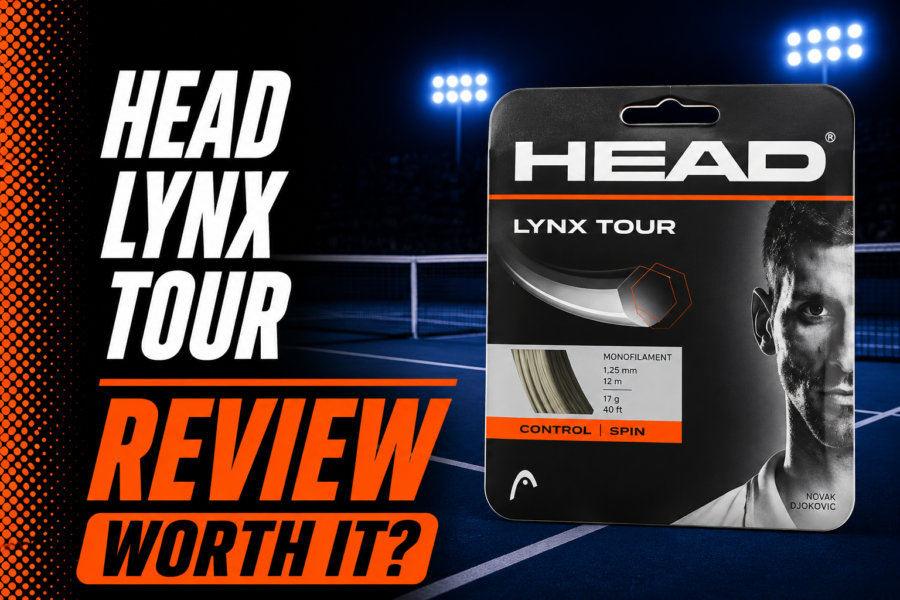
Head Lynx Tour is a shaped co-polyester monofilament developed for players who prioritize control and spin. Its six-sided profile and relatively firm response make it most suitable for intermediate and advanced players who generate their own pace.
This review covers the current Head Lynx Tour string available in 1.25mm and 1.30mm gauges. It should not be confused with the original Head Lynx or Head Lynx Touch, which have round profiles and different performance characteristics.
Head Lynx Tour Rating
| Category | Rating |
|---|---|
| Power | 6.5/10 |
| Spin | 9/10 |
| Control | 9/10 |
| Comfort | 7.5/10 |
These ratings are editorial estimates based on the string’s verified construction, manufacturer positioning and independently reported characteristics. They are not personal playtest scores.
Head Lynx Tour Specifications
| Specification | Detail |
|---|---|
| String type | Co-polyester monofilament |
| Shape | Six-sided |
| Available gauges | 1.25mm and 1.30mm |
| Gauge equivalents | 17g and 16g |
| Available colors | Black, grey, orange and champagne, depending on market |
| Available formats | Individual set and 200m reel |
| Primary characteristics | Control and spin |
| Intended player | Intermediate to advanced |
| Recommended swing type | Moderate to fast |
Material and Construction
Head Lynx Tour uses a single-filament co-polyester construction. Unlike multifilament and synthetic gut strings, it is designed to create a firmer and more controlled response rather than effortless power and softness.
Its most distinctive feature is its six-sided profile. The edges are intended to improve the string’s interaction with the ball and increase spin potential compared with a smooth, round string.
The shaped profile can also help players control the ball’s trajectory when using faster, more vertical swings. However, string shape alone does not create spin. Racket-head speed, technique, string movement, racket pattern and tension remain important.
Head currently offers Lynx Tour in 1.25mm and 1.30mm gauges. The thinner 1.25mm version should provide slightly more response, spin access and feel, while the thicker 1.30mm version should offer greater resistance to physical breakage and a more stable response.
Performance Analysis
The following performance assessment is based on Head Lynx Tour’s construction, official positioning and independently reported characteristics rather than a personal playtest.
Power
Head Lynx Tour provides controlled, moderate power for a polyester string. It is not designed to generate easy depth for players with short or slow swings.
Its firm monofilament construction should allow aggressive players to accelerate through the ball without producing an excessively lively launch. Players who already generate pace through technique and racket-head speed are more likely to benefit from this response.
Compared with natural gut, multifilament or synthetic gut, Lynx Tour supplies considerably less free power. Players who regularly leave the ball short may find it too demanding in a full string bed.
Spin Potential
Spin is one of Head Lynx Tour’s strongest characteristics. Its six-sided profile creates additional edges that are designed to interact with the ball during contact.
The controlled response also allows experienced players to swing faster and more vertically without losing confidence in the ball’s trajectory. This combination of shape, string movement and racket-head speed gives Lynx Tour strong topspin and slice potential.
The string should be especially suitable for aggressive baseliners who use heavy topspin to create margin over the net. However, its response may not feel as lively or produce as high a launch angle as some softer, more aggressively shaped polyester strings.
Control
Control is the clearest strength of Head Lynx Tour. Its relatively low power and firm construction are designed to produce a predictable response during fast swings.
This should help advanced players direct the ball aggressively without relying on the string bed for additional pace. The six-sided profile also supports control by helping players apply spin and bring the ball down inside the court.
Players with compact strokes may not experience the same benefit. Lynx Tour’s control becomes most useful when the player has enough swing speed to generate depth independently.
Comfort and Response
Head Lynx Tour is firm and crisp, but independent reports generally place it among the more manageable control-oriented polyester strings. It should not feel as rigid as some of the stiffest tournament polys, although it remains less comfortable than natural gut, multifilament or synthetic gut.
Comfort will depend heavily on the racket, gauge, tension, string pattern and quality of contact. The 1.25mm version may provide slightly more elasticity and response, while the 1.30mm version should feel more substantial and stable.
Players with elbow, wrist or shoulder sensitivity should not treat Lynx Tour as an arm-friendly string simply because it is more comfortable than some firm polys. A softer string or hybrid setup will normally be more appropriate.
Expected Durability and Tension Maintenance
Head Lynx Tour offers good resistance to physical breakage, particularly in the thicker 1.30mm gauge. This makes it relevant for aggressive players who frequently break thinner or softer strings.
Independent testing also indicates above-average playability duration and tension maintenance for a co-polyester. However, no polyester string maintains its original response indefinitely.
Lynx Tour may lose tension and become more powerful before it physically breaks. Players should monitor changes in launch angle, control, string movement and response rather than waiting for visible damage. Our guide explaining how often you should change the strings on your tennis racket covers the main signs that a string bed needs replacing.
Choosing Between 1.25mm and 1.30mm
The 1.25mm version is the better starting point for most intermediate and advanced players. It should provide a more responsive feel, easier spin access and slightly greater ball pocketing.
The 1.30mm version is more suitable for frequent string breakers, powerful players and those using open string patterns. Its thicker construction should increase physical durability while creating a more stable and controlled response.
Players who are uncertain about which gauge or string type suits their racket and playing style can use the Tennis String Finder to compare different options.
Full Bed, Hybrid and Tension Guidance
A full bed of Head Lynx Tour provides the greatest control and spin potential, but it also creates the firmest setup. It is most appropriate for experienced polyester users with confident, fast swings.
Combining Lynx Tour with natural gut, multifilament or synthetic gut can add comfort and power. Installing Lynx Tour in the mains will preserve more of its shaped, control-oriented character, while using the softer string in the mains will produce a more forgiving response.
Because Lynx Tour has a shaped profile, it may wear through a softer hybrid partner faster than a smooth polyester. Players should inspect both strings regularly for notching and fraying.
There is no universal ideal tension. Players moving from nylon or multifilament will normally use polyester at a lower tension, but the final choice should remain within the racket manufacturer’s recommended range. The Tennis String Tension Calculator can provide a more appropriate starting range.
Who Should Use Head Lynx Tour?
Head Lynx Tour is best suited to:
- Intermediate and advanced players
- Experienced polyester users
- Aggressive baseliners
- Players with moderate or fast swings
- Players who generate their own power
- Players seeking strong spin potential
- Players who prioritize control and predictability
- Frequent string breakers
- Players who want better-than-average polyester playability duration
Its combination of shape, control and physical durability should work particularly well for competitors who take full swings and use spin to manage their shot trajectory.
Who Should Avoid It?
Head Lynx Tour may not be suitable for:
- Most beginners
- Players with short or compact swings
- Players who need effortless depth
- Players looking for a soft string bed
- Anyone with significant arm sensitivity
- Players who rarely restring
- Players who prefer the response of multifilament or natural gut
- Players who want maximum touch and easy power
Beginners and recreational players with slower swings will normally receive more practical benefits from synthetic gut or multifilament.
Pros and Cons
| Pros | Cons |
|---|---|
| Excellent control potential | Limited free power |
| Strong spin from the six-sided profile | Too demanding for most beginners |
| Predictable response during fast swings | Firmer than multifilament or synthetic gut |
| Two useful gauge options | Not suitable for significant arm sensitivity |
| Good physical durability | Shaped profile may wear softer hybrid strings |
| Above-average polyester playability duration | Requires adequate racket-head speed |
| Available in sets and reels | Response changes as tension declines |
Head Lynx Tour vs Similar Strings
Head Lynx Tour vs Head Lynx Touch
Head Lynx Touch has a smooth, round profile and is designed around touch and feel. It should provide a more accessible response for players who want some polyester control without the firmer, more spin-focused character of Lynx Tour.
Lynx Tour is the better choice for players who prioritize spin, control and durability. Lynx Touch should suit players who want greater comfort, touch and versatility.
Head Lynx Tour vs Head Hawk Touch
Head Hawk Touch is a round monofilament developed for high-level players seeking precision and touch. Its smooth profile should create a more direct and consistent response while being less abrasive in a hybrid setup.
Lynx Tour offers the more spin-oriented design because of its six-sided profile. Hawk Touch is better suited to players who value precise feedback and a round-string response, while Lynx Tour should appeal more to aggressive topspin players.
Head Lynx Tour vs Solinco Hyper-G
Solinco Hyper-G is another shaped polyester designed around spin and control. Both strings target players with fast swings who generate their own power.
Lynx Tour has six sides and is generally associated with a crisp, controlled response and good tension maintenance. Hyper-G has a more aggressively shaped profile and may produce a more pronounced spin-oriented response. The better choice will depend on the player’s preferred launch angle, firmness and racket combination.
Head Lynx Tour vs Tecnifibre Ice Code
Tecnifibre Ice Code is a round polyester focused on control, response and consistency. Its smooth profile makes it less mechanically aggressive than Lynx Tour.
Players wanting additional assistance from shaped edges should prefer Lynx Tour. Those who want a smooth polyester with a more straightforward response may find Ice Code more suitable.
Final Verdict
Based on its verified construction and intended player profile, Head Lynx Tour is a strong option for intermediate and advanced players seeking control, spin and dependable physical durability.
Its six-sided co-polyester construction is designed for players who swing confidently and generate their own pace. Control and spin are its greatest strengths, while its limited free power and relatively firm response make it less suitable for beginners and players with compact strokes.
Lynx Tour also offers better playability duration than many polyester strings, although it should still be replaced when its control and response noticeably decline. The 1.25mm gauge is the most versatile choice, while the 1.30mm version is better suited to frequent string breakers and players wanting additional stability.
Players who want a softer or more powerful setup should consider Head Lynx Touch, a multifilament or a hybrid. Those who want a shaped polyester with strong spin and a predictable response should place Head Lynx Tour high on their shortlist.
Frequently Asked Questions
Is Head Lynx Tour suitable for beginners?
It is generally better suited to intermediate and advanced players. Most beginners will benefit more from the additional power and comfort of synthetic gut or multifilament.
Is Head Lynx Tour a soft string?
No. It is a relatively firm co-polyester, although independent research suggests it is more manageable than some extremely stiff control strings. It should not be considered arm-friendly.
Does Head Lynx Tour generate good spin?
Yes. Its six-sided profile is designed to increase interaction with the ball and support spin production. The final result will still depend on technique, racket-head speed, tension and string movement.
Is the 1.25mm or 1.30mm gauge better?
The 1.25mm gauge should suit most players because it provides a useful balance of spin, response and durability. The 1.30mm version is more appropriate for frequent string breakers or players seeking a firmer and more stable setup.
Does Head Lynx Tour hold tension well?
Independent testing indicates above-average tension maintenance for a co-polyester. Its exact playing life will depend on the racket, tension, playing frequency, swing speed and spin production.
Can Head Lynx Tour be used in a hybrid?
Yes. It can be paired with natural gut, multifilament or synthetic gut to change the balance of control, power and comfort. Its shaped surface may increase wear on the softer string.
What type of player is Head Lynx Tour best for?
It is best suited to intermediate and advanced players with moderate or fast swings who prioritize control, spin and predictability over effortless power.