
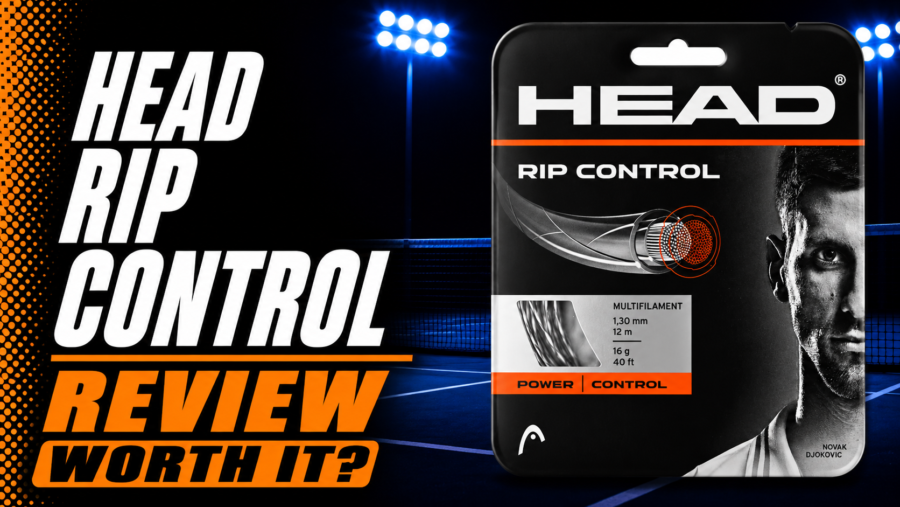
HEAD RIP Control is a control-oriented multifilament tennis string for players who want a softer alternative to polyester without the high launch of a typical power multifilament. Its muted response and unusual ribbon-based construction give it a distinct position within HEAD’s range.
Rather than relying only on a conventional bundle of straight nylon fibers, RIP Control combines nylon filaments with polyolefin ribbon wraps. This layered design produces a firmer, lower-powered response than plush strings such as HEAD Reflex MLT.
RIP Control is best suited to club players who generate some of their own pace, value directional consistency and do not want a full bed of polyester. It can also work as a controlled soft component in a hybrid. The Tennis String Finder can help place it against other material types.
HEAD RIP Control Rating
| Category | Rating |
|---|---|
| Power | 6.5/10 |
| Spin | 7/10 |
| Comfort | 8.5/10 |
| Control | 8.5/10 |
These ratings compare RIP Control with the complete string market. Its power is modest for a multifilament, while comfort and control are its main strengths.
HEAD RIP Control Specifications
| Specification | Details |
|---|---|
| String type | Control-oriented multifilament |
| Composition | Nylon filaments with polyolefin ribbon wraps |
| Profile | Round overall profile with textured outer ribbons |
| Surface | Muted, ribbon-wrapped exterior |
| Gauges | 16 / 1.30mm, 17 / 1.25mm and 18 / 1.20mm |
| Colors | Natural and Black, depending on gauge and market |
| Set length | Approximately 12m |
| Reel length | Approximately 200m, depending on market |
Gauge, color and reel availability can differ by region. The 16 / 1.30mm and 17 / 1.25mm versions are the most broadly relevant choices.
Material and Construction
RIP Control is frequently described simply as a multifilament, but that label does not explain its full construction. The string combines a nylon filament core with flat polyolefin ribbons wrapped around it.
The ribbon layers create a distinctive response. They help reduce rebound compared with a lively premium multifilament and contribute to a muted, dampened impact. This makes the string feel controlled without using a solid polyester monofilament.
Its exterior is not sharply shaped like a five-sided or square polyester. The overlapping ribbons create texture, but spin depends primarily on swing path, pocketing and the string’s ability to move rather than durable geometric edges.
The wrap is also relevant to wear. As the outer layers abrade, they may flatten, fray or separate before the central structure breaks. This visible wear is normal for the design and should be considered alongside changes in launch and feel.
HEAD RIP Control Performance
Power
RIP Control is one of the lower-powered strings in the multifilament category. It still returns more energy than many firm polyesters, but it does not create the effortless depth associated with natural gut or a highly elastic premium multi.
That restrained response can help medium and faster swingers keep the ball inside the baseline. It also makes RIP Control useful in powerful rackets where a soft, lively string might launch too high.
Players with short swings or difficulty producing depth may find it underpowered for a multifilament. HEAD Reflex MLT or Velocity MLT Power would provide easier pace.
Power rating: 6.5/10
Spin
RIP Control provides moderate spin. Its textured ribbon surface can contribute some grip, and the string’s lower power allows players to accelerate without the ball flying as easily.
It does not offer the persistent snapback of a low-friction polyester. The wraps can wear and the mains may remain displaced, especially after repeated topspin contact.
Players using moderate topspin and slice should find enough rotation for an all-court game. Heavy-spin string breakers will normally receive a more durable response from polyester.
Spin rating: 7/10
Control
Control is the product’s defining benefit. The ribbon-wrapped construction creates a predictable, subdued launch that distinguishes RIP Control from most multifilaments.
Independent playtesting has consistently highlighted its ability to support confident swings without excessive rebound. It works particularly well for flat drives, returns, slices and placement-oriented all-court play.
It is not as low powered as a tour-level control polyester. Advanced players with very fast swings may still prefer a monofilament, but RIP Control offers an unusually useful middle ground.
Control rating: 8.5/10
Comfort and Feel
RIP Control is comfortable across the wider market and much more forgiving than a firm polyester. Its nylon base and polyolefin ribbons cushion impact without making the response excessively springy.
The feel is muted rather than crisp or plush. Some players appreciate the dampened pocketing, while others may think it lacks the clean feedback of a conventional solid-core synthetic gut.
Comfort should not be treated as a medical claim. Persistent pain requires qualified assessment, and the complete racket, workload and technique remain important.
Comfort rating: 8.5/10
Durability and Tension Maintenance
Physical durability is above average for a multifilament. The ribbon wraps add abrasion resistance, and the 1.30mm version can last well for players who do not generate extreme topspin.
Heavy rotation can still wear through the outer layers. Fraying or flattened ribbons do not always mean immediate breakage, but they show that the surface and movement characteristics are changing.
Useful playability duration is generally respectable. RIP Control’s naturally subdued response can remain predictable after some tension loss, although string movement and surface wear may eventually reduce control. It should be replaced based on response and condition, not merely whether it is still intact.
Choosing the Right Gauge
| Gauge | General characteristics |
|---|---|
| 16 / 1.30mm | Maximum control, stability and physical resistance |
| 17 / 1.25mm | Balanced feel, spin access and durability |
| 18 / 1.20mm | Livelier response and easier rotation with faster wear |
The 16 / 1.30mm gauge is the safest choice for open patterns and regular string breakers. The 17 / 1.25mm version provides a useful balance, while 1.20mm is best reserved for dense patterns or players prioritizing response.
Full Bed or Hybrid Setup
Full Bed
A full bed delivers RIP Control’s intended combination of comfort and controlled launch. It suits club players who find polyester too rigid but consider conventional multifilaments too powerful.
The muted feel is a matter of preference. Players should try the string in a familiar racket before making large tension changes.
HEAD RIP Control in the Mains With Polyester Crosses
RIP Control mains retain more comfort and pocketing. A smooth polyester cross can lower the launch and add firmness.
The polyester will abrade the ribbon-wrapped mains, and a sharply shaped cross may accelerate wear. This hybrid is most sensible for players who accept reduced string life in exchange for a more controlled response.
Polyester Mains With HEAD RIP Control Crosses
Polyester mains provide most of the spin and directional control, while RIP Control crosses add dampening and a softer impact. This can be useful in powerful, open-patterned rackets.
The result remains much firmer than a full bed of RIP Control. It is designed for established polyester users rather than players seeking maximum comfort.
General Tension Guidance
RIP Control can begin near a player’s usual nylon or multifilament reference. Because it is less powerful than many multis, automatically raising tension to control the ball is rarely necessary.
Lower tension adds depth and pocketing. Higher tension produces a firmer, flatter trajectory but can make the already muted response feel less forgiving.
Stay within the racket manufacturer’s recommended range and change one variable at a time. Pattern, head size and gauge can matter as much as the number on the stringing machine. The Tennis String Tension Calculator offers broader setup guidance.
Who Should Use HEAD RIP Control?
RIP Control is best suited to:
- Club players wanting multifilament comfort with lower launch
- Medium and faster swingers who generate their own pace
- Flat hitters, slicers and all-court players
- Players moving away from a full bed of polyester
- Powerful-racket users seeking a softer control string
- Hybrid users wanting a muted soft component
Who Should Avoid HEAD RIP Control?
RIP Control is less suitable for:
- Players seeking maximum free power
- Users who prefer a crisp or highly connected feel
- Heavy topspin breakers needing polyester durability
- Players wanting long-lasting polyester snapback
- Beginners who struggle to create depth
- Anyone expecting equipment alone to address an injury
Pros and Cons
| Pros | Cons |
|---|---|
| Excellent control for a multifilament | Low powered for its material category |
| High comfort | Muted feel divides opinion |
| Better physical resistance than many soft multis | Ribbon exterior eventually frays or flattens |
| Three useful gauges | Less snapback than polyester |
| Works in full beds and hybrids | Not the easiest string for compact swings |
| Suitable for powerful rackets | Color availability varies by market |
HEAD RIP Control Compared With Other Strings
RIP Control vs HEAD Velocity MLT
HEAD Velocity MLT is livelier and has a smoother low-friction surface. RIP Control feels more muted and provides a lower, more contained launch.
RIP Control vs HEAD Reflex MLT
HEAD Reflex MLT emphasizes plush comfort and easy power. RIP Control is less luxurious but more suitable for players who want to limit rebound.
RIP Control vs Wilson NXT Control
Wilson NXT Control also targets players seeking multifilament comfort with additional control. The two use different internal constructions, so preferred feel and availability should guide the choice.
RIP Control vs Tecnifibre Triax
Tecnifibre Triax combines nylon and polyester fibers for greater resistance and a firmer response. RIP Control uses nylon with polyolefin ribbons and generally feels more muted.
Final Verdict
HEAD RIP Control is one of the clearest alternatives for players caught between a lively multifilament and a rigid polyester. Its nylon-and-polyolefin ribbon construction produces a comfortable but restrained stringbed with excellent category control.
Its defining feel is not universally appealing. Players wanting plush power may prefer Reflex MLT, while heavy hitters needing maximum snapback should choose polyester. RIP Control instead serves the player who values predictability, dampening and moderate durability.
The 16 / 1.30mm version provides the safest all-round starting point. The string is particularly effective in a full bed or as a control-focused soft component for players who understand the wear tradeoffs of hybrids.
Frequently Asked Questions
Is HEAD RIP Control a polyester string?
No. It is a multifilament that combines nylon filaments with polyolefin ribbon wraps.
Is RIP Control powerful?
It is relatively low powered for a multifilament, although it remains livelier than many firm polyester strings.
Why does RIP Control feel muted?
Its layered ribbon construction dampens the response and produces less crisp feedback than many conventional nylon strings.
Does RIP Control fray?
Yes. Its outer ribbons can wear, flatten and fray with use. That surface wear should be assessed separately from complete breakage.
Which gauge is the best starting point?
The 16 / 1.30mm version offers the most stable balance of control and physical resistance for many players.