
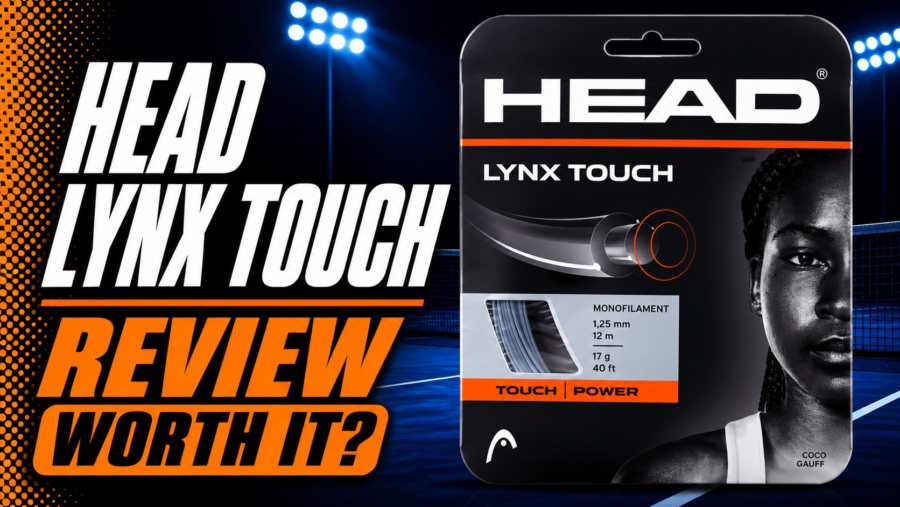
HEAD Lynx Touch is a round co-polyester tennis string designed to combine monofilament control with more comfort, pocketing and touch than a traditional firm polyester. It is the most accessible feel-oriented member of the Lynx family rather than the sharply defined spin option.
The string uses a co-extrusion process that places a softer, more elastic material inside a durable translucent polymer matrix. This dual-character construction allows it to respond more flexibly on moderate contact while maintaining control when swing speed increases.
Lynx Touch targets intermediate and advanced club players who want predictable polyester behavior without an excessively rigid response. It can also serve as a first full-bed polyester for a healthy player with sound mechanics. The Tennis String Finder can help compare it with softer non-polyester alternatives.
HEAD Lynx Touch Rating
| Category | Rating |
|---|---|
| Power | 7/10 |
| Spin | 7.5/10 |
| Comfort | 7.5/10 |
| Control | 8.5/10 |
These ratings compare Lynx Touch with the entire string market. Its comfort is strong for a co-polyester but remains below natural gut and most multifilaments.
HEAD Lynx Touch Specifications
| Specification | Details |
|---|---|
| String type | Co-polyester monofilament |
| Construction | Co-extruded elastic core within a durable polymer matrix |
| Profile | Round |
| Surface | Smooth, translucent exterior |
| Gauges | 16 / 1.30mm and 17 / 1.25mm |
| Color | Transparent Black, sometimes listed as Grey |
| Set length | Approximately 12m |
| Reel length | Approximately 200m |
| Player category | Performance club players |
Retailers may describe the translucent color differently, but HEAD currently identifies it as Transparent Black. Gauge availability is limited to 1.30mm and 1.25mm.
Material and Construction
Lynx Touch is a co-polyester monofilament, not a multifilament. Its single-strand form is produced through co-extrusion, combining materials with different response characteristics inside one string.
Independent product documentation describes a soft and elastic inner material surrounded by a durable translucent polymer matrix. This design distinguishes it from a basic uniform polyester and helps explain its combination of pocketing and directional control.
The string has a round, smooth profile. It does not create spin through sharp edges, so rotation depends on racket-head speed, string movement and snapback. The low-friction exterior can move efficiently while fresh and is less abrasive in a hybrid than an aggressively shaped polyester.
The softer internal response should not be confused with nylon-like softness. Lynx Touch remains a polyester-based monofilament and will feel firmer than HEAD Velocity MLT, Reflex MLT or natural gut in comparable setups.
HEAD Lynx Touch Performance
Power
Lynx Touch provides moderate power for a polyester. Its elastic core gives it more response and pocketing than very dead control strings, but the surrounding matrix keeps the launch from becoming excessively springy.
Players with medium or fast swings can access useful depth without surrendering the ability to accelerate. Compact swingers may still need more help than the string can provide, especially in a flexible, low-powered racket.
The 1.25mm version is the livelier choice. The thicker 1.30mm gauge provides a calmer launch and is better suited to powerful frames or frequent breakers.
Power rating: 7/10
Spin
Spin is good but not extreme. The round surface allows the strings to slide and return, helping players who generate rotation through an upward swing path.
Lynx Touch does not use edges to increase ball grip. Players who rely on a sharply shaped string for maximum bite will find greater potential in HEAD Lynx Tour or Solinco Tour Bite.
Its controlled response still supports aggressive acceleration, which is an important part of spin production. Snapback can weaken as tension drops and surface wear increases.
Spin rating: 7.5/10
Control
Control is Lynx Touch’s central performance strength. The string produces a predictable trajectory and lets medium-to-fast swingers attack the ball without the high rebound of a multifilament.
Its round shape creates a clean, consistent response across flat drives, topspin groundstrokes, returns and volleys. The added pocketing can make directional changes feel less abrupt than with a rigid control polyester.
Control is strongest during the useful life of the stringbed. Once tension loss changes the launch or the mains stop returning, physical integrity alone is not a reason to continue using it.
Control rating: 8.5/10
Comfort and Feel
Lynx Touch is comfortable within the co-polyester category. Its co-extruded internal structure produces more pocketing and a less harsh sensation than many older, uniformly firm monofilaments.
The feel is muted and elastic rather than sharply metallic. This supports touch shots and volleys, although players who prefer crisp feedback may find the response slightly dampened.
It is still polyester. Players with existing arm discomfort should not assume that a softer co-poly is equivalent to a multifilament, and persistent symptoms require qualified medical advice.
Comfort rating: 7.5/10
Durability and Tension Maintenance
Physical resistance to breakage is good. The solid monofilament construction and durable exterior give Lynx Touch a clear advantage over most multifilaments, particularly in the thicker 1.30mm gauge.
Useful playability duration may end earlier than physical life. As with other softer co-polyesters, the string can lose elasticity, launch differently or feel less responsive while remaining unbroken. Player reports vary, which reflects differences in racket, tension, swing speed and playing frequency.
Inspect movement as well as notching. When the mains remain displaced, control becomes inconsistent or the feel turns dull, restringing is more meaningful than waiting for breakage.
Choosing the Right Gauge
| Gauge | General characteristics |
|---|---|
| 16 / 1.30mm | Greater control, stability and physical resistance |
| 17 / 1.25mm | More pocketing, power and spin access with faster wear |
The 17 / 1.25mm version best expresses the string’s responsive character and suits many closed or moderately open patterns. Frequent breakers and powerful-racket users may prefer 1.30mm.
Full Bed or Hybrid Setup
Full Bed
A full bed delivers the clearest balance of control, pocketing and polyester durability. It is appropriate for healthy intermediate and advanced players with established swing mechanics.
Players moving from a multifilament should expect a firmer, lower-powered response even though Lynx Touch is comfortable for its category.
HEAD Lynx Touch in the Mains With Softer Crosses
Lynx Touch mains provide most of the control and snapback, while a multifilament or natural-gut cross adds power and comfort. This is a logical setup for players who want a less rigid polyester-led hybrid.
A smooth soft cross is preferable to one with a rough exterior. The polyester mains will still notch the softer crosses over time.
Softer Mains With HEAD Lynx Touch Crosses
Natural gut or multifilament mains maximize pocketing and power. Lynx Touch crosses add control and provide a smooth surface for main-string movement.
The softer mains determine most of the feel, but the stringbed remains firmer than a complete soft-string setup. Wear at the intersections should be monitored.
General Tension Guidance
Lynx Touch should generally be installed below the tension used for a nylon or multifilament in the same racket. Its monofilament construction does not need high tension to provide control.
Lower tension increases pocketing, depth and comfort. Higher tension produces a flatter trajectory but can make the stringbed feel unnecessarily firm and reduce the benefit of the elastic core.
Use the racket manufacturer’s range as the outer boundary and account for head size, pattern and gauge. Small adjustments are more informative than large changes. The Tennis String Tension Calculator can provide a general starting point.
Who Should Use HEAD Lynx Touch?
Lynx Touch is best suited to:
- Intermediate and advanced club players
- Healthy players wanting a more comfortable co-polyester
- Medium and fast swingers needing predictable control
- All-court players who value pocketing and touch
- Players trying a full bed of polyester for the first time
- Hybrid users wanting a smooth round monofilament
Who Should Avoid HEAD Lynx Touch?
Lynx Touch is less suitable for:
- Beginners who need substantial free power
- Players with current arm pain seeking maximum softness
- Heavy-spin users who depend on sharp geometric edges
- Players who rarely restring polyester
- Users wanting a crisp, highly rigid response
- Frequent breakers who need more than two gauge choices
Pros and Cons
| Pros | Cons |
|---|---|
| Strong control with useful pocketing | Less spin bite than shaped polyester |
| Comfortable for a co-polyester | Still firmer than multifilament or gut |
| Smooth surface supports snapback | Useful life can end before breakage |
| Predictable round profile | Only two gauges |
| Effective in full beds and hybrids | Muted feel may not suit everyone |
| More accessible than many firm polys | Limited free power for compact swings |
HEAD Lynx Touch Compared With Other Strings
Lynx Touch vs HEAD Lynx Tour
HEAD Lynx Tour uses a shaped profile for stronger bite and a firmer, more control-oriented response. Lynx Touch is rounder, softer and better suited to players prioritizing pocketing.
Lynx Touch vs HEAD Sonic Pro
HEAD Sonic Pro is another round, accessible co-polyester. Lynx Touch uses a co-extruded construction and provides a more distinctive combination of elasticity and touch.
Lynx Touch vs Luxilon Element
Luxilon Element is a soft, powerful monofilament aimed at players wanting polyester control with added comfort. Both are accessible for the category, while their feel and power balance differ.
Lynx Touch vs HEAD Velocity MLT
HEAD Velocity MLT is a true multifilament with more comfort and easy depth. Lynx Touch offers greater monofilament control, physical durability and sustained snapback.
Final Verdict
HEAD Lynx Touch is a versatile co-polyester for players who want control without the most rigid polyester response. Its co-extruded core-and-matrix construction, round profile and smooth surface create a useful blend of pocketing, predictability and snapback.
It is not a substitute for multifilament comfort, nor is it the sharpest spin string in the Lynx family. Its strength is balance: enough response for club play, enough control for full swings and enough softness to be more approachable than many tournament polys.
The 17 / 1.25mm version is the best starting point for most players. The 16 / 1.30mm gauge makes more sense when physical resistance and a calmer trajectory take priority.
Frequently Asked Questions
Is HEAD Lynx Touch a multifilament?
No. It is a co-extruded co-polyester monofilament with a softer elastic interior and durable outer matrix.
Is Lynx Touch soft?
It is comfortable for a co-polyester, but it remains firmer than natural gut and most multifilaments.
Is Lynx Touch shaped?
No. It has a round, smooth profile and produces spin mainly through movement, snapback and swing speed.
Which gauge should most players choose?
The 17 / 1.25mm version provides the livelier balance of feel, spin and control. The 16 / 1.30mm gauge favors stability and durability.
Can Lynx Touch be used in a hybrid?
Yes. Its smooth round surface works as either the control-oriented main or cross, depending on which string the player wants to dominate the setup.