
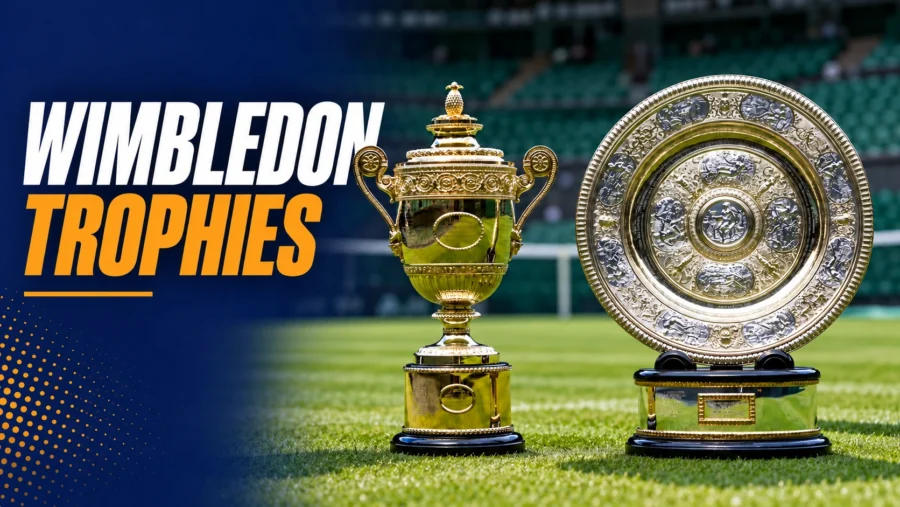
Wimbledon awards two of the most recognizable trophies in tennis. The gentlemen’s singles champion lifts a silver-gilt cup topped by a pineapple, while the ladies’ singles champion receives the Venus Rosewater Dish, a large decorated silver salver.
The champions do not keep those originals. The historic trophies remain the property of the All England Lawn Tennis Club, and each winner receives a smaller replica bearing the names of previous champions.
What Are the Wimbledon Trophies Called?
The main Wimbledon singles trophies are commonly known by the following names:
| Event | Trophy |
|---|---|
| Gentlemen’s singles | Gentlemen’s Singles Trophy or Challenge Cup |
| Ladies’ singles | Venus Rosewater Dish or Venus Rosewater Basin |
The men’s trophy does not have a distinctive personal name comparable to the women’s dish. It is usually described simply as the Gentlemen’s Singles Trophy, Wimbledon Trophy or Challenge Cup.
These prizes form part of a much wider Wimbledon tradition built around grass-court tennis, formal presentation ceremonies and the tournament’s long historical record.
The Gentlemen’s Singles Trophy
The gentlemen’s trophy is a two-handled silver-gilt cup. It stands 18in high and measures 7.5in across, with a small pineapple mounted on its lid.
It bears the inscription, “The All England Lawn Tennis Club Single Handed Championship of the World.” The wording reflects an earlier period in tennis history, when singles was often described as the single-handed game and Wimbledon held the status of a world grass-court championship.
Why Was the Current Trophy Introduced in 1887?
The present cup has been awarded since 1887. Before then, the men’s champion could win permanent possession of a challenge trophy by taking the title three times in succession.
William Renshaw accomplished that feat twice during his run of six consecutive championships from 1881 through 1886. After the second trophy passed into his possession, the club introduced the current cup and decided that it would never become a champion’s personal property.
That policy protected a permanent record of the event. As new champions were added, their names and winning years were engraved around the cup. When space became limited, an additional black plinth with a silver band was created for later names.
The unusual early records behind the change belong alongside many of Wimbledon’s strangest historical records.
Why Is There a Pineapple on the Wimbledon Trophy?
Wimbledon has never published a definitive explanation from the trophy’s original designer. The most widely accepted interpretation is connected to the pineapple’s status in Victorian Britain.
Fresh pineapples were once rare, expensive and associated with prestige, hospitality and high social standing. Placing one at the top of the cup would therefore have made sense as a decorative symbol for an important championship prize.
It is better to treat that as historical interpretation rather than a formally documented tournament meaning. Claims that the pineapple represents one precise idea often go beyond the surviving evidence.
The Venus Rosewater Dish
The ladies’ singles champion receives the Venus Rosewater Dish, a partly gilded sterling-silver salver measuring 18.75in in diameter. It was made by Elkington and Company of Birmingham in 1864 and first presented as Wimbledon’s women’s trophy in 1886.
The dish is not a piece originally created for tennis. Its design reproduces a Renaissance ceremonial basin and is filled with figures and scenes from classical mythology.
Why Is It Called a Rosewater Dish?
A rosewater dish was traditionally used with an ewer during ceremonial handwashing. Scented water would be poured over a guest’s hands and caught in the basin below.
By the 19th century, elaborate versions also served as display pieces. Wimbledon’s dish is therefore closer to a richly decorated salver than a modern sports cup.
What Is Shown on the Dish?
The central figure is Temperance, surrounded by mythological imagery associated with the elements and classical gods. The dense decoration is one reason the trophy looks very different from the clean, cup-shaped design awarded to the men’s champion.
The champions from 1884 through 1957 are engraved on the front of the dish, while later names moved to the back when the original space was filled. A plinth was added in 2016 to provide room for new winners. The players represented include many figures also considered among the greatest women’s tennis players of all time.
Do Wimbledon Champions Keep the Real Trophy?
No. The original singles trophies remain with the All England Club and are normally displayed in the Wimbledon Lawn Tennis Museum when they are not required for tournament ceremonies.
Champions receive three-quarter-size replicas bearing the names of past winners. Since 2007, the women’s champion has also received a three-quarter-size version of the Rosewater Dish, replacing the 8in replica awarded from 1949 through 2006.
The distinction explains why a returning champion can bring a personal Wimbledon trophy to an event without the original leaving the club permanently.
Are the Winners’ Names Engraved Immediately?
The engravers wait until the winning point confirms the result, then begin work immediately. They add the champion’s name to the original trophy or its plinth and engrave the player’s take-home replica during the post-match period.
The short turnaround is part of Wimbledon’s presentation tradition. Accuracy matters because each inscription becomes part of the tournament’s permanent physical record.
Champions are announced using the event’s formal terminology, such as gentlemen’s singles champion and ladies’ singles champion. Although everyday reporting commonly uses men’s and women’s singles, the traditional event names remain visible throughout Wimbledon.
What Trophies Do the Doubles Champions Receive?
Wimbledon also awards distinct trophies for gentlemen’s doubles, ladies’ doubles and mixed doubles.
Gentlemen’s Doubles Trophy
The gentlemen’s doubles champions receive silver challenge cups. The original cup came from Oxford University Lawn Tennis Club and was presented to the All England Club in 1884.
Each member of the winning team receives a trophy. That is different from events that present one shared cup to the pair.
Ladies’ Doubles Trophy
The ladies’ doubles prize is the Duchess of Kent Challenge Cup. The Duchess of Kent presented it to the club in 1949.
Like the men’s doubles award, it is a covered silver cup rather than a dish. Both players on the championship team are recognized individually.
Mixed Doubles Trophy
The mixed doubles trophy is a silver challenge cup and cover presented by the family of Sydney Smith. Smith won Wimbledon doubles titles and was an important British player in the tournament’s early history.
Wimbledon also awards trophies across wheelchair, quad wheelchair and junior events. The exact designs and presentation arrangements differ by competition.
What Do Wimbledon Runners-Up Receive?
The runner-up does not leave empty-handed. Wimbledon presents an inscribed silver plate to the finalist in each main championship event.
The difference between the champion’s trophy and runner-up plate reinforces the tournament’s formal award structure. Prize money is separate from these physical awards and is paid according to the round reached.
Who Presents the Wimbledon Trophies?
The singles trophies are traditionally presented on Centre Court by the patron or another senior representative of the All England Club. The Princess of Wales became the club’s patron in 2016 and has performed the role at multiple finals.
The ceremony normally includes the runner-up presentation, the champion’s trophy, brief on-court interviews and a lap or movement around the court for photographs. The champions then take the trophies through a series of media commitments.
The formal setting is part of what distinguishes Wimbledon from other majors, even though each event maintains its own important traditions. The American major’s evolution is covered separately in US Open history and records.
Why the Wimbledon Trophies Matter
The trophies connect current champions with the earliest years of organized lawn tennis. Their inscriptions record more than a list of winners because rule changes, interrupted championships and different competitive eras all sit behind those names.
Roger Federer’s eight men’s singles championships and Martina Navratilova’s nine women’s singles titles are Open Era Wimbledon benchmarks. Those records help explain why the tournament’s trophies carry such weight in tennis history.
The originals also prevent the tournament’s history from being divided among private collections. Every champion lifts the same central object before receiving a personal replica.
Wimbledon Trophy FAQ
Is the Wimbledon Men’s Trophy Made of Gold?
No. It is a silver-gilt cup, meaning silver covered with a thin layer of gold. Its golden appearance does not mean the entire trophy is solid gold.
Is the Venus Rosewater Dish a Plate?
It can look like a large plate, but it is more accurately described as a salver or ceremonial basin. Its rosewater name comes from the type of object it reproduces, not from anything poured into it during the Wimbledon ceremony.
Do Champions Receive a New Replica for Every Title?
Yes. A multiple champion receives a replica for each championship won. The original cup or dish remains at Wimbledon.
Why Are There Separate Men’s and Women’s Trophy Designs?
The two trophies were acquired at different points in the tournament’s early history and came from different decorative traditions. Their contrasting forms have since become permanent parts of Wimbledon’s identity.