
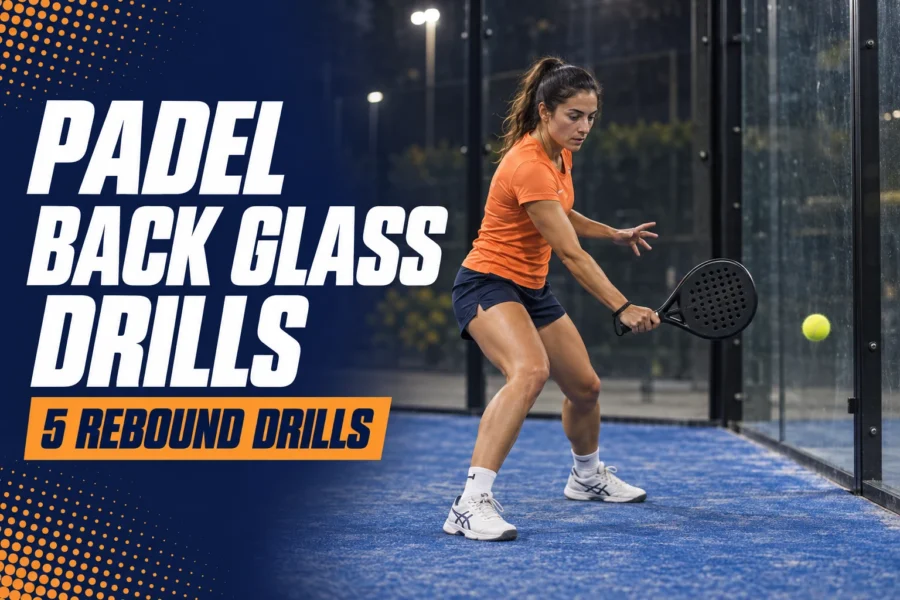
To practice padel back-glass rebounds, start with gentle feeds that bounce on the floor, reach the glass and leave you enough room to make a controlled return. Once you can judge predictable rebounds, introduce different speeds, choose whether to play before or after the glass, and practice handling the next ball.
These five padel back-glass drills follow that progression. They focus on reading ordinary defensive rebounds, with exercises for both forehand and backhand.
Understand the Back-Glass Sequence
When you allow an incoming ball to reach your back glass, the sequence is:
- The ball bounces on your side of the court.
- It rebounds from the back glass.
- You return it before its second floor bounce.
Touching the glass does not restart the floor-bounce count. An untouched incoming shot that hits your glass before bouncing on your court is out.
These are part of the basic rules of padel. The drills below practice receiving a rebound, rather than hitting your own glass to send a return across the net, which is a separate legal option.
You do not have to use the glass whenever a ball lands deep. The useful question is whether the rebound will give you a manageable hitting position before the ball bounces again.
Set Up Your Practice
Use a padel court, a partner and a few balls, with only one ball active at a time. Keep spare balls outside the movement area, wear your racket’s wrist strap and begin with some easy movement and gentle hitting.
Start with simple back-glass feeds away from the corners. A ball that also reaches the side glass creates another change of direction, so introduce that separately after you can judge single-wall rebounds.
The repetition targets below are starting points. Slow the feed or reduce the number of attempts if you begin rushing.
1. Hand-Feed, Catch and Return
This drill lets you learn where the rebound travels before adding the racket swing. Both players work on the same side of the net.
Setup: Stand in the rear of one half of the court. Your partner stands several steps closer to the net and diagonally clear of your movement and swing.
- Your partner gently throws the ball beside you so it bounces on the floor and reaches the back glass.
- Turn and follow its path, leaving space between your body and the rebound.
- Catch the ball after the glass and before another floor bounce.
- Once the catch feels predictable, use your racket to make a gentle, catchable return toward the feeder.
Begin on one wing, then repeat on the other. Try six manageable racket returns on each side before swapping roles.
The catch is an introductory exercise. When you add the racket, keep the same timing while making contact with enough room to swing.
What to watch: If the ball repeatedly comes into your body, adjust your position away from its rebound path. Preparing the racket early, as explained in padel forehand and backhand technique, also reduces the amount you need to organize at the last moment.
Progression: Move the feeder across the net and aim your return into a broad area of the opposite court.
2. Adjust to Short and Long Rebounds
Some balls stay close to the glass after rebounding, while others travel farther into the court. This drill teaches you to adjust your contact position instead of expecting every ball to arrive in the same place.
Setup: Your partner feeds from across the net. Every intended feed should bounce first and reach the back glass, with enough time for a controlled return.
- Begin with several feeds producing a similar rebound.
- Ask your partner to alternate between balls that rebound a short distance and balls that travel farther forward.
- Read the incoming ball, prepare early and adjust to its actual path after the glass.
- Return gently toward a broad target, then reset.
Here, a “short rebound” means the ball stays near the glass after contact. It does not mean a short feed that fails to reach the wall.
Practice target: Over ten usable feeds, count the returns you make with comfortable spacing and control. Notice whether errors occur mainly when the ball stays close or comes farther forward.
Avoid following the incoming ball directly toward its impact point on the glass. Leave room for its return path, then use adjustment steps as the hitting position becomes clearer.
Progression: Remove the predictable alternation. Later, let the feeder change position slightly to introduce different incoming angles while keeping the ball away from the side glass.
If movement is the main difficulty, these padel footwork drills provide additional practice for spacing and balance.
3. Choose Before or After the Glass
Comfort with rebounds also means recognizing when waiting for the glass will make the shot harder. This exercise adds that decision without the pressure of a continuous rally.
Setup: Start in a defensive position behind the service line. Your partner feeds from across the net, mixing shorter balls with deeper balls that produce a playable back-glass rebound.
- Let each feed bounce on your court.
- Judge whether taking it before the glass or allowing the rebound gives you a manageable contact.
- Make one controlled return.
- Reset and briefly identify whether any difficulty came from the decision or the execution.
Start with obvious differences between the feeds. A slow ball that will bounce twice before reaching the wall should be taken earlier, while a suitable deeper ball gives you a chance to practice the rebound.
Practice target: Try ten mixed feeds. Record unnecessary waits separately from missed returns, because a sensible decision can still be followed by a poor shot.
Where the first bounce lands is a clue, but the service line is not an automatic decision boundary. The ball’s remaining pace, direction and your position all matter.
Progression: Make the feeds less predictable. Accept that both choices can work on some balls, rather than assigning one compulsory answer to every feed.
4. Lob From a Manageable Rebound
A back-glass return can give you an opportunity to send the ball high and deep. This drill develops that option when the rebound leaves enough time and space to control the shot.
Setup: Your partner feeds a comfortable deep ball from across the net. Use the area beyond the opposite service line as a broad landing target, leaving a generous margin inside the back glass.
- Allow the floor bounce and back-glass rebound.
- Adjust into a balanced hitting position with room to bring the racket below the ball.
- Play a controlled lob with enough height to pass over an opponent’s net position.
- Let it land, assess the depth and reset.
Begin with six feeds on your easier wing, then practice the other side. Your partner should allow the lobs to land during this stage so you can judge the result.
What to watch: A lob that lands deep but travels low enough for an easy overhead has missed part of the task. Work on height and depth together, using the preparation described in padel lob technique.
Progression: Vary the rebound and choose between a lob and a controlled lower return. If you are cramped or reaching, select the shot you can manage rather than forcing the planned lob.
5. Back-Glass Return and Next Ball
An isolated return gives you time to stop and reset. This exercise adds the next shot so you practice recovering while the exchange continues.
Setup: One player starts near the net and the other defends at the back. Keep the early exchanges within a straight half-width lane.
- The net player sends a controlled deep feed that produces a playable back-glass rebound.
- The defender returns the rebound toward the net player.
- The net player plays a gentle volley back into the lane.
- The defender handles that next ball, taking it before or after the glass as appropriate, then both players reset.
Complete six short sequences before changing roles. Begin with a predictable second ball so the defender can concentrate on preparing again after the first return.
Practice target: Count sequences in which both defensive returns are controlled and the defender is ready as the net player strikes the intervening volley.
There is no requirement for the second ball to reach the glass. Its depth and pace should determine how it is played.
Progression: Vary the second volley, then extend the exchange into a cooperative rally. These padel drills for two players offer further ways to practice decisions within longer exchanges.
Common Back-Glass Mistakes and What to Change
Look for a recurring problem before changing your swing. A missed return may start with the feed, your position or the decision to wait.
| What happens | What to try |
|---|---|
| The rebound crowds your body | Leave more space beside its path and adjust toward the eventual contact position. |
| The ball bounces twice while you wait | Judge earlier whether it will reach the glass and produce a usable rebound. |
| You make contact behind your body | Prepare sooner and adjust your position so you have room to play the ball comfortably. |
| Comfortable feeds produce rushed, hard returns | Reduce the swing size and aim for a broad target at a controlled pace. |
| The first return works, but the next ball catches you unprepared | Use Drill 5 and focus on becoming ready again as the opponent hits. |
Do not count an accidental, unsuitable feed as a failed repetition. Reset if a ball intended for simple back-glass practice reaches the corner or creates a situation beyond the current exercise.
Choose the Drills That Match Your Difficulty
You do not need to complete every drill in each session. Choose a starting exercise and one progression that address the problem you are having.
- New to the glass: Start with Drill 1, then use predictable feeds from Drill 2.
- Comfortable with fixed feeds but struggling with variation: Combine Drills 2 and 3.
- Returning rebounds but struggling to stay in the rally: Combine Drills 4 and 5.
Use the same broad target for a short set of attempts and record how many controlled returns you make. When the set feels manageable, change one feature, such as feed direction, rebound length or the next ball, before increasing the pace.
Can You Practice Back-Glass Rebounds Alone?
Yes. Use your free hand to feed a ball onto the floor toward the back glass, leave room beside its path and return the rebound over the net before the second floor bounce.
Start with one ball and reset after each attempt. These solo padel practice drills explain how to include self-fed glass returns in a wider session.
Self-feeding helps you rehearse contact and spacing, but you know where the ball is going. Add partner feeds when possible to practice reading a shot you did not create yourself.
Is Every Back-Glass Return a Bajada?
No. A routine defensive return after the glass may be a controlled forehand, backhand or lob.
A bajada is an attacking option from a suitable rebound, commonly a higher ball coming off the back glass. Height alone does not make it a good opportunity; you also need enough time, space and balance to control the attack.
Once you can reliably manage ordinary rebounds, work on padel bajada technique as a separate progression.