
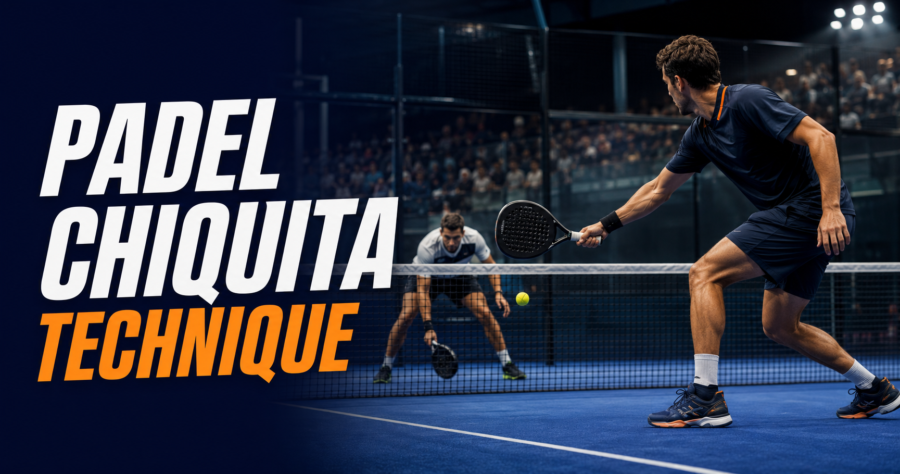
The chiquita in padel is a soft, controlled shot played toward the feet of an opponent at the net. Its purpose is not usually to hit a winner. A good chiquita forces the opponent to contact the ball below net height, making an aggressive volley difficult and potentially giving your team time to move forward.
The shot works best when you are balanced, have a manageable ball and can see space in front of the net players. If the opponents are extremely close to the net or you are defending under pressure, a well-executed padel lob will often be the safer tactical choice.
What Is a Chiquita in Padel?
The Spanish word “chiquita” means “little one,” which reflects the shot’s compact and delicate nature. It is usually played from the back half of the court as a controlled forehand or backhand that travels slowly and stays low.
The ball is directed toward the feet of one of the net players or through the middle between them. If executed correctly, the opponent must volley upward or allow the ball to bounce, giving your team an opportunity to improve its court position.
A chiquita is not simply a drop shot. A drop shot is intended to land very short and become difficult to reach, while a chiquita is designed to make the opponent play an uncomfortable low ball. Its main value comes from disrupting the net team and creating a transition opportunity.
Why the Chiquita Is Effective
Players at the net generally prefer a ball they can contact above net height. From that position, they can hit down into the court, create angles and apply pressure.
The chiquita denies them that comfortable contact point. Because the ball arrives slowly and low, the opponent may have to bend, open the racket face and lift the volley. The resulting reply is more likely to be slower, shorter or easier to attack.
The slower flight also gives you and your partner more time to move forward. However, this advantage disappears if you hit the ball too hard. A fast chiquita may reach the opponent before you can improve your position and can become an easy attacking volley.
When to Use the Chiquita
The chiquita is a situational shot. It becomes effective when the opponent’s position, the incoming ball and your balance all support it.
| Match situation | Recommended decision |
|---|---|
| The net players have left space in front of their feet | Play the chiquita into that space |
| An opponent is moving forward and has not established a stable volley position | Target the moving player’s feet |
| You receive a manageable serve or an easy ball from the back court | Consider a chiquita and prepare to advance |
| Both opponents are extremely close to the net | Use a lob unless a clear gap is available |
| You are stretched, rushed or contacting the ball late | Defend with a higher-margin shot |
| The ball traps you close to the back glass | Recover the point before attempting a delicate shot |
The best opportunity usually comes from a comfortable ball that allows you to prepare early and make contact in front of your body. The opponents should be occupying the net but not standing so close that they can reach forward and attack the ball before it drops.
A chiquita can also be effective when an opponent expects a hard drive. The sudden change of speed can disturb their timing, particularly if they are moving or preparing a larger volley swing.
How to Hit a Chiquita Step by Step
1. Read the Opponents Before Choosing the Shot
Look at the net players before beginning your swing. Identify whether either player is moving, standing too far back or leaving a large space around the middle.
Do not decide to play a chiquita solely because the incoming ball is slow. The shot must also make sense against the opponents’ positions.
2. Establish a Balanced Base
Use small adjustment steps to create space between your body and the ball. Bend your knees and keep your upper body stable rather than reaching with the racket.
You should feel balanced enough to control both the direction and speed of the shot. If you are falling backward or contacting the ball beside your body, choose a simpler defensive option.
3. Use a Compact Preparation
Turn your shoulders and take the racket back only as far as necessary. A large backswing creates unnecessary speed and makes touch more difficult.
The continental grip is a useful default because it allows subtle racket-face adjustments on both sides. Players with reliable padel forehand and backhand technique can also use their normal controlled groundstroke grip, provided the racket face remains stable.
4. Keep the Racket Face Stable
The racket face should normally be neutral or slightly open, depending on the height and spin of the incoming ball. An excessively open face sends the ball too high, while a closed face often sends it into the net.
Avoid changing the angle with a sudden wrist movement. Make the adjustment before contact and maintain it through the ball.
5. Contact the Ball in Front
Meet the ball in front of your body at a comfortable height. Keep your hand relaxed enough to absorb pace but firm enough to prevent the racket from twisting.
The movement should feel more like guiding or gently pushing the ball than striking through it aggressively. Use the shoulder and forearm together rather than flicking the wrist.
6. Send the Ball Low Toward the Feet
Guide the ball over the net with enough clearance to avoid unnecessary errors. The objective is a low trajectory that begins dropping before it reaches the opponent.
Aim for the space around the opponent’s feet rather than trying to hit the sideline. Placement, height and speed are more important than an extreme angle.
7. Use a Short Follow-Through and Recover
Finish with the racket moving toward the target. The follow-through should remain compact and controlled instead of wrapping around your body like a powerful groundstroke.
Return the racket to the ready position immediately. Watch the quality of your shot and the opponent’s contact before deciding how far to move forward.
Should You Hit the Chiquita Flat or With Spin?
Spin is not what defines a chiquita. The essential features are controlled speed, a low trajectory and accurate placement near the net player’s feet.
A neutral or nearly flat contact is usually the simplest option. It gives beginners and intermediate players a predictable ball flight without requiring additional racket-head speed.
Light underspin can help the ball stay low, but the action must remain subtle. Chopping steeply underneath the ball can make it float, land too short or sit up after the bounce.
Advanced players may occasionally use light topspin to make the ball dip. This variation requires precise timing and enough racket-head speed to create spin without turning the shot into a drive. It is an option rather than a requirement.
Where Should You Aim?
At the Moving Player’s Feet
A player moving from the back court toward the net must volley while controlling their body movement. A slow ball around their feet can be particularly difficult because they may have to stop, lower their body and adjust the racket face simultaneously.
This is also an effective return-of-serve target. The server is often moving forward after serving and may not yet be settled at the net.
Through the Middle
The middle is a high-percentage target because the net is lower and the court provides more margin. It can also create uncertainty over which opponent should take the ball.
A middle chiquita limits the available volley angles and helps your team move forward without immediately exposing a large gap.
Toward the Weaker Low Volley
If one opponent struggles with low forehand or backhand volleys, direct more chiquitas toward that side. Target a technical weakness without attempting an unnecessarily precise sideline shot.
Crosscourt
A crosscourt chiquita has more court available and may create a useful angle toward the feet. However, it can also give the opponent an angle for the next volley. Use it when the target is clearly available rather than treating crosscourt as the automatic choice.
What to Do After Hitting the Chiquita
A successful chiquita creates an opportunity to approach the net, but it does not guarantee one. Judge the shot by its height, depth and the opponent’s contact point.
If the ball stays low and forces the opponent to lift the volley, move forward while the ball is travelling. Stop and perform a split step just before the opponent makes contact so you can react to the reply. Once you establish an attacking position, sound volley technique becomes important for handling the next ball.
You and your partner should advance together. If one player charges forward while the other remains deep, the opponents can attack the gap between you. Communication and coordinated positioning are central to being an effective padel partner.
Do not follow a poor chiquita automatically. If the ball floats, lands too deep or reaches the opponent above net height, hold your position and prepare to defend. Moving forward behind an attackable ball compounds the original mistake.
Chiquita vs Lob, Drive and Bajada
These shots can all help a team escape the back court, but they solve different tactical problems.
| Shot | Main purpose | Best opportunity |
|---|---|---|
| Chiquita | Force a low volley and create time to advance | A comfortable ball with space in front of the net players |
| Lob | Send the opponents away from the net | Opponents are tight to the net or you need more defensive margin |
| Drive | Pressure or pass the net players with speed | A high, comfortable ball that can be attacked |
| Bajada | Attack after the ball rebounds from the back wall | A high wall rebound that provides an offensive contact point |
Unlike the chiquita, the bajada is normally struck with greater speed after a suitable wall rebound. The chiquita relies on softness and placement, while the bajada attempts to turn the rebound into a more direct attack.
Alternating chiquitas and lobs can be especially effective. A chiquita may draw the net players closer, creating more space behind them for a later lob. A successful lob may push them away from the net and create room for a future chiquita.
Common Chiquita Mistakes
Hitting Too Hard
Excessive speed prevents the ball from dropping and gives you less time to advance. Relax your grip, shorten the swing and focus on controlling the opponent’s contact height.
Playing It Against Opponents Tight to the Net
A net player standing very close can reach forward and intercept the ball before it falls. Recognize the lack of space and switch to a lob.
Opening the Racket Face Too Much
An overly open face sends the ball upward and presents an easy volley. Stabilize the racket before contact and guide it forward rather than lifting sharply.
Treating It Like a Drop Shot
A ball that lands extremely short may not reach the intended target and can give the opponent time to move forward. Aim for the opponent’s expected contact area, not directly behind the net.
Using Too Much Wrist
A sudden wrist flick makes the racket face unpredictable. Keep the wrist stable and control the shot through a compact movement of the arm and shoulder.
Attempting It While Off Balance
Touch becomes much harder when you are stretched, falling backward or trapped against the glass. Recover your position first and wait for a more suitable opportunity.
Charging Forward Behind Every Chiquita
The decision to advance depends on the result, not the name of the shot. Move when the opponent must play upward, but stay back when your ball can be attacked.
Drills to Improve the Chiquita
Target-Zone Drill
Place markers in the areas where net players normally position their feet. Have a partner feed comfortable balls from the opposite side while you alternate forehand and backhand chiquitas.
Count only shots that clear the net safely, land in the target area and remain low enough to prevent an aggressive volley. Once your control improves, vary the feed’s depth and direction.
Chiquita and Approach Drill
Start with one player at the back and one at the net. The back player hits a chiquita, then reads the resulting volley.
Move forward when the net player contacts below net height. Hold the defensive position when the ball sits up. This develops the decision that must accompany the technique.
Chiquita-or-Lob Drill
Ask the net player to alternate between standing close to the net and leaving more space in front. Play a lob when the opponent closes tightly and a chiquita when space appears near the feet.
The feeder should change position before each shot so the player must look up and make a decision rather than repeating a fixed pattern.
Return-of-Serve Drill
Have a partner serve at a manageable pace and move toward the net. Return softly toward the server’s feet, then recover and assess whether your team can move forward.
Practise from both return sides. Accuracy is more important than trying to make every return extremely short.
Frequently Asked Questions
Can Beginners Use the Chiquita?
Yes, but beginners should first develop a compact swing and reliable directional control. The simplest beginner version uses a neutral racket face, minimal spin and a large target around the middle.
Players who are still learning positioning may benefit from a broader guide to starting padel before making the chiquita a regular tactical choice.
Can You Hit a Chiquita With Both Forehand and Backhand?
Yes. The tactical objective remains the same on both sides: control the speed, keep the trajectory low and direct the ball toward the feet.
Choose the side that the incoming ball naturally presents. Avoid running around a comfortable backhand if doing so leaves you off balance.
Is the Chiquita Always Played With Slice?
No. It can be played with a neutral contact, light slice or, at a more advanced level, controlled topspin. Placement and trajectory matter more than producing a particular type of spin.
Should You Always Move to the Net After a Chiquita?
No. Advance only when the shot forces a low or defensive contact and your partner can move with you. If the opponent can volley aggressively, remain balanced and prepare for the next ball.
Is the Chiquita Intended to Win the Point?
It can force an immediate error, but that is not its primary purpose. The shot is most valuable when it weakens the opponent’s volley, disrupts their rhythm or helps your team progress from defense into a better attacking position.