
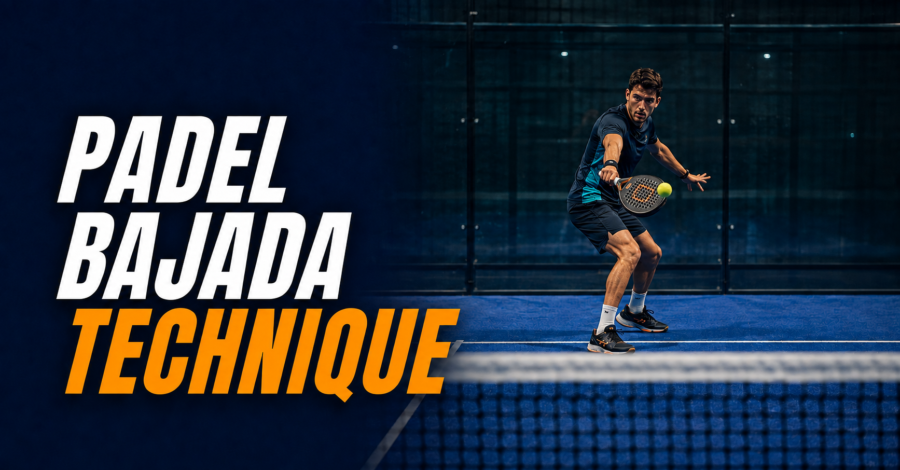
A bajada is an attacking shot played after the ball bounces in your court and rebounds high from the back glass. Instead of letting the rebound fall into a defensive contact zone, you meet it in front of your body and drive it back low and firmly to pressure the opponents.
The most important part of the shot is selection. A clean, high rebound that moves away from the glass can be attacked, but a low, tight or awkward rebound should usually be returned with a safer wall shot, lob or controlled ball to the opponents’ feet.
What Is a Bajada?
The full Spanish term is bajada de pared, meaning a descent from the wall. The usual sequence is that an opponent’s shot, often a deep lob, bounces in your court, reaches the back glass and rebounds forward. You then strike it before it bounces on the court a second time.
Not every return from the back glass is a bajada. A normal wall return may be neutral or defensive, while a bajada uses an attackable high rebound to counterattack from the back of the court. Its primary objective is to force a difficult volley and create a chance to advance, although a well-placed shot can also win the point directly.
The back glass is central to the definition. A complicated side-glass or double-glass rebound can sometimes be attacked, but it should not automatically be treated as the same opportunity. Those rebounds generally demand more conservative shot selection because their direction and spacing are harder to read.
When Should You Hit a Bajada?
Play a bajada when the ball rebounds far enough from the back glass to create swinging room, remains at a comfortable attacking height and gives you time to establish balance. The ball should be in front of you at contact, with your body positioned between it and the glass.
There is no universal contact height. A clean rebound may be attacked around chest or shoulder height, while another may still be playable closer to the waist. What matters is whether you can contact it in front with control and send it over the net on a penetrating trajectory.
Use a safer response when:
- The ball stays low or close to the glass.
- The rebound enters an unpredictable double-glass path.
- You are late, off balance or still moving backward.
- Contact would be behind your body or crowded against your hip.
- You would need to hit at maximum speed just to make the shot threatening.
How to Hit a Bajada Step by Step
1. Read the Ball Before It Reaches the Glass
Recognize the deep trajectory early and turn rather than backpedaling while square to the net. Move behind and slightly to the side of the projected rebound path, then use smaller adjustment steps as the ball approaches the glass.
Do not run directly to the point where the ball will touch the wall. Your aim is to arrive where the ball will be after it rebounds, not where it is going first.
2. Create Space From the Rebound
Allow the ball to bounce, reach the back glass and separate from it. Viewed from the back wall toward the net, the sequence should be glass, player, contact point and opponents’ court. The ball must be on the court side of your body, not trapped between you and the glass.
The required distance from the glass changes with the rebound’s height, pace and angle. Use the rebound itself as your guide instead of standing at a fixed distance.
3. Set the Grip and Preparation
A continental grip is a versatile starting point because it supports flat and sliced contact without a late grip change. Experienced players may use a small personal adjustment, especially on the forehand, but the grip should still allow a stable racket face through contact.
Turn the shoulders and prepare the racket compactly behind and above the expected contact point. The non-dominant hand can help track the rebound and maintain balance, but avoid an oversized backswing close to the glass.
4. Let the Ball Reach the Attacking Window
Do not rush into contact while the ball is still tight to the wall. Let it move into the court, then strike at the earliest comfortable point after it has created enough separation, commonly as it begins to descend.
Waiting too long is also a problem. Once the ball drops below a useful attacking height, the downward angle disappears and a forceful swing becomes much riskier.
5. Contact the Ball in Front
Establish a stable base with flexed knees and keep enough lateral space between your body and the ball. The racket must approach from behind the ball, with contact in front of the hitting shoulder and toward the opponents’ court.
Watch the ball through the center of the racket face. If contact happens beside your body or behind your shoulder, direction becomes difficult and the shot often floats into an easy volley.
6. Rotate and Drive Through the Shot
Transfer weight from the rear leg toward the front leg while rotating the hips and shoulders. Send the racket forward through the ball with a controlled downward component, using the body and arm together rather than creating speed with a sudden wrist flick.
The motion should penetrate toward the target, not chop sharply toward the floor. Continue the follow-through forward and across the body while maintaining balance.
7. Recover According to the Result
Let the forward weight transfer start your movement back into the court. If the bajada reaches the opponents low or jams a net player, advance with your partner and split-step before the next contact.
Do not charge forward automatically behind a short or floating shot. If an opponent can volley comfortably, stop in a position from which both players can defend the reply.
Flat or Slice?
A bajada can be hit flat or with slice. Flat contact produces direct pace, while modest slice can keep the trajectory and rebound lower when the ball is high enough to strike downward with control.
More aggressively brushed variations exist, but topspin is not required for an effective bajada. Direction, net clearance and clean contact matter more than forcing a particular effect.
The cuchilla is a faster, more heavily worked bajada variation and should be learned only after the controlled version is reliable. Avoid trying to manufacture heavy spin with the wrist. A stable face, body rotation and a smooth path through the ball make the shot easier to repeat.
Forehand and Backhand Bajadas
The forehand is often easier to accelerate when you have time to move around the rebound. Its preparation resembles a high forehand or forehand volley with more shoulder rotation and a longer drive through the ball.
However, running around every backhand can make you late, crowd your partner or leave a large part of the court exposed. Use a backhand when the rebound enters the middle or your backhand-side corner and moving around it would compromise your spacing. The same principles from sound forehand and backhand technique still apply: prepare early, contact in front and transfer your weight toward the target.
Because the backhand is often harder to accelerate from a cramped rebound, prioritize direction and a clean strike. A controlled sliced backhand through the middle can be more effective than forcing a powerful forehand from poor position.
Where Should You Aim?
The middle is the most dependable starting target. It provides useful court margin, reduces the angles available on the next volley and can create hesitation over which opponent should take the ball.
Other useful targets include:
- The body: A fast ball into a net player’s hip or hitting side can restrict the swing.
- The feet: This forces the opponent to contact below net height, but requires enough control to avoid the net.
- An open gap: Use it when the opponents separate or one player recovers slowly.
- Crosscourt: The longer diagonal provides more margin and can create a difficult rebound.
- Down the line: This can surprise an opponent, although the shorter path offers less room over the net and inside the sideline.
Read the opponents before choosing. If they are very close to the net, the body or middle may be safer than trying to thread a narrow gap. If one player stays deep, direct the ball away from the closer opponent rather than feeding an easy volley.
The return must bounce in the opponents’ court before touching their wall or fence. Hitting directly into the opposing enclosure loses the point.
Bajada vs Other Shots
| Shot | When it is played | Main purpose |
|---|---|---|
| Bajada | After a court bounce and high rebound from your back glass | Counterattack from the rear court |
| Wall return | After the back glass, usually from a lower or less comfortable rebound | Keep the rally neutral or defend |
| Chiquita | From the back or transition area with a soft, low trajectory | Make a net player contact near the feet |
| Bandeja | As an overhead before the ball bounces | Handle a deeper lob while preserving the net |
| Vibora | As a more aggressive overhead before the bounce | Apply pace and lateral spin from an attacking position |
| Smash | As an overhead before the bounce from a shorter, attackable lob | Finish the point or create a decisive rebound |
These shots can lead to similar targets, but their timing and tactical starting positions are different. The bajada is defined by attacking after the ball has already bounced and rebounded from your back glass.
Common Bajada Mistakes
- Backpedaling toward the glass: Turn and move with crossover or adjustment steps so you can read the rebound safely.
- Following the ball into the wall: Position for where it will exit, leaving room between your body and contact point.
- Hitting too early: Let the ball separate from the glass before accelerating.
- Waiting until it drops too low: Attack while the rebound is still comfortably high, or choose a safer shot.
- Contacting behind the body: Move earlier so the racket can approach from behind and meet the ball in front.
- Using an excessive backswing: Compact preparation improves timing and avoids crowding the glass.
- Chopping with the wrist: Drive through the ball with rotation and forward weight transfer.
- Swinging at maximum power: Add speed only after you can control height and direction.
- Advancing alone: Recover as a pair and judge the quality of the opponents’ next contact.
Drills to Improve Your Bajada
Rebound-Reading Drill
Have a partner or coach feed high, deep lobs toward the back glass. Instead of hitting, move into position and catch each rebound in front of your hitting shoulder. This isolates the most important skills: reading the wall, creating space and arriving balanced.
Middle-Target Drill
Place a large target through the middle of the opposite court. Hit controlled bajadas from clean single-wall rebounds and score only balls that clear the net safely and reach the target area. Increase pace after you can repeat the direction without losing balance.
Attack-or-Reset Drill
Ask the feeder to mix clean high rebounds with low, tight and double-glass balls. Play a bajada only from the attackable rebounds, then use a controlled return or lob on the others. This trains the decision rather than turning every wall ball into the same swing.
Bajada-Plus-One Drill
Play the bajada, move forward with your partner and split-step as the opponent volleys. Continue the point with one controlled shot. The drill connects the bajada to its real tactical purpose: creating a better next ball and an opportunity to regain the net.
The Most Useful Bajada Cue
Think: read the rebound, create space, contact in front and move through the ball. When those four parts are present, controlled pace is usually enough to turn the back glass from a defensive problem into an attacking opportunity.