
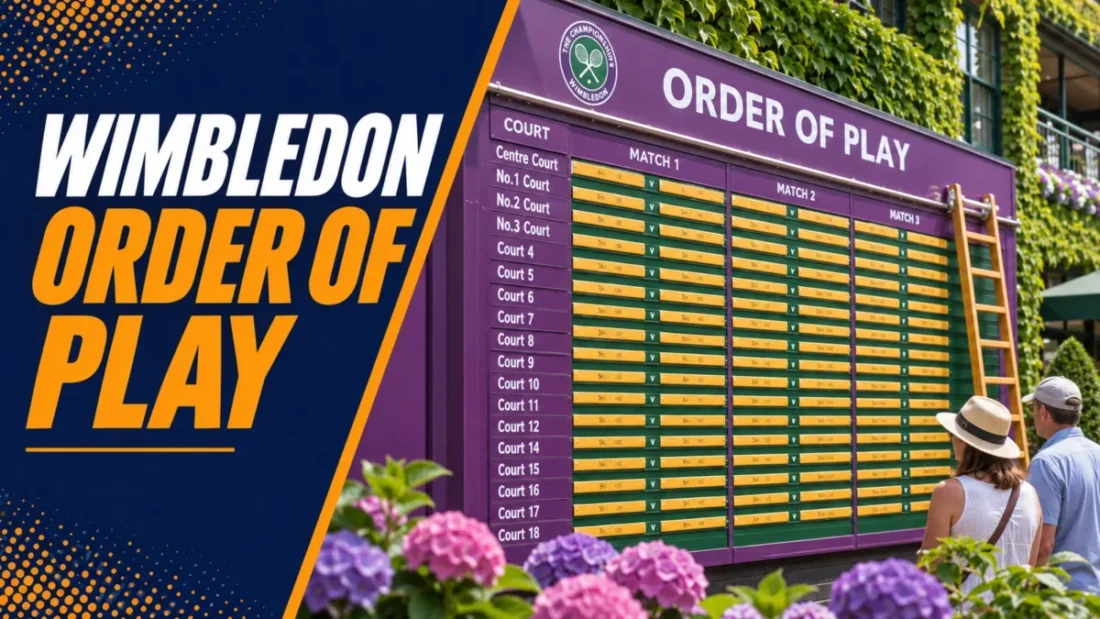
The Wimbledon order of play is the official daily timetable showing which matches are assigned to each court and the sequence in which they will be played. The Referee and scheduling team build it by balancing player rest, draw progress, match length, court capacity, weather, television, spectators and fairness.
The full order of play is normally released the night before the next day’s matches. It cannot be finalized far in advance because the players, unfinished matches and weather situation are not known until the current day develops.
What Is the Wimbledon Order of Play?
The order of play answers three practical questions:
- Which matches are scheduled today?
- On which court will each match be played?
- In what order or at what earliest time will it begin?
It covers more than Centre Court. The document can include singles, doubles, mixed doubles, junior, wheelchair and invitational matches across every active competition court.
Order of Play vs Draw vs Tournament Schedule
These three documents are related but not interchangeable.
| Document | What it tells you |
|---|---|
| Tournament schedule | Which rounds and events are planned for each date |
| Draw | Each player’s opponent and possible path through the event |
| Order of play | The specific matches, courts and sequence for one day |
A draw cannot provide exact match times because it does not know which players will advance. A tournament schedule can show that quarterfinals are planned, but it cannot identify the matchups before earlier rounds finish.
How rounds and draws work in tennis explains the bracket structure behind the daily timetable.
Who Makes the Wimbledon Order of Play?
The Tournament Referee oversees the playing schedule with the tournament’s scheduling team. Court assignments must fit the competition rules, available courts and the progress of each draw.
The Referee has final operational responsibility for court assignments and match progress. This role is different from the chair umpire, who controls one match on court.
The wider division of responsibilities is covered in the tennis officiating guide.
Player needs, spectators and broadcast audiences create competing demands. A useful way to understand the finished schedule is to examine those demands together, rather than assuming one factor explains every court assignment.
How the Daily Order of Play Is Built
Progress the Correct Sections of the Draw
Players in the same area of a draw should normally progress on the same day. This keeps the tournament synchronized and prevents one quarter from moving much farther ahead than another.
Bad weather can break the ideal pattern. The scheduling team then decides which unfinished and new matches are most important to restore balance.
Protect Player Rest
A singles player should not be given an unreasonable turnaround after a long match. Organizers also need to consider whether the player remains in doubles or mixed doubles.
Rest is not measured only by whether the player competed the previous day. A match finishing near the 11pm curfew creates a different recovery problem from a quick afternoon victory.
Tennis has no fixed match duration. How long a tennis match lasts explains why a best-of-five assignment can occupy a court for far longer than expected.
Estimate Match Length
The team estimates how long each type of match may take. Two close men’s singles matches on Centre Court can fill most of the available day if both require five sets.
Potential duration depends on format, players and conditions, but estimates can never be exact. A one-sided match may end quickly, while a contest expected to be routine can become a long upset.
Scheduling too many matches risks unfinished play. Scheduling too few can waste usable court time and leave the tournament vulnerable to later rain.
Create a Balanced Show-Court Programme
Wimbledon tries to provide a balanced mixture of gentlemen’s and ladies’ singles and other events at the appropriate stage of the fortnight. Centre Court and No.1 Court should offer competitive, high-interest matches rather than one category receiving automatic preference.
Potentially one-sided matches may be less attractive for a show court, but rankings cannot guarantee competitiveness. A low-ranked grass specialist or qualifier can still produce the match of the day.
Distribute Leading Players
Top seeds and major champions do not appear on Centre Court every time. Organizers need to use both Centre Court and No.1 Court and provide a reasonable balance of premier-court appearances.
Rankings, name recognition, British interest, opponent quality and the stage of the event all influence the decision. How tennis world rankings work explains why a seed is based on competitive standing rather than television popularity alone.
Account for Grass-Court Wear
Wimbledon’s courts are living surfaces. Groundstaff monitor wear, moisture, firmness and weather, especially as the fortnight progresses.
The main courts are prepared to handle their planned workload, but moving extra matches onto a show court is not a consequence-free solution. How grass tennis courts are made explains the construction and maintenance behind that limit.
Plan Around Weather and Roofs
Centre Court and No.1 Court have retractable roofs, allowing play to continue through rain and darkness. The outside courts remain far more exposed to delays.
When rain creates a backlog, organizers may move matches, use a covered court or revise the following day’s schedule. A roof protects play, but closing it takes time and can change playing conditions.
Wimbledon’s low natural bounce and roof conditions are explored in what makes its grass special.
Work Within the 11 PM Curfew
Play is normally required to finish by 11pm The schedule must therefore leave a realistic chance of completing the final match on Centre Court and No.1 Court.
An earlier match can still run long and force a suspension. The curfew is a planning condition connected to the residential setting, transport and late play under the roof.
Consider Spectators and Broadcasters
Ticket holders reasonably expect a strong programme on the court they purchased. Broadcasters also need important matches at times that can reach domestic and international viewers.
Those interests matter but do not give television complete control. Fairness, player health and completion of the draws can take priority.
Who Opens Play on Centre Court?
Wimbledon follows a tradition in which the defending gentlemen’s singles champion opens Centre Court on the first Monday. The defending ladies’ singles champion normally opens the court on the first Tuesday.
If the defending champion is absent, the tournament selects another appropriate match. This is a tradition within the order of play, not a permanent seed-based right that overrides withdrawal or scheduling realities.
The rest of the first two days mix men’s and women’s first-round matches across the courts. All 128-player singles fields need to begin while maintaining balanced sections of the draw.
When Is the Wimbledon Order of Play Released?
Wimbledon states that the full order of play will be available the night before the next day’s play. During the Championships, it often appears in the evening after enough results are known.
The tournament’s published Queue guidance tells visitors to look for the following day’s schedule after 8pm. That is a useful guide, not a promise that every day’s complete document will appear at exactly 8pm
Late matches, weather or unresolved medical situations can delay publication. Use the official website or app rather than a screenshot circulated earlier in the day.
The broad process resembles US Open scheduling, but Wimbledon’s grass, roofs, traditions and curfew create its own constraints.
Can the Order of Play Change After Release?
Yes. The published schedule is the plan, not a guarantee that every match will begin in that order.
Changes can result from:
- Rain or unsafe court conditions
- A player withdrawal or walkover
- An unfinished match from the previous day
- An unexpectedly long earlier match
- Medical or operational issues
- Moving a match to complete the tournament fairly
Official updates can replace the original document. The app, court screens and public announcements are more reliable than a saved copy once play has begun.
How to Read the Wimbledon Order of Play
Some entries have a fixed start time. Others are listed after an earlier match or marked “not before” a particular time.
| Schedule wording | Meaning |
|---|---|
| 11am | Scheduled start time for the first match |
| Followed by | Begins after the preceding match and court preparation |
| Not before 3pm | Cannot begin earlier, but may start later |
| To finish | A suspended match resumes from its recorded score |
| TBA | Assignment or timing remains to be announced |
“Not before” is not an appointment time. If the previous match continues beyond it, the later players must wait.
What the Order of Play Means for Ticket Holders
Wimbledon tickets are sold for a date and court, not for one guaranteed player. Public Ballot applicants cannot choose a specific player, and the match list is unknown when many seats are allocated.
A reserved show-court ticket normally covers every match played on that named court during the day. It also permits Grounds access, subject to the entry conditions.
A Grounds Pass does not include a reserved Centre Court, No.1 Court or No.2 Court seat. It allows access to eligible outside courts, where capacity and spectator movement still apply.
If a match is suspended and resumed another day, the original ticket generally does not carry over. Ticket terms and any rain refund policy depend on the amount of play completed, not on whether your preferred match finished.
How Fans Should Use the Order of Play
First, confirm that you are viewing the correct date and latest version. Then mark several possible matches rather than building the day around one player.
For a Grounds Pass, consider court distance and capacity. Two appealing matches starting together at opposite ends of the grounds cannot both be watched from the opening point.
For television, use the order of play alongside the authorized broadcaster’s channel schedule. Where to watch tennis matches online explains why Grand Slam rights may not be included with a regular ATP streaming subscription.