
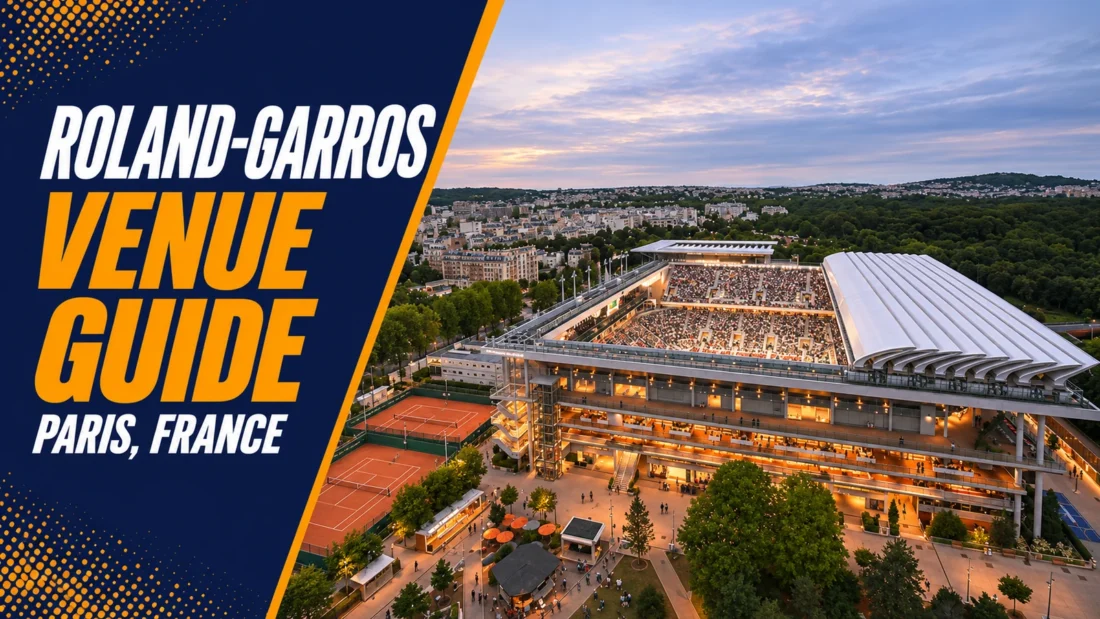
Roland-Garros is in the 16th arrondissement of Paris, on the western edge of the city beside the Bois de Boulogne and Jardin des Serres d’Auteuil. The stadium’s commonly listed address is 2 avenue Gordon-Bennett, 75016 Paris, France.
The venue hosts the French Open every spring. It is not in a town called Roland Garros, and it is not named after a tennis player. Roland Garros was a French aviation pioneer and First World War pilot.
For ticket sale routes, prices and session choices, use the French Open ticket guide. The venue details below explain where to go and how the different courts fit together.
Roland-Garros Location at a Glance
| Detail | Information |
|---|---|
| City | Paris |
| Arrondissement | 16th |
| Area | Porte d’Auteuil |
| Address | 2 avenue Gordon-Bennett, 75016 Paris |
| Main court | Court Philippe-Chatrier |
| Surface | Outdoor red clay |
| Nearest Metro options | Porte d’Auteuil, Michel-Ange Auteuil and Michel-Ange Molitor |
| 2027 tournament dates | May 17 to June 6 |
The grounds sit close to the southern end of the Bois de Boulogne. Court Simonne-Mathieu is integrated into the Serres d’Auteuil botanical garden, giving part of the venue a setting unlike any other Grand Slam.
How to Get to Roland-Garros by Metro
Metro is usually the most practical option because roads and parking are heavily restricted around the stadium during the tournament. The best station can depend on the gate shown in the current access instructions.
Common approaches include:
- Porte d’Auteuil on Line 10.
- Michel-Ange Auteuil on Lines 9 and 10.
- Michel-Ange Molitor on Lines 9 and 10.
The latest published transport guide gives roughly eight minutes from Michel-Ange Auteuil to the Auteuil mandatory checkpoint and nine minutes from Michel-Ange Molitor to the Molitor checkpoint. These estimates end at the outer security perimeter, not at a stadium seat. Visitors must pass through a designated checkpoint before reaching the stadium entrances; follow the current edition’s routing instructions and event signs.
Allow extra time for the walk, security screening and any ticket checks. A train arriving shortly before the first scheduled point does not leave enough margin to reach a reserved seat.
Can You Drive to Roland-Garros?
Driving is possible in Paris, but it is rarely the easiest tournament plan. There is no general spectator parking at the stadium, nearby roads can be controlled, and parking spaces in the 16th arrondissement are limited.
If a car is essential, reserve an appropriate legal parking space away from the immediate venue and complete the trip by public transport or on foot. Do not rely on finding street parking near the gate.
Accessible transport and drop-off arrangements are published separately. Spectators who need those services should check the current reduced-mobility information before choosing a route.
The Main Courts at Roland-Garros
Court Philippe-Chatrier
Court Philippe-Chatrier is the main stadium and holds approximately 15,000 spectators. It hosts the leading matches, night sessions and the men’s and women’s singles finals.
Its retractable roof allows play to continue during rain on the main court. Closing a roof does not mean every match around the grounds can continue, because most courts remain uncovered.
Court Suzanne-Lenglen
Court Suzanne-Lenglen is the second-largest court, with roughly 10,000 seats. It stages major singles and doubles matches and is also used prominently during Opening Week.
A retractable roof was added for 2024. The court’s larger capacity and strong schedule make it an appealing alternative when Philippe-Chatrier tickets are unavailable.
Court Simonne-Mathieu
Court Simonne-Mathieu holds approximately 5,000 spectators and is surrounded by four greenhouses in the Jardin des Serres d’Auteuil. It opened in 2019 as part of the modernized stadium.
Its intimate shape and garden setting make it one of the most distinctive show courts in professional tennis. It does not have a retractable roof.
Outside Courts
The remaining courts host early-round singles, doubles, qualifying, juniors, wheelchair tennis and practices. These smaller courts can provide some of the closest views at the tournament, but seats are often unreserved and subject to capacity.
During the first week, moving among outside courts is one of the best ways to see several players in one day. Later in the event, the schedule contains fewer senior singles matches and more doubles, junior tennis and wheelchair events.
The Court Surface
Roland-Garros is the only Grand Slam played on clay. Its red playing surface is a layered construction with a fine crushed-brick top dressing. The guide to tennis court surfaces explains how clay affects bounce and movement.
How the Venue Is Laid Out
Roland-Garros is compact compared with the enormous spread of some major sports complexes. The three show courts anchor different areas, with smaller courts, practice spaces, shops, food outlets and public squares between them.
Compact does not mean instant. Crowds, one-way walking routes and queues can make a short distance take longer than expected. Use the tournament map inside the official app or website and identify these locations before arrival:
- Assigned entrance.
- Reserved show court.
- Nearest outside-court cluster.
- Water and food areas.
- Restrooms.
- Guest services and accessibility points.
If two desired matches overlap, allow for the possibility that an unreserved court will reach capacity while you walk across the grounds.
What Can You Bring Into Roland-Garros?
Current visitor guidance permits bags with a capacity of no more than 15 litres. Prohibited-item lists and security procedures can change, so recheck them for the year and day of your visit.
Pack lightly and consider:
- A small refillable water bottle if permitted under current rules.
- Sun protection and a hat.
- A compact rain layer.
- A phone with the official digital ticket ready.
- A portable charger.
- Any necessary medication in suitable packaging.
Large bags, bulky luggage and restricted objects can prevent entry or create a storage problem. Do not assume a policy from another Grand Slam applies in Paris.
When Should You Arrive?
Arrive well before the first match you care about. The Metro walk, security line and route to the court can easily use the margin between reaching Porte d’Auteuil and sitting down.
For an unreserved outside court, early arrival also improves the chance of finding a seat. Leaving between matches can mean joining a capacity queue when you return.
Tennis sessions do not have a predictable finishing time. A straight-sets match may end quickly, while a close men’s match can continue for several hours. The guide to how long tennis matches last explains the variables that affect the day.
Where to Stay for the French Open
Staying beside the stadium is convenient but not essential. Paris Metro connections make several neighborhoods practical if they provide a simple route to Lines 9 or 10.
Useful areas can include the 16th arrondissement, Boulogne-Billancourt, Passy, Trocadéro and neighborhoods farther east along the Metro. Compare the full door-to-gate journey rather than straight-line distance.
A hotel near a direct Metro line may be more convenient than a slightly closer hotel requiring several transfers. Late night-session visitors should also check the final public-transport times for their date.
Why the Venue Is Called Roland-Garros
The stadium opened in 1928 after France’s Four Musketeers won the Davis Cup, creating the need for a venue to stage the title defence. Its name honours the aviator Roland Garros, rather than a former tennis champion.
The complex has remained at its western Paris location while expanding and rebuilding its principal courts. For a current visit, the entrance shown in the event instructions matters more than the historic street address alone.