
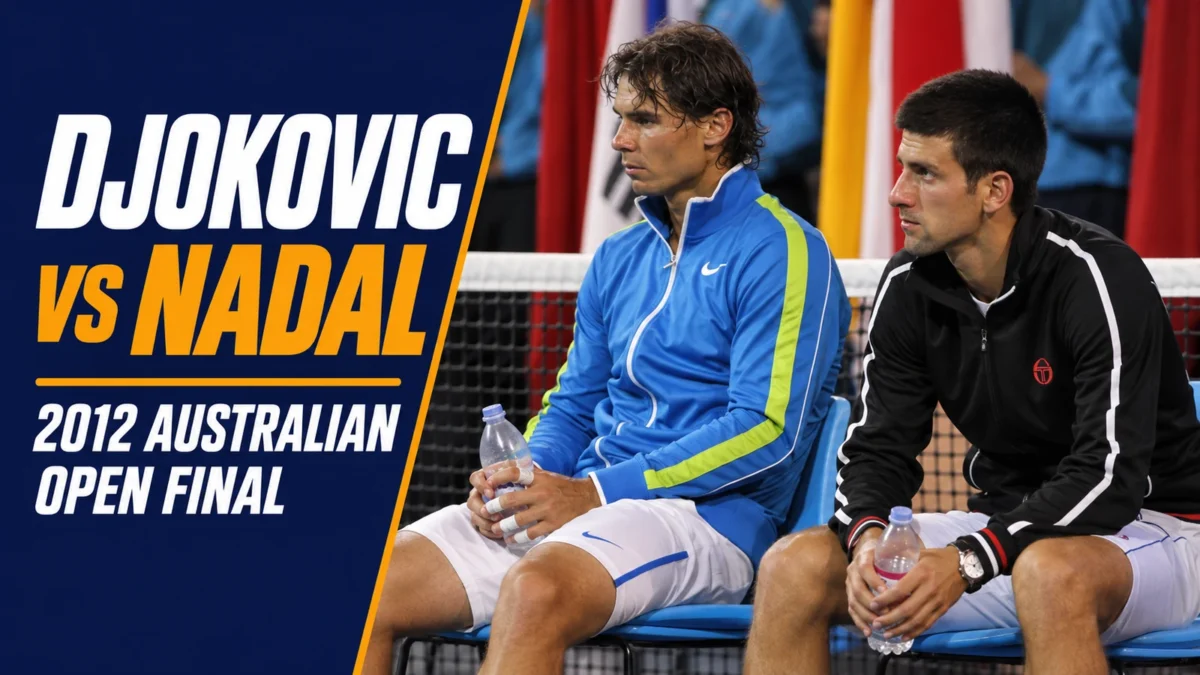
Novak Djokovic defeated Rafael Nadal 5-7, 6-4, 6-2, 6-7(5), 7-5 in the 2012 Australian Open men’s singles final. The match lasted five hours and 53 minutes, making it the longest Grand Slam singles final on record.
The final began on January 29 and finished after midnight in Melbourne. Its significance came from more than the clock: Djokovic appeared to be moving toward victory, Nadal recovered and led in the fifth set, and Djokovic then reversed the match again.
The Final at a Glance
| Detail | Result |
|---|---|
| Champion | Novak Djokovic |
| Runner-up | Rafael Nadal |
| Venue | Rod Laver Arena, Melbourne Park |
| Surface | Hard court |
| Score | 5-7, 6-4, 6-2, 6-7(5), 7-5 |
| Duration | 5 hours, 53 minutes |
| Djokovic’s Australian Open title number | Third |
“Longest Grand Slam final” should not be confused with “longest tennis match.” The famous Isner-Mahut match at Wimbledon in 2010 was longer, but it was a first-round match rather than a final.
The Rivalry Entering Melbourne
Djokovic had beaten Nadal in six finals during 2011, including Wimbledon and the US Open. The Australian Open final therefore carried a clear competitive question: could Nadal change a matchup that had repeatedly gone against him at the decisive stage?
Nadal defeated Roger Federer in the semifinals. Djokovic came through a five-set semifinal against Andy Murray, leaving him with another demanding match before the championship contest.
This was already a major chapter in Djokovic’s Australian Open career. He had won the tournament in 2008 and 2011; successfully defending the title would establish a new level of sustained success in Melbourne.
How the First Three Sets Developed
Nadal won the opening set 7-5. Djokovic responded by taking the next two, 6-4 and 6-2, putting himself one set from the title.
The central tactical pressure came from Djokovic’s ability to compete in the backhand diagonal against Nadal’s left-handed forehand. Nadal could not assume that a heavy cross-court forehand would immediately produce a weak ball. Djokovic could absorb it, maintain depth and change direction when the opening appeared.
Nadal still had ways to disturb that pattern: moving Djokovic wider, finding depth with the forehand and changing the location of the next attack. The problem was sustaining those solutions while both players were repeatedly forced to defend.
The match is a useful example of why topspin and slice are tools within a rally pattern rather than isolated tricks. Height, depth and direction only become effective when they change the opponent’s next contact.
Nadal’s Fourth-Set Escape
The fourth set reached a tie-break. Djokovic led 5-3, two points from winning the match if he could complete the sequence, but Nadal won the next four points to take the tie-break 7-5.
That recovery changed the final’s structure. Instead of Djokovic completing a four-set victory, both players had to begin another full set after hours of physical competition.
It also illustrates why scoreboard pressure can be misleading. Djokovic was close, but “close” did not mean that Nadal had to attempt a winner on every ball. The immediate job was to win the next point with a workable pattern.
For readers interpreting the result, the fourth-set notation 6-7(5) records Djokovic’s five tie-break points. It does not mean the tie-break itself finished 6-7. The tennis tie-break guide explains the notation.
The Fifth Set and the Missed Backhand
Nadal broke serve and led 4-2 in the fifth set. At 30-15 in the following game, he missed a short backhand pass with space available in the court. Djokovic eventually broke back and restored the contest.
The missed shot became the final’s best-known turning point, but it did not decide the match by itself. Nadal still had points to play in that game, and the players still had to contest the remaining games. Turning an entire five-hour match into one error exaggerates the certainty of what might have happened next.
Djokovic later broke for 6-5 and served out the championship. The 7-5 final-set score reflected the rules then in use: an advantage set rather than the modern Australian Open deciding-set tie-break arrangement.
Why the Match Was So Physically Demanding
Both players could turn defensive positions into neutral rallies and then create a new attack. That meant a strong shot often failed to finish the point; it merely began the next difficult phase.
The duration also included the rhythm of serving, returning, recovery and changes of end. Five hours and 53 minutes does not mean six uninterrupted hours of running. Even with those pauses, the repeated demands of stopping, accelerating and striking under pressure were considerable.
The aftermath made that visible. Both players struggled to stand comfortably during the presentation and were eventually given chairs. Their exhaustion became an enduring image of the match, but it should not overshadow the tactical quality that produced such a long contest.
What Club Players Can Learn
The useful lessons are smaller than attempting to reproduce their physical workload.
First, a difficult matchup can require changes in court position and direction, not simply more effort. Second, recovering one defensive ball is only valuable if the next shot improves the situation. Third, an important missed chance does not remove the need to make the next decision clearly.
Those ideas fit the broader principles of singles strategy. The final remains compelling because both players kept finding responses to problems that had already seemed decisive.