
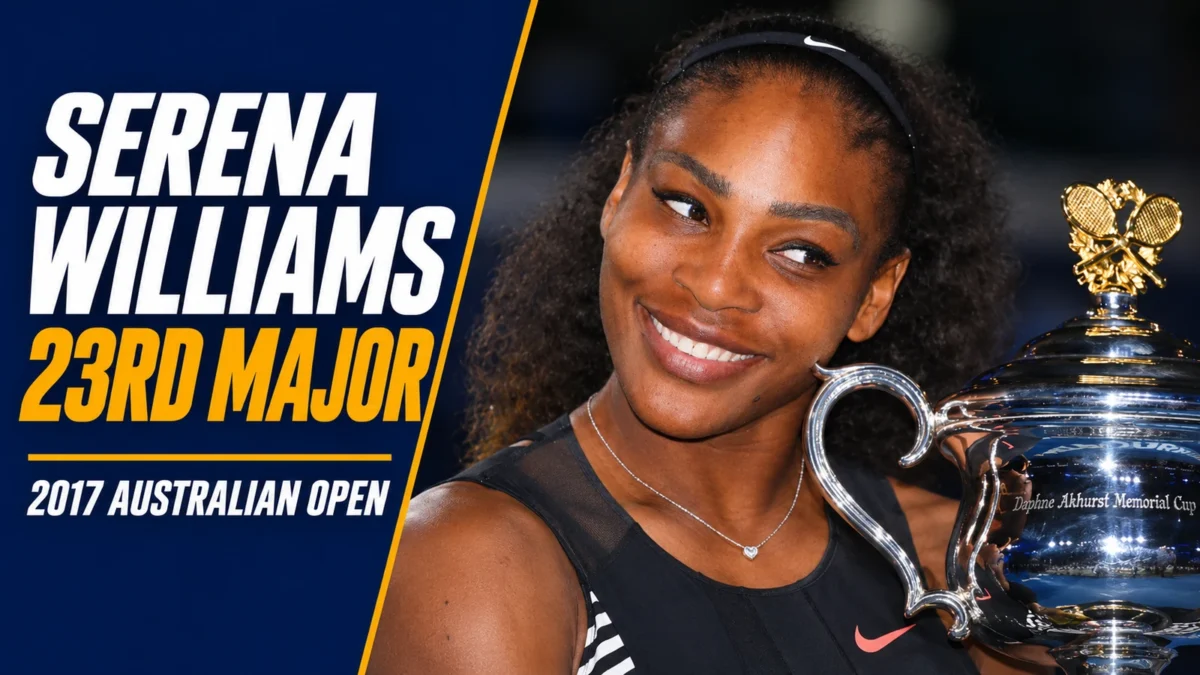
Serena Williams won the 2017 Australian Open women’s singles title by defeating Venus Williams 6-4, 6-4 in the final. It was her seventh Australian Open singles championship and her 23rd Grand Slam singles title, moving her ahead of Steffi Graf’s Open Era total of 22.
Serena won all seven matches without dropping a set. The title run was therefore both a record-setting achievement and a particularly controlled fortnight, with only 43 games conceded across the tournament.
Serena’s Route to the Title
| Round | Opponent | Score |
|---|---|---|
| First round | Belinda Bencic | 6-4, 6-3 |
| Second round | Lucie Safarova | 6-3, 6-4 |
| Third round | Nicole Gibbs | 6-1, 6-3 |
| Fourth round | Barbora Strycova | 7-5, 6-4 |
| Quarterfinal | Johanna Konta | 6-2, 6-3 |
| Semifinal | Mirjana Lucic-Baroni | 6-2, 6-1 |
| Final | Venus Williams | 6-4, 6-4 |
Every score is shown from Serena’s perspective. The table describes women’s singles only; doubles and mixed doubles titles belong to separate records.
The Australian Open format guide explains why seven main-draw victories are needed to win a 128-player singles championship.
A Demanding Opening Draw
Being the No.2 seed did not give Serena an effortless opening route. Bencic was a dangerous first-round opponent, and Safarova had already reached a Roland Garros singles final in her career.
Serena came through both matches in straight sets before defeating Gibbs. The sequence allowed her to move into the second week without a prolonged deciding-set contest.
That is a competitive advantage rather than a guarantee. A player who finishes quickly still has to recover, prepare and adjust to the next opponent. In Serena’s case, the early results gave her a strong platform without requiring the kind of rescue that can consume a major campaign.
Strycova, Konta and Lucic-Baroni
Strycova took Serena to 7-5 in the first set of their fourth-round match. It was the only set in the title run that required Serena to win seven games.
Konta then presented a strong quarterfinal challenge, but Serena won 6-2, 6-3. The semifinal against Lucic-Baroni finished 6-2, 6-1.
The different opponents mattered. Strycova could vary the shape of an exchange, Konta sought to take control with assertive baseline tennis, and Lucic-Baroni brought aggressive ball striking. Serena did not need the same rally length or identical positioning to solve each match.
Her serving and returning gave her repeated opportunities to take the initiative. That combination is central to effective singles strategy: establish a favorable first exchange, then use the next ball to keep the opponent reacting.
The Final Against Venus
The final was played on January 28, 2017. Serena was 35 and Venus 36, giving the match an unusual place in the history of major finals: two sisters with long-established careers competing for another championship at the same time.
Serena won both sets 6-4. Venus remained close enough that the match never became a procession, but Serena did not allow it to extend to a deciding set.
The result added another chapter to a rivalry that was also a family partnership. They had won major doubles titles together, yet in singles only one could leave Melbourne with the trophy.
That context should not obscure Venus’s own achievement. Reaching the final required six wins and represented another major result deep into her career. Serena’s victory and Venus’s run were separate accomplishments within the same event.
What the 23rd Major Meant
The title moved Serena to 23 Grand Slam singles championships, one ahead of Graf’s 22. It was the women’s Open Era record.
It was not the all-era record of 24 held by Margaret Court. Court’s total includes titles from before the Open Era, so accurate comparisons need to state the period they include.
The same care applies to the Australian Open count. Serena’s seventh title was the women’s Open Era tournament record; Court won 11 Australian singles championships across the amateur and Open eras. The Grand Slam title-record guide explains why those categories should remain distinct.
Her Seven Australian Open Singles Titles
Serena won in Melbourne in 2003, 2005, 2007, 2009, 2010, 2015 and 2017. Her final opponents across those titles included Venus Williams, Lindsay Davenport, Maria Sharapova, Dinara Safina and Justine Henin.
The sequence covered 14 years from the first title to the seventh. It also included consecutive wins in 2009 and 2010, so the early pattern of victories in odd-numbered years was never a permanent rule.
The winner receives the Daphne Akhurst Memorial Cup, whose background is covered in the guide to Australian Open trophies.
A Title Won During Pregnancy
Serena was about two months pregnant during the tournament, a fact that became public later in 2017. She gave birth to her daughter Olympia in September. That personal context added another dimension to the achievement, alongside the seven straight-set victories and the record 23rd major.
Why This Run Remains Distinctive
Serena’s 2017 title combines several clearly defined achievements: seven straight-set wins, a seventh Melbourne crown, a final against Venus and a new Open Era singles-major benchmark.
It is easy to treat the tournament only as the moment she reached 23. The complete draw shows why that understates it. The record was earned through a full sequence of matches against different opponents, with consistent control from the first round to the final.
Within her place among the greatest women’s tennis players, Melbourne 2017 stands as a major example of sustained championship performance late in an already exceptional career.