
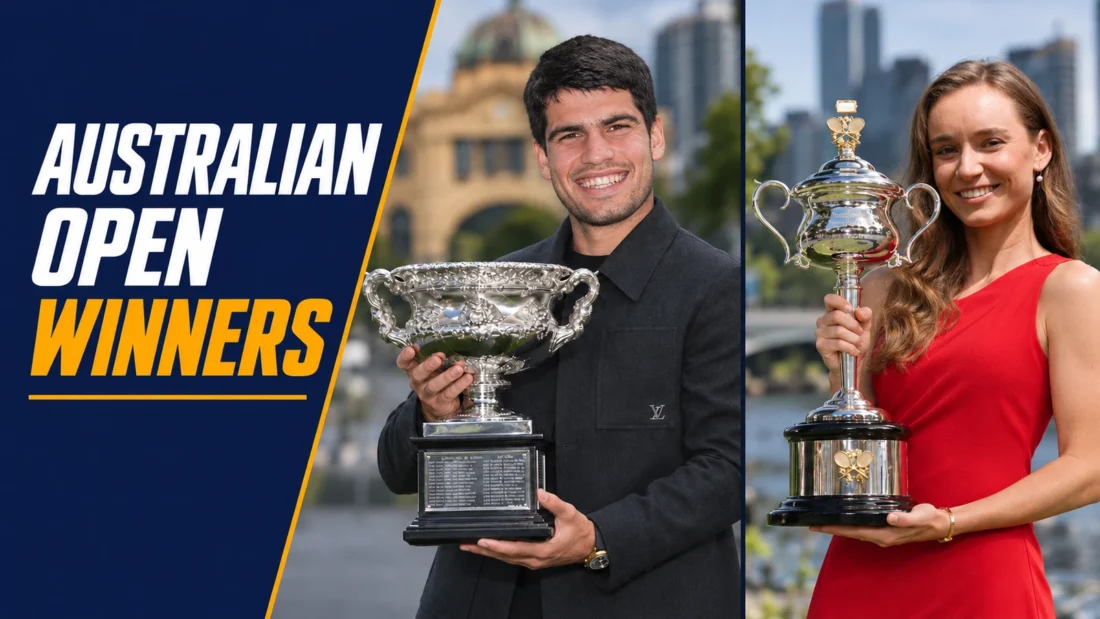
Carlos Alcaraz and Elena Rybakina won the 2026 Australian Open singles titles. Alcaraz defeated Novak Djokovic in the men’s final, while Rybakina beat Aryna Sabalenka in the women’s final.
The complete singles champions list below covers the men’s event from 1905 and the women’s event from 1922 through the completed 2026 tournament. It includes the championships’ earlier names, the two editions played in 1977 and the years when no tournament took place.
The latest Australian Open singles winners
| Event | 2026 champion | Runner-up | Final score |
|---|---|---|---|
| Men’s singles | Carlos Alcaraz | Novak Djokovic | 2-6, 6-2, 6-3, 7-5 |
| Women’s singles | Elena Rybakina | Aryna Sabalenka | 6-4, 4-6, 6-4 |
These are singles results. Men’s doubles, women’s doubles, mixed doubles, wheelchair and junior competitions have separate champions. The Australian Open tournament guide explains the event’s wider structure.
Australian Open champions: 1969–2026
The Australian tournament first admitted professionals in 1969. That is the starting point for its Open Era records, even though the broader Open Era began in 1968.
The table runs from newest to oldest. “No competition” means no title was awarded in that year. In 1977, January and December were separate editions with separate champions.
| Year / edition | Men’s singles champion | Women’s singles champion |
|---|---|---|
| 2026 | Carlos Alcaraz | Elena Rybakina |
| 2025 | Jannik Sinner | Madison Keys |
| 2024 | Jannik Sinner | Aryna Sabalenka |
| 2023 | Novak Djokovic | Aryna Sabalenka |
| 2022 | Rafael Nadal | Ashleigh Barty |
| 2021 | Novak Djokovic | Naomi Osaka |
| 2020 | Novak Djokovic | Sofia Kenin |
| 2019 | Novak Djokovic | Naomi Osaka |
| 2018 | Roger Federer | Caroline Wozniacki |
| 2017 | Roger Federer | Serena Williams |
| 2016 | Novak Djokovic | Angelique Kerber |
| 2015 | Novak Djokovic | Serena Williams |
| 2014 | Stan Wawrinka | Li Na |
| 2013 | Novak Djokovic | Victoria Azarenka |
| 2012 | Novak Djokovic | Victoria Azarenka |
| 2011 | Novak Djokovic | Kim Clijsters |
| 2010 | Roger Federer | Serena Williams |
| 2009 | Rafael Nadal | Serena Williams |
| 2008 | Novak Djokovic | Maria Sharapova |
| 2007 | Roger Federer | Serena Williams |
| 2006 | Roger Federer | Amelie Mauresmo |
| 2005 | Marat Safin | Serena Williams |
| 2004 | Roger Federer | Justine Henin-Hardenne |
| 2003 | Andre Agassi | Serena Williams |
| 2002 | Thomas Johansson | Jennifer Capriati |
| 2001 | Andre Agassi | Jennifer Capriati |
| 2000 | Andre Agassi | Lindsay Davenport |
| 1999 | Yevgeny Kafelnikov | Martina Hingis |
| 1998 | Petr Korda | Martina Hingis |
| 1997 | Pete Sampras | Martina Hingis |
| 1996 | Boris Becker | Monica Seles |
| 1995 | Andre Agassi | Mary Pierce |
| 1994 | Pete Sampras | Steffi Graf |
| 1993 | Jim Courier | Monica Seles |
| 1992 | Jim Courier | Monica Seles |
| 1991 | Boris Becker | Monica Seles |
| 1990 | Ivan Lendl | Steffi Graf |
| 1989 | Ivan Lendl | Steffi Graf |
| 1988 | Mats Wilander | Steffi Graf |
| 1987 | Stefan Edberg | Hana Mandlikova |
| 1986 | No competition | No competition |
| 1985 | Stefan Edberg | Martina Navratilova |
| 1984 | Mats Wilander | Chris Evert-Lloyd |
| 1983 | Mats Wilander | Martina Navratilova |
| 1982 | Johan Kriek | Chris Evert-Lloyd |
| 1981 | Johan Kriek | Martina Navratilova |
| 1980 | Brian Teacher | Hana Mandlikova |
| 1979 | Guillermo Vilas | Barbara Jordan |
| 1978 | Guillermo Vilas | Chris O’Neil |
| 1977 (Dec) | Vitas Gerulaitis | Evonne Goolagong Cawley |
| 1977 (Jan) | Roscoe Tanner | Kerry Reid |
| 1976 | Mark Edmondson | Evonne Goolagong Cawley |
| 1975 | John Newcombe | Evonne Goolagong Cawley |
| 1974 | Jimmy Connors | Evonne Goolagong Cawley |
| 1973 | John Newcombe | Margaret Court |
| 1972 | Ken Rosewall | Virginia Wade |
| 1971 | Ken Rosewall | Margaret Court |
| 1970 | Arthur Ashe | Margaret Court |
| 1969 | Rod Laver | Margaret Court |
Earlier champions: 1905–1968
The men’s championship began in 1905. Women’s singles was added in 1922, so the earlier women’s cells say “Not yet contested.” The event was known as the Australasian Championships before becoming the Australian Championships in 1927, and the Australian Open in 1969.
For readability, Margaret Court’s titles are grouped under that name, including the wins recorded under her maiden name, Margaret Smith. Evonne Goolagong Cawley’s entries are also shown consistently across her name change.
| Year / edition | Men’s singles champion | Women’s singles champion |
|---|---|---|
| 1968 | Bill Bowrey | Billie Jean King |
| 1967 | Roy Emerson | Nancy Richey |
| 1966 | Roy Emerson | Margaret Court |
| 1965 | Roy Emerson | Margaret Court |
| 1964 | Roy Emerson | Margaret Court |
| 1963 | Roy Emerson | Margaret Court |
| 1962 | Rod Laver | Margaret Court |
| 1961 | Roy Emerson | Margaret Court |
| 1960 | Rod Laver | Margaret Court |
| 1959 | Alex Olmedo | Mary Carter Reitano |
| 1958 | Ashley Cooper | Angela Mortimer |
| 1957 | Ashley Cooper | Shirley Fry |
| 1956 | Lew Hoad | Mary Carter |
| 1955 | Ken Rosewall | Beryl Penrose |
| 1954 | Mervyn Rose | Thelma Long |
| 1953 | Ken Rosewall | Maureen Connolly |
| 1952 | Ken McGregor | Thelma Long |
| 1951 | Dick Savitt | Nancye Bolton |
| 1950 | Frank Sedgman | Louise Brough |
| 1949 | Frank Sedgman | Doris Hart |
| 1948 | Adrian Quist | Nancye Bolton |
| 1947 | Dinny Pails | Nancye Bolton |
| 1946 | John Bromwich | Nancye (Wynne) Bolton |
| 1945 | No competition | No competition |
| 1944 | No competition | No competition |
| 1943 | No competition | No competition |
| 1942 | No competition | No competition |
| 1941 | No competition | No competition |
| 1940 | Adrian Quist | Nancye Wynne Bolton |
| 1939 | John Bromwich | Emily Westacott |
| 1938 | Donald Budge | Dorothy Bundy |
| 1937 | Vivian McGrath | Nancye Wynne Bolton |
| 1936 | Adrian Quist | Joan Hartigan |
| 1935 | Jack Crawford | Dorothy Round |
| 1934 | Fred Perry | Joan Hartigan |
| 1933 | Jack Crawford | Joan Hartigan |
| 1932 | Jack Crawford | Coral Buttsworth |
| 1931 | Jack Crawford | Coral Buttsworth |
| 1930 | Edgar Moon | Daphne Akhurst |
| 1929 | Colin Gregory | Daphne Akhurst |
| 1928 | Jean Borotra | Daphne Akhurst |
| 1927 | Gerald Patterson | Esna Boyd |
| 1926 | John Hawkes | Daphne Akhurst |
| 1925 | James Anderson | Daphne Akhurst |
| 1924 | James Anderson | Sylvia Lance |
| 1923 | Pat O’Hara Wood | Margaret Molesworth |
| 1922 | James Anderson | Margaret Molesworth |
| 1921 | Rhys Gemmell | Not yet contested |
| 1920 | Pat O’Hara Wood | Not yet contested |
| 1919 | Algernon Kingscote | Not yet contested |
| 1918 | No competition | Not yet contested |
| 1917 | No competition | Not yet contested |
| 1916 | No competition | Not yet contested |
| 1915 | Gordon Lowe | Not yet contested |
| 1914 | Arthur O’Hara Wood | Not yet contested |
| 1913 | Ernie Parker | Not yet contested |
| 1912 | James Parke | Not yet contested |
| 1911 | Norman Brookes | Not yet contested |
| 1910 | Rodney Heath | Not yet contested |
| 1909 | Tony Wilding | Not yet contested |
| 1908 | Fred Alexander | Not yet contested |
| 1907 | Horace Rice | Not yet contested |
| 1906 | Tony Wilding | Not yet contested |
| 1905 | Rodney Heath | Not yet contested |
Who has won the most Australian Open singles titles?
The record depends on whether you count the tournament’s whole history or only the Open Era.
| Record | Player | Singles titles |
|---|---|---|
| Men’s all-time and Open Era record | Novak Djokovic | 10 |
| Women’s all-time record | Margaret Court | 11 |
| Women’s Open Era record | Serena Williams | 7 |
Djokovic’s titles came in 2008, 2011–2013, 2015–2016, 2019–2021 and 2023. The detailed account of Djokovic’s Australian Open titles explains that sequence and his finals.
Court won seven consecutive editions from 1960 through 1966, then added 1969, 1970, 1971 and 1973. Four of her 11 titles belong to the Australian Open’s Open Era. Serena Williams won in 2003, 2005, 2007, 2009, 2010, 2015 and 2017.
Australian Open totals should not be confused with a player’s combined record across all four majors. The Grand Slam singles title records cover that wider comparison.
Why were there two Australian Opens in 1977?
The tournament moved from its January slot to December. As a result, both a January edition and a December edition took place in 1977.
Roscoe Tanner and Kerry Reid won the January singles titles. Vitas Gerulaitis and Evonne Goolagong Cawley won in December. Both editions count in the official record, which is why removing one as a duplicate would produce an incomplete champions list.
The event stayed in December through 1985. When it moved back to January, the next edition was held in 1987, leaving no Australian Open in 1986.
Why do the earlier records look different?
The tournament changed names, locations, surfaces and eligibility rules over its history. A title won before professionals were admitted still belongs in the all-time list, but it belongs to a different competitive era.
Similarly, the earliest champions did not win at today’s Melbourne Park. The event moved there in 1988 after its years at Kooyong. Those changes are useful context when comparing runs across decades.
The men’s champion receives the Norman Brookes Challenge Cup, and the women’s champion receives the Daphne Akhurst Memorial Cup. The Australian Open trophies guide explains the names behind both awards.
Use the year-by-year list for identifying a champion, the era-specific records for comparing totals, and the separate event category when looking for a doubles or junior winner. That keeps different achievements from being mixed into a single count.