
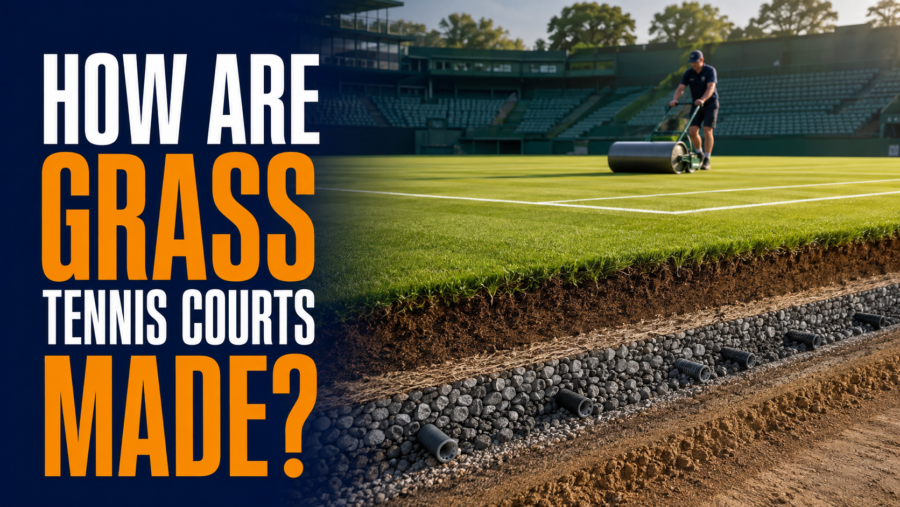
A natural grass tennis court is made by shaping a stable, free-draining site, building a carefully specified soil and rootzone profile, establishing dense fine turf, and maintaining a level, firm playing surface. The visible grass is only the top layer of a system that depends on drainage, soil structure, grading and year-round professional care.
It is not the same as laying artificial turf over a hard base. Natural courts are living surfaces, and their construction must be designed for the local soil, rainfall, grass species, playing calendar and maintenance resources.
Natural Grass Court Construction at a Glance
| Stage | Main purpose | What can go wrong |
|---|---|---|
| Site investigation | Understand soil, levels, drainage, access and climate | Building on unstable or waterlogged ground |
| Design and permits | Set orientation, runoff, drainage, fencing and support facilities | Treating the marked court as the entire site requirement |
| Earthworks and grading | Create a stable, accurately shaped formation | Settlement, uneven slopes or trapped water |
| Drainage installation | Move excess water away from the rootzone and site | Saturation, soft areas and inconsistent growth |
| Rootzone construction | Support roots while balancing firmness, drainage and moisture | A profile that drains too slowly or dries too quickly |
| Seeding or turfing | Establish the chosen grass cover | Unsuitable species, weak establishment or visible seams |
| Grow-in and leveling | Develop density, roots and a smooth surface | Opening before the turf is stable |
| Court fit-out | Add lines, posts, net and surrounding equipment | Incorrect dimensions or poorly anchored hardware |
| Continuing maintenance | Preserve level, density, firmness and safe traction | Rapid wear, compaction, disease or an unreliable bounce |
The exact profile should be produced by a sports-turf designer or agronomist after testing the site. A generic layer diagram cannot account for every climate and native soil.
1. Survey the Site
The first stage is a topographic and ground investigation. The design team needs to understand existing levels, soil type, groundwater, drainage outlets, shade, tree roots, wind exposure, utilities and how machinery will reach the court.
A grass court needs much more than the painted playing rectangle. The official court is 23.77m long and 8.23m wide for singles or 10.97m for doubles, but safe run-backs, side runs, fencing and maintenance access expand the required footprint considerably.
Tennis Court Dimensions and Size Guide provides the complete court and surrounding-space measurements. This article stays focused on how the natural surface is constructed.
2. Design the Court and Drainage Together
Orientation, surface levels and drainage cannot be solved independently. The finished court must be sufficiently even for predictable play while still moving water toward a designed collection or outfall system.
Depending on the site, the drainage design may use a shaped formation, permeable rootzone, lateral drains, collector drains and perimeter interception. The correct combination depends on rainfall, infiltration, soil and the available legal discharge route.
Water should not simply be directed toward neighboring land, buildings or public drainage without approval. Planning, environmental and water-discharge requirements must be checked locally.
3. Prepare a Stable Formation
Vegetation and unsuitable material are removed within the designed work area. Earth is cut, filled and compacted in controlled layers to create the formation beneath the court.
The goal is stability and accurate levels, not maximum compaction everywhere. A formation that settles unevenly can create low spots, while damage during wet construction can destroy soil structure and make future drainage more difficult.
Contractors use surveyed levels throughout the work rather than judging flatness by eye. Small irregularities that are barely visible can affect water movement and ball response across a closely mown surface.
4. Install the Drainage System
Drain lines are normally placed before the upper profile is completed. Trenches, pipes, permeable backfill and collection points must follow the project specification so water can leave the playing area without causing the surface to collapse above them.
Drain spacing and depth should not be copied from another court without a site assessment. A high-rainfall clay site and a free-draining sandy location do not need identical systems.
Surface drainage also matters. Even a well-drained profile can remain unplayable if water sits in depressions created by poor grading, settlement or wear.
5. Build the Soil and Rootzone Profile
The rootzone is the engineered growing medium beneath the turf. It must hold enough air, water and nutrients for healthy grass while remaining firm and allowing excess water to pass through.
Sand, soil and organic components may be combined to meet a performance specification, but the proportions are not universal. Particle-size distribution, infiltration, water retention, stability and compatibility between layers should be tested rather than selected from a simple recipe.
Abruptly different materials can restrict water movement at an interface. The designer therefore considers the entire profile, from turf through rootzone and drainage layer to the underlying formation.
6. Grade and Consolidate the Surface
The upper rootzone is placed and leveled in controlled lifts. It is then consolidated enough to create a stable seedbed without crushing the pore space needed for roots and drainage.
Final grading uses survey equipment, straightedges and repeated correction. Rolling alone cannot permanently repair a poorly constructed level, and excessive rolling can increase compaction.
The finished surface needs a consistent profile before grass is established. Trying to correct major lows after the turf is mature is slower and more disruptive.
7. Choose the Grass Species
Grass selection depends on climate, shade, wear, mowing height, disease pressure, irrigation and the standard of maintenance available. Perennial ryegrass is valued on many elite cool-season courts for wear tolerance, recovery and the ability to create a dense surface under close management.
Wimbledon’s courts use perennial ryegrass and are cut to 8mm for The Championships. That is an elite venue specification, not a universal instruction for every private or club court.
A species that performs well in southwest London may not be the best choice in a hot, humid, dry or heavily shaded location. Local turf specialists should choose cultivars from current regional performance data.
8. Seed or Lay Turf
Seeding
Seed can produce a uniform surface without turf seams and allows the exact cultivar mixture to be chosen. It requires a suitable establishment window, careful irrigation and enough time before play.
The seed is distributed evenly, brought into contact with the prepared surface and protected while germination begins. Washout, wind, birds and uneven moisture can all reduce establishment quality.
Turfing
Prepared turf gives faster visible coverage, but it still needs time to root into the court profile. The supplied turf must be compatible with the rootzone and suitable for close sports-turf management.
Joints are laid and managed carefully to avoid ridges, gaps and drying. A green surface immediately after installation is not proof that it is ready for tennis.
9. Grow In the Court
The establishment period builds root depth, density and surface uniformity. Irrigation, nutrition, mowing, light rolling, disease monitoring and weed control are adjusted from observation and testing rather than a fixed calendar.
Mowing begins when the young turf can tolerate it and the machinery will not damage the surface. Height is reduced gradually toward the intended playing level instead of removing a large amount in one cut.
The court remains closed until the grass is anchored and the profile can support movement without tearing or rutting. Opening too soon can undo months of establishment work in one session.
10. Mark the Court and Install Equipment
Post sockets, anchors and other permanent fittings should be coordinated with the drainage and construction design. Installing them later without records can damage buried systems or disturb finished levels.
Lines on natural grass are normally marked with a suitable sports-turf line product. Their position must match the official dimensions, and repeated marking should avoid creating ridges or damaging the grass.
The net, posts, center strap, fencing, gates, player seating and maintenance access are installed for the intended level of use. Complete Guide to Building a Tennis Court covers the broader facility-planning decisions that apply across surfaces.
What Is Under a Grass Tennis Court?
A simplified section may contain:
- Closely managed living turf
- An engineered or selected rootzone
- Drainage material and pipes where required
- Prepared native or imported subsoil
- A stable formation shaped to the design levels
Not every project uses five visually separate layers. Materials and transitions are designed as one hydraulic and structural profile, and the exact arrangement should be documented in the construction specification.
Natural grass also differs fundamentally from artificial grass. Synthetic carpet, infill and a constructed base do not create the same living rootzone or maintenance needs.
Why Grass Courts Need So Much Maintenance
Every match removes leaf tissue, compresses soil and wears the most-used zones. Baselines, service positions and routes toward the net often deteriorate faster than quiet areas.
Routine work can include:
- Frequent precision mowing
- Irrigation based on soil and plant need
- Nutrition planned from testing and growth
- Brushing or switching to manage dew and presentation
- Aeration to manage compaction when conditions permit
- Rolling for controlled firmness and smoothness
- Overseeding worn zones
- Disease, pest and weed monitoring
- Line marking
- Divoting and localized repair
- End-of-season renovation and leveling
The appropriate operation depends on moisture and turf condition. Deep aeration on saturated soil, heavy rolling at the wrong time or mowing with poorly set blades can cause damage rather than improvement.
Wimbledon’s grounds team describes spring and autumn renovations, nutrition, mowing, marking, pest and disease management, court covers and specialist machinery as year-round work. A private grass court needs a smaller operation, but it does not become a low-maintenance surface.
How a Grass Court Is Prepared for Play
Before opening, the groundsperson checks moisture, firmness, grass health, height of cut, surface levels, traction, lines, net equipment and weather. Play may be stopped even when the grass looks green if the soil is too wet or the surface is vulnerable to tearing.
Mowing and rolling influence firmness and ball response, but neither can compensate for poor drainage or weak turf. Preparation is the final stage of a long management process, not a cosmetic treatment performed on match morning.
Court covers can limit direct rainfall at major venues, but they do not remove moisture already in the soil or guarantee immediate play. Decisions remain condition-specific.
How Grass Changes the Tennis
A closely mown, firm grass court tends to produce a lower, faster response than many other surfaces, but there is no single grass-court speed. Soil moisture, firmness, wear, cultivar, mowing and weather can change the bounce during a season and even across a tournament.
How Do Tennis Court Surfaces Differ? compares the broader playing characteristics. Wimbledon: What Makes Grass So Special? focuses on the experience and tactics at the sport’s best-known grass event rather than repeating this construction process.
Ball selection also belongs to the complete setup. Best Tennis Balls for Every Court Surface explains why a ball should be chosen for the playing conditions and applicable competition rules rather than by court color alone.
Can a Grass Tennis Court Be Used All Year?
In many climates, no. Growth slows, soils remain wet and recovery becomes limited during colder or wetter periods, so clubs often operate a seasonal window and close the surface during unsuitable conditions.
Warm-season grasses can follow a different calendar in suitable regions. Climate, irrigation and maintenance capability determine whether the practical season is long, short or interrupted.
Forcing play onto saturated or dormant turf can cause loss of grass, rutting and compaction. A closure protects the surface and the investment in its construction.
How Long Does Construction Take?
There is no reliable universal schedule. Design approvals, earthworks, drainage, weather, seeding season and grow-in can make a natural court project substantially longer than the visible installation work suggests.
Seeding normally needs a longer establishment period than laying mature turf, but turf still requires rooting and surface integration. A contractor should provide separate milestones for construction completion, establishment and release for play.
Avoid promising an opening date before the turf has been assessed under the actual site conditions. Calendar time does not prove root strength or surface stability.
Can You Build a Grass Court in a Garden?
It is physically possible on a sufficiently large, suitable site, but the project needs professional design, drainage, construction access, irrigation, machinery storage and ongoing turf expertise. The marked court is only part of the space required.
Planning rules, neighbors, trees, water discharge and maintenance noise can also affect feasibility. A lawn cut short is not automatically a safe or consistent tennis court.
The owner should budget for continuing specialist work as well as construction. Without suitable mowing, aeration, repair and seasonal renovation, the surface can lose performance quickly.
Common Grass-Court Construction Mistakes
Treating Drainage as an Add-On
Drainage must be designed with the site levels and rootzone. Adding isolated pipes after waterlogging appears may not correct the underlying profile.
Copying Wimbledon’s Specification
Elite practices can provide context, but the correct grass, rootzone and mowing program depend on local conditions and resources. Copying an 8mm height without the supporting turf system is not a construction plan.
Opening the Court Too Soon
Visual coverage is not the same as rooted, stable turf. Early play can shear the surface and create levels that are difficult to repair.
Underestimating Maintenance Access
Mowers, aerators, rollers, irrigation equipment and renovation materials need safe access and storage. A beautiful design with no machinery route is difficult to maintain.
Assuming Flat Means Level Enough
Sports-turf tolerances and drainage gradients require survey control. Visual inspection alone cannot confirm the finished profile.
Final Explanation
A grass tennis court is an engineered living surface. Stable earthworks, drainage, a tested rootzone, accurate grading and properly established turf must work together before the first line is marked.
The construction is only the beginning. Mowing, moisture control, aeration, rolling, repair and seasonal renovation preserve the level and firmness that make grass-court tennis possible.
FAQ
Are Wimbledon courts real grass?
Yes. They are natural perennial ryegrass courts managed by a professional grounds team. Artificial grass is a different court system.
How short is the grass at Wimbledon?
Wimbledon states that its perennial ryegrass is cut to 8mm for The Championships. That venue-specific figure should not be applied automatically to every climate or club court.
Is a grass tennis court built on concrete?
A traditional natural court is built as a living turf and soil/rootzone system over a prepared formation, with drainage as required. It is not normally a grass carpet placed on concrete.
Why are there so few natural grass courts?
They require suitable climate and soil management, specialist machinery, seasonal closures and frequent skilled maintenance. Hard and synthetic surfaces are generally easier to keep available for heavy year-round use.
Can natural turf be replaced with artificial grass?
Yes, as a separate reconstruction project, but artificial grass has a different base, carpet, infill, drainage behavior and playing response. It should not be described as the same surface with lower maintenance.
Why do worn patches appear near the baseline?
Players repeatedly start, stop and change direction in that area. Wear removes leaf cover and can expose or compact the soil, requiring repair, overseeding and workload management.