
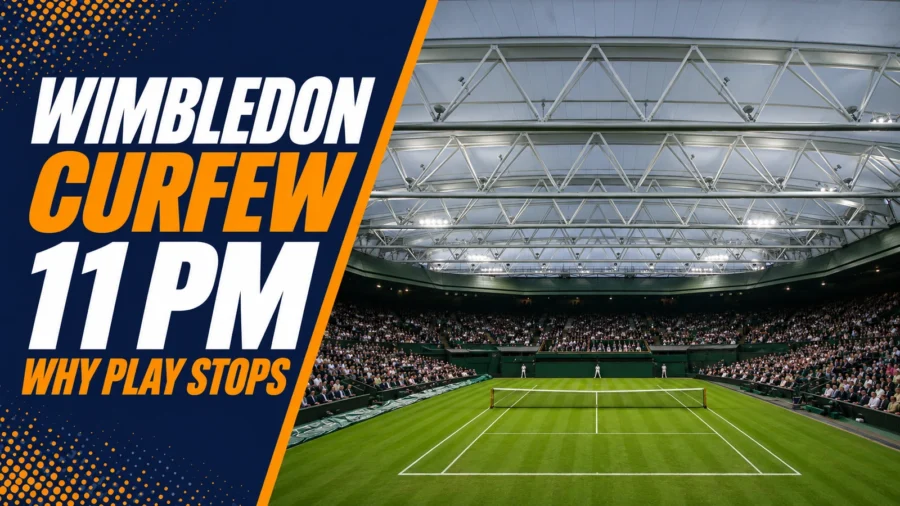
Wimbledon matches are normally required to stop by 11:00 p.m. local time. The limit exists because the All England Club sits in a residential area and the 11:00 p.m. finish is a planning condition connected to late play under the Centre Court roof.
The curfew balances the tournament’s ability to continue after dark with noise, transport and safety considerations for nearby residents and spectators. A match that cannot finish in time is suspended and resumed later.
What Time Is the Wimbledon Curfew?
The Wimbledon curfew is 11:00 p.m. British local time. During the Championships, the United Kingdom normally observes British Summer Time.
The practical conversion is usually:
| Location | Wimbledon curfew time |
|---|---|
| London | 11:00 p.m. BST |
| New York | 6:00 p.m. ET |
| Los Angeles | 3:00 p.m. PT |
| Central Europe | 12:00 a.m. CEST |
Daylight-saving rules can change the relationship between time zones outside the tournament dates. Viewers should confirm the current local conversion rather than relying on the table year-round.
Why Does Wimbledon Have an 11 PM Curfew?
The 11:00 p.m. limit is a planning condition intended to balance three main concerns:
- The effect of a major international event on local residents
- The movement of large crowds through a residential area late at night
- Transport connections that spectators need to get home safely
The All England Club is not an isolated sports complex surrounded by large parking areas. It is located among homes and local streets in southwest London.
The curfew was introduced when the Centre Court roof opened in 2009. The roof and artificial lighting made genuinely late tennis possible, so the planning arrangements needed a clear stopping point.
Is the Curfew an Official Tennis Rule?
The curfew is not part of the universal ITF Rules of Tennis. Those rules define how points, games, sets and matches are played, while Wimbledon sets its own operational schedule within planning and event requirements.
That is why the Australian Open, French Open and US Open can stage matches beyond midnight while Wimbledon stops much earlier. The difference is a venue condition, not a different method of tennis scoring.
The main tennis rules still apply normally before and after a suspension. The complete guide to tennis rules explains the match framework that continues when play resumes.
Which Courts Are Affected?
The curfew is most noticeable on Centre Court and No.1 Court because both have retractable roofs and lighting. Those facilities allow play to continue through rain and darkness, but not indefinitely.
Outside courts generally stop earlier because they do not all have the same roof and lighting capabilities. Poor light, rain or surface safety may end play well before 11:00 p.m.
Wimbledon’s natural surface adds another constraint. The way grass changes through a match is covered in what makes Wimbledon’s grass special.
What Happens When a Match Reaches the Curfew?
Officials monitor the time and estimate whether a match, set or game can reasonably finish. If completion is not possible, the referee and on-court officials identify a suitable stopping point.
The exact moment does not follow a simple rule such as always stopping at the end of a set. Factors include the score, how close the clock is to 11:00 p.m., court conditions and the time required to prepare for suspension.
When play stops:
- The current score is recorded.
- The players leave the court.
- The unfinished match is placed on a later order of play.
- Play resumes from the same score and with the correct player serving.
Completed points and games are not replayed. A suspension delays the match but does not restart it.
Can a Match Continue Past 11 PM?
The curfew should be treated as a firm limit, but there has been a rare, very small exception. In 2012, Andy Murray completed his victory over Marcos Baghdatis at approximately 11:02 p.m.
Murray was close to finishing, and communication took place with local authorities. The two-minute overrun is often described as an example of discretion rather than evidence that every close match can continue.
Tournament officials may stop a match before 11:00 p.m. if they do not believe there is a realistic or appropriate way to complete the next stage. Players cannot insist on continuing simply because several minutes remain.
Notable Wimbledon Matches Stopped by the Curfew
Novak Djokovic vs Rafael Nadal in 2018
The men’s semifinal began late after Kevin Anderson and John Isner played an exceptionally long first semifinal. Djokovic and Nadal completed three sets before the match was suspended and returned the following day.
Djokovic eventually won in five sets. The sequence showed how one unusually long match can affect the entire Centre Court programme.
Novak Djokovic vs Hubert Hurkacz in 2023
Djokovic led Hurkacz by two sets when their fourth-round match was stopped as the curfew approached. They returned the next day, and Djokovic completed the victory.
Andy Murray vs Stefanos Tsitsipas in 2023
Murray led by two sets to one when play ended for the night. Tsitsipas recovered when the match resumed and won in five sets.
The change in momentum was not caused by a rule adjustment. It was the normal uncertainty of pausing a match and returning under new physical and atmospheric conditions.
Curfew Pressure in 2026
The rule remained active during the 2026 Championships. Coco Gauff completed a fourth-round win over Belinda Bencic at about 10:58 p.m., while Novak Djokovic finished his record five-hour, 15-minute quarterfinal with Felix Auger-Aliassime at about 10:54 p.m.
These matches finished before the limit, but the clock became a visible tactical and scheduling concern.
Why Does Wimbledon Start Some Matches So Late?
The tournament does not normally intend to create a race against 11:00 p.m. Tennis matches have no fixed duration, and the schedule must estimate how long several unpredictable contests will take.
A straight-sets match may finish quickly, while a close best-of-five match can occupy the court for hours. The range is explained in how long tennis matches last.
Late starts can result from:
- Earlier five-set matches
- Rain delays and roof closures
- Medical interruptions
- Long tie-breaks or extended games
- Matches carried over from the previous day
- The need to complete particular sections of the draw
Organizers can adjust later assignments, but moving or postponing a match also affects players, ticket holders, broadcasters and other courts.
How the Roof Changes Late Play
Before Centre Court had a roof, darkness and weather usually ended play naturally. The 2009 roof allowed the court to become an indoor-like environment with controlled lighting when necessary.
Closing the roof is not instantaneous. Play is suspended, the structure moves into place and the internal environment must be prepared before the match continues.
No.1 Court’s retractable roof became operational in 2019. Having two covered courts gives Wimbledon much more protection from rain, but both remain subject to the late-night limit.
The underlying lawns are still carefully constructed natural courts. How grass tennis courts are made explains why covering and protecting the surface is more complicated than simply switching on indoor lights.
How a Suspended Match Affects the Next Day
An unfinished match must be added to a schedule that may already be full. Organizers need to protect player rest, keep the two halves of the draw progressing and avoid creating conflicts with doubles commitments.
The resumed match may be listed first on the same court or moved when tournament rules and conditions permit. There is no guarantee that a ticket holder for the original day can return to watch the completion.
Tickets are generally valid for the date and court stated, not for a particular player or a completed match. The curfew can therefore disappoint spectators even when the tournament has followed its published conditions.
Does the Curfew Make Wimbledon Fairer?
The rule prevents the extremely late finishes seen at some other events, which can leave players competing in the early hours and recovering on a shortened schedule. A predictable stopping limit can therefore support player welfare and transport planning.
However, a suspension can also change match conditions and momentum. One player may prefer to continue while another benefits from time to recover or adjust tactics.
There is no completely neutral solution once a match runs late. Wimbledon prioritizes the venue’s planning obligations, then resumes the contest under the same recorded score.
Wimbledon Curfew FAQ
Does Wimbledon Stop Exactly at 11 PM?
That is the normal requirement. Officials may stop earlier when reaching a suitable break in play is unrealistic, and the rare 2012 overrun should not be treated as a general grace period.
Does the Curfew Apply During the Final?
Yes. A final is not automatically exempt, although finals are scheduled early enough to reduce the risk.
What Happens to a Bet When a Match Is Suspended?
Betting settlement depends on the operator’s own rules. The official tennis result remains pending until the match is completed or otherwise decided.
Is Wimbledon the Only Grand Slam With a Curfew?
Wimbledon is the Grand Slam most clearly associated with a fixed 11:00 p.m. match curfew. Other majors manage late play under different venue, scheduling and local requirements.
Can Players Refuse to Stop?
No. Scheduling and suspension decisions belong to tournament officials. Refusing to follow an instruction could create a conduct issue under the event’s rules, which are distinct from the basic scoring situation.