
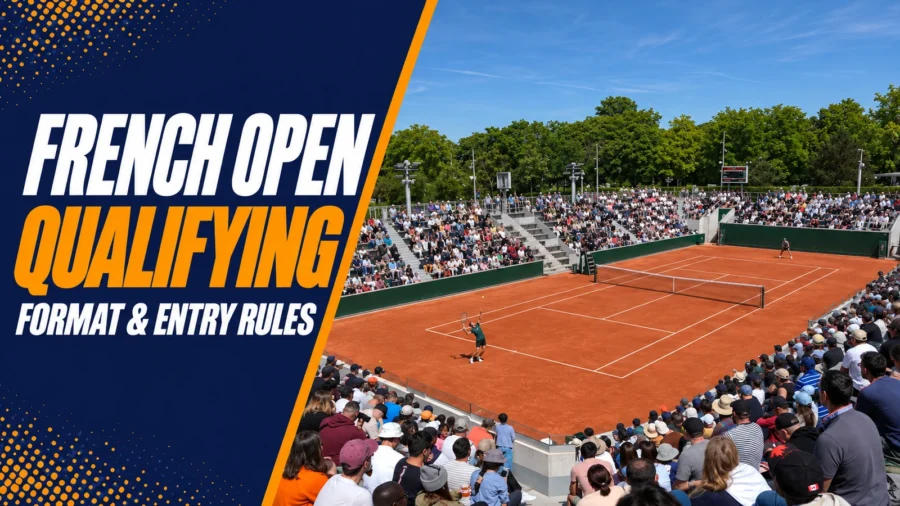
French Open qualifying is a 128-player knockout tournament in both men’s and women’s singles. Sixteen players from each draw earn main-draw places by winning three consecutive matches. The competition takes place during Roland-Garros Opening Week, immediately before the 128-player main draws begin.
Qualifying is not a preliminary practice event. It carries ranking points and prize money, and every match can decide whether a player reaches one of the four biggest tournaments in tennis.
French Open Qualifying Format at a Glance
The 2026 tournament used the following structure, which has been standard in recent editions:
| Stage | Players remaining | What a win means |
|---|---|---|
| First qualifying round | 128 | Advance to the last 64 |
| Second qualifying round | 64 | Advance to the last 32 |
| Third qualifying round | 32 | Win one of 16 main-draw places |
There is no group stage and no double elimination. One loss ends a normal qualifying run, although a final-round loser may later enter the main draw as a lucky loser if a vacancy opens.
The types of tennis tournaments guide explains how a single-elimination draw narrows after every round.
How Many Players Qualify for the French Open?
Sixteen men and 16 women qualify. Each starts in a 128-player qualifying draw and must win three matches.
The main singles draws contain 128 players each. Most places go to direct acceptances based on the entry ranking, while eight main-draw wild cards and 16 qualifiers complete the usual structure. Protected or special rankings can be used by eligible players for direct entry, but they do not create extra positions beyond the 128-player field.
Seeds are placed through the qualifying draw to reduce the chance of the highest-ranked entrants meeting in the opening round. A seed is not guaranteed to qualify, and unseeded players can defeat seeds at any stage.
When Is French Open Qualifying Played?
Qualifying is held during Opening Week, the week before the main draw. In 2026, the published qualifying schedule ran from Monday, May 18 through Friday, May 22, while the main draw began on Sunday, May 24.
Exact dates change with the annual calendar. The tournament may also adjust individual match times because of weather, unfinished matches or scheduling needs.
Opening Week includes more than qualifying. Spectators can usually watch selected player practices and activities around the grounds, but the qualification matches remain the competitive center of the schedule.
Who Can Enter French Open Qualifying?
Qualifying is an entry-controlled professional event, not an open sign-up tournament. Players generally enter through one of these routes:
- Ranking-based acceptance into the qualifying draw.
- A protected or special ranking recognized under the applicable tour rules.
- A qualifying wild card awarded by the tournament.
- Movement from an alternate list after another accepted player withdraws.
The entry deadline comes weeks before the event. The tours and tournament use the applicable ranking date to build the acceptance list, and players outside the initial cutoff can move in as higher-ranked entrants withdraw.
The tennis world ranking guide explains how results create the ranking positions used for tournament entry.
Direct Acceptance
Direct acceptance means a player’s eligible ranking is high enough for the qualifying field after main-draw acceptances have been removed. The cutoff is not fixed at one ranking number because withdrawals, protected rankings and other entry decisions change the list.
A ranking that gained entry one year might leave a player on the alternate list in another. The official acceptance list is more reliable than an assumed historical cutoff.
Protected or Special Ranking
Eligible players returning from a qualifying absence may enter with a protected ATP ranking or WTA special ranking. This can place a player in a draw even when the current ranking appears too low.
The protected number is used for entry, not automatically for seeding. Seeding follows the rules and ranking used for that purpose at the tournament.
Qualifying Wild Cards
Roland-Garros awards qualifying wild cards to selected players who would not otherwise enter. Many go to French players, but federation agreements can create opportunities for players from partner nations.
A wild card changes the route into the qualifying draw, not the route through it. The recipient still needs three match wins to qualify.
How Are French Open Qualifying Matches Scored?
Men’s and women’s qualifying singles are played as best-of-three-set matches. The first player to win two sets advances.
This differs from the men’s main draw, where singles matches are best of five sets. Women’s singles remains best of three in both qualifying and the main draw.
If a deciding set reaches 6-6, Grand Slam singles use a 10-point tie-break, won by the first player to reach at least 10 points with a two-point margin. Earlier sets normally use a standard seven-point tie-break at 6-6, again requiring a two-point margin.
The guide to how tennis scoring works covers points, games, sets and both types of tie-break.
What Is a Lucky Loser at Roland-Garros?
A lucky loser is a player who loses in qualifying but enters the main draw after an accepted main-draw player withdraws before playing. It is a replacement mechanism, not an additional qualifying place.
Final qualifying-round losers receive priority under the Grand Slam selection procedure. Ranking and any required draw among eligible players determine the order, rather than the tournament simply choosing its favorite defeated player.
The number of lucky losers is unpredictable because it depends on late withdrawals. Some editions have several, while others have few or none.
Can a First-Round Qualifying Loser Become a Lucky Loser?
Normally, eligible final-round losers are considered first. Earlier-round losers do not jump ahead merely because they have a higher profile.
Players must also remain available and complete the required sign-in process. Leaving the site or missing a deadline can remove the opportunity.
What Happens When a Qualifier Reaches the Main Draw?
The qualifier is placed into one of the positions marked for qualifiers in the main draw. Once qualifying is complete, the tournament conducts or completes the placement process under its draw rules.
A qualifier can face a seed, another qualifier, a wild card or an unseeded direct acceptance in the first round. Qualifiers are not protected from leading players simply because they have already won three matches.
The main-draw result is recorded separately from qualifying. A player who wins the title from qualifying would need 10 match victories in total: three in qualifying and seven in the main draw.
Ranking Points and Prize Money
Qualifying provides both ranking points and prize money, but the exact ranking award can differ between the ATP and WTA systems. A player does not normally stack the points for every qualifying round as separate prizes; the tour table credits the result reached under its rules.
In 2026, a player eliminated in the first qualifying round earned €24,000. Second-round and final-round qualifying losses paid €33,000 and €48,000 respectively, while a qualifier entering the main draw was guaranteed the €87,000 first-round main-draw payment.
These are gross tournament awards. Taxes, coaching, travel and support costs affect what a player ultimately keeps, as explained in the guide to how tennis players make money.
Can Fans Attend French Open Qualifying?
Yes. Roland-Garros sells Opening Week tickets for qualifying, and it is one of the most affordable ways to visit the stadium.
In 2026, a full-price Opening Week ticket cost €29, with a €15 under-25 offer. It provided access to qualifying on Suzanne-Lenglen and outside courts, subject to capacity, plus specified practice viewing and activities.
Qualifying is particularly good for spectators who want to move between courts and watch from close range. Later rounds carry visible pressure because one win separates each player from the main draw.
French Open Qualifying Strategy
Best-of-three qualifying rewards players who settle quickly. There is less time to recover from a poor start than in a best-of-five men’s main-draw match, and three matches in five days place a premium on efficient recovery.
Clay adds another challenge. Movement, patience, point construction and tolerance for longer rallies can matter more than on a faster surface. Players also have to handle changing weather and court conditions across the week.
The goal is not merely to survive one match. A successful qualifier must repeat the performance three times and still be ready for a main-draw opponent soon afterward.
Frequently Asked Questions
How many rounds are in French Open qualifying?
There are three rounds in both men’s and women’s singles qualifying.
How many players are in each qualifying draw?
Each draw begins with 128 players.
How many players qualify for the main draw?
Sixteen men and 16 women qualify by winning three matches.
Are men’s qualifying matches best of five sets?
No. Men’s qualifying is best of three sets. Best-of-five competition begins in the men’s singles main draw.
Can a player lose in qualifying and still reach the main draw?
Yes. An eligible final-round loser can enter as a lucky loser if a main-draw vacancy opens and the player is selected under the replacement procedure.
Can anyone enter French Open qualifying?
No. Players need ranking-based acceptance, an eligible protected or special ranking, a qualifying wild card, or movement into the field from the alternate list.
Is qualifying open to spectators?
Yes. It is ticketed as part of Opening Week and normally offers access to qualifying courts, selected practices and other activities.