
Affiliate disclosure: This page contains affiliate links. If you make a purchase through one of these links, Tennis Overload may earn a commission at no additional cost to you.
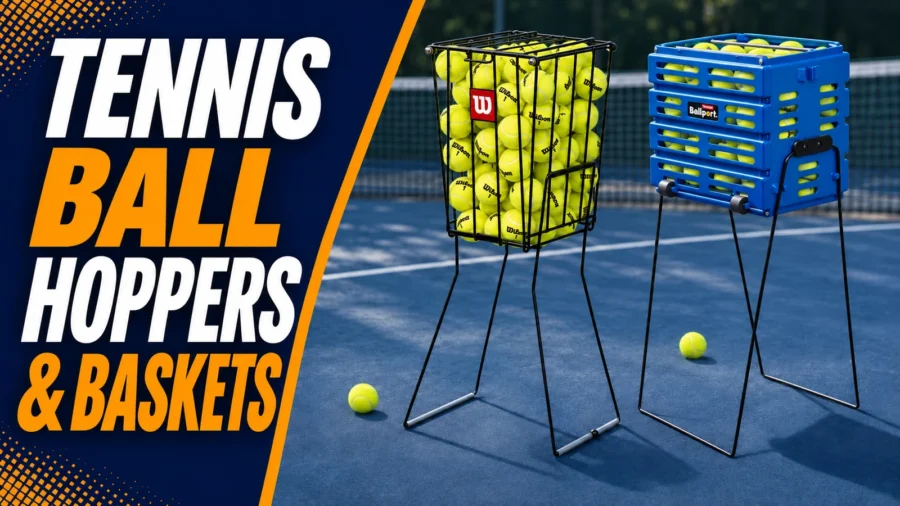
The best tennis ball hopper for most individual players is the Wilson 75 Ball Pick-Up Hopper because it combines useful capacity, simple court-side feeding and hands-free ball collection. Tourna’s Ballport Deluxe is a lighter wheeled alternative, while coaches who feed hundreds of balls should move up to a 140- or 150-ball basket or teaching cart.
Capacity is only one part of the decision. A wire basket can collect, store and feed; a rolling fabric cart is easier for coaching but does not pick balls up; and a rolling collector gathers balls quickly but needs a separate feeding container.
Best Tennis Ball Hoppers at a Glance
| Product | Capacity | Best for | Type |
|---|---|---|---|
| Wilson 75 Ball Pick-Up Hopper | 75 balls | Most players | Wire pickup basket |
| Tourna Ballport Deluxe With Wheels | 80 balls | Lightweight transport | Polypropylene pickup basket |
| GAMMA Ballhopper Whopper 140 | 140 balls | Large practice sessions | Heavy-duty wire basket |
| Wilson Tennis Teaching Cart & Bag | 150 balls | Coaches and clinics | Folding rolling cart |
| Kollectaball K-Court | 50 tennis balls | Fast pickup | Rolling ball collector |
Manufacturer capacities are approximate maximums. A basket filled to the top can be awkward to carry and may not leave room for mixed ball types.
1. Wilson 75 Ball Pick-Up Hopper: Best Overall
Wilson’s 75 Ball Pick-Up Hopper is a straightforward wire basket with handles that let the player collect balls without repeated bending. Its capacity is large enough for serve practice but still manageable for one person to carry.
This format also works as a feeding basket once the handles are raised into a stand. It is the most versatile choice for a club player who wants one tool for pickup, transport and drills.
The limitations are typical of a wire hopper: it can become heavy when full, the stand must be stable before feeding and small objects can pass through the basket. Keep fingers away from pickup openings and check that the handles lock correctly.
Best for: Solo serve sessions, lessons and players who want one simple basket.
2. Tourna Ballport Deluxe With Wheels: Best Lightweight Hopper
Tourna’s Ballport Deluxe With Wheels uses reinforced polypropylene rather than a conventional steel cage. The wheeled version holds 80 balls and weighs about 4.5lb according to the manufacturer.
Wheels help move a full hopper from the gate to the baseline, while the plastic body avoids a heavy all-metal construction. The handles convert for court-side feeding, so it remains a true hopper rather than only a storage bin.
Small wheels are most useful on smooth hard courts. They will not roll as easily across rough paths, steps or soft grass, and the plastic basket should not be dragged over sharp edges.
Best for: Players who want a lighter pickup basket with short-distance rolling convenience.
3. GAMMA Ballhopper Whopper 140: Best Large Wire Basket
The GAMMA Whopper 140 is a high-capacity wire hopper with reinforced welds, a weather-resistant coating and wear bumpers. Its 140-ball capacity suits coaches, team captains and players running extended feeding sessions.
The basket can collect balls and then stand at feeding height, preserving the familiar hopper workflow at a larger scale. The tradeoff is weight and bulk. A full 140-ball basket is less pleasant to carry than a 75-ball model, especially through a parking lot or up stairs.
Best for: High-volume drills when a wheeled teaching cart would be inconvenient.
4. Wilson Tennis Teaching Cart & Bag: Best for Coaching
Wilson’s Tennis Teaching Cart & Bag combines a foldable wheeled frame with a removable bag that holds up to 150 balls. It places the supply at a comfortable feeding height and folds for transport.
This format is more efficient for lessons and clinics than a small basket because the coach can roll it between stations and keep a large ball supply open. It does not collect balls from the court by pressing down, so pair it with player pickup, tubes or a dedicated collector.
The essential equipment for tennis and padel coaches can help a coach build the rest of a practical court kit around the cart.
For a wider court kit, prioritize the grips, targets, storage and training aids that support the sessions you actually run.
Best for: Coaches, academies and group sessions with repeated feeds.
5. Kollectaball K-Court: Best Dedicated Ball Collector
The Kollectaball K-Court is a rolling wire collector that holds up to 50 tennis balls. Lobster Sports says it works on hard courts, clay, grass and indoor surfaces, and its V-Opener dispenses balls into a hopper, cart or machine.
It reduces bending and gathers scattered balls more quickly than picking them up one by one. However, it is not a raised feeding basket. Buy it when collection is the main problem and you already have somewhere to put the balls.
The K-Court arrives flat-packed and requires assembly. Its wires are replaceable, which is useful for a device that contacts the ground repeatedly.
Best for: Coaches, facilities and players who already own a cart or ball machine.
Ball Hopper, Basket, Cart or Tube?
These terms overlap in product listings, so focus on the function.
Pickup Hopper
A pickup hopper collects balls through openings in the bottom. Its handles usually convert into legs, turning the basket into a feeding stand. It is the best all-purpose choice for most players.
Teaching Cart
A teaching cart holds more balls in a fabric bag on a rolling frame. It is comfortable for long feeding sessions but usually cannot collect balls by itself.
Ball Collector
A rolling collector sweeps balls into a wire drum or cage. It is optimized for pickup, not feeding. This makes sense when a court regularly has dozens or hundreds of scattered balls.
Pickup Tube
A tube is light, easy to store and suitable for a small number of balls. Its limited capacity makes it less efficient for a full basket drill, but it is convenient for a player who walks or cycles to the court.
How Much Capacity Do You Need?
| Use | Practical capacity |
|---|---|
| Short serving session | 40–75 balls |
| Solo basket drills | 60–100 balls |
| Private lesson | 75–150 balls |
| Group clinic | 140–250+ balls |
| Ball-machine loading | Match the machine’s capacity |
More balls are not always better. A 150-ball cart takes longer to collect, occupies more storage space and may encourage low-quality repetition if the player never pauses to review the target.
Start with a quantity that lets you complete a focused block, then collect and reset. This guide to the best ways to practice tennis alone includes drill structures that do not require a partner.
What to Look for in a Tennis Ball Hopper
Secure Pickup Openings
The bottom should admit a ball under downward pressure but hold it during normal carrying. Gates that are too loose can spill balls when the basket is lifted.
Stable Handles and Legs
If the handles convert into a stand, check the locking method and place the basket on a level area. Do not lean on it or let children climb around the legs.
Comfortable Height
A raised basket should let you feed without repeatedly reaching toward the ground. Very tall and very short coaches may prefer a cart with a different working height.
Transport
Consider the route, not only the court. Stairs, narrow gates and a long walk from the car can make a large metal hopper impractical. A lighter basket or folding cart may be the better real-world choice.
Weather Resistance
Coatings and plastic help with outdoor use, but no hopper should become permanent court furniture. Dry metal after rain, avoid storing balls in a damp container and keep moving parts free of clay buildup.
Choosing Balls for Basket Practice
Use balls with similar pressure and felt condition within one drill. Mixing new pressurized balls with dead practice balls creates inconsistent bounce and can make technical feedback misleading.
Pressureless balls are useful for high-volume practice because their bounce changes differently over time, but they can feel firmer and do not perfectly reproduce every match ball. The comparison of the best tennis balls for each court surface explains regular-duty, extra-duty and practice choices.
Beginners and children may need red, orange or green transition balls rather than standard yellow balls. Confirm that the hopper’s pickup openings work with the larger red balls before buying.
Useful Hopper Drills
Serve Targets
Divide each service box into wide, body and T targets. Hit 10 serves to one target, record the number that land in and then change direction. A 60-ball basket gives two complete rounds across three targets.
Two-Ball Movement Pattern
Feed one ball wide and one shorter ball toward the middle. Recover after the first shot, move forward for the second and finish with a controlled target. Pause every six repetitions so speed does not replace technique.
Crosscourt Consistency
Drop-feed or self-feed to a crosscourt target. Count only balls that clear the net with safe height and land beyond the service line. The goal is a repeatable pattern, not maximum pace.
Players building a first kit can combine a hopper with the items in the beginner tennis equipment checklist rather than buying every training gadget at once.
Safety and Maintenance
- Check for exposed wire ends, cracked plastic and loose fasteners.
- Lock the stand before placing balls at feeding height.
- Keep the basket outside the playing area during live points.
- Do not overload a cart beyond its stated capacity.
- Remove wet balls and dry the container before storage.
- Rinse clay dust from wheels and hinges, then dry them.
- Lift with both hands when a hopper is full.
Facilities should inspect shared hoppers regularly because repeated drops and transport can loosen connections without obvious warning.
Final Verdict
Wilson’s 75 Ball Pick-Up Hopper is the best all-purpose option for most players. Tourna Ballport Deluxe 80 is easier to transport, GAMMA Whopper 140 serves high-volume basket work, Wilson’s 150-ball teaching cart is the better coaching station, and Kollectaball K-Court solves the separate problem of rapid pickup. Choose the smallest capacity that supports your session and remains easy to carry, store and refill.