
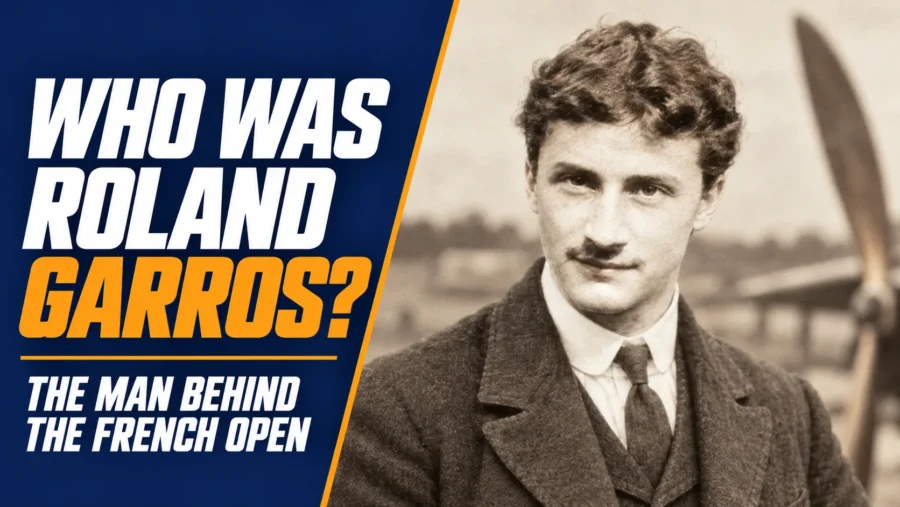
Roland Garros was a French aviation pioneer and First World War pilot, not a tennis champion. The French Open venue was named in his honor in 1928 after Émile Lesieur, president of Stade Français and a former classmate and friend, requested that the new stadium carry Garros’s name.
His connection to tennis came through Stade Français, where he had been a member, and through the friendship behind the naming decision. His fame came from aviation, especially the first nonstop flight across the Mediterranean in 1913.
Roland Garros at a Glance
| Detail | Information |
|---|---|
| Full name | Roland Eugène Adrien Georges Garros |
| Born | October 6, 1888 |
| Birthplace | Saint-Denis, Réunion |
| Died | October 5, 1918 |
| Age at death | 29 |
| Known for | Aviation records and wartime flying |
| Famous flight | First nonstop aerial crossing of the Mediterranean in 1913 |
| Tennis connection | Former Stade Français member and friend of Émile Lesieur |
| Stadium named | 1928 |
Early Life and Education
Roland Garros was born on the island of Réunion, a French territory in the Indian Ocean. He later moved to metropolitan France for his education and studied at HEC Paris, graduating in 1908.
He was an active sportsman and pursued cycling and rugby, but tennis was not the achievement that made him famous. After working around automobiles and starting a business, he became fascinated by the new field of powered flight.
Aviation was still dangerous and experimental. Pilots flew machines with limited range, reliability and navigation equipment, and public air meetings turned successful aviators into international celebrities.
How Roland Garros Became an Aviation Pioneer
Garros learned to fly in 1910 and quickly entered races, exhibitions and record attempts. He developed a reputation for ambition and control at a time when both engines and airframes regularly failed.
His early achievements included altitude records and long-distance flights. The most famous came on September 23, 1913, when he flew a Morane-Saulnier from Fréjus in southern France to Bizerte in Tunisia.
The journey took 7 hours and 53 minutes and made him the first person to fly nonstop across the Mediterranean. He landed with very little fuel remaining, turning the flight into one of the defining aviation achievements before the First World War.
Roland Garros in the First World War
When war began in 1914, Garros joined the French military aviation effort. Aircraft initially served mainly for observation, but pilots and engineers were rapidly trying to make them effective fighting machines.
Garros worked with a system that allowed a machine gun to fire forward through the arc of a spinning propeller. Metal deflector wedges were fitted to the propeller blades so bullets that struck them would be diverted rather than shatter the wood.
This was an important practical step in the development of fighter aircraft, but it was not the later fully synchronized interrupter gear. Describing Garros as the sole inventor of firing through a propeller would overstate a development that involved several engineers and competing systems.
Garros achieved combat victories with the deflector arrangement in 1915. His aircraft later came down behind enemy lines, and he was captured.
Captivity, Escape and Death
Garros spent nearly three years as a prisoner of war in Germany. After several attempts, he escaped in 1918 and returned to France.
Despite declining eyesight and the years away from combat flying, he returned to active service. On October 5, 1918, one day before his 30th birthday and only weeks before the armistice, he was shot down and killed in the Ardennes.
His death fixed his public image as both an aviation pioneer and wartime hero. Streets, airports, memorials and the Paris tennis stadium later carried his name.
Why Is the French Open Named After Roland Garros?
The tournament itself existed long before the present stadium. The decisive event came in 1927, when the French team of Jacques Brugnon, Jean Borotra, Henri Cochet and René Lacoste won the Davis Cup in the United States.
France needed a suitable venue to host the 1928 defense. A new stadium was built on a roughly three-hectare site at Porte d’Auteuil in Paris, with Stade Français and Racing Club de France involved in the project.
Émile Lesieur, president of Stade Français, agreed to the use of the land on the condition that the stadium be named after Roland Garros. Lesieur had known Garros from HEC and Stade Français.
The request was accepted, and Stade Roland-Garros opened in 1928. As the French championships became identified with their home, Roland-Garros also became the common name of the tournament.
This history is why the answer to “Was Roland Garros a tennis champion?” is no. His name reached tennis through personal remembrance and national history, not a championship record.
Was It Always Called the French Open?
The French national championships began in 1891 and were initially restricted to members of French clubs. International players were admitted from 1925, before the move to the new stadium.
“French Open” is the common English name for the tournament. “Roland-Garros” is the official French name and also identifies the stadium. The overview of the four Grand Slam tournaments explains how the Paris event fits beside the Australian Open, Wimbledon and US Open.
The event became the first Grand Slam tournament of the Open Era in 1968, when professionals were allowed to compete alongside amateurs. The tennis terms glossary explains the language used around the sport, while the guide to different types of tennis tournaments shows where the four majors sit in the modern professional structure.
How Roland Garros Is Remembered at the Stadium
The venue contains several references to the aviator rather than treating the name as an unexplained label. A monumental steel sculpture called The Cloud Kisser stands at Aviator Square near Gate 1.
The work, created by Caroline Brisset, is more than 6m high and was inspired by an image of Garros in an aircraft cockpit. Its title refers to the daring flights that earned him fame.
Spectators also see the aviation connection in historical displays and the continued use of his biography in tournament storytelling. These reminders distinguish the person from the champions whose names appear on courts and trophies.
Roland Garros and Other Names at the Tournament
The stadium is named for the aviator, but its main courts and trophies honor major figures in French tennis.
- Court Philippe-Chatrier honors the influential French tennis administrator.
- Court Suzanne-Lenglen honors the French champion who transformed women’s tennis in the 1920s.
- Court Simonne-Mathieu honors the French champion and wartime resistance figure.
- The men’s singles trophy is the Coupe des Mousquetaires, named for France’s Four Musketeers.
- The women’s singles trophy is the Coupe Suzanne-Lenglen.
This mix explains why several historical stories meet at one venue. Garros represents aviation and sacrifice, while the court and trophy names preserve the tournament’s tennis heritage.
Common Myths About Roland Garros
He Won the French Open
Garros never won the tournament. He was not a famous competitive tennis player.
He Invented the Fighter Plane by Himself
Garros helped develop and successfully use an important forward-firing deflector system. Fighter-aircraft development involved multiple inventors, engineers and later synchronization systems, so the achievement should be described precisely.
The Tournament Was Named Directly After His 1913 Flight
The Mediterranean crossing made Garros famous, but the stadium received his name because Émile Lesieur requested it when the new venue was built in 1928.
Roland-Garros Is Outside Paris
The stadium is inside Paris in the 16th arrondissement, near Porte d’Auteuil and the Bois de Boulogne.
Why His Name Still Fits the Tournament
Roland Garros did not contribute a forehand, trophy or tennis rule. His story instead reflects risk, innovation, resilience and the history of modern France.
The naming also preserves a personal act of remembrance. Lesieur used the creation of a national sporting venue to honor a friend who had died at 29.
Today, many visitors know “Roland-Garros” first as a clay-court championship. Learning about the man behind it adds a second history to the event without confusing him with the players who built its tennis records, including the existing account of Rafael Nadal’s journey to greatness.
Frequently Asked Questions
Was Roland Garros a tennis champion?
No. He was an aviation pioneer, wartime pilot and former Stade Français member.
What was Roland Garros famous for?
He was the first person to fly nonstop across the Mediterranean, completing the journey from southern France to Tunisia in 1913. He also played an important role in early fighter-aircraft development during the First World War.
Why did Émile Lesieur choose his name?
Lesieur had known Garros through HEC and Stade Français. When a new tennis stadium was built for France’s 1928 Davis Cup defense, Lesieur requested that it honor his late friend.
When did Roland Garros die?
He died on October 5, 1918, when his aircraft was shot down in the Ardennes. It was one day before his 30th birthday.
Is Roland-Garros the official name of the French Open?
Yes. Roland-Garros is the tournament’s official French name and the name of its Paris venue. French Open is the common English name.