
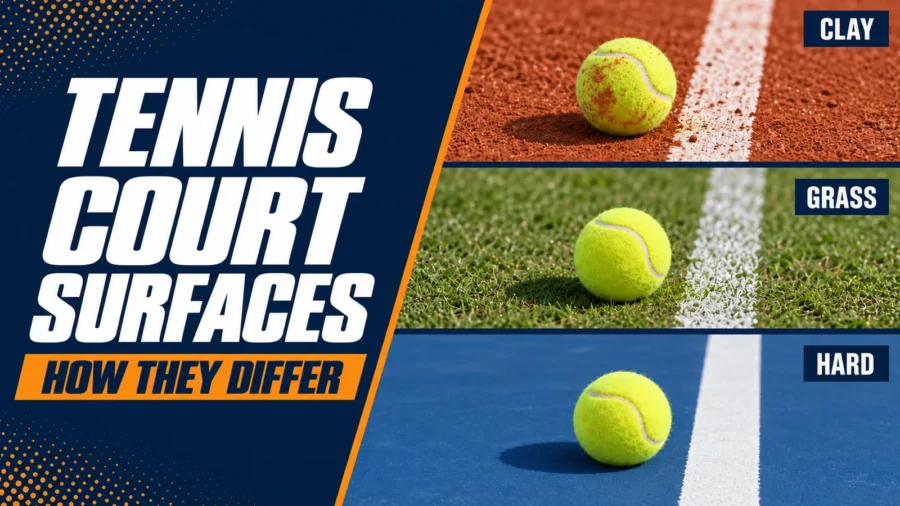
The three main tennis court surfaces are hard court, clay, and natural grass. Hard courts usually give the most balanced combination of pace and bounce, clay generally slows the ball and produces a higher bounce, while grass tends to keep the bounce lower and reward earlier contact.
Those are useful starting points, not universal rules. Construction, texture, moisture, maintenance, temperature and the ball can make two courts in the same broad category play differently. The International Tennis Federation therefore tests court pace rather than assuming every clay court is slow or every grass court is fast.
Tennis Court Surfaces Compared
| Surface | Typical pace | Typical bounce | Movement | Maintenance | Grand Slam example |
|---|---|---|---|---|---|
| Clay | Slow to medium | Higher and more responsive to spin | Controlled sliding is common | Frequent watering, brushing and line care | Roland Garros |
| Grass | Medium-fast to fast | Lower and less uniform | Small adjustment steps; traction changes with wear and moisture | Intensive mowing, irrigation and turf care | Wimbledon |
| Hard | Slow to fast, depending on coating | Predictable, usually medium height | Firm footing; advanced players may slide | Cleaning, crack repair and periodic resurfacing | Australian Open and US Open |
| Carpet or synthetic indoor | Medium to fast in many installations | Usually low to medium | Depends on textile or modular system | Cleaning and replacement as material wears | No current Grand Slam |
The playing lines and dimensions remain the same. The tennis court dimensions and size guide explains the layout separately from the material underneath it.
How the ITF Classifies Court Speed
The ITF uses a Court Pace Rating based on how the surface affects a standardized ball’s speed and rebound. The system places tested surfaces into five categories.
| ITF category | Court Pace Rating | Classification |
|---|---|---|
| 1 | 0–29 | Slow |
| 2 | 30–34 | Medium-slow |
| 3 | 35–39 | Medium |
| 4 | 40–44 | Medium-fast |
| 5 | 45 or more | Fast |
Most clay surfaces fall toward the slow end, many acrylic systems sit in the middle categories, and natural grass commonly falls toward the fast end. These are examples rather than guaranteed labels because the finished system must be tested.
Court pace describes what happens after the ball contacts the surface. It is not the same as raw shot speed before the bounce, and it does not fully describe bounce height, footing or how the court responds to spin.
Clay Tennis Courts
Clay courts use a compacted mineral base with a loose granular top layer. European red clay is associated with crushed brick and limestone systems, while American green clay is often made from crushed metabasalt and sold under names such as Har-Tru.
Roland Garros is not simply a deep layer of red powder. Its courts use several engineered layers for drainage, stability and moisture, with a very thin red brick dust finish at the top.
How Clay Changes the Ball
The loose surface absorbs and redistributes some of the ball’s forward energy. The ball normally slows more after the bounce and rises higher than it does on grass.
Topspin becomes especially effective because the slower court gives the rotating ball time to climb. Heavy shots can push an opponent farther behind the baseline, while drop shots become useful when that opponent retreats.
Conditions matter. A damp, cool clay court can feel heavy and slow, while a dry court may play quicker and produce more dust and irregular footing.
Movement on Clay
Players often slide into wide shots and use the slide to decelerate before recovering. Good clay movement is controlled: the player lowers the center of gravity, enters the slide in balance and organizes the next step before contact.
Beginners should learn the pattern gradually rather than forcing a long slide. Shoes designed for clay commonly use a full herringbone outsole that releases loose material while maintaining traction.
Styles That Often Work on Clay
Clay can reward:
- Heavy topspin that creates a high contact point.
- Patience through longer rallies.
- Fitness and repeated recovery behind the baseline.
- Drop shots and changes of height.
- Point construction that opens the court before the winner.
An aggressive player can still succeed on clay, especially with a strong first strike and the ability to finish at the net. The surface changes the risk and timing of an attack; it does not prohibit attacking tennis.
Clay Court Maintenance
Clay needs regular watering, rolling, brushing and line cleaning. The surface must remain level and retain enough moisture to bind without becoming slippery or muddy.
Seasonal repair can include replacing loose material, correcting low spots and restoring compacted layers. The practical schedule in how to maintain a clay tennis court covers daily and periodic work in more detail.
Grass Tennis Courts
Natural grass is grown over a carefully prepared soil profile. At Wimbledon, the bounce depends heavily on the hardness and dryness of the soil beneath the turf, not only on the grass blades.
The surface changes during play. Baseline areas wear, soil can become more exposed and the amount of moisture affects traction and rebound.
How Grass Changes the Ball
Grass generally produces a lower, faster skid than clay. Players have less time after the bounce, so compact preparation and an early contact point become important.
Slice stays low and can be difficult to attack. Serves also retain more of their effectiveness after the bounce, although modern grass preparation and slower balls have made many rallies more baseline-oriented than in earlier eras.
Movement on Grass
Traction can vary between lush and worn areas. Players use small adjustment steps, keep their center of gravity controlled and avoid abrupt direction changes when the surface is damp.
The outsole pattern must provide grip without damaging the turf. Tournament rules and facilities may require a specific grass-court sole.
Styles That Often Work on Grass
Grass can reward:
- Accurate serving and an aggressive first shot.
- Compact returns and blocked return positions.
- Low slices that stay below an opponent’s strike zone.
- Volleys and forward movement behind a strong approach.
- Short backswings and early ball recognition.
A powerful serve helps, but it is not the only route to success. Return quality, balance on low balls and the ability to defend a fast first exchange are equally valuable.
Grass Court Maintenance
Natural grass demands mowing, irrigation, aeration, rolling, disease control and recovery between periods of play. Grounds teams also manage soil firmness and grass density to produce a consistent court.
It is the most difficult major surface to maintain for year-round recreational use. How grass tennis courts are made explains the construction and preparation process in depth.
Hard Tennis Courts
Most hard courts use acrylic coatings over asphalt or concrete. The visible color layer is part of a system that can include primers, resurfacing products, texture coats and cushioned layers.
The Australian Open uses a hard-court system, as does the US Open, but different products and preparation mean they do not have to play identically. Even courts at the same facility can vary with age, repainting and exposure.
How Hard Courts Change the Ball
Hard courts generally provide a predictable bounce with a pace between clay and fast grass. That balance is why they suit many playing styles and are common in public facilities.
Manufacturers adjust pace through the coating formulation and the amount and size of aggregate in the texture layers. A rougher surface creates more friction and usually slows the ball, while a smoother finish tends to play faster.
Cushioned acrylic layers can change underfoot comfort, but the word cushioned does not mean soft like a gym mat. The base remains firm, and players still experience repeated loading from starts, stops and landings.
Movement on Hard Courts
Hard courts offer reliable traction but punish poor deceleration because the surface does not release like loose clay. Advanced professionals often slide on hard courts, yet recreational players should not copy that movement without appropriate strength, technique and footwear.
Use a shoe built for lateral tennis movement and the court’s abrasion level. The right outsole must balance grip and durability without catching excessively during direction changes.
For current footwear options, compare the best tennis shoes for men and best tennis shoes for women by traction, stability, cushioning, and fit.
Styles That Often Work on Hard Courts
Hard courts are relatively neutral, so success depends more on the exact pace and the player’s ability to execute. Strong servers, counterpunchers, aggressive baseliners and all-court players can all perform well.
On a slower, grittier hard court, patience and spin become more valuable. On a quicker, smoother court, a strong serve, early return and flatter first strike may have greater effect.
Hard Court Maintenance
Routine work includes cleaning debris, treating organic growth, checking drainage and repairing cracks. Acrylic color and texture layers wear with ultraviolet exposure, weather and traffic, so courts eventually need resurfacing.
Painting over structural cracks without addressing movement underneath provides only a temporary cosmetic change. The tennis court resurfacing guide explains when a surface needs cleaning, patching or a more complete repair.
Carpet and Other Synthetic Surfaces
Carpet is a broad term for removable textile, needle-punch or polymer-based systems installed over a firm base. Many indoor versions play quickly and produce a low bounce, but the category includes different products.
Artificial grass uses synthetic fibers with an infill and can resemble a grass court visually without matching natural turf’s behavior. Artificial clay systems attempt to provide clay-like sliding with different construction and maintenance needs.
Wood and modular tiles appear in some indoor or multi-sport venues. A surface should be judged by its tested pace, traction, uniformity and suitability for tennis rather than its marketing name alone.
How Weather Affects Each Surface
Temperature, humidity, wind and moisture influence both the court and the ball.
Hot, Dry Conditions
Warmer balls tend to feel livelier because internal pressure increases, while dry courts can play more quickly. Clay may need additional watering and can become dusty if it loses too much moisture.
Cool or Damp Conditions
Cooler balls generally feel slower and less lively. Damp clay becomes heavier, and wet grass can become unsafe before the playing characteristics are even considered.
Hard courts may remain structurally playable in varied climates, but water on an acrylic surface creates a slipping hazard. Play should resume only when the surface is properly dry.
Altitude
At altitude, thinner air creates less drag, so the ball travels faster and can be harder to control. Tournament organizers may select an approved high-altitude ball to compensate.
The interaction between felt, pressure and surface is covered in the best tennis balls for each court surface.
Which Surface Is Best for Beginners?
A well-maintained medium-pace hard court is often the most practical option because the bounce is predictable and courts are widely available. That does not make it universally safest or easiest; a gritty court may feel slow, and a very fast acrylic finish can reduce reaction time.
Clay gives beginners more time after the bounce but adds a sliding and maintenance challenge. Grass keeps the ball low and can make timing difficult for a new player.
Choose a level, dry and consistent court before worrying about category. Predictable footing and a true bounce matter more to a beginner than copying a Grand Slam surface.
How to Adjust Your Game by Surface
On Clay
Use more net clearance, accept longer rallies and recover with enough space behind the baseline. Build the point with depth and spin before changing direction or using a drop shot.
On Grass
Prepare early, shorten the backswing and stay balanced for a lower bounce. A compact return and a controlled slice can be more useful than a large swing.
On Hard Courts
Read the specific court during the warm-up. Test how high a topspin ball jumps, how much a slice skids and whether the surface rewards patient height or early aggression.
Your equipment does not need a complete rebuild for every court. Footwear and ball selection are the most surface-specific choices, while racket and string adjustments should be small enough to preserve timing.
Tennis Court Surface FAQ
What is the fastest tennis court surface?
Natural grass is commonly among the fastest major surfaces, but tested pace varies. Some indoor carpet or smooth acrylic systems can also fall into the ITF’s fast category.
What is the slowest tennis court surface?
Many clay courts are classified as slow because the granular surface creates substantial friction after the bounce. A particular court’s moisture, construction and maintenance can change how slow it feels.
Why does the ball bounce higher on clay?
Clay creates more friction and normally slows the forward component of the ball’s motion, allowing topspin to drive the rebound upward. The exact bounce depends on compaction, moisture, spin and ball condition.
Are hard courts made from concrete?
Some use concrete and others use asphalt as the structural base. Acrylic and texture coats form the playable finish, so players do not normally contact bare concrete.
Do tennis rules change by surface?
The scoring and basic playing rules stay the same. Surface-specific event procedures can cover footwear, court maintenance, suspending play and deciding whether the court is safe.
Which Grand Slam uses each surface?
The Australian Open and US Open use hard courts, Roland Garros uses red clay, and Wimbledon uses natural grass.