
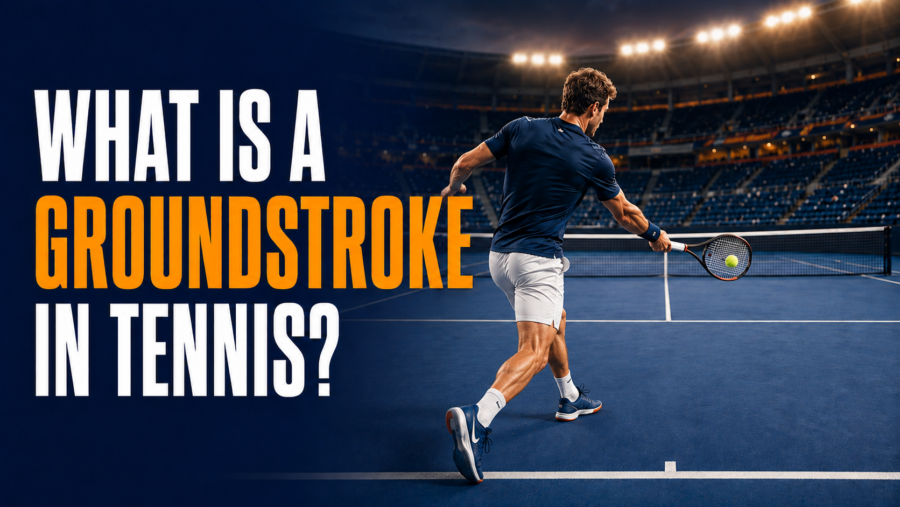
A groundstroke is a tennis shot played after the ball has bounced. It is usually hit from near the baseline as a forehand or backhand, although the defining feature is the bounce rather than the player’s location.
Groundstrokes form the majority of many baseline rallies. A reliable one combines preparation, spacing, racket-face control, a suitable swing path and recovery for the next ball.
Groundstroke Meaning
The official tennis glossary defines a groundstroke as a shot played after the ball has hit the ground. That separates it from a volley, which is struck before the bounce, and from the serve, which starts the point.
The name does not require the player to stand behind the baseline. A forehand hit after a bounce from inside the service line is still a groundstroke, while a ball struck in the air from behind the baseline is technically a volley.
| Shot | Does the ball bounce first? | Typical court position | Main purpose |
|---|---|---|---|
| Groundstroke | Yes | Baseline or mid-court | Rally, defend or attack after the bounce |
| Volley | No | Near the net, but possible anywhere | Take time away and finish or redirect |
| Serve | Player initiates the point without a court bounce | Behind the baseline | Start the point diagonally into the service box |
| Overhead | Usually no | Mid-court or net area | Attack a high ball, often a lob |
| Half-volley | Yes, immediately before contact | Often near the service line or net | Manage a low ball close to the bounce |
A half-volley meets the broad after-the-bounce definition but is usually taught as a specialist shot because its timing and contact are different from a standard baseline groundstroke.
Forehand and Backhand Groundstrokes
Forehand
For a right-handed player, a forehand is normally struck on the right side with the palm side of the hitting hand oriented toward the shot. The sides reverse for a left-handed player.
Forehands are commonly hit with one hand and can use flat, topspin or slice trajectories. How To Hit A Forehand in Tennis owns the complete grip, preparation and swing instruction.
Backhand
A backhand is played on the opposite side, with the back of the racket hand oriented generally toward the shot direction. It may be hit with one hand or two.
The two-handed backhand often provides beginners with additional stability, while the one-handed version has different spacing and preparation demands. How to Hit a Backhand in Tennis explains those techniques in depth.
The Five Parts of a Groundstroke
1. Ready Position and Recognition
The player begins balanced, watches the opponent’s contact and identifies direction, depth, height and pace. A split step timed around the opponent’s strike helps the first movement begin in either direction.
Recognition matters before the swing. Late preparation is often the result of a late read or slow first move rather than simply moving the racket back too slowly.
2. Turn and Preparation
The shoulders and torso turn as the player moves toward the ball. The racket preparation should fit the available time, with a more compact response for fast or deep balls and a fuller preparation when time permits.
Preparation is not a race to create the largest backswing. The purpose is to organize the body and racket so contact can occur at a controllable distance.
3. Spacing and Contact
Footwork creates room between the body and ball. Crowded contact restricts the swing, while excessive distance forces reaching and reduces balance.
The ideal contact point varies with grip, stroke, ball height and whether the backhand uses one or two hands. The general priority is a stable position with the ball far enough in front to control the racket face.
4. Swing Path and Racket Face
Swing path contributes to trajectory and spin, while racket-face orientation strongly influences launch direction. A low-to-high path can support topspin, but the result also depends on face angle, contact quality and racket-head speed.
A flatter drive still needs net clearance and depth control. “Flat” describes relatively less topspin, not a perfectly horizontal ball with no rotation.
5. Finish and Recovery
The follow-through is a result of the swing and can help the player decelerate in control. Its exact shape changes with height, spin, direction and tactical goal.
Recovery begins as the shot is completed. The player should move toward a position that covers the opponent’s likely replies rather than automatically returning to the geometric center of the court.
Groundstroke Spin: Topspin, Flat and Slice
| Groundstroke type | Typical ball behavior | Useful situations | Main risk |
|---|---|---|---|
| Topspin | Curves downward and jumps forward or upward after bounce | Rally margin, angles, passing shots and higher contact | Short ball if the player brushes without driving through enough |
| Flatter drive | More direct path with less arc and rotation | Taking time away and attacking suitable balls | Lower net margin and depth control |
| Slice | Backspin with a lower, often skidding trajectory | Defense, pace change, approach or keeping the contact manageable | Floating short when the face opens excessively |
Spin is not a ranking in which one option is always better. Ball height, court position, time and target should decide the shot.
Understanding Topspin and Slice in Tennis owns the fuller explanation of rotation and ball behavior. A focused comparison of two common forehand trajectories belongs in Topspin Forehand vs. Flat Forehand in Tennis.
Groundstroke Direction and Depth
Cross-Court
A cross-court groundstroke travels diagonally and usually crosses the net near its lower center. The diagonal court is longer than the down-the-line path, creating useful margin for rallying.
Cross-court is not automatically safe if the player is late, off balance or aiming too close to the sideline. A central cross-court target is often more repeatable than a sharp angle.
Down the Line
A down-the-line groundstroke changes the direction of the rally and can expose open court. It travels over a higher part of the net and offers less court length, so timing and balance matter.
Changing direction from a difficult ball increases risk. Strong players often wait for a shorter or more comfortable contact before attacking the line.
Middle of the Court
Deep through the middle can limit an opponent’s angles and reduce the hitter’s target risk. It is a useful neutral option when recovering or when the ball does not support a directional change.
“Middle” should still have a depth goal. A short central ball can give the opponent time to step inside the court.
Height Over the Net
Net clearance is a tactical tool. A defensive ball can use more height to create time and depth, while an attacking ball from inside the court may use a more direct trajectory.
The same clearance does not suit every spin. Topspin can bring a higher ball down into the court, while a flatter drive normally has a narrower vertical margin.
Beginners should first learn to send a comfortable ball safely above the net and into a large target. Painting the lines is not the foundation of consistent groundstroke play.
Groundstroke Footwork
A player rarely receives the ball at the ideal distance without adjustment. The first move covers ground, while smaller final steps help organize spacing and balance.
Open, semi-open and neutral stances are tools, not rigid level labels. The available time, direction of movement and intended recovery influence which stance appears.
After contact, efficient recovery reflects the opponent’s options. Tennis Footwork in 3 Simple Steps covers movement patterns in more detail rather than turning this groundstroke definition into a full footwork course.
Groundstrokes by Court Position
Behind the Baseline
The player has more distance from the net but may be defending against depth. Higher net clearance and depth can create recovery time, while attempting a low-risk winner from a poor position often produces errors.
On or Near the Baseline
Holding position can take time away from the opponent. It also requires earlier preparation because the ball reaches the player sooner.
Inside the Baseline
A shorter ball may allow a more attacking groundstroke. The player can use the closer position to direct the ball, but must also prepare for the next shot or transition toward the net.
Court position changes the appropriate target and trajectory. It should not automatically change every ball into a winner attempt.
A Simple Groundstroke Decision Process
Before choosing the swing, read four conditions:
- Ball: Is it deep or short, high or low, fast or slow?
- Balance: Is the player stable, stretched or recovering?
- Position: Is contact behind, on or inside the baseline?
- Opponent: Where are the open spaces and likely replies?
Then choose one of three broad intentions:
- Neutralize: use height, depth or the middle to regain position
- Rally: send a repeatable ball to a large cross-court or deep target
- Attack: use a suitable shorter ball to take time or open the court
This process prevents the stroke from being judged only by appearance. A technically simple high cross-court ball can be the correct shot under pressure.
How to Practise Groundstrokes
Stage 1: Self-Rally
Drop the ball, tap it upward and control its height before catching it. Progress to several taps and alternate forehand and backhand faces.
Stage 2: Hand Feed
A partner tosses predictable balls to one side while the hitter focuses on spacing, contact and recovery. Use a large central target rather than a line.
Stage 3: Cooperative Rally
Partners rally at a pace that allows several contacts. Count consecutive balls and increase distance only when control is stable.
Stage 4: Directional Pattern
Rally cross-court, then change direction only after a designated ball or short feed. This separates consistency from the more demanding change of direction.
Stage 5: Live Point
Start the point with a feed or serve and award a bonus for the session goal, such as depth or recovery. Remove the bonus once the behavior appears naturally.
The progression is deliberately brief. Dedicated forehand and backhand pages should carry the detailed mechanical instruction, while this page explains how the shot family fits together.
Common Groundstroke Mistakes
Preparing After the Bounce
Waiting for the ball to bounce before turning reduces available time. Begin reading and organizing the body from the opponent’s contact.
Standing Too Close to the Ball
Crowded spacing traps the swing near the body. Use adjustment steps and create room for the intended contact.
Swinging Harder When Balance Is Poor
More effort does not repair a stretched position. A higher, deeper neutral ball may be the better response.
Aiming at Lines During Rally Balls
Small targets increase error without always adding tactical value. Build points with larger zones and reserve narrow targets for suitable attacking opportunities.
Watching the Shot Instead of Recovering
The point continues after contact. Complete the swing in balance and move based on the opponent’s next options.
Forehand-specific problems are covered in 5 Common Forehand Mistakes in Tennis.
Final Explanation
A groundstroke is any tennis shot played after the bounce, most commonly a forehand or backhand from the baseline. Its quality depends on reading the ball, creating space, controlling the racket face and recovering, not simply swinging faster.
Learn a repeatable rally ball first, then add direction, spin and attack according to court position. That foundation connects the individual forehand and backhand techniques to actual point play.
FAQ
Is a forehand always a groundstroke?
No. A forehand describes the side and orientation of the stroke. It can be hit after the bounce as a groundstroke or before the bounce as a forehand volley.
Is a backhand slice a groundstroke?
Yes, when it is hit after the ball bounces. Slice describes the backspin and trajectory, not whether the shot is a groundstroke or volley.
Can a groundstroke be hit near the net?
Yes. Court position does not define it. A ball struck after a bounce from inside the service line is still a groundstroke.
What is the difference between a groundstroke and a rally?
A groundstroke is one type of shot. A rally is the sequence of legal shots exchanged during a point and can include groundstrokes, volleys, lobs and other shots.
Should beginners learn forehand or backhand first?
Both are needed to rally across the court. A coach may introduce one side first for simplicity, but practice should soon develop recognition and movement to each side.
Is topspin necessary for a good groundstroke?
No single spin is correct for every ball. Topspin can add margin, while flatter drives and slice have useful roles when chosen for the contact and target.