
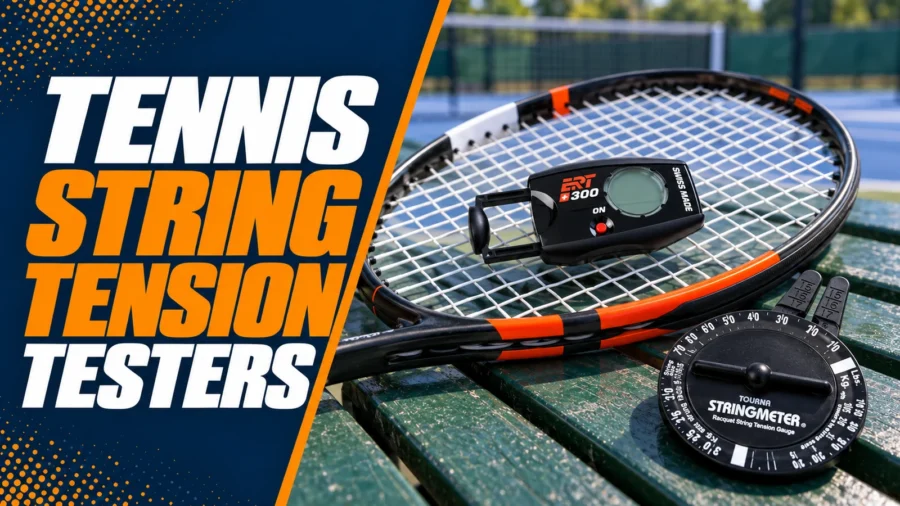
A tennis string tension tester is most useful for tracking how a racket changes after stringing. Depending on the tool, it estimates local string tension, analyzes the sound of the stringbed or measures its dynamic stiffness. Those results are different from the reference tension selected on a stringing machine.
For a player monitoring one or two rackets, a repeatable phone-based measurement or a simple mechanical tester may be enough. A dedicated stringbed device becomes more useful when comparing many string jobs. In either case, establish a fresh baseline and compare later readings with that baseline using the same method.
Reference Tension vs Measured Stringbed Response
If you ask a stringer for 52lb, that figure describes the machine setting used during installation. It does not promise that every string in the finished racket will remain at 52lb.
String friction, clamping, knots, installation method and subsequent settling affect the completed stringbed. Its stiffness also depends on the racket and string construction. A handheld tool displaying a different number is therefore not, by itself, evidence that the stringer used the wrong setting.
Keep three concepts separate:
| Term | What it describes |
|---|---|
| Machine reference tension | The pull setting requested for installation |
| Estimated installed tension | A tool’s estimate based on its measurement method and assumptions |
| Stringbed stiffness or dynamic tension | The resistance of the installed stringbed to deformation, expressed on the tool’s relevant scale |
The guide to choosing a stringing tension covers the first decision. Measuring the racket afterward is a separate task.
The Main Types of Tennis String Tension Tester
Mechanical testers
A mechanical tool applies a small, controlled displacement to the strings and translates resistance into a reading. Its positioning and the way you operate it matter, so follow the exact instructions instead of improvising a twist or pull.
Tourna’s String Meter is one example. Tourna directs users to align its pins at a string intersection, twist into the specified position and take readings across several mains. The purpose is to compare readings again after subsequent play.
This category can be useful for a simple routine without a phone or battery. Its limitation is that a local reading does not describe every aspect of the complete stringbed, and readings from different positions should not be treated as automatically interchangeable.
Sound-based phone apps
Frequency-based apps analyze the sound produced when the strings are tapped. They use that signal, together with the required racket and string information, to estimate tension or stringbed response.
The iOS string-tension app from developer Sten Kaiser provides this approach, including a history of measurements. Its description explicitly distinguishes installed string tension from the original machine setting. Check the developer when choosing between similarly named apps.
A phone app is convenient when you already carry the device and want a record of changes. The main challenges are getting a clean signal, entering the correct setup and using the same measurement procedure each time.
Follow the app’s instructions for racket dimensions, string information and any required string factor. Do not change an input merely to make the displayed result match the number on the stringer’s label.
Dedicated dynamic-tension devices
The ERT300 reports a dynamic-tension value, commonly called DT, representing stringbed stiffness. This is not a pounds reading that can be compared directly with a machine reference.
Its manufacturer defines DT using the force associated with a 1cm stringbed deflection. The supplied conversion disc estimates an equivalent average tension, but that conversion remains an approximation influenced by racket and string characteristics.
A dedicated device can suit a stringer or player who wants a consistent check across repeated jobs. It still needs correct placement and a sensible baseline; purchasing a more expensive tool does not remove the need for a method.
Which Type Should You Buy?
| Your main purpose | Sensible starting option | What to prioritize |
|---|---|---|
| Track one racket over time | Compatible sound-based app | Reliable readings and an easy history log |
| Make quick checks without a phone | Mechanical tester | Clear operating instructions and repeatable placement |
| Compare repeated jobs on matched rackets | Dedicated stringbed device or a well-controlled app routine | Consistency across installations |
| Check a stringing machine’s actual pull | A suitable machine tension calibrator | Compatibility and correct calibration procedure |
A machine calibrator belongs in the last row because it checks a different thing. Measuring a finished racket cannot isolate a calibration fault from all the other variables introduced during stringing.
Before buying, confirm the device supports your racket type, that instructions are available and that your phone can run the app if one is required. An inexpensive tool used consistently is more informative than an advanced tool used differently every week.
How to Establish a Repeatable Baseline
1. Record the complete string job
Write down the racket, string model, diameter, main and cross reference tensions, stringer and installation date. Include both materials when using a hybrid.
If the string family is unclear, use the explanation of different tennis string constructions before creating the record. A nylon setup and a polyester setup should not be compared as though a matching number makes them equivalent.
2. Choose a consistent measurement time
Take a reading soon after the racket is returned, noting the elapsed time since stringing. A further reading before the first playing session can help distinguish initial settling from later change through use.
For future jobs, repeat the same timing as closely as practical. Comparing one racket immediately off the machine with another several days later adds a variable that can obscure the result.
3. Follow the tool’s placement and holding method
For the ERT300, the manual specifies central placement, holding the racket steady and avoiding contact with the stringbed during measurement. It also warns that moving the device away from the center changes the reading.
For a mechanical tester, repeat the same locations and operating motion. For a sound-based app, follow its tapping, holding and microphone guidance in a quiet environment, removing accessories when the instructions require it.
4. Repeat enough to check your technique
As a practical routine, take three measurements without changing the setup. If they differ substantially, check positioning or signal quality before recording a value.
Do not simply select the reading closest to your expectation. Save the individual results or a representative value once the method is repeatable, and use the same recording rule next time.
Track Change With the Same Tool
Use a log that combines the measurement with playing observations:
| Date | Time since stringing | Playing time since last check | Tool and reading | Playing observations |
|---|---|---|---|---|
| Baseline | Record actual interval | None | Record value and unit | Fresh setup |
| Next check | Record interval | Record use | Same method | Depth, control, feel and visible wear |
If the baseline is 40DT and a later reading is 36DT, the measured DT has fallen by 10%. That does not establish a 10% reduction in spin, remaining life or the original machine setting.
Avoid combining a mechanical reading, an app estimate and DT into one trend line. Even when two tools both display pounds, their methods and assumptions can differ.
Can a Tester Tell You Exactly When to Restring?
A tester can flag change, but it cannot define a universal replacement point. Pair its result with visible notching, fraying, unusual string movement and a meaningful change in your normal shots.
Research on used strings shows that performance changes involve friction and string movement as well as tension and stiffness. A single number therefore cannot diagnose the entire condition of the stringbed.
Use the factors in when to change tennis strings alongside the log. Over several string jobs, you may identify the measurement range in which a particular setup stops working well for you.
That personal pattern should stay attached to the same racket, string and measurement method. It is not automatically transferable to a different material or another player’s setup.
Common Measurement Mistakes
- Treating an app’s estimate as proof of the exact original machine setting.
- Comparing readings taken at different string intersections or device locations.
- Changing string details in the app to obtain an expected result.
- Measuring one racket cold and another immediately after different playing conditions.
- Assuming a low reading proves that a string is comfortable or safe for an injured arm.
- Keeping damaged or unpleasant strings because a display remains inside a preferred range.
If the next job needs a different reference setting, the string tension calculator can help frame that discussion. It estimates a starting setting; it does not measure the racket you are holding.
The most useful tester is the one you can use repeatably. Establish the baseline, keep the method consistent and connect the numbers to actual play before using them to guide a restring.