
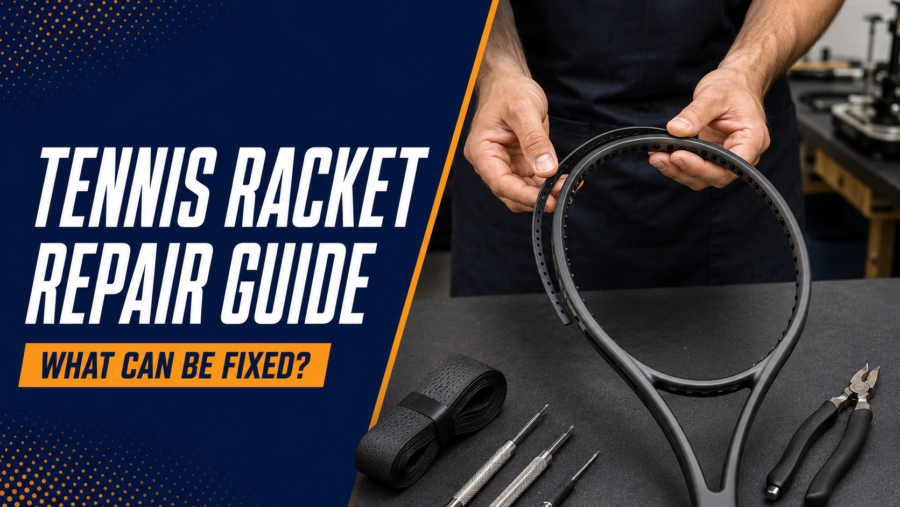
A tennis racket can often be restored when the problem is a worn stringbed, grip, butt cap, bumper guard or grommet set. Damage to the load-bearing frame is different. A crack, split, deformation or exposed composite fibers should be assessed before the racket is played with or restrung.
The safest decision depends on what is damaged, whether a compatible part still exists and whether the frame remains structurally sound. This guide helps separate routine service from damage that deserves a professional opinion or replacement.
Quick Repairability Guide
| Problem | Usually repairable? | Sensible next step |
|---|---|---|
| Broken or badly worn strings | Yes | Inspect the frame and grommets, then restring to the manufacturer’s instructions |
| Worn overgrip | Yes | Remove and replace the overgrip |
| Damaged replacement grip | Yes | Replace it and check the handle underneath |
| Loose butt cap | Often | Have the cap and handle structure inspected, then refasten or replace the correct part |
| Split or missing grommet | Often | Replace the correct grommet set or let a qualified stringer assess a limited protective repair |
| Worn bumper guard | Often | Fit a compatible model-and-generation-specific replacement |
| Rattle inside the frame | Sometimes | Ask a technician to identify and remove loose material if accessible |
| Paint chip or surface scuff | Cosmetic if only the finish is affected | Clean, photograph and monitor it; inspect further if the area changes |
| Exposed graphite, soft spot or suspected delamination | Uncertain and potentially structural | Stop using the racket and obtain a professional assessment |
| Cracked, split, crushed or visibly distorted frame | Generally not a routine repair | Do not play or restring it until assessed; replacement is usually the prudent option |
“Repairable” does not always mean “restored to factory condition.” A replaced consumable part can return its intended protection or function, while a structural composite repair may alter weight, balance, stiffness or long-term reliability.
Start by Identifying the Damaged Part
A modern performance racket is a system rather than one solid component. The stringbed is supported by plastic grommets, the top of the hoop is protected by a bumper guard, and the handle normally includes a grip, butt cap and an underlying handle structure.
Those removable or consumable parts are serviceable on many rackets. The frame itself carries the stringing load and repeated impact forces, so suspected frame damage needs a much more cautious response.
If the racket has taken a heavy impact, inspect the whole frame rather than only the contact point. Manufacturer safety guidance notes that an impact can load more than the visibly affected area, and damage may become apparent later.
Is It a Paint Chip or a Structural Crack?
A paint chip affects the finish. A structural crack extends into the frame material or indicates separation, crushing or deformation beneath the finish. Unfortunately, a photograph or fingernail test cannot prove that a suspicious line is harmless.
Use these signs to decide whether professional inspection is warranted:
- The line crosses through the finish and appears to continue into the frame.
- Composite fibers are visible.
- The area opens, flexes or changes when handled gently.
- The hoop no longer looks symmetrical.
- There is a soft, crushed, raised or separated area.
- A new clicking or creaking sound appears near the damage.
- Strings near the area repeatedly break or sit against an unprotected frame edge.
- The mark followed a hard collision with the court, net post, fence or another racket.
Do not bend, squeeze or strike the frame to test it. If the damage is uncertain, stop using the racket and let an experienced racket technician inspect it without loading it on a stringing machine.
Photographing the area in clear light can help with monitoring and a warranty inquiry. A line that grows, changes shape or begins exposing fibers should not be treated as a cosmetic mark.
String and Stringbed Repairs
Broken strings are normally a routine service issue, provided the frame and grommets are sound. A stringer should inspect the hoop, bumper and grommet barrels before mounting the racket.
Restringing is not a way to repair a damaged frame. The machine applies significant controlled loads around the hoop, so a suspected crack or distortion should be resolved before a new stringbed is installed.
Players who want to understand the full installation process can use How to String a Tennis Racket Step by Step as a separate procedure guide. If the strings are intact but have become notched, frayed, unresponsive or inconsistent, What Happens If You Never Restring Your Racket? explains why physical breakage is not the only replacement signal.
Never glue, knot or splice a broken tennis string and expect the original stringbed to be restored. The practical repair is a complete restring using the frame’s published pattern and tension guidance.
Grommet and Bumper Guard Repairs
Grommets form a protective interface between the strings and the frame. A split, flared, collapsed or missing grommet can leave a string resting against a sharp frame edge, increasing localized wear.
The bumper guard protects the upper hoop from abrasion against the court. Once it has worn through, the underlying frame may be exposed. Replacing the plastic protection can help prevent further wear, but it cannot reverse graphite that has already been ground away.
Full bumper-and-grommet sets are commonly specific to the exact racket model, head size, string pattern and generation. A part with a similar family name may still have different hole spacing or geometry.
Manufacturers that sell replacement sets generally instruct the installer to remove the strings first. Installation can be awkward, and forcing the wrong grommet barrel through the frame can create another problem. A stringer is the sensible choice when the fit is uncertain.
When a complete set is unavailable, a qualified technician may be able to protect an isolated hole with purpose-made tubing or an individual grommet. That is a limited string-protection solution, not a repair for a cracked hoop.
Grip, Handle and Butt Cap Repairs
A dirty or slippery overgrip is simple to replace. The dedicated How to Change a Tennis Overgrip guide covers that routine task without turning it into a frame repair.
A worn replacement grip can also be removed and replaced. Once it is off, inspect the underlying handle for cracks, movement, moisture damage or missing material before covering it again.
A loose butt cap may be refastened or replaced when the handle beneath it remains sound. If the cap moves because the handle material is crushed or split, repeatedly adding staples, tape or adhesive can hide the real issue. A technician should determine whether the handle can hold the part securely.
Handle construction and serviceability vary by brand and model. A technician should confirm compatibility before removing or replacing underlying handle material. Deliberately changing grip shape, weight or balance belongs in the Tennis Racket Customization Guide, because that work changes the setup rather than simply restoring it.
Can a Cracked Graphite Frame Be Repaired?
Composite-repair businesses may offer to rebuild a cracked area with carbon reinforcement and resin. Whether that work is technically possible is not the same as whether the racket will retain its original playing characteristics, withstand stringing safely or remain eligible for a manufacturer’s warranty.
A structural repair introduces new material and a new bond into a carefully engineered frame. The result may have a different local stiffness, mass distribution and surface profile. It should not be described as “like new” without objective evidence specific to that repaired racket.
For most players, a visible structural crack, crushed section, delamination or significant deformation makes replacement the lower-risk decision. A specialist assessment may still be worthwhile for a rare or sentimental frame, but the service should explain its inspection method, limits, post-repair checks and warranty in writing.
Do not attempt to restore a structural frame with household glue, filler, tape, heat or drilling. These methods can conceal damage, complicate professional assessment and affect warranty eligibility without establishing that the frame is safe to string or play.
What About an Internal Rattle?
A rattle can come from a small piece of loose material inside the frame or handle. It is annoying, but it does not identify its own cause or prove that the frame is structurally damaged.
A technician may be able to locate and remove the loose piece through the handle or an accessible opening. If the noise began after a major impact or appears alongside a crack, movement or deformation, treat the impact damage as the priority rather than assuming the problem is only debris.
When a Racket Should Not Be Restrung
Do not ask a stringer to proceed automatically when any of these conditions are present:
- A crack, split, soft spot or crushed section is visible in the hoop, throat or shaft.
- The frame is warped or no longer symmetrical.
- Composite fibers are exposed where the bumper has worn through.
- Several grommets are missing and strings would contact the frame directly.
- The handle moves independently of the throat or the butt cap cannot be secured to sound material.
- The racket has just suffered a severe impact and the condition is uncertain.
A professional stringer can inspect the racket and decline work that would be unsafe or unreliable. Certification directories from racket-service organizations can help owners find trained technicians, although certification does not turn every damaged frame into a repair candidate.
Check the Warranty Before Authorizing Work
Warranty terms vary by manufacturer, region and purchase channel. They commonly distinguish defects in materials or workmanship from impact damage, normal wear, faulty stringing, misuse and unauthorized repair.
Before altering a relatively new racket:
- Stop using it and leave the damaged area unchanged.
- Find the receipt and exact model information.
- Photograph the full racket and the damaged area clearly.
- Contact the authorized retailer or manufacturer for the applicable claim process.
- Ask whether removing strings or attempting a repair would affect the claim.
Do not assume that a crack is covered, but do not erase useful evidence before the seller has reviewed it. The manufacturer’s current regional policy controls, not a general rule found on a forum.
Repair or Replace? Use This Decision Checklist
| Question | Why it matters |
|---|---|
| Is the frame itself structurally damaged? | Structural uncertainty weighs strongly toward replacement |
| Is the problem limited to a replaceable component? | Strings, grips, grommets, bumpers and butt caps are often serviceable |
| Is the exact replacement part available? | Similar-looking parts may not fit another generation |
| Will the repair require restringing? | Labor and a new stringbed are part of the decision |
| Is there a valid warranty route? | Unauthorized work may affect eligibility |
| Can a technician verify a safe, secure result? | Appearance alone does not confirm structural integrity |
| Would changed weight or stiffness matter? | Structural additions can change how a matched racket performs |
| Is a reliable replacement available? | A sound replacement is usually preferable to an uncertain competition frame |
If the frame is near the end of its useful life, How Long Does a Tennis Racket Last? explains the difference between calendar age, normal wear and actual replacement signs. Players choosing a new frame can then use the Ultimate Tennis Racket Buying Guide to compare specifications rather than trying to preserve an unsafe racket at any cost.
How to Speak With a Racket Technician
Bring the exact racket, not only a close-up photograph, when practical. Explain when the issue appeared, whether there was an impact, whether the sound or mark has changed, and when the racket was last restrung.
Useful questions include:
- Is the damage limited to a replaceable part?
- Is the correct model-and-generation-specific part available?
- Must the strings be removed before the work?
- Is the frame safe to mount and restring?
- Will the proposed work alter weight, balance or grip shape?
- Does the service warranty the work, and what does that warranty exclude?
A careful technician should be willing to say that a frame is not a sensible repair candidate.
Frequently Asked Questions
Can a cracked tennis racket still be used?
A suspected structural crack should be assessed before further play or restringing. Continuing to use it can enlarge the damage, and the frame’s appearance alone cannot establish that it will handle impact and stringing loads safely.
Can a bumper guard be replaced?
Yes, if a compatible set is available and the underlying frame remains sound. Full replacement commonly requires the strings to be removed, and the part must match the exact model, head size, pattern and generation.
Can one broken grommet be repaired without replacing the full set?
Sometimes. A qualified stringer may use an individual grommet or protective tubing for an isolated damaged hole. That solution protects the string and does not repair structural frame damage.
Is a loose butt cap a serious problem?
It is often repairable, but the handle beneath it must be solid enough to hold the cap securely. Movement caused by crushed or split handle material needs assessment rather than another layer of tape.
Does paint damage weaken a tennis racket?
A mark confined to the finish is cosmetic. The difficulty is confirming that the material underneath is unaffected, especially after a hard impact. Monitor the area and seek an inspection if it opens, flexes, changes or exposes fibers.
Is structural racket repair worth it?
It may be considered for a rare or sentimental frame after specialist assessment. For a regular playing racket, replacement is usually more predictable because a structural repair may change the frame and cannot automatically recreate factory condition.