
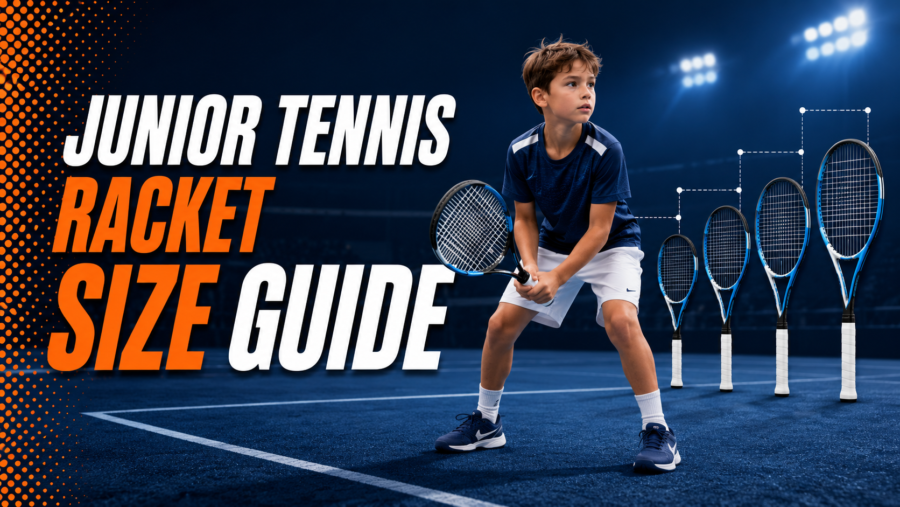
Junior tennis racket size is based mainly on the child’s height and ability to control the frame, with age used only as a quick starting point. Most junior rackets are 17in, 19in, 21in, 23in, 24in, 25in, or 26in long. A 27in racket is a full-size adult frame and should be considered only when the player is tall and physically ready enough to swing it without changing technique.
Use the chart below to narrow the choice, then check the racket beside the child and watch several normal swings. If two sizes appear suitable, the shorter, easier-to-control option is normally the better first comparison.
Junior Tennis Racket Size Chart by Age and Height
| Racket length | Approximate age | Approximate height | Best used as |
|---|---|---|---|
| 17in | 2–3 | Under 90cm | First coordination activities with a very short, light frame |
| 19in | 3–4 | 90–105cm | Early mini-tennis and simple contact skills |
| 21in | 4–6 | 105–120cm | Beginner lessons and short-court rallying |
| 23in | 6–8 | 120–130cm | Developing full swings and more consistent rallies |
| 24in | 7–9 | 125–135cm | A transition between 23in and 25in when available |
| 25in | 8–10 | 130–140cm | Regular lessons, rallies, and junior competition |
| 26in | 9–12 | 140–150cm | The final common junior step before an adult racket |
| 27in | Usually 11+ | Over 150cm and physically ready | A full-size frame for a junior who can control its length, mass, and swingweight |
These ranges overlap because children of the same age can differ substantially in height, strength, coordination, and experience. Current manufacturer guides also use slightly different age bands. Treat the chart as a screening tool, not a rule that every child must follow.
When age and height point to different rows, begin with the height-based suggestion. The final choice should still be confirmed by how naturally the child can hold, prepare, swing, stop, and recover with that particular racket.
Should You Choose a Junior Racket by Age or Height?
Height is usually the more useful starting measurement. Age bands are based on average growth, so they become less reliable for a child who is notably taller or shorter than peers.
Age still helps a parent find the likely area of the junior range quickly. For example, a five-year-old will often begin around 21in, but a tall five-year-old may compare 21in with 23in. A shorter or less physically developed player may be better served by the smaller option.
Playing experience matters most after an appropriate physical size has been found. An experienced junior may benefit from a more stable graphite version of the correct length, but experience does not make an oversized frame easy to control.
The broader junior tennis guide for parents and players explains balls, courts, lessons, and competition. This page stays focused on choosing racket length and fit.
How to Measure a Child for a Tennis Racket
1. Measure height in tennis shoes
Have the child stand upright in the shoes normally worn on court. Use the height column in the chart to identify one likely size and, when close to a boundary, the neighboring size.
Do not round a measurement upward simply to buy a racket the child can grow into. The purpose is to fit the player now.
2. Check the racket beside the body
Ask the child to hold the racket normally with the arm relaxed beside the body and the head pointing down. Manufacturer guidance commonly uses a small clearance between the racket head and the floor, around 5cm, as a practical reference.
This is not a universal pass-or-fail test. Arm length, posture, grip position, and racket geometry all affect the gap. If the racket strikes or drags on the ground in a relaxed position, it is a strong sign that the frame is too long.
3. Watch several relaxed swings
Ask for a few forehand and backhand shadow swings, then simple contact with an appropriate low-compression ball if possible. Look for a complete motion with stable posture rather than a shortened swing designed to manage the racket.
Try the smaller size if the child:
- struggles to lift or position the racket head
- grips much harder just to control the frame
- contacts late because the racket is slow to arrive
- loses balance during an ordinary swing
- cannot stop the racket safely after the follow-through
A child may pass the beside-the-body check yet still find a heavier performance model too demanding. Length and swingability both have to work.
4. Compare adjacent sizes when uncertain
If the child is near a height boundary, compare both sizes rather than choosing from the chart alone. Use similar balls and simple swings so the difference comes from the rackets, not a harder drill.
The shorter option is normally the safer starting point when control is unclear. Moving up later is more useful than spending months compensating for a frame that is too long.
Junior Tennis Racket Sizes Explained
17in junior rackets
A 17in racket is the shortest common retail size. It is intended for very young children, often under 90cm tall, who are beginning with balance, tracking, rolling, and simple contact activities.
At this stage, easy handling matters more than advanced frame technology. A very light, correctly sized racket and an age-appropriate ball give the child a better chance of moving the frame independently.
19in junior rackets
A 19in racket commonly suits children around 90–105cm tall. It adds a little reach over a 17in frame while remaining short enough for early coordination work and mini-tennis.
Compare 17in and 19in if a child is near 90cm. The 19in option should not drag on the court or require the player to lift the shoulder to keep the head clear.
21in junior rackets
A 21in racket is a common choice around 105–120cm. Many four-to-six-year-old beginners fall in this range, although height should decide whether 19in, 21in, or 23in deserves the first trial.
Most 21in rackets are pre-strung and built for easy handling. The child should be able to prepare early, swing through contact, and recover without the racket head controlling the movement. Suitable low-compression balls are also more important at this stage than buying a more advanced frame, so include them in the child’s beginner tennis equipment.
23in junior rackets
A 23in racket generally suits a child around 120–130cm. It is often used when players begin rallying more consistently and developing fuller forehand and backhand motions.
This size is available in simple aluminum versions and more performance-oriented constructions. Choose the version that remains manageable rather than assuming the more expensive frame is automatically the better fit.
24in junior rackets
A 24in racket fills the smaller transition between 23in and 25in. It can be useful around 125–135cm when a 23in frame is clearly short but a particular 25in model is still difficult to control.
Not every brand offers 24in. Its absence does not mean a child must move to 25in immediately. Comparing the mass and handling of available 23in and 25in models can identify the better temporary fit.
25in junior rackets
A 25in racket commonly suits players around 130–140cm. This category includes both light recreational frames and graphite performance rackets for juniors who train or compete regularly.
That construction difference can be significant. Two 25in rackets may share a length but differ in mass, balance, stiffness, and swingweight. Test the exact frame rather than buying by length alone.
26in junior rackets
A 26in racket is the final common junior length before a standard adult frame. It often suits players around 140–150cm who have outgrown 25in but are not yet ready for the reach and physical demand of 27in.
There is no need to rush through this stage. A suitable 26in graphite racket can support serious training and competition while preserving faster preparation and cleaner timing than an adult frame the player cannot yet manage.
27in adult rackets
A 27in racket is not a junior size. It becomes an option when the player is generally over 150cm, controls a 26in racket comfortably, and can swing a suitable lightweight adult model without shortening the motion or losing balance.
The adult category introduces a much wider spread of mass, balance, swingweight, head size, and stiffness. Length readiness does not mean every 27in racket is appropriate. The tennis racket buying guide explains how those specifications work together once the junior is ready to compare adult frames.
When Should a Junior Move Up a Racket Size?
Consider the next length when the current racket leaves a large floor gap in the beside-the-body check, looks visibly short through normal strokes, or limits reach after the child has grown. Confirm the change by comparing the next size during ordinary swings and rallies.
Do not move up only because:
- a birthday has passed
- a teammate uses a longer racket
- the child has started competing
- a professional player promotes an adult model
- the larger racket appears to offer better value over time
Growth and improved strength can change the answer quickly, so reassess fit periodically. There is no required schedule for progressing from one length to the next.
Length Is Not the Only Fit Question
Static mass and swingability
Static mass is the weight shown on a scale. Swingability also depends on where that mass is placed, so two rackets with the same length and stated weight can move differently.
Ask the child to repeat several swings, not just lift the racket once. The player should remain balanced and maintain roughly the same preparation as repetitions continue.
Grip size
Many recreational junior rackets come in one manufacturer-selected grip size. Some 25in and 26in performance models provide more choice.
The handle should allow a secure but relaxed hold. Do not build up a very small junior handle with many overgrips simply to imitate an adult measurement, because that also changes shape and mass. Older juniors approaching adult frames can use the tennis grip size calculator as a reference and then confirm fit on the actual racket.
Aluminum, composite, and graphite construction
Aluminum junior rackets are generally affordable and easy to handle, making them practical for beginners and occasional play. Composite designs occupy the middle of the market, while graphite performance frames are commonly offered at 25in and 26in for regular training and competition.
Material does not replace correct sizing. A premium graphite frame that overwhelms the player is a worse fit than a simpler racket of the correct length and manageable mass.
Head size and other specifications
Junior models can also differ in head size, string pattern, beam, and stiffness. These details matter more as the player progresses, but they should be considered after length and handling have been solved.
For a focused explanation of adult and junior dimensions, use the tennis racket size guide. Once the player has moved into adult frames, compare mass, swingweight and head size against the player’s current development rather than choosing only from an age label.
Common Junior Racket Sizing Mistakes
Buying a racket to grow into
An oversized racket may look economical, but it asks the child to compensate during the period when coordination and swing patterns are developing. Fit the current player and reassess after meaningful growth.
Choosing entirely by age
Age bands are convenient averages. Height, arm length, strength, coordination, and actual handling can point to a different size.
Treating the ground check as the only test
The beside-the-body check identifies obvious length problems but does not reveal whether the child can accelerate and stop the exact racket. Always add a swing check.
Assuming every racket of one length is equal
A 26in aluminum beginner model and a 26in graphite performance model can have different mass distribution and physical demand. Compare the exact products in the child’s normal playing conditions.
Moving directly from 25in to a demanding adult frame
The 26in category exists for a reason. It can preserve junior-friendly handling while adding reach and performance for a growing player.
A Simple Junior Racket Decision Checklist
Before choosing, confirm that:
- the height chart points to this size or an adjacent size
- the racket does not drag during the relaxed beside-the-body check
- the child can make repeated forehand and backhand swings without losing balance
- the frame does not force a shortened preparation or follow-through
- the grip permits a secure, relaxed hold
- the exact model remains manageable after several repetitions
- the choice fits the player now rather than an expected future height
If several checks are unclear, compare the next shorter model. A coach or qualified retailer can also observe the child with both sizes.
Frequently Asked Questions
What size tennis racket should a five-year-old use?
A 21in racket is a common starting point for a five-year-old, especially around 105–120cm tall. Compare 19in or 23in when the child’s height and handling fall outside that range.
What size tennis racket should a seven-year-old use?
Many seven-year-olds begin with 23in, but a height around 120–130cm is a better indicator than age alone. A 24in or 25in option may suit a taller child who can control it.
What size tennis racket should a nine-year-old use?
A 25in racket is a frequent choice around 130–140cm. A smaller player may still suit 23in or 24in, while a taller, physically ready player can compare 26in.
What size tennis racket should a twelve-year-old use?
A twelve-year-old may use a 26in junior racket or a suitable 27in adult model. Height over about 150cm is one indicator, but repeated swing control and the adult racket’s mass and swingweight should make the decision.
Is the larger size better when a child is between two rackets?
Not automatically. Compare both, and choose the shorter frame when the larger one changes timing, balance, grip pressure, or swing shape.
Can a junior keep using a 26in racket for competition?
Yes, if the competition permits it and the frame fits the player. Competition level alone is not a reason to move to 27in before the junior can control it.
How often should junior racket size be checked?
Recheck after noticeable growth or when the current frame appears short. There is no universal calendar interval because children grow at different rates.
The right junior racket is the one the child can control now. Height identifies the likely length, while the beside-the-body check, repeated swings, and the exact frame’s mass determine whether that length actually fits.