
Affiliate disclosure: This page contains affiliate links. If you make a purchase through one of these links, Tennis Overload may earn a commission at no additional cost to you.
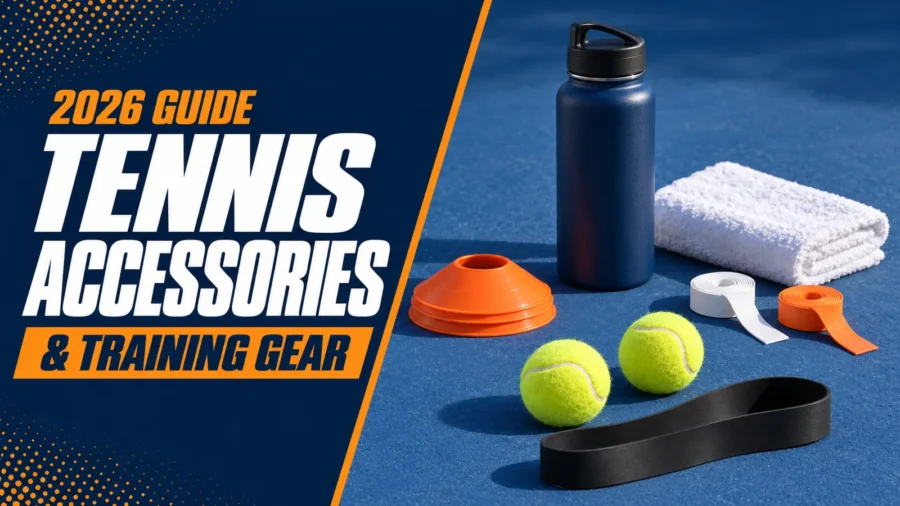
The best tennis accessories solve a real court problem: maintaining grip, carrying enough balls, organizing practice, staying hydrated, or protecting equipment. For most players in 2026, a few inexpensive essentials will improve a session more than a bag full of gadgets.
Start with overgrips, a water bottle, a towel, and suitable tennis balls. Add a hopper, targets, resistance bands, or a training device only when it matches how and where you practice.
Tennis Accessories Worth Buying First
| Accessory | Best for | Priority |
|---|---|---|
| Overgrips | Reliable grip feel and sweat management | Essential |
| Insulated water bottle | Hydration during long or hot sessions | Essential |
| Small towel | Hands, handle, and face between points | Essential |
| Extra tennis balls | Drills, warm-ups, and replacing worn balls | Essential |
| Cap or visor | Shade and glare management | Situational essential |
| Broad-spectrum sunscreen | Outdoor sun protection | Situational essential |
| Ball hopper or basket | Repetitive feeding and serve practice | High value for regular practice |
| Cones or flat targets | Placement and movement drills | High value for regular practice |
| Resistance bands | Portable warm-up and strength exercises | Useful when used correctly |
| Rebounder or ball machine | Independent repetition | Useful for specific practice needs |
This order is deliberate. A premium sensor cannot compensate for a slipping handle, flat practice balls, or a session cut short because you did not bring water.
1. Overgrips
An overgrip wraps over the base grip and changes the surface feel, moisture handling, and effective handle size. It is one of the least expensive ways to keep the racket secure without squeezing harder.
Choose between two broad types:
- Tacky overgrips feel slightly adhesive and suit players who want the handle to feel locked in.
- Dry-feel or absorbent overgrips suit players whose hands become wet quickly.
Tourna Grip Original XL remains a widely available dry-feel option designed for moisture-heavy conditions. Wilson Pro Overgrip is a familiar tackier alternative with a softer feel. Neither is universally better, because hand moisture, climate, and personal preference matter more than marketing labels.
Replace an overgrip when it becomes slick, hard, torn, or visibly compressed. Frequent players and heavy sweaters may need to change it far more often than occasional players. Follow the overgrip replacement guide to keep the overlap even and avoid a bulky ridge.
2. An Insulated Water Bottle
An insulated bottle keeps water more pleasant during long outdoor sessions and makes it easier to monitor whether you brought enough. A wide opening is useful for ice and cleaning, while a secure lid matters in a crowded tennis bag.
Choose a capacity that fits your court access and session length. Hydration needs vary with heat, humidity, body size, effort, and individual sweat rate, so a universal amount is not appropriate. Drink regularly, use changeovers, and follow medical guidance if you have a condition that affects fluid or electrolyte needs.
3. A Small Court Towel
A compact absorbent towel has several jobs: drying hands, wiping sweat from the face, and keeping the grip surface usable. A second small towel can be reserved for the racket handle so sunscreen and skin oils are not transferred back onto it.
Microfiber dries quickly and packs small, while cotton may feel softer and absorb well. Whichever material you choose, wash it regularly and let it dry fully before returning it to a closed bag.
4. The Right Tennis Balls
Practice quality depends on consistent balls. Worn pressureless balls can still work for some feeding drills, but dead pressurized balls change the bounce, timing, and depth enough to distort live-ball practice.
Use regular-duty felt primarily on softer indoor or clay-style surfaces and extra-duty felt primarily on hard courts, while following the ball manufacturer’s surface guidance. High-altitude balls are designed for locations where standard balls can play unusually fast. Beginners and children may need stage balls with lower compression rather than standard yellow balls.
The tennis ball buying guide compares ball types by surface and player level.
5. A Ball Hopper or Basket
A hopper saves repeated bending and makes serve, feed, and target practice more efficient. Capacity matters, but stability, handle height, wire construction, and a secure lid matter too.
The Gamma Ballhopper Hi-Rise 75 is a practical example of the category. It holds 75 balls, uses handles that convert into a standing basket, and includes a locking lid and wear bumpers. The Gold version adds heavier-gauge carbon-steel wire and reinforced side welds. It is useful for a coach or player who feeds regularly, but a simple pickup tube may be lighter and cheaper for smaller sessions.
Before buying, consider:
- How many balls you actually use in one drill
- Whether the hopper fits in your car and storage space
- Whether you need wheels for larger loads
- Whether children can safely carry and operate it
- Whether a zippered bag would be quieter and easier to transport
Players who feed only occasionally should compare the hopper’s cost and storage space with a simpler pickup tube or zippered ball bag.
6. Cones, Lines, and Flat Targets
Targets turn a vague instruction such as “hit deeper” into visible feedback. Flat rubber spots are safer than tall cones in landing areas because they are less likely to interrupt footwork. Cones are better for movement routes placed away from normal ball contact.
You do not need a branded target system. Low-profile markers, painter’s tape where permitted, or spare ball cans can define zones. Make targets large enough to reward a high-percentage ball, then reduce the area only after accuracy improves.
Useful target drills include:
- Three serve zones: wide, body, and T
- A deep crosscourt rectangle for neutral rally balls
- A short-ball zone that triggers an approach
- Recovery markers near a realistic base position
- A large return target through the middle
7. Resistance Bands
Light resistance bands are portable and useful for a structured warm-up, shoulder rotation exercises, and lower-body activation. They are not a shortcut to serve speed and should not be used to imitate a full-speed stroke under heavy resistance.
Use a band with intact material, anchor it securely, and keep the movement controlled. Exercise selection and resistance should match your training history. If an exercise causes pain, stop and seek qualified guidance rather than forcing the range.
8. A Cap, Visor, and Sports Sunglasses
A cap or visor can reduce overhead glare and keep sweat away from the eyes. Choose a lightweight, breathable design that stays secure during sprints. A dark underbrim may reduce reflected light for some players.
Sports sunglasses should fit close enough to stay stable without pinching. Look for impact-resistant lenses and clear ultraviolet protection information. Lens color affects contrast and visible-light transmission, but the darkest lens is not automatically the best for every condition.
9. Broad-Spectrum Sunscreen
Outdoor players should use broad-spectrum sunscreen with SPF 30 or higher on exposed skin and reapply according to the product label, especially after heavy sweating or toweling. Water resistance describes a tested time period; it does not mean waterproof.
Combine sunscreen with shade, clothing, a hat, and sensible scheduling when possible. Keep the bottle in a sealed pouch so a leak does not coat grips and strings.
10. A Dedicated Tennis Bag
A tennis bag protects rackets and separates damp clothing, shoes, food, and small accessories. The right size depends on whether you carry one racket for a local session or several frames, footwear, and coaching equipment.
Useful features include:
- A padded racket compartment
- Ventilated shoe or clothing storage
- A small pocket for keys and valuables
- An insulated or heat-resistant section, with realistic expectations about extreme temperatures
- Comfortable straps that suit the loaded weight
- A shape that fits your normal transportation and storage
A backpack is often enough for one or two rackets. A larger six- or nine-racket bag suits league travel, tournament days, or coaching. Compare the formats in the guide to the best tennis bags and backpacks.
11. A Basic First-Aid and Repair Pouch
A small pouch can hold adhesive bandages, blister dressings, athletic tape, spare dampeners, an extra overgrip, a shoelace, and any personal medication you are instructed to carry. It is for minor, routine needs, not for treating a serious injury.
Check expiration dates and replace used items. Know the venue’s emergency process and stop play for severe pain, suspected head injury, breathing difficulty, chest symptoms, or other urgent concerns.
Tennis Training Gear for Solo Practice
Training gear is valuable when it improves feedback or repetition without teaching a compensating movement. Begin with the simplest tool that solves the problem.
Rebounders and practice walls
A rebounder or solid practice wall provides continuous balls without a partner. It is useful for rhythm, compact preparation, volleys, and movement, but it cannot reproduce every depth, spin, or decision from a live opponent.
Mark a safe net-height line and target areas if the facility allows it. Vary distance and tempo rather than hitting every ball at maximum pace. The solo tennis practice guide includes wall, serve, footwork, and self-feed sessions.
Ball machines
A ball machine can deliver repeated feeds to a chosen location, which helps isolate movement patterns and contact points. Random modes can add variation, but even advanced machines do not read your positioning or make tactical decisions like a partner.
Compare capacity, feed rate, spin controls, remote operation, battery life, transport weight, and warranty. Plan every session around a goal, such as recovering after a wide forehand, instead of standing still and accumulating swings.
Swing-path trainers
Devices such as the TopspinPro provide a physical reference for a low-to-high racket path and brushing contact. They can help a beginner understand a movement concept at low speed, but they do not prove that the same stroke will transfer automatically to a moving ball.
Use short sets, alternate quickly with normal balls, and check that the device is not forcing an uncomfortable joint position. Video and qualified coaching can reveal whether the intended pattern transfers to live hitting.
Phone tripod
A stable tripod turns a phone into a useful feedback tool. Record from behind the baseline for direction and spacing, then from the side for contact point and recovery. Keep the device outside the playing area, obtain permission before recording others, and follow facility rules.
Short clips are easier to review than an entire session. Compare one variable at a time under similar conditions rather than judging technique from a single swing.
Accessories for Coaches
Coaches usually gain more from durable, versatile equipment than from specialized gadgets. A large basket, low-profile targets, cones, a clipboard or tablet protected from weather, spare grips, and an accessible first-aid kit cover most sessions.
The guide to essential equipment for tennis and padel coaches focuses on group management and feeding. Label equipment and inspect baskets, bands, nets, and target straps regularly so a worn item does not become a court hazard.
What Beginners Actually Need
A beginner does not need every item in this guide. A suitable racket, court-specific shoes, a few appropriate balls, water, sun protection, and comfortable clothing are enough to start. An extra overgrip and small towel make the first sessions easier.
Use the beginner tennis equipment checklist before adding training tools. Spend first on court time, instruction, and equipment that fits. Specialized accessories make sense after a recurring practice need becomes clear.
What to Skip
Avoid accessories that promise instant power, perfect technique, or injury prevention without explaining how they work. A tool that fixes the racket or arm into one path may not suit different grips, body dimensions, or strokes.
Also skip products that duplicate something you already own. A set of flat markers can support dozens of drills; several single-purpose plastic devices may stay in the bag. Check independent return policies, warranty terms, replacement parts, and actual packed dimensions before buying.
How to Build a Useful Tennis Kit
Buy in layers. First, cover grip, hydration, balls, sun, and basic storage. Next, add targets and a collection tool if you practice often. Finally, consider a rebounder, ball machine, or swing aid when it supports a defined training plan.
Keep the kit clean and ready. Remove damp clothes, wipe dirt from shoes before it hardens using a material-safe method, replace worn grips, and check ball pressure before a session. The most useful accessory is the one that reliably gets used on court.