
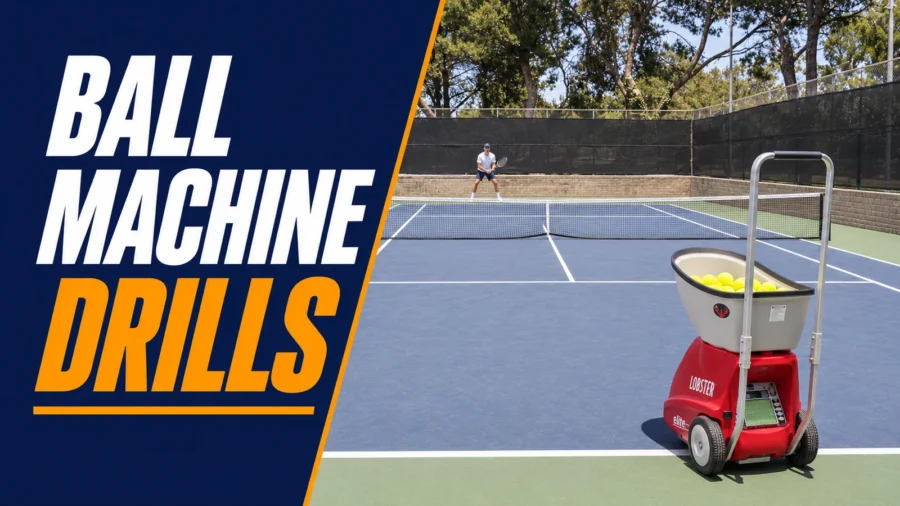
A tennis ball machine is most useful when each feed has a purpose. Beginners can use repeatable balls to build contact and direction, intermediate players can add recovery and patterns, and advanced players can combine variable feeds with targets and consequences.
Start below maximum speed. Set a feed interval that allows a balanced recovery before the next ball, then progress only one variable at a time. Faster feeds, wider movement and greater randomness are not improvements if contact quality collapses.
Choose the Right Drill Level
| Level | Main training goal | Machine setup | Progress when |
|---|---|---|---|
| Beginner | Repeatable contact, height and basic direction | One predictable location, moderate arc, slow feed | Balance and target shape remain consistent across a set |
| Intermediate | Recovery, depth, direction and simple point patterns | Two locations or a programmed sequence | The player recovers on time without rushing the swing |
| Advanced | Pattern execution, transition, uncertainty and pressure | Multi-ball sequence or controlled random mode | Decisions and shot quality remain stable at match-relevant movement |
These labels describe the drill demand, not a rating system for the player. An advanced competitor can use a beginner feed to rebuild a technical detail, while a new player should not use wide random oscillation merely because the machine offers it.
Ball Machine Safety Before Every Session
Ball machines can launch without the hitter’s visual warning, and model controls differ. Read the exact owner’s manual before use, then apply these baseline precautions.
| Step | Safety check |
|---|---|
| 1 | Inspect the court and do not operate on a wet or unsafe surface. |
| 2 | Keep people out of the firing path while the machine is powered. |
| 3 | Stand to the side during initial aim and trajectory checks. |
| 4 | Use a delay or remote start where available so the player can reach a safe receiving position. |
| 5 | Never look or reach into the exit opening while the machine has power. |
| 6 | Turn the main power off and wait for the throwing wheels to stop before clearing a jam. |
| 7 | Do not place hands or foreign objects into a moving feeder. |
| 8 | Use only the ball type and hopper capacity permitted by the manual. |
| 9 | Stop the machine before collecting balls and clear loose balls from the player’s movement area. |
| 10 | Supervise juniors and inexperienced users directly. |
Manufacturers differ on ball type, capacity, safe distance and charging. The model manual controls over any generic article. A pause button is not a substitute for disconnecting or switching off the machine when accessing moving parts.
How to Set Up a Useful Feed
Position
Place the machine on the opposite side in the location required by the drill, commonly near the center of the baseline for neutral groundstrokes. Realign it after its start-up sequence if the manual requires that step.
Machine position changes the incoming angle. A feed from the center cannot perfectly reproduce every opponent position, so move the machine deliberately only when the manufacturer’s setup permits it.
Speed and depth
Begin with enough speed for the ball to reach the target area without forcing a rushed swing. Adjust speed, elevation and spin together because changing one can alter where the ball lands.
Use a safe test ball with nobody in front of the launcher. A high machine number is not a level badge, and settings do not translate directly between brands.
Feed interval
Set the interval so the player can hit, decelerate, recover and split-step with control. If the next ball arrives while the player is still off balance, slow the feed before shortening the swing or abandoning recovery.
The interval can become more demanding later. Do not reduce it and widen the feed at the same time, because that makes it difficult to identify why accuracy changed.
Spin and ball consistency
Use moderate spin until the bounce is predictable. Extreme topspin or slice can be valuable for a specific goal, but it should not dominate every session.
Use balls of similar type and wear. Manufacturer manuals note that a mixture of new and old balls can create inconsistent launches. Follow the machine maker’s recommendation on pressurized, pressureless, low-compression and junior balls.
A Simple Scoring System
Divide the opposite court into three useful zones. Make each zone large enough for the player’s current control:
- Safe: the ball lands beyond the service line and inside a generous crosscourt or middle target.
- Attack: the ball reaches a smaller deep or directional target with the intended shape.
- Miss: the ball lands short of the chosen depth line, outside the target or into the net.
Score one point for a safe ball and two for an attack ball, with zero for a miss. Use sets of 10 feeds and record the total. A player progresses after meeting the chosen score with balanced movement in two sessions, not after one lucky sequence.
This scoring system is a flexible practice tool, not an official standard. Adjust target size to the player’s current control.
Beginner Ball Machine Drills
Beginners should remove unnecessary decisions at first. Use one feed location, a comfortable bounce and enough recovery time to prepare without panic.
Drill 1: Forehand Contact Lane
| Element | Setup |
|---|---|
| Feed | Predictable ball to the forehand side with no oscillation |
| Target | Large crosscourt zone beyond the service line |
| Set | 10 balls, then a full stop and review |
| Focus | Turn, space from the ball, balanced contact and finish |
| Progression | Shrink the target before increasing feed speed |
Return to a ready position after every shot even though the next location is known. A player still learning the stroke can pair this drill with the guide to forehand technique in tennis rather than using the machine to guess at technique.
Drill 2: Backhand Contact Lane
Aim a single repeatable feed to the backhand. Keep the target large and crosscourt, then score depth without demanding a line-painting angle.
Use 10-ball sets and reset posture between them. If the player crowds the ball or contacts late, increase the feed interval and simplify the target. The guide to backhand technique in tennis covers stroke structure separately.
Drill 3: Forehand and Backhand Blocks
Hit one set of forehands, stop the machine, then aim it for one set of backhands. Alternating blocks allows both sides to develop without the movement demand of random oscillation.
After both sides reach a similar safe-zone score, alternate locations only if the machine can deliver a controlled two-line feed. Start narrow and make the player recover to a marked center position.
Drill 4: Depth Ladder
Create a large short target between the service line and mid-court, plus a deeper target behind it. Hit five controlled balls into the first zone, then five into the deeper zone without changing to an all-out swing.
The goal is to adjust height, shape and acceleration while preserving balance. If deeper targets cause uncontrolled misses, enlarge the zone or reduce machine pace.
Intermediate Ball Machine Drills
Intermediate sessions should connect the stroke to recovery and point direction. The machine remains predictable enough to build a pattern, but the player must move with purpose.
Drill 5: Crosscourt Hit and Recover
Set the machine to feed one corner or a controlled narrow two-line pattern. The player hits crosscourt, recovers toward an appropriate position, split-steps and repeats.
Place a marker near the recovery point without creating a trip hazard. Score only balls hit after a genuine recovery. The guide to tennis footwork in three steps explains why moving back into position matters beyond this drill.
Drill 6: Two Crosscourt, One Down the Line
Use three repeatable feeds to one wing if the machine can program sequences. Send the first two shots crosscourt and the third down the line, then recover for the next cycle.
The down-the-line target should be larger and safer than the sideline. This drill trains a planned direction change, not a low-percentage attempt at every third ball. If programming is unavailable, count the pattern while using a stable single-location feed.
Drill 7: Two-to-One Groundstroke Pattern
Program two feeds to one side and one to the other, or use the closest repeatable pattern the machine provides. The hitter recovers after every shot rather than waiting in the favored corner.
Begin with all shots crosscourt. Progress by assigning the final ball to a deeper or more aggressive target only after movement remains organized.
Drill 8: Defense to Neutral
Set a wider, deeper feed that moves the player outside a comfortable contact position. The first shot goes high and crosscourt into a large deep target. The next, more central feed is directed to a neutral target without attempting an immediate winner.
Use slower speed and a generous interval until the player can recover. The purpose is to turn a difficult ball into time, not to reward a desperate low-margin shot.
Drill 9: Short Ball and Approach
Program a neutral baseline feed followed by a shorter ball. The player hits the first ball with depth, moves forward on the short feed and sends the approach to a large directional target.
Stop after the approach if the machine cannot safely and accurately supply a volley sequence. When it can, add one controlled volley only after the transition path is clear of balls.
Advanced Ball Machine Drills
Advanced drills should challenge execution and choices without pretending a machine is an opponent. Introduce uncertainty gradually and keep targets connected to a point pattern.
Drill 10: Wide Ball, Recovery Ball, Attack Ball
Program this three-feed sequence.
| Feed | Task |
|---|---|
| 1 | Play a wide ball with an outside-court recovery shot. |
| 2 | Play a more central neutral ball with depth. |
| 3 | Direct a shorter ball to an attacking target. |
The sequence trains state changes within a point. Reduce feed speed if the player cannot recover safely from the first ball, then build pace after the footwork is stable.
Drill 11: Inside-Out Forehand Pattern
Feed repeatable balls toward the backhand half for a player who has time to move around them. Alternate an inside-out target with an inside-in target, returning through a recovery marker after each stroke.
Do not force this pattern on a ball that arrives too wide or too quickly. The player should learn the movement window in which running around the backhand remains a reasonable choice.
Drill 12: Approach and First Volley
Use a short feed followed by a controlled volley-height ball if the machine supports a reliable sequence. The player approaches to a large target, split-steps before the second feed and volleys through the open target.
Clear loose balls from the transition lane before every set. The player should stop the repetition rather than sprint through a hazardous court.
Drill 13: Controlled Random Recognition
Select a narrow random or two-line mode rather than full-court randomness. Assign simple decisions, such as crosscourt from a stretched position and directional attack from a balanced central ball.
Score the decision and execution separately. A well-chosen safe shot that narrowly misses should not be analyzed the same way as a reckless direction choice.
Drill 14: Pressure Score
Choose one established pattern and a target score for 10 feeds. A safe-zone ball earns one, an attack-zone ball earns two and a miss earns zero. The final two feeds count double only if the player has maintained normal preparation and does not rush.
Repeat the set once. If the score falls sharply under pressure, keep the same machine settings and enlarge the target before adding speed.
Sample Ball Machine Sessions by Level
Beginner session: 30 to 40 minutes
| Block | Time | Content |
|---|---|---|
| Dynamic preparation and shadow swings | 5 to 8 minutes | Easy movement and rehearsal without feeds |
| Forehand contact lane | 8 minutes | Two or three 10-ball sets with review |
| Backhand contact lane | 8 minutes | Two or three 10-ball sets with review |
| Depth ladder | 6 to 8 minutes | Short and deep target changes |
| Easy finish and ball collection | 3 to 5 minutes | Stop machine fully before collection |
Intermediate session: 40 to 50 minutes
| Block | Time | Content |
|---|---|---|
| Preparation and feed calibration | 8 minutes | Test pace, height, spin and recovery time |
| Crosscourt hit and recover | 10 minutes | Both wings |
| Two crosscourt, one down the line | 10 minutes | Pattern sets with target scoring |
| Defense to neutral | 8 minutes | Wide ball followed by central recovery feed |
| Short ball and approach | 8 minutes | Clear transition lane between sets |
| Review | 4 minutes | Record score and one next-session goal |
Advanced session: 45 to 60 minutes
| Block | Time | Content |
|---|---|---|
| Preparation and calibration | 8 to 10 minutes | Stable feeds before variability |
| Wide, recover, attack sequence | 12 minutes | Three-ball pattern from both sides |
| Approach and first volley | 10 minutes | Transition sequence with safety resets |
| Controlled random recognition | 10 to 15 minutes | Decision and execution scores |
| Pressure score | 6 to 8 minutes | Two 10-feed sets |
| Review | 4 minutes | Note pattern quality, not only total makes |
These durations and set sizes are adjustable session templates, not validated prescriptions. Stop earlier if technique, concentration or safe movement deteriorates.
How to Progress a Drill Correctly
Use this order.
| Step | Progression |
|---|---|
| 1 | Establish a repeatable feed and large target. |
| 2 | Improve balance and contact. |
| 3 | Add a recovery position. |
| 4 | Shrink or move the target. |
| 5 | Widen the feed. |
| 6 | Shorten the interval slightly. |
| 7 | Add a two- or three-ball pattern. |
| 8 | Introduce controlled randomness or scoring pressure. |
Change one step at a time. If accuracy falls while the player is still moving safely, keep the new difficulty for another set. If balance or court safety breaks down, return to the previous step.
What a Ball Machine Cannot Train Well
A conventional machine does not show an opponent’s preparation, court position or tactical intention before the ball arrives. Repetition can improve stroke execution, but tennis decisions also depend on reading a live player.
Combine machine work with serving, returning, cooperative rallies and points. The guide to practicing for singles tennis matches covers that match-transfer work. Players comparing machines with walls, rebounders and self-feeds can use these ways to practice tennis alone, while the tennis rebounder guide explains how to practice with a rebounder.
Video can help review spacing and recovery, but camera placement must remain outside the movement and ball paths. A coach can also adjust the drill when repetitive feeding starts reinforcing the wrong contact or recovery.
Common Ball Machine Mistakes
Setting the feed too fast
If the player cannot recover, the drill becomes repeated emergency hitting. Increase the interval or narrow the movement before changing technique.
Using full random mode too soon
Randomness can hide whether the problem is reading, movement or stroke execution. Begin with a controlled pattern and expand only after the player owns it.
Watching the result instead of recovering
The machine will send the next ball regardless of admiration or frustration. Finish, recover and split-step before evaluating the previous result.
Mixing very different balls
Different wear and pressure can produce different trajectories. Use a consistent batch and remove damaged or wet balls according to the machine manual.
Collecting while the machine can launch
Stop, switch off and wait for the wheels as the manual directs before entering the firing line or clearing the court. Do not rely on memory of the previous feed setting.
Frequently Asked Questions
How many balls should be in one drill set?
Ten feeds is an easy unit for scoring, but it is a practical starting point rather than a universal rule. Use fewer when movement is demanding and stop when quality or safety declines.
Where should a tennis ball machine be placed?
Near the opposite baseline center is a common groundstroke starting point. The exact position depends on the drill and machine, and some models require realignment after start-up.
Should beginners use oscillation?
Not immediately. A single predictable feed helps establish contact first. Narrow two-line oscillation can follow when the player can recover with balance.
Are pressureless balls better for ball machines?
Some manufacturers recommend them for durability and consistent machine use, while machine compatibility differs. Follow the exact manual and keep the ball batch similar in type and wear.
Can a ball machine replace a coach or hitting partner?
No. It supplies repeatable practice but usually lacks opponent cues, live feedback and genuine point decisions. It works best as one part of a wider practice plan.
How often should settings change?
Change settings when the current task is repeatable with sound movement, not after a fixed number of minutes. Adjust one variable so the player can identify what caused the result.
Final Training Advice
The best ball machine drill matches the player’s current task. Beginners need predictable contact, intermediate players need recovery and direction, and advanced players need purposeful patterns with controlled uncertainty.
Keep the machine below the level at which safe movement and clear decisions disappear. Record target scores, progress one variable at a time and transfer the pattern to live tennis so repetition becomes usable point play.