
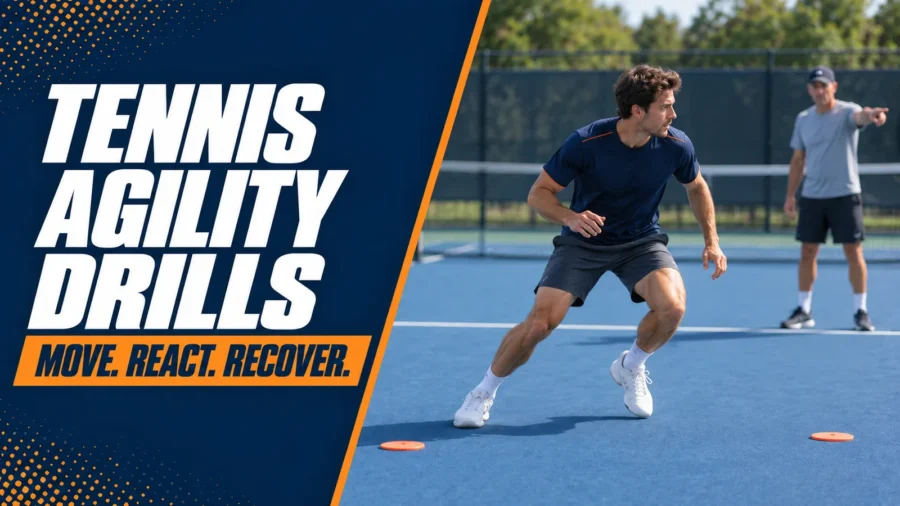
The best tennis agility drills combine controlled acceleration, braking, direction changes and a reaction to an external cue. Planned cone patterns can teach movement mechanics, but tennis also requires the player to read a ball or opponent and move without knowing the direction in advance.
A useful agility session therefore progresses from simple movement quality to reactive work. Speed matters only after the player can stop, change direction and recover with control.
Agility, Speed and Footwork Are Related but Different
Straight-line speed is the ability to cover distance quickly. Change-of-direction speed describes a planned cut or turn. Agility adds a perceptual decision, such as reacting to a partner, ball, color or call.
Tennis needs all three. A player may accelerate to a short ball, brake before contact, recover with lateral or crossover steps and react again as the opponent changes the next shot.
The technical foundation is covered in the guide to tennis footwork in three steps. The drills below focus on training movement and reaction rather than teaching every on-court footwork pattern.
Before Starting an Agility Session
Use a flat, dry, clear surface with enough space to slow down safely. Flexible markers are preferable to objects that create a trip hazard, and footwear should suit the surface.
Complete a dynamic warm-up that gradually raises movement intensity. Jogging, controlled side shuffles, skips, lunges and progressive accelerations are more relevant immediately before agility work than beginning with maximal cuts from rest.
Stop if pain, dizziness or loss of control develops. Players returning from an injury, managing a medical condition or unsure about cutting mechanics should seek guidance from an appropriately qualified clinician or strength and conditioning professional.
Movement Priorities for Every Drill
These cues should remain visible as the drill gets faster:
- Use an athletic ready position rather than standing upright and locked.
- Decelerate before the intended stopping point instead of relying on one uncontrolled final step.
- Keep the trunk controlled as the hips, knees and ankles help absorb the stop.
- Plant with the foot in a position the body can control, not excessively far outside the base of support.
- Push into the new direction rather than twisting on a fixed foot.
- Recover under control and regain visual attention toward the imagined opponent.
Unplanned cuts can create greater demands than rehearsed patterns. Master the route at moderate speed before adding late cues or competition.
Tennis Agility Drills at a Glance
| Drill | Main quality | Equipment | Best starting level |
|---|---|---|---|
| Split-step direction cue | First reaction and initial push | Partner or colored markers | Beginner onward |
| Mirror shuffle | Reading and lateral reaction | Partner | Beginner onward |
| Ball-drop reaction | Visual reaction and acceleration | Partner and tennis ball | Beginner onward |
| Fan drill | Multidirectional movement and recovery | Five markers | Beginner onward |
| Random four-cone call | Reactive change of direction | Four markers and partner | Intermediate onward |
| Shuffle-crossover-recover | Lateral movement transition | Two markers | Intermediate onward |
| Short-ball and recovery | Forward movement, braking and retreat | Court lines or markers | Intermediate onward |
| Spider drill with variable order | Repeated court movement | Tennis balls or markers | Intermediate onward |
| Ladder with random exit | Coordination followed by reaction | Agility ladder and side markers | Beginner onward |
1. Split-Step Direction Cue
Stand in an athletic ready position facing a partner. The partner points left or right, shows a colored marker or rolls a ball to one side. Time a small split step with the cue, then push toward the indicated side and stop under control.
Return to the start before the next repetition. Begin with an early, obvious cue, then make the cue later only when the player consistently lands balanced and moves in the correct direction.
This drill trains the connection between perception and the first movement. It should not become a guessing contest. A false start means the player moved before reading the cue.
2. Mirror Shuffle
Two players face each other inside a clearly marked lane. One leads with short lateral movements, while the other mirrors the direction and tries to maintain the same spacing.
Keep the first rounds controlled. The leader should change direction often enough to require attention but not so violently that the follower crosses feet or loses posture on every turn.
Progress by adding a forward or backward step, changing the leader without warning, or having the follower hold a racket in ready position. The partner’s body is a more tennis-relevant cue than a memorized cone sequence.
3. Ball-Drop Reaction
A partner holds a tennis ball at arm’s length while the player begins in a ready position a manageable distance away. The partner releases either the left or right ball, and the player reacts, moves and catches it after the agreed number of bounces.
Start close enough for success. Increase the starting distance, vary the release side or reduce the allowed bounces only when the player can accelerate and stop safely.
The drill trains visual reaction and first-step speed. Keep the release and catching rule appropriate to the player’s movement ability rather than making the first version a race.
4. Fan Drill
Place one recovery marker near the center and arrange several destination markers in a fan shape: wide left, wide right, forward left, forward right and forward center. Begin at the recovery marker, move to one destination, perform a controlled shadow stroke and return.
First use a fixed order to learn efficient routes. Then ask a partner to call or point to the next destination, turning the same layout into a reactive drill.
Keep the chest oriented toward the imagined opponent whenever the movement pattern permits. Do not race for a faster time if turns become uncontrolled or the player repeatedly shows their back to the court.
5. Random Four-Cone Call
Arrange four markers around a central start point. Give each marker a color or number. A partner calls the destination after the player completes a split step.
The player moves to the marker, brakes under control, simulates the appropriate stroke position and recovers to the center. The next cue should arrive only after balance has been regained during the learning stage.
Progress by giving the next cue slightly earlier, showing a visual signal instead of speaking, or adding a ball feed. The cue should become more tennis-like as skill improves.
6. Shuffle-Crossover-Recover Drill
Set two wide markers with a central recovery position. From the center, shuffle toward one side for the first steps, transition to a crossover when more distance must be covered, then decelerate at the outside marker.
Simulate a groundstroke and recover using the movement that fits the distance. Repeat on both sides.
The drill is not about declaring one recovery step correct for every ball. It teaches the player to transition between short lateral adjustments and a faster movement pattern without tangling the feet.
7. Short-Ball and Recovery Drill
Use a baseline start, a short-ball marker inside the court and a recovery area. React to a partner’s cue, move forward, brake before the marker, perform a shadow forehand or backhand and recover according to the imagined tactical situation.
The first version can use a planned side. A later version lets the partner indicate forehand or backhand and whether the player should recover toward the baseline or continue toward the net.
Forward speed is only one part of the task. The player must arrive balanced enough to coordinate the stroke and choose the next position.
8. Spider Drill With a Variable Order
Place tennis balls or markers at several court positions around a central base. Move from the base to one location, touch or collect the marker, return and repeat.
A traditional fixed order makes this a planned change-of-direction drill and a repeatable test. To train agility, have a partner call the next location after each return or show a direction signal.
Do not compare times from different layouts as though they were the same test. Surface, spacing, cue timing and route all affect the result.
9. Agility Ladder With a Random Exit
Use a simple ladder pattern that the player can perform without looking down constantly. At the end, a partner points to a left or right marker and the player accelerates through that exit.
The ladder portion develops rhythm, coordination and accurate foot placement. The external exit cue adds a genuine reaction and direction decision.
Complicated foot patterns are not automatically more useful. Select a pattern that preserves posture and lets the player transition into a tennis-relevant first step.
10. Partner Roll, Hit and Recover
Begin near the center of the baseline while a partner stands safely to the side with several balls. The partner rolls a ball toward a forehand or backhand movement zone. The player reacts, approaches under control, stops the ball with the racket or hand, simulates recovery and returns to the start.
Rolling keeps the early version manageable and lets the player focus on movement rather than stroke quality. Progress to gentle racket feeds only when both people can control the area safely.
This is a useful bridge between fitness movement and live-ball training because the ball supplies the cue.
How to Progress the Drills
Change one demand at a time. The following order works for most movements:
- Learn the route slowly.
- Increase speed while keeping the route planned.
- Add a clear early cue.
- Make the cue less predictable.
- Add a racket or shadow stroke.
- Add a controlled ball feed.
- Add scoring or competition only after movement quality remains stable.
Reducing rest, adding more cones and increasing speed simultaneously makes it difficult to know why technique broke down. A drill that looks harder is not necessarily producing better tennis movement.
Building One Agility Session
This page does not replace a balanced weekly fitness plan. For one focused agility session, use a simple sequence:
| Phase | Example content | Main objective |
|---|---|---|
| Preparation | Dynamic warm-up and progressive movement | Raise readiness without fatigue |
| Braking practice | Planned shuffle, run-and-stop or fan routes | Rehearse control and body position |
| Reactive work | Split-step cues, mirror drill or random cone calls | Read and respond |
| Tennis transfer | Short-ball pattern or controlled live feed | Connect movement to a stroke decision |
| Finish | Easy movement and recovery | End before mechanics deteriorate |
Choose two or three main drills rather than performing every drill in one session. Use short, high-quality efforts with enough recovery to preserve speed and decision-making. If the work turns into slow conditioning, it is no longer targeting the same quality.
General solo training options are compared in the best ways to practice tennis alone. Agility work should complement hitting and a wider strength, endurance and recovery plan rather than replace them.
Agility Drills Without Equipment
A ladder and cones are convenient, but they are not essential. Court lines can define movement zones, and a partner can point, clap or roll a ball to provide a cue.
Useful no-equipment options include:
- Split-step and react to a partner’s point
- Mirror movement inside a service box
- Shadow a short ball, wide ball and recovery pattern using court lines
- Use a spoken “left,” “right,” “short” or “deep” call
- React to an opponent’s shadow swing direction
Players training completely alone can use shuffled audio cues or a pre-recorded random call track, provided the device is positioned safely away from the movement area. A self-selected direction is less reactive because the player already knows the decision.
Common Agility-Training Mistakes
Skipping the Warm-Up
Fast cuts demand more than a cold start. Progress through a dynamic warm-up before high-speed changes of direction.
Confusing Fatigue With Quality
An exhausting circuit may train conditioning, but fatigue can reduce braking control and reaction quality. End the set when posture, accuracy or stopping mechanics deteriorate.
Using Only Planned Patterns
Cone routes teach useful mechanics, but the player knows where to go. Add a partner, ball or visual cue after the route is stable.
Making Ladder Patterns Too Complicated
Looking down and memorizing a dance-like sequence can dominate the task. Use the ladder for coordination, then exit in response to a cue.
Ignoring Deceleration
Reaching a marker is only half of the movement. Train the ability to reduce speed, control the body and push into the next action.
Training Only the Preferred Side
Repeat movements in both directions and watch for meaningful asymmetry. Persistent pain, instability or a large control difference deserves qualified assessment, not extra maximal repetitions.
Using the Wrong Conditions
A wet court, poor lighting, extreme heat or inadequate footwear changes the risk. These tips for training in the heat cover hot-weather planning, while the guide to breathing in tennis addresses breathing habits during play rather than agility technique.
How to Measure Improvement
Timing can be useful for a fixed drill, but it should not be the only measure. Record whether the player moves in the correct direction, stops under control and returns to a useful position.
Possible measures include:
- Correct reactions out of total cues
- Controlled stops out of total repetitions
- Time for a fixed planned route
- Time for a standardized reactive route with the same cue method
- Difference between left and right movement quality
- Successful transitions from movement into a controlled ball contact
Keep the surface, footwear, layout and cue procedure consistent when comparing results. A faster time from a shorter or more predictable drill is not evidence of improved agility.
Agility is one part of tennis fitness. The overview of tennis as a form of exercise explains the broader physical demands without turning these drills into a promise of injury prevention or match success.
Frequently Asked Questions
What is the best agility drill for tennis?
No single drill covers every demand. A strong starting combination is a planned fan drill for movement control plus a split-step reaction or mirror drill for decision-making.
Are ladder drills good for tennis agility?
They can improve coordination, rhythm and foot placement. They become more agility-focused when the player must react to an unpredictable exit cue rather than complete only a memorized pattern.
How often should tennis players do agility drills?
Frequency depends on age, training history, match schedule, surface, intensity and the rest of the program. Avoid placing a universal weekly number on every player. A coach or qualified conditioning professional can integrate the work without crowding recovery.
Can beginners perform agility drills?
Yes. Beginners should use simple routes, early cues and moderate speed. Braking and balance come before maximal pace or competitive races.
Can agility be trained alone?
Planned change-of-direction drills can be done alone. True reactive work is easier with a partner, ball or random cue that prevents the player from knowing the direction in advance.
Do agility drills prevent tennis injuries?
They can develop movement qualities, but no drill guarantees injury prevention. Training load, strength, technique, recovery, health history, footwear and court conditions also matter.