
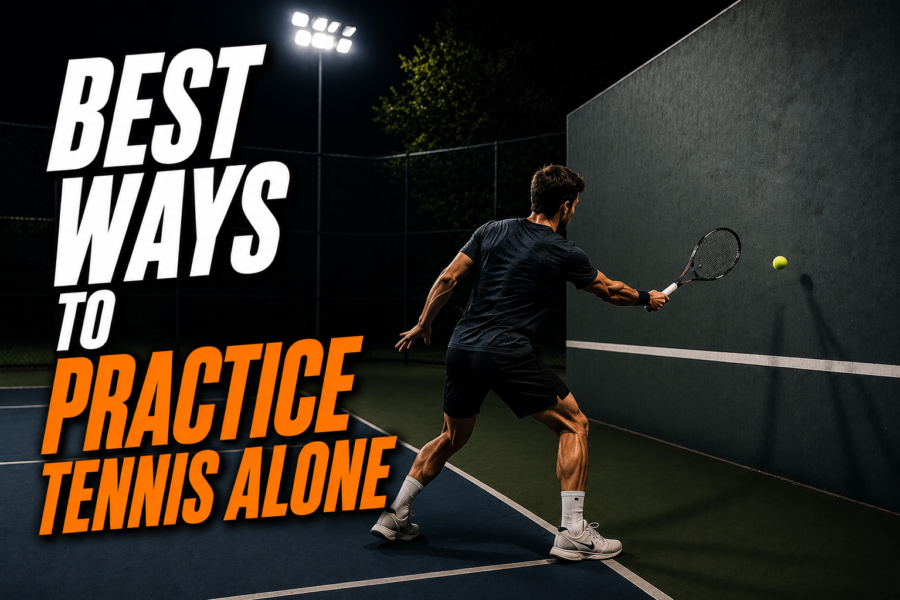
The best way to practice tennis alone is to choose one skill, use a method that gives repeatable feedback and finish with a measurable target. A wall provides continuous rallies, a ball machine controls the feed, a basket of balls makes serve practice possible, and shadow swings or footwork drills work when court space is limited.
Solo training cannot reproduce an opponent’s decisions, pressure or changing ball quality. It can, however, build useful repetitions and make the next partner or coaching session more productive when every exercise has a clear purpose.
Solo Tennis Practice Methods Compared
| Method | Space needed | Equipment | Best use | Main limitation |
|---|---|---|---|---|
| Wall practice | Safe hitting area and suitable wall | Racket, balls and target markers | Rhythm, consistency, compact preparation and alternating strokes | Return timing is faster and less realistic than a full-court rally |
| Ball machine | Full court and safe machine setup | Racket, balls and machine | Repeatable feeds, movement patterns and shot combinations | Predictable feeds can encourage passive anticipation |
| Rebounder | Flat open area | Racket, balls and rebounder | Portable repetition when no wall is available | Return angle and pace depend heavily on setup |
| Serve basket | Tennis court | Racket, balls and targets | Toss, rhythm, spin and placement | Does not train the return or next live decision |
| Self-feed practice | Court or marked open space | Racket, balls and targets | Contact point, direction and controlled first-ball patterns | Feed quality is self-created rather than opponent-generated |
| Shadow swings | Small safe area | Racket optional | Slow technical rehearsal and sequencing | No ball-flight feedback |
| Footwork drills | Flat, clear surface | Cones or simple markers | Split step, movement patterns, braking and recovery | Planned movement does not fully reproduce reaction to an opponent |
Choose the method that matches the day’s objective and available space. More equipment does not automatically create a better session.
Build a Solo Session Around One Objective
Unstructured hitting can produce many repetitions without showing whether the target skill improved. A simple session plan needs four elements:
- Define one primary skill, such as crosscourt depth, backhand preparation or first-serve placement.
- Select a drill that produces enough repetitions of that skill.
- Measure an outcome, such as successful targets out of 20 attempts or a longest controlled rally.
- Finish with a variation that adds movement, direction or a second shot.
Technique quality should remain the priority. If balance, contact or recovery deteriorates, lower the pace, enlarge the target or take a break instead of collecting poor repetitions.
Practice Against a Wall
A wall is the simplest way to create repeated ball contact without a partner. Mark a net line and one or two large targets, begin at a controlled pace and let the ball bounce before each groundstroke.
The rebound reaches the player sooner than an opponent’s full-court shot. Use compact preparation and recover early rather than standing close and swinging faster than control allows. A lower-compression ball can slow the exchange when the available space is short.
Useful wall objectives include:
- Maintain a controlled rally without chasing speed
- Alternate forehand and backhand contacts
- Send the ball above a marked net line and into a large target zone
- Hit one crosscourt-style target followed by one down-the-line-style target
- Move back toward a recovery marker after each shot
Wall training can expose a late preparation or inconsistent contact point, but it cannot diagnose every stroke problem. Use the guides to forehand technique and backhand technique for the full technical checkpoints rather than trying to rebuild both strokes inside one solo session.
Use a Ball Machine With a Progression
A ball machine is most useful when the settings match a specific exercise. Begin with a predictable feed, establish the movement and contact pattern, then add one variable at a time.
A practical progression is:
- Fixed location and moderate pace for contact quality.
- Two locations for movement and recovery.
- Different depths or heights for recognition.
- A short-ball or approach sequence followed by recovery.
- A scored block in which only balls meeting the target count.
Avoid setting maximum speed simply to make the drill feel difficult. The feed should challenge preparation, movement and decision quality without forcing rushed technique.
Place the machine, remote, cables and ball supply according to its manual. Keep people clear of the firing path, do not stand directly in front of the machine while it is active, and collect loose balls before they become a slipping or tripping hazard.
Train With a Tennis Rebounder
A rebounder uses a tensioned net to return the ball without a permanent wall. The angle and net tension influence the height, speed and direction of the return, so begin with the manufacturer’s setup and a gentle feed.
It works well for compact groundstrokes, volleys, touch and hand-eye coordination. Its return is not identical to an opponent’s shot, and a hard feed can produce an unexpectedly fast rebound in a small area.
Secure the frame, inspect the net and choose a flat space with clearance behind the player. The guide to using a tennis rebounder covers setup and method in more depth.
Practice the Serve Alone
The serve begins under the player’s control, making it well suited to solo practice. Use targets inside the correct service box and divide the basket into small blocks rather than hitting every ball at maximum effort.
Possible blocks include:
- Toss and catch without swinging
- Smooth serves aimed through a large central window
- Deuce-court placement to two broad zones
- Ad-court placement to two broad zones
- Second-serve spin and clearance at controlled pace
- A pressure finish requiring a set number of successful targets
Count only serves that land in the intended service box and meet the day’s technical goal. A fast serve that misses the target is not a successful placement repetition.
The ultimate tennis serving guide covers the complete motion, spin types and tactical development. Solo practice should reinforce one current serve priority, not introduce several new mechanical changes at once.
Use Self-Feeds for Groundstrokes and First-Ball Patterns
Self-feeding means dropping, tossing or bouncing a ball into the desired contact area before hitting it. It removes incoming-ball difficulty and lets the player focus on spacing, balance and direction.
Start from a stable position and aim through a large target window. Progress by beginning farther from the ideal contact point, moving into position, hitting and recovering. A more advanced version can combine a self-fed deep ball with a self-fed short ball to rehearse transition movement.
This is technical rehearsal, not a realistic rally. The exercise becomes less useful when the feed is manipulated to create only perfect contact.
Shadow Swings and Video Feedback
Shadow swings allow the motion to be rehearsed slowly without the timing pressure of a ball. They are useful for checking preparation, spacing, balance and recovery position.
Work in front of a clear background or record from a safe angle. Compare one or two visible checkpoints rather than trying to copy the complete swing of a professional player. Body proportions, grips and tactical intentions differ.
Video can reveal whether the intended movement occurred, but camera angle can distort racket path and contact position. When a change is uncertain or painful, pause it and consult a qualified coach.
Practice Tennis Footwork Alone
Footwork practice should connect movement to a tennis action. Begin from a ready position, use a split step, move to a marker, simulate or hit the stroke, then recover under control.
Useful patterns include lateral baseline movement, forward movement to a short ball and a return from the corner toward a recovery position. Deceleration matters as much as speed. Arriving too fast and losing balance does not reproduce a usable hitting position.
The guide to tennis footwork in three steps explains the movement principles behind these patterns. Planned cone work should eventually be combined with visual or audio cues because real tennis requires a response to uncertain information.
Three 30-Minute Solo Tennis Sessions
These templates are adjustable practice structures, not fixed fitness prescriptions. Change the pace, rest and ball type to match skill, conditions and physical capacity.
Wall Session
| Time | Focus |
|---|---|
| 5 minutes | General movement, mini contacts and controlled wall feeds |
| 8 minutes | Forehand consistency to a large target |
| 8 minutes | Backhand consistency to a large target |
| 6 minutes | Alternating strokes with recovery to a marker |
| 3 minutes | Record the best controlled rally or target streak |
The purpose is repeatable rhythm, not maximum pace. Stop or move farther back if the rebound becomes too fast for safe preparation.
Court Session Without a Wall or Machine
| Time | Focus |
|---|---|
| 5 minutes | Dynamic movement and slow shadow swings |
| 7 minutes | Self-fed forehand targets |
| 7 minutes | Self-fed backhand targets |
| 8 minutes | Serve placement in small scored blocks |
| 3 minutes | Review results and note the next session’s priority |
This session works best with large target areas. Narrow lines can create artificial failure without improving the contact pattern.
Ball-Machine Session
| Time | Focus |
|---|---|
| 5 minutes | Warm-up feeds at moderate pace |
| 7 minutes | Fixed-location contact and depth |
| 8 minutes | Two-location movement and recovery |
| 7 minutes | One simple pattern, such as deep ball then short ball |
| 3 minutes | Scored target block at controlled pace |
Do not alter speed, spin, interval and location at the same time. One change makes the cause of success or failure easier to understand.
How to Make Solo Practice More Match Relevant
Add a Recovery Position
Place a marker where the next movement should begin. After every shot, rebalance and recover instead of watching the result.
The exact recovery point changes with ball direction and court position. The marker is a training reference, not a rule that applies to every rally.
Score Outcomes, Not Just Repetitions
Examples include 15 of 20 serves in a broad zone, ten wall shots above the net line and inside a target, or eight controlled machine feeds completed with recovery. Record both the result and the quality standard.
A streak goal adds pressure, but it should not reward tense, improvised technique. Reduce difficulty when misses become random.
Use Constraints
A constraint focuses attention on a relevant behavior. Examples include clearing a wall net line, recovering behind a marker, using only crosscourt targets or alternating forehand and backhand.
Add one constraint at a time. A drill with too many rules becomes hard to evaluate.
Finish With a Pattern
After isolated work, combine two actions. Serve then shadow the first groundstroke, hit a machine-fed deep ball then move to a short ball, or complete a wall rally before changing direction.
Keep the pattern brief. Full singles tactics and point construction belong in the guide to practicing for singles tennis matches.
Solo-Practice Safety Checklist
Before starting:
- Use a dry, level surface with enough space for the racket and follow-through
- Check for people, windows, vehicles and fragile objects in the hitting direction
- Inspect the wall, rebounder or machine for obvious damage
- Secure rebounders and follow the ball machine’s operating instructions
- Clear loose balls from movement paths regularly
- Use controlled feeds before increasing pace
- Stop if pain, dizziness or unsafe fatigue develops
Public courts and shared walls may have local rules. Get permission where required and keep noise and stray balls away from other users.
What Solo Practice Cannot Replace
A wall or machine does not read body position, disguise direction or change tactics spontaneously. Solo training also lacks the social pressure, scoring decisions and uncertainty of a real point.
Combine solo sessions with partner rallies, points, matches and occasional coaching feedback when possible. A coach can identify a technical problem that high repetition might otherwise reinforce.
The best solo plan therefore targets repeatable building blocks. It does not try to simulate an entire opponent.
Final Thoughts
Wall practice, ball machines, rebounders, serve baskets, self-feeds, shadow swings and footwork drills can all make solo tennis training productive. The right method is the one that supplies relevant repetitions, safe feedback and a result that can be measured.
Choose one objective, begin at a controllable difficulty and add movement or a second shot only after the base pattern is stable. Focused solo work then supports, rather than replaces, live practice and match play.