
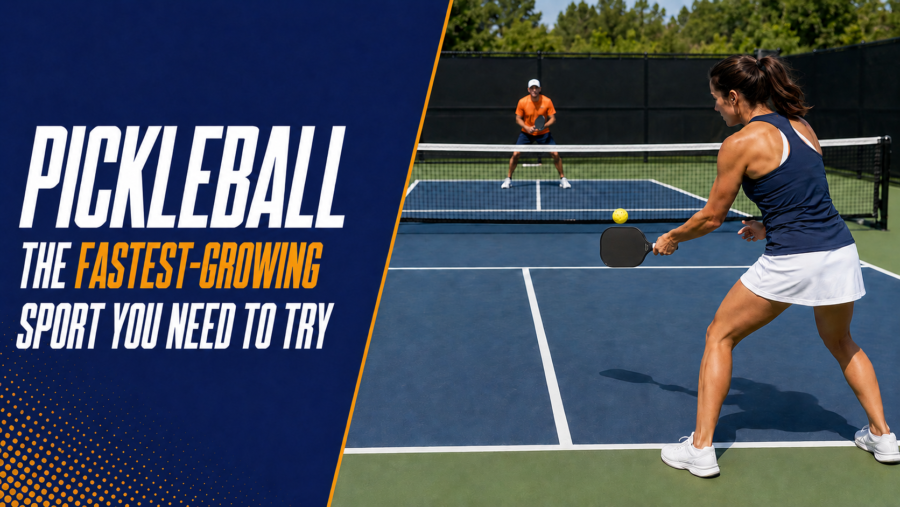
Pickleball is a paddle sport played on a 20ft by 44ft court with a low net and a perforated plastic ball. It can be played as singles or doubles, but doubles is the format many beginners encounter first. The sport has its own serving, bounce, non-volley-zone and scoring rules, so it is more than a smaller version of tennis.
Its United States growth has been substantial. The Sports & Fitness Industry Association’s 2026 report estimated that 24.3 million Americans played pickleball in 2025, up from 4.2 million in 2020. Those figures describe US participation under the report’s methodology, not the number of regular competitive players worldwide.
What Is Pickleball?
Players use a solid paddle to send a lightweight plastic ball over a net. The ball must land inside the court, and a rally ends when a player or team commits a fault, such as hitting out, failing to clear the net, allowing a second bounce or violating the non-volley-zone rule during a volley.
Pickleball is often introduced as a blend of tennis, badminton and table tennis. The comparison helps explain the compact court, paddle and net, but modern pickleball has distinct equipment, techniques and tactics.
The sport works at several intensities. Beginners can learn enough rules to rally relatively quickly, while advanced doubles involves precise soft shots, fast hand exchanges and coordinated positioning. Competitive singles requires more court coverage and can be physically demanding.
Pickleball at a Glance
| Feature | Pickleball standard |
|---|---|
| Formats | Singles and doubles |
| Court size | 20ft wide by 44ft long for both formats |
| Net height | 36in at the sidelines and 34in at the center |
| Equipment | Solid paddle and perforated plastic ball |
| Serve | Diagonal, using a legal volley serve or drop serve |
| Return sequence | Serve must bounce, then return must bounce before either side may volley |
| Non-volley zone | 7ft from the net on each side |
| Common recreational scoring | Side-out scoring, normally to 11 and win by two |
| 2026 rally scoring | Provisional option in specified tournament formats, not a universal recreational rule |
Who Invented Pickleball?
Pickleball began in the summer of 1965 on Bainbridge Island, Washington. Its founders were Joel Pritchard, Bill Bell and Barney McCallum.
Pritchard and Bell began experimenting on a badminton court with table-tennis paddles and a perforated plastic ball. McCallum helped develop stronger paddles and contributed to the game’s early equipment and rules. The activity was created for family members looking for something to play together.
Organized competition followed gradually. The first known tournament was held in Tukwila, Washington, in 1976, and the sport later developed national organizations, standardized rules, dedicated equipment and professional events.
That history is summarized here so this page can remain a beginner introduction. The article on who invented pickleball and how it got its name covers the origin story and evidence in more detail.
Why Is It Called Pickleball?
The strongest documented explanation is that Joan Pritchard compared the new game’s mixture of equipment and ideas with a “pickle boat,” a crew-racing term associated with a boat assembled from leftover rowers. USA Pickleball’s historical account says the game was named in 1965.
The familiar story about a dog named Pickles is likely a later invention. The Pritchard family said the dog arrived in 1968 and was named after the game, not the other way around.
What Equipment Do You Need?
A basic setup requires:
- A pickleball paddle
- An indoor or outdoor pickleball suited to the venue
- A correctly marked court and net
- Supportive court shoes
- Comfortable sports clothing appropriate for the conditions
Paddle
A pickleball paddle has a rigid, non-compressible face and no strings. Materials, face shapes, core thicknesses and weights differ, but a beginner does not need the most specialized model available.
Tournament players should verify that a paddle appears on the relevant approved-equipment list. Someone choosing a first paddle can use the guide to the best pickleball paddles for every level for product-level guidance.
Ball
A pickleball is a single-color plastic ball with circular holes. Indoor and outdoor models often use different hole patterns and constructions to suit surface and wind conditions.
A tennis ball is not a substitute. Its mass, felt surface, compression and rebound would create a different game.
Shoes
Court shoes are more suitable than casual running shoes for repeated lateral movement. The outsole should match the surface and provide a secure fit without restricting movement.
No shoe can prevent injury. Check the court for moisture, debris and uneven areas before playing.
Pickleball Court Layout
A regulation pickleball court is 20ft wide and 44ft long. Singles and doubles use the same lines.
The net stands 36in high at each sideline and 34in at the center. Each half contains a right and left service court separated by a centerline.
The area extending 7ft from the net on each side is the non-volley zone, commonly called the kitchen. Its boundary line is part of the zone. The kitchen is central to pickleball tactics because players cannot volley while touching it.
The court itself is smaller than a tennis court, but the complete playing area needs safe run-off around the lines. A painted court squeezed into an unsafe space is not made suitable simply because the line rectangle fits.
Basic Pickleball Rules
This is a concise orientation rather than a substitute for the current rulebook. The complete pickleball rules guide covers serving positions, faults, line calls, the kitchen, scoring and format variations in detail.
The Serve
The server stands behind the baseline and sends the ball diagonally into the opposite service court. Only one serve attempt is allowed.
A volley serve is struck before the bounce using a legal upward motion and contact position. A drop serve is released without propulsion and struck after it bounces; the volley-serve motion restrictions do not apply in the same way. The serve must clear the non-volley zone and its line.
The Two-Bounce Rule
The receiving side must let the serve bounce before returning it. The serving side must then let the return bounce before playing the next shot.
After those two required bounces, either side may volley or play the ball after a bounce. The rule stops the serving team from serving and immediately taking the return out of the air.
The Kitchen Rule
A player cannot volley while touching the non-volley zone or its boundary. It is also a fault when momentum from a volley carries the player or something the player is wearing or carrying into the zone.
Players may enter the kitchen to play a ball after it bounces. They may also stand there when not volleying, although remaining there is often tactically unhelpful.
Common Faults
Common faults include:
- Serving outside the correct diagonal service court
- A serve landing on the kitchen line or inside the kitchen
- Hitting the ball into the net or out of bounds
- Volleying before the required bounce on each side
- Allowing the ball to bounce twice
- Volleying while touching the kitchen or being carried into it by momentum
- Touching the net while the ball is in play
Most court lines count as in. The kitchen line is the important service exception because it belongs to the non-volley zone.
How Does Pickleball Scoring Work in 2026?
Traditional side-out scoring remains the format most recreational beginners encounter. Only the serving side scores a point. Games are normally played to 11, and the winner must lead by two.
In doubles, each team normally has two servers during a service turn. The first service sequence of the game is the exception: only one partner serves before the first side out. That is why a traditional doubles game begins with the score called as 0-0-2.
The three numbers mean:
- Serving team’s score
- Receiving team’s score
- First or second server in the current service turn
USA Pickleball also permits rally scoring as a provisional tournament option in 2026. Under rally scoring, the winner of each rally receives a point, including a receiving side that wins the game-ending rally. A tournament director may select specified rally-scoring formats, with exclusions including double-elimination doubles, 2026 Golden Ticket events and the 2026 USA Pickleball National Championships.
Rally scoring is therefore recognized, but it is not a universal scoring replacement for casual play. Confirm the format before every league or tournament match rather than assuming all pickleball now uses rally scoring.
Pickleball vs Tennis
| Feature | Pickleball | Tennis |
|---|---|---|
| Hitting tool | Solid paddle | Strung racket |
| Ball | Perforated plastic ball | Felt-covered rubber ball |
| Court | 20ft by 44ft for singles and doubles | Larger court with separate singles and doubles widths |
| Serve | Diagonal volley serve or drop serve under pickleball rules | Overhead or underhand legal serve into a diagonal service box |
| Scoring | Commonly side-out to 11; provisional rally formats also exist | Points, games and sets using love, 15, 30 and 40 |
| Special zone | 7ft non-volley zone on each side | No equivalent non-volley zone |
| Early-rally rule | Bounce required on each side before volleys | No two-bounce rule |
Tennis generally uses longer swings, a heavier ball and more court. Pickleball emphasizes compact preparation, controlled paddle angles, coordinated movement near the kitchen and soft shots such as dinks and third-shot drops.
Some skills transfer, including tracking, split steps, volleys and directional control. Other tennis habits need adjustment. The tennis vs pickleball comparison covers those differences without treating either sport as a simplified version of the other.
Why Has Pickleball Grown So Quickly?
The SFIA participation data confirms major US growth, but no single statistic proves why every participant joined. Several features help explain the sport’s broad appeal:
- Beginners can learn the basic objective and begin rallying relatively quickly
- The same compact court supports singles and doubles
- Doubles keeps four players close enough for frequent social interaction
- Community open-play sessions make it easier to meet partners
- Schools, parks and clubs can add programs using dedicated or shared facilities
- Equipment needs are straightforward for casual play
- The sport provides tactical depth after the introductory rules are learned
Accessibility should not be confused with low athletic demand at every level. Competitive singles involves repeated court coverage, while advanced doubles features rapid reactions and precise movement around the kitchen.
The 24.3 million figure also needs context. It counts people who participated under SFIA’s survey definition, while the report separately identified 7.5 million “core” players who played at least eight times in 2025. Casual and highly engaged participation are not the same measure.
Is Pickleball Good for Tennis Players?
Tennis players often arrive with useful tracking, volley, movement and racket-sport awareness. They may also find the underhand serve and smaller court easier to understand than a completely unfamiliar sport.
The transfer is not automatic. Large groundstroke backswings can be difficult to control on the compact court, and a tennis player may need to develop shorter swings, dinks, drop shots and patience near the kitchen. The paddle and plastic ball also respond differently from a strung racket and felt ball.
Playing pickleball can be enjoyable alongside tennis, but it should not be presented as a guaranteed way to improve tennis technique or fitness. Each sport rewards its own movement and shot-selection patterns.
Is Pickleball an Olympic Sport?
Pickleball is not included in the LA28 Olympic sport program as of August 9, 2026. International expansion and professional growth do not automatically produce Olympic inclusion.
Olympic recognition involves governance, global participation and International Olympic Committee processes beyond popularity in one country. The guide to pickleball’s Olympic status explains the current position and pathway in more detail.
How to Start Playing Pickleball
- Find a dedicated or correctly marked shared court with safe run-off.
- Borrow or choose a basic paddle and use the correct indoor or outdoor ball.
- Learn the diagonal serve, two-bounce rule and kitchen rule first.
- Confirm whether the group uses traditional side-out or another scoring format.
- Begin with cooperative rallies before trying to win every point.
- Play doubles with other beginners to learn positioning and score calling.
- Add dinks, drops and more advanced patterns after the rules feel natural.
The guide to how to play pickleball provides the complete start-to-first-game sequence. Local open play may use skill-level sessions or house rules, so tell the organizer that you are new and ask how rotations work before joining a court.
Final Thoughts
Pickleball is a distinct paddle sport with a compact court, perforated ball, underhand-style serving rules, a two-bounce sequence and a non-volley zone. Its basic orientation is accessible, while its advanced game rewards precision, anticipation and coordinated positioning.
The sport’s rapid US participation growth is well documented, but the best reason to try it is practical: find a safe court, learn the three core rules, confirm the scoring format and play with people at a similar level. The specialist rules and how-to pages can then provide the detail this introductory guide intentionally leaves out.
Frequently Asked Questions
Is Pickleball Easier Than Tennis?
Its smaller court, underhand serve and introductory rules can make the first rally more accessible for many beginners. High-level pickleball is still technically, tactically and physically demanding, so “easier” depends on the skill being compared.
Can Pickleball Be Played on a Tennis Court?
Yes, when the facility permits it and the pickleball lines, net height and playing area are set up correctly. Temporary conversion must not damage the tennis surface or create unsafe loose equipment.
Can You Volley From the Kitchen?
No. A player touching the non-volley zone or its line cannot volley. A player may enter the zone to play a ball after it bounces.
Does Every Pickleball Rally Produce a Point?
Not in traditional side-out scoring, where only the serving side scores. Rally scoring awards a point after each rally, but under the 2026 USA Pickleball rules it remains a provisional option for specified tournament formats rather than the universal recreational system.
Do Singles and Doubles Use Different Court Sizes?
No. Both use a 20ft by 44ft court, although movement and positioning differ.