
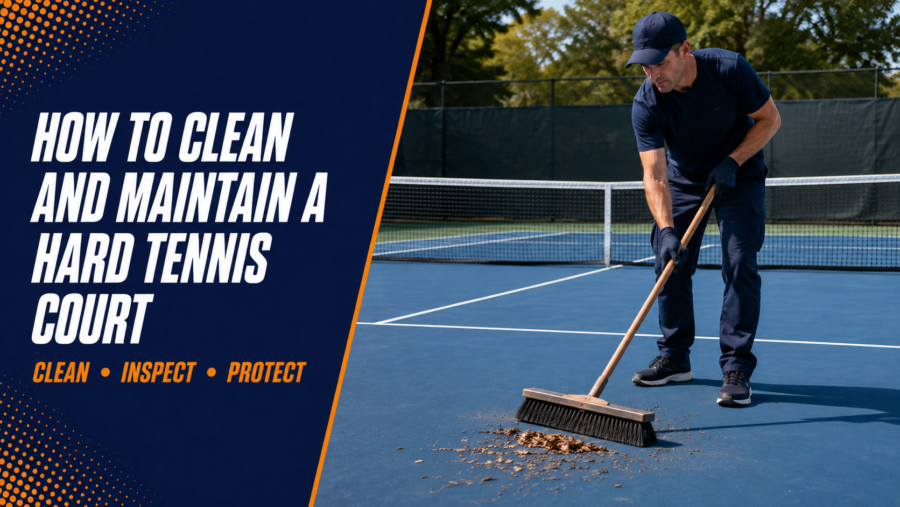
Routine hard-court maintenance is mostly about removing debris, controlling moisture and finding small defects before they become larger ones. A clean acrylic surface is safer to inspect and less likely to be abraded by leaves, grit, furniture or maintenance equipment.
There is no universal calendar for every court. Tree cover, drainage, humidity, usage and the exact coating system all matter. Use the schedule below as a starting point, then follow the court installer or surface manufacturer’s instructions when they differ.
Hard Tennis Court Maintenance Schedule
| Frequency | Main tasks | What to look for |
|---|---|---|
| Before play and after storms | Remove hazards, check for standing water and confirm the surface is dry | Branches, glass, loose equipment, puddles and slippery areas |
| Weekly or as needed | Sweep or blow away leaves, grit and other loose debris | Blocked drains, staining and debris collecting at edges |
| Monthly during regular use | Wash dirty areas with water and an approved mild cleaner | Organic growth, spills, bird droppings and worn texture |
| Each season | Inspect the full surface, lines, net, posts, fence and drainage | New cracks, low spots, peeling, bubbling and loose hardware |
| Annually | Record condition with photographs and ask a court professional to assess concerning changes | Structural movement, drainage failure and widespread coating wear |
A heavily shaded court may need more frequent organic-growth control. A lightly used court in a dry, open site may need less washing but still needs inspections after severe weather.
What You Need to Clean a Hard Court
Use tools that remove contamination without cutting into the acrylic coating. The following kit covers routine work:
- A soft-bristle push broom or court-safe blower
- A garden hose with an adjustable spray nozzle
- Buckets and clean water
- A soft nylon hand brush for localized marks
- A neutral or mild detergent approved for the surface system
- Absorbent cloths or pads for fresh spills
- Gloves and eye protection required by the cleaner’s label
- Cones or a closed gate to keep players off the wet court
Avoid wire brushes, metal scrapers, stiff rotary brushes and sharp snow tools. They can remove texture, scratch coatings or damage line paint. If the surface manufacturer specifies a particular cleaner, dilution or tool, that instruction controls.
How to Clean a Hard Tennis Court Step by Step
1. Close and inspect the court
Keep players off the area while it is wet or being cleaned. Walk the court first and note cracks, blisters, peeling, loose lines, drainage problems and any unknown spill.
Do not wash an unidentified chemical into a drain. Contain it, check the site’s spill procedure and obtain professional advice when necessary.
2. Remove loose debris
Start with leaves, twigs, dirt and grit. A soft broom gives more control around the net, fence and drains, while a blower can be faster on an open surface if local noise and debris rules allow it.
Work gently rather than grinding sand across the coating. Clear perimeter drains and channels without forcing debris farther into them.
3. Rinse a small test area
Use a gentle spray and begin in an inconspicuous corner. This can reveal loose coating, unexpected discoloration or a cleaner incompatibility before the entire court is treated.
Water alone may be enough for light dust. Direct runoff toward the designed drainage path, not onto neighboring property or into an area where sediment can collect.
4. Wash dirty areas with an approved cleaner
Mix only the amount and concentration stated by the cleaner or surface manufacturer. Apply it to manageable sections, allow only the stated contact time and agitate lightly with a soft nylon brush where needed.
Never mix cleaning products. Bleach, acids, solvents and household degreasers can damage coatings or create a chemical hazard, so they should not be improvised as universal court cleaners.
5. Rinse thoroughly
Remove cleaner residue with a low-force rinse. Residue can leave a slippery film, attract dirt or affect the appearance of the coating.
Keep the rinse controlled around cracks and lifted edges. Forcing water into a defect can worsen moisture-related damage beneath the surface.
6. Let the court dry completely
Do not reopen the court because the center looks dry while shaded corners remain damp. Check baselines, low spots and perimeter areas before removing the closure.
Once dry, inspect the cleaned surface again. Dirt can hide small cracks, worn texture and early delamination.
How to Treat Common Hard-Court Stains
| Problem | First response | Important caution |
|---|---|---|
| Leaves and organic staining | Remove debris promptly, then use water and an approved mild cleaner | Do not grind leaves into the coating with a stiff brush |
| Algae, mildew or moss | Confirm the growth is on surface contamination, then use the coating manufacturer’s approved treatment | Do not assume one bleach mixture is safe for every acrylic system |
| Food or sports-drink spill | Blot promptly, wash with approved mild detergent and rinse | Avoid solvents and do not leave sugary residue |
| Bird droppings | Wet the spot, allow it to soften, then remove it with a soft brush and cleaner | Wear appropriate gloves and avoid dry aggressive scrubbing |
| Gum, paint or unknown chemical | Isolate the area and contact the surface manufacturer or contractor | Scraping and solvent use can permanently mark the coating |
| Rust-colored mark | Identify whether it comes from metal equipment, irrigation water or the pavement below | Treat the source before repeatedly cleaning the symptom |
An acrylic coating itself does not provide food for mold. Organic matter, spills, moisture and shade on top of the court create the conditions in which growth can appear. Correcting the drainage, debris or irrigation cause is more useful than repeatedly treating the visible patch.
Can You Pressure-Wash a Tennis Court?
Pressure washing can strip acrylic color, line paint and texture when the nozzle is too close, the jet is too narrow or the pressure is excessive. A surface-cleaning attachment distributes water more evenly, but it is not automatically safe for every coating.
Only pressure-wash when the surface manufacturer or installer approves it. Ask for the permitted equipment, nozzle, pressure, distance and cleaning agent for that exact system. Test a small area, keep the spray moving and never aim a concentrated jet into cracks, seams or peeling edges.
Hiring an experienced court contractor is the safer choice for widespread organic growth or a deeply soiled surface. Manufacturer guidance and some court-industry instructions use different pressure limits, which is why a single number should not be treated as universal.
Cracks: Inspect, Record and Escalate
Cleaning is not crack repair. Photograph each crack with a scale, note the date and watch for changes in width, length, level or moisture staining.
A narrow, stable surface crack may still need a compatible repair system. A recurring crack, displaced edge, soft area, low spot or crack that holds water can indicate movement or base and drainage problems. Ask a qualified court contractor to diagnose the cause before applying filler.
Do not pour household sealant, roof compound or general concrete filler into an acrylic tennis court. An incompatible material can prevent a professional repair from bonding and may create a raised playing hazard.
Routine construction and major repairs belong in the complete guide to building a tennis court, while this page is limited to preventive care and early condition checks.
Drainage and Water Management
Standing water accelerates staining, supports organic growth and points to a drainage or surface-level problem. Remove leaves from drainage paths and check that sprinklers do not repeatedly wet the court.
Do not drill drainage holes or cut channels into a finished court as a quick fix. If puddles remain after normal drying conditions, record their location and ask the installer or a court builder to assess slope, birdbaths and subsurface drainage.
The playing lines are only part of the space that must drain and remain clear. The tennis court dimensions guide explains the difference between the marked court and the surrounding run-off area.
Protecting the Court During Everyday Use
- Require clean, non-marking tennis shoes.
- Keep chairs, benches and ball baskets on protective feet where the surface supplier recommends them.
- Lift equipment instead of dragging it.
- Keep bicycles, skateboards, vehicles and unsuitable wheeled equipment off the court.
- Do not place hot grills, open flames, solvents or fuel containers on the coating.
- Check the net center strap, posts and anchors without overtightening or altering fixed hardware.
- Use a suitable mat or route for maintenance equipment that must cross the surface.
- Keep tree roots, irrigation overspray and soil migration under observation at the perimeter.
Hard, clay and grass courts require different maintenance systems. Do not transfer watering, rolling or brushing practices from the guide to maintaining a clay tennis court to an acrylic hard court. The comparison of tennis court surfaces explains why their layers and playing characteristics need different care.
Winter and Severe-Weather Care
Inspect the court after freeze-thaw cycles, flooding, high winds and prolonged heat. Remove fallen branches safely and check fencing, posts, drains, surface edges and any previous cracks.
For snow and ice, follow the coating manufacturer’s cold-weather instructions. Do not use metal blades or sharp tools against the surface, and do not apply de-icing chemicals unless the manufacturer specifically approves them. Allowing ice to melt naturally is often safer for the coating than aggressive removal.
After flooding, keep the court closed until it is clean, dry and structurally assessed where necessary. Floodwater can leave contamination and may affect the base, electrical equipment and fencing as well as the visible surface.
When Maintenance Is No Longer Enough
Routine cleaning cannot restore missing texture, correct base movement or reattach a coating that has begun to delaminate. Arrange a professional condition assessment when you find:
- Widespread fading with slick or polished playing areas
- Multiple recurring cracks or changes in surface level
- Bubbling, peeling or hollow-sounding areas
- Puddles that persist in normal drying weather
- Large areas of organic growth returning after the moisture source is addressed
- Lines or repairs that have become raised, loose or hazardous
Some acrylic system manufacturers describe resurfacing intervals measured in years, but traffic, climate, drainage, construction quality and maintenance can change the timing substantially. Condition should drive the decision, not a generic anniversary.
When tennis court resurfacing is being considered, request an inspection that separates coating wear from pavement or drainage failure. A new color coat will not solve movement underneath it.
Hard-Court Maintenance Checklist
| Check | Pass condition | Action if it fails |
|---|---|---|
| Surface is dry before play | No wet or slippery areas | Close the court and allow drying; investigate recurring moisture |
| Court is free of debris | No grit, leaves, glass or loose objects | Sweep or blow gently |
| Drainage paths are clear | Water can leave the site as designed | Remove debris; call a contractor for recurring blockage or ponding |
| Coating is intact | No peeling, bubbling or exposed pavement | Mark and photograph the area; seek professional assessment |
| Cracks are stable | No visible growth, displacement or moisture movement | Record changes and obtain a court-builder diagnosis |
| Fixtures are secure | Net, posts, strap, fence and gates present no hazard | Close the affected area until repaired |
| Cleaning method is compatible | Product and tools are approved for the exact surface | Stop and confirm with the manufacturer or installer |
Final Maintenance Advice
The most effective hard-court routine is simple: keep debris and standing water off the surface, clean with compatible products, use soft tools and record changes before they spread. Pressure washing, chemical treatment, crack repair and resurfacing should follow the exact coating system rather than a generic internet formula.
A short maintenance log with dates, photographs, products used and problems observed gives a contractor far better evidence than memory alone. It also makes it easier to distinguish routine dirt from a drainage, pavement or coating issue that needs professional work.
Frequently Asked Questions
How often should a hard tennis court be cleaned?
Remove hazards and standing water before play, clear loose debris weekly or as needed, and schedule a more thorough wash when visible dirt or organic growth appears. Shaded, humid and heavily used courts usually need more frequent attention.
Can household bleach be used on a tennis court?
There is no universal bleach formula that is safe for every acrylic coating. Use only a treatment approved by the exact surface manufacturer, follow its label and safety data, and never mix chemicals.
Is a leaf blower safe for an acrylic court?
It can be useful when operated gently and in accordance with local rules. Keep the nozzle and equipment from scraping the coating, and do not blow debris into drains or neighboring areas.
Should puddles be pushed off the court?
A court-safe water remover may be used if the surface manufacturer permits it and the tool is clean and undamaged. Recurring puddles should be assessed rather than treated only as a cleaning problem.
Does a dirty court change tennis-ball performance?
Loose grit, water and organic material can affect traction and ball behavior, but choosing the right ball also depends on the surface and playing conditions. The guide to the best tennis balls for each court surface covers that separate equipment decision.
How long should a hard court last before resurfacing?
There is no reliable universal interval. Climate, base movement, drainage, traffic, construction and coating system all influence useful life, so use a documented condition assessment and the manufacturer’s guidance.