
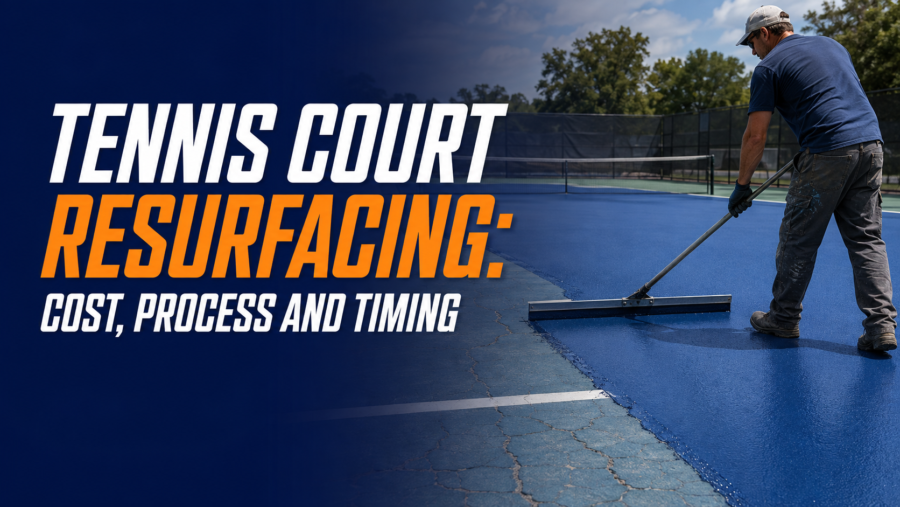
Tennis court resurfacing renews the playing surface, repairs suitable defects and restores texture, color and lines without automatically rebuilding the pavement base. For one outdoor acrylic hard court in the United States, a practical 2026 starting range is about $5,000 to $9,000 for a basic recoat on a structurally sound court and $8,000 to $13,000 when ordinary crack and low-spot repairs are included.
More complex work costs more. A cushion upgrade may raise the total to $10,000 to $15,000 or more, while a crack-repair membrane and resurfacing can reach approximately $12,000 to $20,000. Structural base failure, heaving or major drainage problems can require reconstruction costing tens of thousands of dollars.
These figures are planning benchmarks rather than universal quotes. Region, court condition, access, drainage, climate, coating system and optional cushion layers can all change the final price.
Tennis Court Resurfacing Cost at a Glance
Published US estimates differ because contractors, manufacturers and cost databases do not always include the same work under the word “resurfacing.” The table below separates several common project scopes for a single outdoor acrylic hard court.
| Project scope | Approximate US planning range | Typical situation |
|---|---|---|
| Acrylic-only resurfacing | $4,000 to $10,275 | National cost-data estimate for the acrylic surface; base repairs may cost extra |
| Basic acrylic recoat | $5,000 to $9,000 | Structurally sound court requiring preparation, color coats and new lines |
| Resurfacing with crack and low-spot repair | $8,000 to $13,000 | Ordinary crack filling and localized leveling before coating |
| Resurfacing with a cushion upgrade | $10,000 to $15,000+ | Rubber-granule cushion layers added beneath the color surface |
| Crack-repair membrane and resurfacing | $12,000 to $20,000 | Recurring cracks requiring a more advanced repair system |
| Full reconstruction | Often tens of thousands of dollars | Failed base, widespread heaving, settlement or major drainage problems |
Published estimates vary because they cover different scopes. HomeAdvisor’s 2026 cost database places acrylic resurfacing at $4,000 to $10,275 but notes that repairs to the asphalt or concrete base cost extra.
Precision Sports CT’s 2026 cost guide estimates $5,000 to $9,000 for a basic acrylic recoat, $8,000 to $13,000 with crack and low-spot repair, $10,000 to $15,000 or more with a cushion upgrade and $12,000 to $20,000 for a crack-repair membrane and resurfacing. Its $30,000 to $70,000+ reconstruction estimate is a contractor-specific benchmark for its market, not a universal national price.
Surface manufacturer SportMaster gives a broader average of $12,000 to $20,000 because drainage, cracking, low spots, peeling coatings, cleaning and optional surface systems can all influence the total.
These US-dollar figures were checked in August 2026. Labor rates, taxes, transport, climate and material availability differ across states and can be very different in Europe and other regions.
Resurfacing, Repair or Reconstruction?
The first decision is not the color of the court. It is whether the existing asphalt or concrete base remains structurally suitable.
| Work type | What it does | What it cannot do |
|---|---|---|
| Resurfacing | Renews the acrylic layers, surface texture, color and lines | Correct a moving or badly failed pavement base |
| Surface repair plus resurfacing | Treats suitable cracks, depressions and isolated defects before coating | Guarantee that cracks caused by underlying movement will never return |
| Reconstruction | Rebuilds failed pavement, drainage or foundation components | Avoid the cost and downtime associated with major civil work |
Acrylic crack filler can close suitable surface cracks, but it is not a permanent cure for movement beneath the court. Repeated wide cracks, frost heave, settlement and drainage failure require a contractor to assess the pavement base rather than simply cover the visible symptoms.
The USTA’s court-repair guidance warns that applying new asphalt over a compromised court can allow existing cracks to reflect through the new surface. It also emphasizes that drainage problems must be addressed instead of being hidden beneath another coating.
Owners planning a new facility rather than restoring an existing court should start with The Complete Guide to Building a Tennis Court. New construction includes site preparation, orientation, drainage, fencing and other work beyond normal resurfacing.
Signs a Tennis Court Needs Resurfacing
A faded court does not always require immediate structural work. However, several signs together can justify a professional resurfacing assessment.
- Color coats have worn through in high-traffic areas.
- The surface has become unusually smooth or inconsistent underfoot.
- Lines are faded, peeling or difficult to read.
- Small cracks and shallow depressions are developing.
- Water remains in isolated low spots after the rest of the court dries.
- Old coatings are peeling or separating from the layer below.
- Ball response has become inconsistent because the surface texture is uneven.
- Previously repaired cracks have reopened.
Standing water deserves special attention. A shallow isolated depression may be patchable, but widespread ponding can indicate slope, settlement or drainage problems that a new color coating cannot solve.
SportMaster’s maintenance guidance recommends an annual inspection covering cracks, low spots, drainage, premature wear, texture, fading and other surface damage. Detecting these problems early makes it easier to distinguish normal resurfacing from structural repair.
The complete playing area and surrounding run-off space also affect material quantities and contractor access. Tennis Court Dimensions and Size Guide explains why a contractor measures considerably more than the lines inside the court.
What Affects the Cost?
Base Condition and Crack Repair
Preparation is often the largest unknown. A regularly maintained court with a stable base is less complicated than one with recurring cracks, loose coating and numerous depressions.
Ask the contractor to distinguish ordinary surface crack filling from reinforced membranes, pavement patching and base repair. These methods address different levels of movement and should not be treated as interchangeable.
Simple crack filling cannot guarantee that cracks caused by movement in the underlying pavement will not return. A more expensive membrane can reduce the likelihood of cracks reflecting through the new surface, but the appropriate solution depends on the type and severity of the movement.
Drainage and Low Spots
Water that cannot leave the court can damage coatings and expose problems in the underlying grade. Localized low-spot patching adds labor and material, while a drainage or settlement problem may require work outside a normal resurfacing package.
A newly paved court should also be checked for ponding before it is color coated. Applying the final surface without correcting drainage problems can trap the owner in another repair cycle.
Number of Coats and Surface System
An acrylic system can include one or more resurfacer coats, textured color coats and line paint. Additional preparation coats, premium systems, cushioning courses or a surface designed for a different court-speed rating can increase material and labor costs.
The number of resurfacer coats should match the roughness, porosity and condition of the pavement. A heavily repaired or uncoated surface may require a different build than a court with an intact existing acrylic system.
Court Access and Location
Restricted equipment access, long material carries, remote delivery, local wage rates and permit requirements can affect a quote. Work on several neighboring courts may reduce some mobilization costs per court, but the saving depends on the site and contractor.
Added Lines and Accessories
Additional sport lines, net-post repair, fencing, lighting and windscreen work should be itemized separately. These upgrades may be sensible while the court is closed, but they are not automatically included in resurfacing.
The Tennis Court Resurfacing Process
The sequence below describes a professional acrylic hard-court project over an asphalt or concrete base. Clay, synthetic turf and natural grass require different maintenance or replacement methods, as explained in How Do Tennis Court Surfaces Differ?.
1. Inspect the Court and Base
The contractor maps cracks, peeling areas, low spots and drainage concerns. The inspection should determine whether resurfacing is appropriate and identify defects requiring a different repair method.
This is also when the owner confirms colors, line layout, optional cushion layers and the intended court pace.
2. Clean and Prepare the Surface
Dust, dirt, vegetation, loose material and biological growth must be removed so the new system can bond. The cleaning method should suit the existing coating and its condition rather than relying on an overly aggressive one-size-fits-all wash.
SportMaster’s acrylic court-surface application instructions require the surface to be cleaned of dust, dirt and debris. Pavement defects, depressions and cracks must be repaired before the color coating is applied, and repairs must finish flush with the adjoining surface.
Loose or delaminated coating may require additional removal. The court must also be allowed to dry before repairs and coatings proceed.
3. Repair Cracks and Pavement Defects
Suitable cracks are cleaned and treated with the repair system specified in the quote. Damaged pavement may require patching, and completed repairs should finish flush with the surrounding surface.
Recurring structural cracks may need a membrane or pavement intervention. A contractor should not promise that simple acrylic filler will permanently stop a crack caused by movement beneath the court.
4. Level Appropriate Depressions
Shallow low spots can be patched with compatible materials after their cause is assessed. The objective is to improve drainage and create a more uniform plane, not to conceal major settlement beneath an acrylic layer.
Completed patches need the manufacturer-specified cure time before the next coating is applied.
5. Apply Acrylic Resurfacer
An acrylic resurfacer helps reduce surface porosity and provides a more uniform underlayment for the color system. The required number of coats depends on the roughness, porosity, repairs and selected system.
Resurfacer is part of the coating build. It is not a substitute for repairing a structurally failed pavement slab.
6. Apply Textured Color Coats
Professional sport coatings combine acrylic material with controlled amounts of silica sand. Sand content and system design influence traction, surface texture and court pace.
SportMaster recommends a minimum of two coats for its Color Concentrate system and requires each coat to dry thoroughly before the next one is applied. Its published drying period between coats is approximately two to four hours under suitable conditions.
Standard exterior house paint is not a substitute for a purpose-designed acrylic sports surface.
7. Mark and Paint the Lines
Once the color surface is ready, the court is measured, taped and striped. Accurate layout matters because even a well-coated court is not suitable for proper play if its lines are misplaced.
Additional pickleball or other sport lines should be confirmed in the quote because they may carry a separate cost.
8. Cure and Inspect Before Play
The completed surface needs adequate drying time before players, maintenance equipment or furniture return. SportMaster specifies a 48-hour wait before opening its finished color surface for play.
Weather, humidity and the exact products can change the schedule. The contractor’s written system specification should therefore control the final handover.
How Long Does Resurfacing Take?
HomeAdvisor estimates that most tennis court resurfacing projects take approximately three to seven days of clear, dry weather. Severe cracks, drainage repairs, extended curing requirements, rain and low temperatures can lengthen the project.
A practical schedule may look like this:
| Stage | Typical planning allowance | Main delay risk |
|---|---|---|
| Cleaning and preparation | About 1 day | Heavy contamination or loose coating |
| Crack and low-spot work | 1 day or more | Extensive repairs and product cure requirements |
| Resurfacer and color coats | 2 to 3 suitable days | Rain, low temperature or high humidity |
| Line marking and final drying | 2 days or more | Product-specific drying time |
These stages can overlap differently depending on the system and crew. Ask whether the contractor’s quoted duration includes the final 48-hour waiting period before play.
Do not book a tournament based only on the shortest possible coating schedule. Leave additional time for weather delays and inspection.
If the work includes new asphalt or concrete, the wait before coating is much longer. SportMaster requires new asphalt to cure for 14 to 30 days and new concrete to cure for 28 days before its acrylic surface system is applied. An overlay or reconstruction should therefore be planned in weeks rather than days.
Best Weather and Time of Year
Acrylic coating requires warm, dry and stable conditions. SportMaster’s application instructions require a temperature of at least 50°F and rising and state that coatings should not be applied when rain is imminent or forecast.
The USTA’s repair guidance also says that color coating requires temperatures of at least 50°F and recommends maintaining that temperature for the following 24-hour period.
The best calendar window depends on the local climate. Spring through early autumn may be practical in a freeze-thaw region, while very hot or wet locations can have a different working season. Schedule around the selected product’s written limits rather than relying on a generic month.
How Often Should a Tennis Court Be Resurfaced?
A practical planning interval for an acrylic hard court is approximately four to eight years. SportMaster’s detailed maintenance guide describes five to eight years as its standard resurfacing cycle, while its general resurfacing guidance uses four to eight years depending on usage and maintenance.
Heavy play, strong sunlight, freeze-thaw cycles, poor drainage and delayed cleaning can move a court toward the shorter end. Good maintenance and a stable pavement base may extend the useful interval.
Use the calendar as a prompt for inspection rather than an automatic order. Annual checks for cracks, drainage, low spots, surface wear and peeling are more useful than waiting for the court to become visibly unplayable.
Clay courts follow a different maintenance cycle and do not receive the same acrylic resurfacing process. Owners of that surface should use How to Maintain a Clay Tennis Court rather than applying hard-court resurfacing intervals.
What to Ask for in a Resurfacing Quote
Request written answers to the following questions before comparing bids:
- Is the asphalt or concrete base considered structurally sound?
- Which cracks and low spots are included, and which are excluded?
- What repair method will be used for each defect type?
- How many resurfacer, color and cushion coats are specified?
- Which exact coating products and systems will be used?
- Are line marking, cleaning and waste removal included?
- What weather limits and cure times apply?
- Does the stated schedule include the waiting period before play?
- How will rain delays affect the schedule and payment?
- Are drainage, net posts, fencing and extra sport lines separate items?
- What workmanship and product warranties apply?
- What damage or crack movement is excluded from the warranty?
Photographs and a condition map make competing quotes easier to compare. The lowest number is not necessarily the best value if it omits the preparation or repairs the court needs.
Final Recommendation
Confirm that the pavement base is structurally suitable before budgeting for resurfacing. For one US acrylic hard court in 2026, use approximately $5,000 to $9,000 as a starting allowance for a basic recoat and $8,000 to $13,000 for a project with ordinary crack and low-spot repairs.
Cushion layers or a crack-repair membrane can raise the project to approximately $10,000 to $20,000. If cracks repeatedly reopen, the pavement has heaved or water cannot drain properly, request a structural assessment instead of assuming another color coat will solve the problem.
Obtain multiple local, itemized quotes and compare the included preparation, repair system, number of coats, drying time and warranty. Plan for several suitable working days plus the final wait before play.
Cost and Technical Sources
Prices and specifications were checked in August 2026. Actual costs vary by location, court condition, contractor and project scope.
- HomeAdvisor, “How Much Does It Cost to Resurface a Tennis Court?” supports national cost ranges, acrylic-only pricing, resurfacing frequency and typical project duration.
- SportMaster, “How Much Does It Cost to Resurface a Tennis Court?” supports manufacturer cost guidance, repair factors and the general four-to-eight-year interval.
- Precision Sports CT, “Tennis Court Resurfacing Cost Guide” supports 2026 contractor estimates for recoating, crack repair, cushion systems, membranes and reconstruction in its market.
- SportMaster Acrylic Court-Surface Application Specifications supports surface preparation, minimum coat requirements, temperatures, drying periods and pavement curing times.
- SportMaster Tennis Court Maintenance Guide supports cleaning, drainage inspections, annual assessments and the five-to-eight-year standard resurfacing cycle.
- USTA, “5 Things to Consider When Repairing Tennis Courts” supports the guidance concerning cracks, drainage, temperature and compromised pavement bases.