
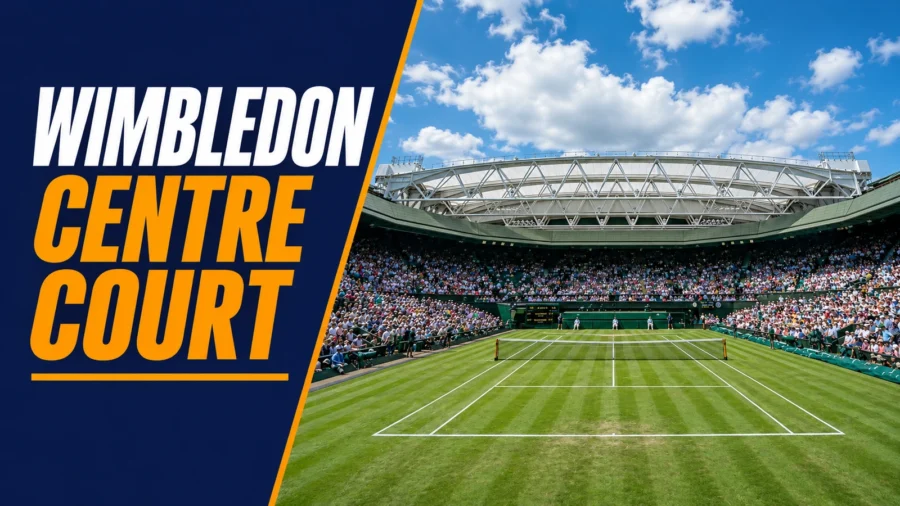
Centre Court is Wimbledon’s main stadium and has a seating capacity of 14,979. The present court at the All England Lawn Tennis Club’s Church Road grounds opened in 1922, while its retractable roof was completed for the 2009 Championships.
It hosts Wimbledon’s biggest matches, including the gentlemen’s and ladies’ singles finals. Centre Court combines natural grass, the Royal Box and a historic setting with a modern roof-and-climate-control system.
Centre Court Facts at a Glance
| Feature | Centre Court detail |
|---|---|
| Location | All England Lawn Tennis Club, Church Road, Wimbledon |
| Current capacity | 14,979 spectators |
| Present stadium opened | 26 June 1922 |
| Original Church Road capacity | Approximately 13,500 |
| Surface | Natural perennial ryegrass |
| Grass height for The Championships | 8mm |
| Retractable roof introduced | 2009 |
| Regular role | Wimbledon’s principal show court and finals court |
The marked playing area has the same dimensions as every regulation court. A singles court remains 78ft long and 27ft wide, as shown in the complete tennis court dimensions guide. The stadium’s importance comes from its setting and use, not from a larger court inside the lines.
Why Is It Called Centre Court?
The name dates back to the All England Club’s original grounds off Worple Road. Wimbledon began there in 1877, with the courts arranged around the site.
In 1881, two central courts were combined to form the main show court. Its position among the surrounding courts made “Centre Court” a literal description.
The club moved to Church Road in 1922 and kept the name, although the court was not then at the physical center of the grounds. Additional courts built in 1980 placed it closer to the center again.
The Move to Church Road in 1922
Wimbledon’s popularity outgrew the Worple Road grounds after the First World War. The All England Club acquired land at Church Road and built a larger home designed around a new Centre Court.
The stadium was ready for the 1922 Championships and accommodated approximately 13,500 spectators. It was formally opened on 26 June with King George V in attendance.
The move established the venue associated with Wimbledon today. Club facilities were incorporated around the court, helping create its enclosed bowl.
Centre Court During the Second World War
The Championships were not held from 1940 through 1945. On 11 October 1940, a bomb struck Centre Court during an air raid and damaged part of the stadium.
Wimbledon returned in 1946 before repairs were complete, and restoration continued until 1949. The stadium was repaired rather than replaced, preserving the 1922 venue.
How Centre Court’s Capacity Changed
Centre Court opened with room for about 13,500 people. In 1979, part of the roof over the stands was raised to create space for more seats, while a 1990s redevelopment improved sightlines.
The retractable-roof project added six rows to parts of the upper tier. It raised the commonly stated capacity from about 13,800 to approximately 15,000 while adding wider seats, lifts, stairs and updated media facilities.
The official current figure is 14,979. Rounded descriptions may still call it a 15,000-seat stadium, but 14,979 is the more precise capacity used for Centre Court.
How the Centre Court Roof Works
Centre Court’s retractable roof was publicly inaugurated in May 2009 and used during the Championships that summer. It allows play to continue when rain or fading natural light would otherwise make the court unusable.
Large moving trusses support a translucent roof fabric. When closed, artificial lighting provides the level required for professional play and television.
Closing the roof is not the entire process. Ventilation and air-management systems must regulate the enclosed space, while officials need to be satisfied that the court is safe before play resumes. That is why a roof closure produces an interruption rather than an instant switch from outdoor to indoor play.
The moving and fixed roof components weigh roughly 3,000 tonnes. The structure also had to preserve upper-level views and fit around a stadium already more than 80 years old.
Who Decides When the Roof Closes?
Players do not vote on roof use. Tournament officials decide based on the weather, light, court condition and the likelihood that play can continue safely. They may close it before a match or suspend play and close it during one.
Once play resumes under the roof, the match is effectively being played in indoor conditions. The tournament does not repeatedly open and close it in response to every short change in the weather.
Wimbledon still operates under an 11 p.m. curfew. A roof can protect a match from rain and darkness, but it does not permit unlimited play into the night.
Does the Roof Change Playing Conditions?
Closing Centre Court removes wind and prevents rain from reaching the surface. It also changes the sound inside the bowl and replaces changing natural light with a more controlled lighting environment.
Players often describe a different feel under the roof, but it is too simple to state that closing it always makes the court faster or slower. Ball behavior depends on temperature, humidity, the condition of the grass, the stage of the tournament and the players’ shots as well as the roof.
The clearest difference is predictability. With less wind and no rain, the ball toss and flight are less exposed to sudden weather changes. Crowd noise can also feel louder inside the closed structure.
What Grass Is Used on Centre Court?
Centre Court uses perennial ryegrass and is cut to 8mm for the Championships. The court is not assembled shortly before the tournament. It is grown, renovated and maintained through a long annual cycle.
Wimbledon prepares a firm soil base beneath the turf for a consistent surface. Daily mowing, moisture management, rolling and measurements help the grounds team control the court as closely as a living surface allows.
Even with that work, grass changes through use. The areas around the baselines gradually lose visible grass as players stop, push off and change direction. The detailed guide to how grass tennis courts are made explains the construction and maintenance behind the surface.
The effect on tennis is covered separately in why Wimbledon’s grass is special. Centre Court shares the same fundamental surface specification as the other Championship courts, although wear, shade and individual match use can create small differences.
What Matches Are Played on Centre Court?
Centre Court stages leading matches throughout the Championships and becomes the main home of the late rounds. The ladies’ and gentlemen’s singles finals are played there.
A high seed is not guaranteed to play every match on Centre Court. Scheduling must balance star appeal, British interest, competitive importance, previous court assignments and the program across Centre Court, No. 1 Court and the outer courts.
The stadium was also used for the London 2012 Olympic tennis tournament, and the roof’s 2009 inauguration included exhibition matches. These are exceptions to a court otherwise protected for Wimbledon.
The Royal Box and Centre Court Traditions
The Royal Box has 74 seats for invited guests, including members of royal families, former champions and leading figures from tennis and public life. Its tickets are not sold to the general public.
Another visible tradition is the players’ entrance beneath lines from Rudyard Kipling’s poem If. The words about meeting “Triumph and Disaster” are positioned where players can see them before stepping onto the court.
Famous Centre Court Matches
Centre Court has staged many defining finals. In 1980, John McEnroe won an 18-16 fourth-set tie-break before Björn Borg took the fifth set and the title.
The 2008 final between Rafael Nadal and Roger Federer lasted four hours and 48 minutes of playing time and finished in fading light after rain delays. It took place before the retractable roof was ready, making the weather and darkness part of the match’s story.
In 2019, Novak Djokovic saved two championship points against Federer and won the first Wimbledon singles final decided by the tournament’s 12-12 final-set tie-break. More unusual milestones can be found in the strangest records in Wimbledon history.
Long matches are possible because tennis is not controlled by a game clock. Match format, deuce games, close sets and extended tie-breaks all affect the duration, as explained in how long a tennis match lasts.
Centre Court vs No. 1 Court
Centre Court is Wimbledon’s largest stadium, while No. 1 Court is the second main show court. Both have retractable roofs, but Centre Court hosts the singles finals and contains the Royal Box. Having two covered stadiums protects more of the schedule when rain stops play elsewhere.
The names can be confusing. “Centre Court” is a historic proper name, while “No. 1 Court” is part of the numbered court system. Centre Court is not simply another way of saying the court assigned first on a daily schedule.
Frequently Asked Questions
What is the capacity of Wimbledon’s Centre Court?
Centre Court holds 14,979 spectators. It is often described as a 15,000-seat stadium when the figure is rounded.
When was Centre Court built?
The current Centre Court at Church Road opened on 26 June 1922. The name had already been used for the main court at Wimbledon’s earlier Worple Road site.
Does Centre Court have a retractable roof?
Yes. Its retractable roof was completed and first used for the Championships in 2009.
How long does it take to close the Centre Court roof?
The roof movement itself takes only part of the interruption. Play resumes after the enclosed environment has been prepared and officials confirm that the court is safe, so spectators should not assume an exact restart time from the moment the decision is made.
Is Centre Court bigger than a normal tennis court?
The stadium is much larger, but the marked court uses standard tennis dimensions. The singles playing area is 78ft × 27ft and the doubles court is 78ft × 36ft.
Is Centre Court used all year?
No. It is protected primarily for the Championships rather than used as a normal club court throughout the year. Exceptional events, including the London 2012 Olympics and special exhibitions, have also been held there.
Can a Wimbledon match continue all night under the roof?
No. Wimbledon has an 11 p.m. curfew. The roof permits play in rain or darkness, but it does not remove that finishing-time restriction.
Are the fastest serves always hit on Centre Court?
No. Major servers frequently play there, but Wimbledon serve records can be set on other courts. The list of tennis players with the fastest serves includes a Wimbledon record produced outside a final.