
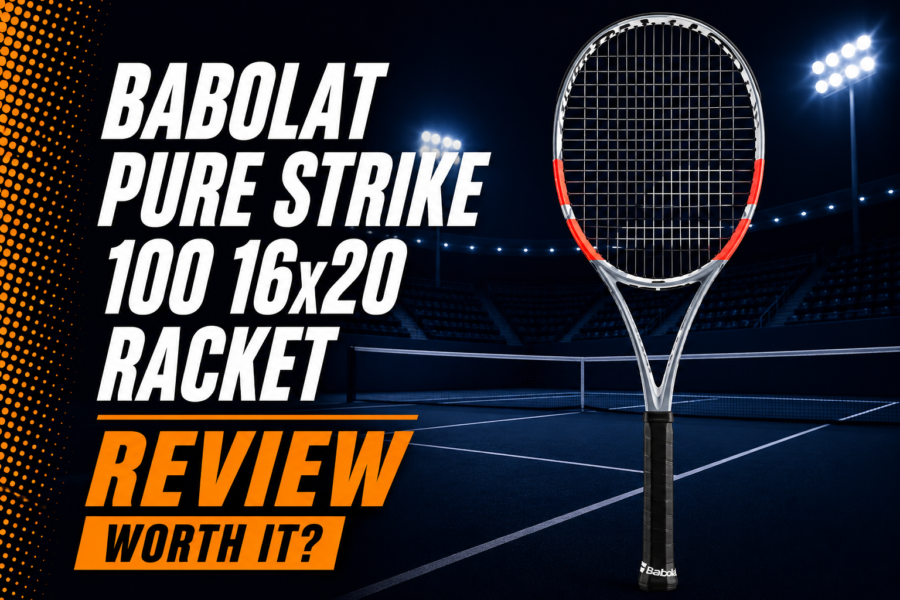
The Babolat Pure Strike 100 16×20 Gen4 is the denser-pattern 100 sq in model in Babolat’s fourth-generation control family, introduced in 2024. This review covers the 305 g 16×20 version only, not the standard Pure Strike 100 Gen4 with its 300 g weight and 16×19 pattern.
It occupies a useful middle ground between the more forgiving standard 100 and the smaller Pure Strike 97. The larger head preserves contact margin, while the extra cross, 31 cm unstrung balance and 305 g unstrung weight target aggressive counterpunchers and all-court players who value a predictable launch.
This is still a performance racket rather than an effortless beginner frame. Its approximate 323 g strung weight and 320 swingweight reward medium-to-full swings, but its head-light setup makes it easier to accelerate than those numbers might imply.
Babolat Pure Strike 100 16×20 Gen4 Score
| Category | Score |
|---|---|
| Power | 7.5/10 |
| Spin | 8/10 |
| Control | 9/10 |
| Comfort | 8.5/10 |
These scores are editorial estimates based on the Pure Strike 100 16×20 Gen4’s verified specifications, construction, intended playing profile and position within the broader racket market. Finished specifications, string setup and technique can change its response.
Babolat Pure Strike 100 16×20 Gen4 Specifications
| Specification | Details |
|---|---|
| Head size | 100 sq in / 645 cm² |
| Length | 27 in / 68.5 cm |
| Unstrung weight | 305 g ±7 g / 10.8 oz, official |
| Strung weight | Approximately 323 g / 11.4 oz, retailer/lab measurement; string-dependent |
| Unstrung balance | 31 cm ±0.7 cm / 12.2 in, official |
| Strung balance | Approximately 32 cm / 12.6 in, 7 pts HL, retailer/lab measurement |
| Swingweight | 295 kg·cm² unstrung, official; approximately 320 kg·cm² strung, retailer/lab measurement |
| Stiffness | 65 RA ±3, official target; approximately 61 RA, retailer/lab measurement |
| Beam width | 21 mm / 23 mm / 21 mm |
| String pattern | 16×20 |
| Composition | Graphite |
| Recommended tension | 48-57 lb / 22-26 kg |
| Grip | Babolat Syntec Team |
Babolat’s official product page confirms the Gen4 identity, unstrung specifications, graphite composition, recommended range and grip. The approximate strung weight, balance, swingweight and independent stiffness measurement are retailer or lab averages; production tolerance, strings, grip size, overgrips, dampeners and other accessories can alter finished figures.
Design, Materials and Technologies
Head Size, Beam and Frame Geometry
The 100 sq in head provides more geometric margin than the 97 and 98 sq in Pure Strike models. That extra area helps preserve playable depth when contact drifts slightly, without turning the racket into an oversized or especially powerful frame.
Babolat’s 21 mm / 23 mm / 21 mm hybrid beam combines squarer and more elliptical sections. The 23 mm middle supplies some rebound and stability, while the narrower ends help maintain the control-focused profile expected from the Pure Strike line.
Standard 27 in length keeps timing, leverage and reach conventional. The 100 16×20 derives its distinctive response from weight distribution and pattern density rather than extra length or a very thick beam.
Weight, Balance and Swingweight
The official 305 g unstrung weight places this model 5 g above the standard Pure Strike 100. Its 31 cm balance is notably head light before stringing, giving the handle enough mass to support quick changes of direction.
Babolat publishes an unstrung swingweight of 295, while independent testing places the finished racket near 320. Strings add weight around the hoop, so the official unstrung figure and approximate strung result should not be compared as if they were measured in the same condition.
An approximate 320 swingweight offers useful substance without becoming unusually demanding for an advanced 100 sq in frame. Static weight and swingweight describe different things, so the 323 g finished mass can coexist with relatively quick preparation.
Materials and Construction
The frame is graphite, with strategic flax-fiber additions under Babolat’s NF²-Tech name. Babolat specifies flax in the handle and at 3 and 9 o’clock for this exact model, intended to filter selected impact vibrations and change the sound or feel.
The official stiffness target is 65 RA ±3, while a major retailer’s sample measured about 61 RA. Measurement method, sample variation and production tolerance can explain part of that difference; neither number describes torsional stiffness or string-bed stiffness.
The lower independent figure and moderate hybrid beam suggest more flex than earlier, firmer Pure Strike associations might imply. Marketing language about feel remains subjective, so setup and contact quality must remain part of the evaluation.
String Pattern
The 16×20 bed is the model’s defining specification. One additional cross makes the response more contained than the standard 100’s 16×19, supporting a lower launch and more predictable directional window for aggressive swings.
The pattern remains more open through the mains than an 18×20. It can therefore support topspin and string movement when the player creates speed, while the 100 sq in face keeps the bed from becoming as compact as the Pure Strike 97’s 16×20.
String count alone cannot determine trajectory or rotation because spacing and drilling differ between frames. Gauge, tension, material and string wear also influence launch, snapback and durability.
Technologies
Control Frame Technology is Babolat’s term for the hybrid beam, combining the stability associated with squarer sections and the dynamism associated with elliptical sections. Its geometry is verifiable, while the exact increase in either quality cannot be guaranteed for every player.
NF²-Tech uses flax fibers in selected areas of this 100 16×20. Babolat says the material filters unwanted vibration and produces a more muted impact sound, which can shape feedback without removing the role of strings or contact location.
FSI Control Pure Strike 24 combines tighter string spacing with Babolat’s Woofer interaction between frame and strings. The design is intended to improve trajectory control and extend ball-string interaction, but actual pocketing and launch still depend heavily on setup.
The fourth-generation package should not be described with technologies from earlier Pure Strike generations unless Babolat confirms they remain present. The verified Gen4 combination is Control Frame geometry, NF²-Tech and the line’s updated FSI Control approach.
Babolat Pure Strike 100 16×20 Gen4 Performance
Comfort and Feel
The independent measurement near 61 RA, narrow-ended beam and flax placement suggest a relatively flexible, muted response for a current performance racket. Its approximate 323 g finished mass can also make centered impact seem more settled than a lighter frame.
Independent evaluations commonly identify pocketing and feedback as strengths, while noting that the response remains direct enough for target awareness. Off-center contact can still feel less composed because the frame does not have an oversized face or very high swingweight.
Comfort is individual and depends on technique, timing, grip size, string material, tension and age. A low measured RA and vibration-filtering material do not ensure that every player or polyester setup will be comfortable.
Comfort score: 8.5/10
Power
The 100 sq in head, 23 mm center beam and approximate 320 swingweight provide a useful base for depth. The racket offers more assistance than a thin, low-swingweight 97 sq in control frame, especially when the player completes a full stroke.
The dense-for-category 16×20 bed and flexible sample measurement keep rebound from becoming overly lively. Independent evaluations generally find controllable pace rather than easy explosive power, particularly compared with the standard Pure Strike 100.
Players with medium-to-full swings should be able to drive through the court, but short or passive swings may leave the ball shallow. Power here comes mainly from acceleration and clean energy transfer, with measured frame assistance.
Power score: 7.5/10
Control
Control is the 100 16×20’s primary strength. The extra cross, head-light balance and moderate flex support a predictable launch, while the 100 sq in head provides more margin than compact control frames.
Independent evaluations consistently praise targeting and trajectory management from the baseline. The approximate 320 swingweight supplies enough momentum to redirect pace without making last-second face adjustments unnecessarily difficult.
The racket cannot create accuracy independently of the player. Late preparation, unstable contact or an excessively lively string bed can still change direction and depth, but the design gives a technically sound swing a clear response window.
Control score: 9/10
Spin
Sixteen mains leave meaningful space for string movement, and the head-light balance helps a player accelerate upward or across the ball. The 100 sq in face makes the 16×20 bed less closed than the same count in a 97 sq in head.
The extra cross lowers launch relative to the standard 16×19 Pure Strike 100. Fast swingers can use that containment to apply aggressive racket-head speed without sending every ball high, producing penetrating topspin rather than only a looping shape.
Technique, swing speed and string snapback remain decisive. A dense pattern does not eliminate spin, just as an open count does not automatically generate it.
Spin score: 8/10
Maneuverability
The official 31 cm unstrung balance is strongly head light, and the approximate 320 strung swingweight remains manageable for its weight class. Independent evaluations describe quick handling at the baseline and net despite the 323 g approximate finished mass.
It still requires more repeated effort than the 285 g Team. Players should assess preparation late in a match rather than interpreting head-light balance as proof that static mass is irrelevant.
Stability
The 305 g unstrung weight, approximate 320 swingweight and hybrid beam provide a sound platform against incoming pace. Central contact should resist deflection better than the lighter Team, and the added cross can make the string bed seem more controlled on a firm block.
It is not a very high-swingweight frame, so the outer hoop can yield more than in a heavier traditional player’s racket. Customization may add torsional resistance, but even small hoop additions can materially change swingweight and balance.
Performance by Shot
Groundstrokes
From the baseline, the 100 16×20 rewards full, confident swings and early preparation. The controlled launch supports flatter drives and directional changes, while sixteen mains retain enough movement for topspin forehands and backhands.
Independent testing finds a productive blend of stability and speed, with more control and slightly less easy depth than the standard Pure Strike 100. The larger head makes defensive contact more viable than with the Pure Strike 97, although passive recovery balls still need purposeful racket speed.
Aggressive counterpunchers are the clearest fit because the frame can redirect pace without forcing a high trajectory. Players who build points through height and effortless net clearance may prefer the 16×19 sibling.
Serves
The head-light balance supports overhead acceleration, and the 16×20 bed supplies a predictable target for flat first serves. Its mobile mains still allow slice and kick when the player creates the necessary brushing path.
The standard length and moderate power mean serve speed depends more on timing than extra leverage. Placement and variation should be easier to access than effortless pace for a short motion.
Volleys and Net Play
Quick balance and a 100 sq in face make the racket practical in fast exchanges. The controlled bed supports punch placement and drop angles, while the finished mass supplies useful stability on centered volleys.
Independent evaluations generally find the frame maneuverable at net. Contact near the perimeter remains less secure than the center, and players who prefer a very lively volley response may want the standard 100 or a wider-beamed alternative.
Returns
The 100 16×20 can use a compact preparation against first serves, with enough mass to block or redirect pace. Its head-light balance also allows a fuller attack against second serves without making the face difficult to set.
The larger head provides more return margin than the Pure Strike 97. A player who mostly chips from a stretched position may still prefer a frame with more automatic depth.
String and Setup Considerations
Fast swingers may pair the controlled 16×20 bed with polyester when they need durable snapback and lower launch. A full polyester setup should be chosen for actual performance needs, and it should be replaced when loss of elasticity or heavy notching changes the response.
Multifilament, synthetic gut or natural gut can add elasticity, depth and a livelier impact. A hybrid can balance those properties with a more controlled component, and changing which string occupies the mains can materially alter feel and durability.
Because this 16×20 is more contained than the standard 100’s 16×19, players do not automatically need the stiffest or lowest-powered string available. A thinner or more responsive setup may open the launch, while a thicker gauge can increase durability and further calm trajectory.
Babolat lists 48-57 lb / 22-26 kg as the frame range, not a personalized target. The Tennis String Finder can compare string families, and the Tennis String Tension Calculator can establish a general starting point for discussion with a qualified stringer.
Comfort depends on the complete racket and string system plus technique and grip size. Recording string, gauge, reference tension and playing time makes later adjustments more meaningful.
Build Quality and Durability
The graphite frame has a full bumper across the top of the hoop and grommets that protect strings at the drill holes. These parts take routine abrasion and should be checked when the racket is restrung.
The 16×20 pattern may distribute contact across one more cross than the standard model, but it does not guarantee longer string life. Spin, surface, gauge, material and contact location remain more important to breakage and notching.
Paint chips, bumper scuffs and light surface scratches are generally cosmetic. Cracks, exposed fibers, soft sections or permanent distortion may indicate structural damage and deserve inspection before the racket is used or restrung.
Replacement bumper and grommet sets must match the Pure Strike 100 16×20 Gen4. Parts for the standard 100, the 97, the 98 models or older generations should not be assumed compatible, and no exact service life can be promised.
Who Should Use It?
The Pure Strike 100 16×20 Gen4 best suits strong intermediates, advanced players and competitors with medium-to-full swings. It is particularly appropriate for aggressive counterpunchers who want 100 sq in margin without an open, highly assisted launch.
Baseline attackers can use its control and spin balance, while all-court and doubles players benefit from the head-light handling. It is also a logical step for a player who finds a 97 or 98 sq in control frame too unforgiving but does not want a lighter Team.
The player should be able to repeat an approximate 320 swingweight and 323 g finished mass throughout a match. Technique and preparation capacity matter more than a broad skill label.
Who Should Avoid It?
Beginners and compact swingers who need easy depth may find the 305 g frame and controlled bed demanding. A lighter 100 sq in racket with a 16×19 pattern will generally provide easier launch and acceleration.
Players seeking the lowest possible trajectory may prefer an 18×20 frame, while those wanting maximum spin height may prefer a more open pattern. The 100 16×20 deliberately occupies the middle rather than either extreme.
Anyone who struggles with a 323 g finished racket late in play should consider the Team. Players who want the narrowest, most traditional target window may instead prefer the heavier Pure Strike 97.
Pros and Cons
| Pros | Cons |
|---|---|
| 100 sq in head provides margin without an open trajectory | Less effortless power than the standard Pure Strike 100 |
| 16×20 bed supports excellent launch control | More demanding than the 285 g Team |
| Approximate 320 swingweight balances stability and speed | Outer-hoop contact is less solid than in heavier frames |
| Flax placement and flexible lab sample support a moderated response | Denser bed may not suit players wanting maximum launch |
Babolat Pure Strike 100 16×20 Gen4 Compared With Similar Rackets
The standard Pure Strike 100 Gen4 is 5 g lighter unstrung, balanced 1 cm closer to the head and uses a 16×19 pattern. It produces easier launch, spin and depth, while the 100 16×20 is more head light and trajectory-focused; the Babolat Pure Strike 100 Racket Review covers that exact fourth-generation sibling.
The Pure Strike 97 Gen4 weighs 310 g unstrung, has a 97 sq in head, a 21 mm / 22 mm / 21 mm beam and a natural leather grip. It provides a smaller, more exacting contact window and traditional feedback, while the 100 16×20 supplies greater margin at a similar approximate swingweight; see the Babolat Pure Strike 97 Racket Review.
The Pure Strike Team Gen4 is 20 g lighter unstrung, uses a 16×19 pattern and carries a more forward 32.5 cm unstrung balance. It is easier to swing but less stable against pace, making the Babolat Pure Strike Team Racket Review relevant for players who cannot comfortably manage the 100 16×20’s finished mass.
The Wilson Defyer 98 Pro V1 also weighs 305 g unstrung and uses a 16×20 bed, but it has a smaller 98 sq in head, slightly lower approximate swingweight and a power-and-spin-focused dual-taper shape. The Babolat offers more hitting area, while the Defyer is more compact and aerodynamically oriented; the Wilson Defyer 98 Pro Racket Review covers that exact V1.
Final Verdict
The Babolat Pure Strike 100 16×20 Gen4 successfully separates itself from the standard 100. Its 305 g unstrung weight, 31 cm balance, 100 sq in head and controlled pattern provide a predictable response without demanding the compact contact precision of the Pure Strike 97.
Control, flexible feel and all-court handling are its clearest strengths. Its limited free power and 323 g approximate finished weight make it most suitable for a committed intermediate or advanced player who supplies acceleration and wants a lower, more disciplined launch.
Frequently Asked Questions
What generation is the Pure Strike 100 16×20?
This review covers the fourth-generation model introduced in 2024. It should not be confused with an earlier Pure Strike or the standard Gen4 100 with a different pattern and weight.
Is the Pure Strike 100 16×20 the same as the standard Pure Strike 100?
No. The 16×20 weighs 305 g unstrung and balances at 31 cm, while the standard 16×19 weighs 300 g and balances at 32 cm.
How heavy is it when strung?
Independent retailer testing places it at approximately 323 g / 11.4 oz, although strings and production tolerance change the result. Babolat officially specifies 305 g ±7 g unstrung.
Is the Pure Strike 100 16×20 comfortable?
An independent sample measured near 61 RA, and the Gen4 frame uses flax in the handle and hoop to tune vibration and sound. Comfort remains subjective and depends on strings, tension, technique, timing and grip size.
Does a 16×20 pattern still generate spin?
Yes. Sixteen mains, a 100 sq in head and manageable swingweight support strong spin potential when the player accelerates, although launch is more contained than on the standard 16×19.
Who should choose the 16×20 over the standard 100?
Players who prioritize trajectory control, head-light handling and stability on full swings should favor the 16×20. Those wanting easier launch, lighter static weight and more accessible depth may prefer the standard 100.
What strings suit the Pure Strike 100 16×20?
Polyester can help fast swingers manage launch, while multifilament, synthetic gut or natural gut can add elasticity and depth. Hybrids provide another route, and the best choice depends on swing speed, breakage, desired response and previous setup.