
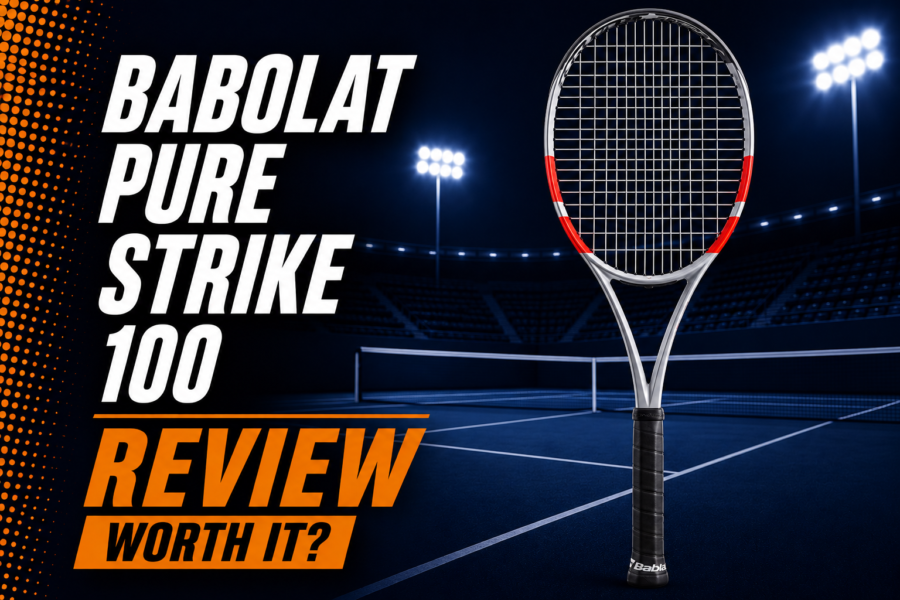
The Babolat Pure Strike 100 Gen4 is the standard 300 g, 100 sq in model in Babolat’s fourth-generation control family, introduced in 2024. This exact version uses a 16×19 string pattern, not the 16×20 pattern of the separately named Pure Strike 100 16×20 Gen4.
It is the most broadly accessible full-weight Pure Strike, combining a forgiving head with a conventional performance weight and a more open launch than the denser sibling. Babolat positions it for intermediate-to-advanced attacking players who want controllable power, modern spin and all-court versatility rather than the narrowest possible target window.
The standard 100 also differs from the lighter Team and compact 97. Its 300 g unstrung weight, 32 cm balance and approximate 324 strung swingweight give it more stability than the Team while remaining easier to use than the smaller, heavier 97.
Babolat Pure Strike 100 Gen4 Score
| Category | Score |
|---|---|
| Power | 8.5/10 |
| Spin | 8.5/10 |
| Control | 8/10 |
| Comfort | 8/10 |
These scores are editorial estimates based on the Pure Strike 100 Gen4’s verified specifications, construction, intended player profile and place in the wider racket market. Individual frames, strings, tension and technique can change performance.
Babolat Pure Strike 100 Gen4 Specifications
| Specification | Details |
|---|---|
| Head size | 100 sq in / 645 cm² |
| Length | 27 in / 68.5 cm |
| Unstrung weight | 300 g ±7 g / 10.6 oz, official |
| Strung weight | Approximately 318 g / 11.2 oz, retailer/lab measurement; string-dependent |
| Unstrung balance | 32 cm ±0.7 cm / 12.6 in, official |
| Strung balance | Approximately 33 cm / 13.0 in, 4 pts HL, retailer/lab measurement |
| Swingweight | 295 kg·cm² unstrung, official; approximately 324 kg·cm² strung, retailer/lab measurement |
| Stiffness | 68 RA ±3, official target; approximately 63 RA, retailer/lab measurement |
| Beam width | 21 mm / 23 mm / 21 mm |
| String pattern | 16×19 |
| Composition | Graphite with NF²-Tech flax and SMAC material |
| Recommended tension | 48-57 lb / 22-26 kg |
| Grip | Babolat Syntec Team |
Babolat’s official product page confirms the exact Gen4 identity, 16×19 pattern, unstrung specifications, beam, graphite construction, tension range and grip. The approximate strung weight, balance, swingweight and independent stiffness measurement are retailer or lab averages; actual results vary with production tolerance, strings, grip size, overgrips, dampeners and other accessories.
Design, Materials and Technologies
Head Size, Beam and Frame Geometry
The 100 sq in head gives the standard Pure Strike 100 more contact margin than the 97 or 98 sq in models. It helps preserve depth on slightly imperfect impact while staying within the familiar dimensions of a current performance racket.
The 21 mm / 23 mm / 21 mm hybrid beam is narrower at the tip and throat and wider through the middle. This geometry adds some rebound and structural support without relying on the uniformly thick profile common to maximum-power frames.
Control Frame Technology combines square and elliptical sections within that taper. Standard 27 in length keeps swing timing conventional, so the racket’s accessible performance comes from the head, pattern and weight distribution rather than extra leverage.
Weight, Balance and Swingweight
At 300 g unstrung, the standard 100 occupies a widely used performance-racket category. It is 15 g heavier than the Team, 5 g lighter than the 100 16×20 and 10 g lighter than the Pure Strike 97.
Its official 32 cm unstrung balance is head light, although less handle weighted than the 31 cm figures on the 100 16×20 and 97. Retailer testing places a typical strung frame near 33 cm and 4 points head light, providing a practical blend of hoop presence and handling.
Babolat publishes 295 as the unstrung swingweight, while independent testing measures approximately 324 after stringing. The finished inertia is higher than on the denser 100 despite the lower static weight because weight distribution, not scale weight alone, determines swingweight.
Materials and Construction
The frame is graphite with fourth-generation vibration-tuning materials. Babolat’s product description places natural flax fibers in the handle and SMAC patches at 3 and 9 o’clock, intended to filter selected vibration and alter the impact sound.
Babolat publishes a 68 RA ±3 stiffness target, while a major independent sample measured about 63 RA. Sample variation and measurement conditions can produce different results, and an overall RA number does not describe torsional stiffness or the installed string bed.
The moderate independent measurement and material package suggest a less rigid response than the official target alone might imply. Feel remains subjective, and the standard 100’s higher swingweight also influences how settled central contact seems.
String Pattern
The exact standard Pure Strike 100 Gen4 uses 16×19. This is the critical distinction from the 305 g 100 16×20 and must remain consistent in specification, performance and comparison sections.
Its open count gives the mains more opportunity to move and recover, supporting spin and a higher launch than the 16×20 sibling. Babolat’s FSI Control spacing is still intended to be tighter and more predictable than an extremely open spin-specific bed.
Pattern count does not determine response by itself because spacing, drilling, material, gauge and tension all matter. Frequent topspin hitters may also notch strings sooner as the mains move across the crosses.
Technologies
Control Frame Technology is Babolat’s hybrid of square and elliptical frame sections. The geometry reasonably shapes stability and rebound, while claims about maximum control or dynamism remain dependent on the player and setup.
NF²-Tech adds natural flax fibers to tune selected impact vibrations and sound. Babolat’s descriptive copy for the standard 100 distinguishes handle flax from SMAC material at 3 and 9 o’clock, so it should not be described with the 100 16×20’s handle-and-hoop flax layout.
The SMAC viscoelastic patches are intended to refine feedback at the sides of the hoop. They cannot eliminate the firmer response of old strings or the instability of contact near the perimeter.
FSI Control Pure Strike 24 combines tighter pattern spacing with the Woofer system’s frame-string interaction. Babolat associates it with predictable trajectory and longer ball-string interaction, but practical launch remains highly sensitive to the installed string bed.
Babolat Pure Strike 100 Gen4 Performance
Comfort and Feel
The approximate 63 RA independent measurement, narrow beam ends, flax and SMAC material suggest a moderately flexible response for a current 100 sq in performance frame. The approximate 324 swingweight adds substance on centered contact, which can make impact seem more settled.
Independent evaluations generally describe improved pocketing and a dampened or plush character relative to earlier Pure Strike expectations. Some players may interpret vibration filtering as muted, while others may value the reduced sharpness.
Comfort remains subjective and depends on technique, timing, grip size, string material, tension and age. Neither vibration-oriented technology nor an independent stiffness figure ensures individual comfort.
Comfort score: 8/10
Power
The 100 sq in head, 23 mm center beam, 16×19 bed and approximate 324 swingweight all contribute to accessible depth. The standard 100 has more free launch and mass-through-contact than its 300 g static figure might suggest.
Independent evaluations find it the easiest full-weight Gen4 Pure Strike to use for depth. It remains more controlled than a wide, stiff power specialist, so the strongest results still come from medium-to-full acceleration.
Compact swings receive more help than they would from the Pure Strike 97 or 100 16×20. A very powerful string or low tension can make the response lively, requiring the player to manage trajectory through spin and face angle.
Power score: 8.5/10
Control
The hybrid beam and FSI Control spacing preserve a predictable Pure Strike identity despite the open pattern. Head-light balance helps the player set face angle, and the 100 sq in area provides useful margin around the center.
The 16×19 launch is less contained than the 100 16×20’s response. Independent testers sometimes find easier net clearance and depth at the cost of the densest trajectory control, especially when swinging aggressively with a lively setup.
Control therefore comes from matching string response to swing speed and using spin appropriately. The racket supports accurate attacking tennis, but it does not remove the need for clean preparation and stable contact.
Control score: 8/10
Spin
The 16×19 pattern, 100 sq in head and practical head-light balance support strong racket-head speed and string movement. An approximate 324 swingweight provides enough momentum to drive a heavy, shaped ball rather than producing only superficial rotation.
Independent evaluations commonly identify spin access and net clearance as strengths relative to the denser Gen4 options. The frame can also hit flatter, but players moving from 16×20 or 18×20 should expect a higher natural window.
Actual spin depends on swing path, contact speed and the strings’ ability to slide and recover. Notched strings or tentative technique limit rotation regardless of pattern.
Spin score: 8.5/10
Maneuverability
The 300 g unstrung weight and 32 cm balance create familiar handling for an intermediate-to-advanced 100 sq in frame. It is quicker by static weight than the 100 16×20 and 97, but its approximate 324 swingweight gives the hoop more inertia than either measured sibling.
That combination supports smooth, committed swings rather than last-instant flicking. Players should confirm they can prepare consistently late in a session, because moderate static weight does not erase the finished swingweight.
Stability
The 324 approximate swingweight, hybrid beam and 318 g finished mass provide useful resistance against pace. Central contact should be more stable than with the Team, particularly on blocks, returns and punch volleys.
The larger head adds margin, though outer-hoop contact can still twist. Customization is possible, but adding weight to a stock swingweight already near 324 can quickly make the racket more demanding.
Performance by Shot
Groundstrokes
The standard 100 is the most versatile Pure Strike in this group from the baseline. The 100 sq in face and 16×19 bed help produce depth and topspin, while the hybrid beam retains enough containment for flatter forehands and backhands.
Independent testing finds easier net clearance and a zippier response than the 100 16×20. That makes neutral and defensive groundstrokes more productive, but fast hitters may need a controlled string to prevent the trajectory from becoming too lively.
The approximate 324 swingweight supports a penetrating ball when preparation is early. Players who consistently arrive late may prefer the Team’s lower inertia, while those seeking a lower launch should choose the denser sibling.
Serves
The 16×19 bed supports slice and kick, and the finished swingweight provides momentum for flat first serves. Standard length keeps toss and contact timing familiar.
Independent context suggests a productive blend of pace and placement rather than either extreme. The player must still accelerate fully, but the open pattern and center beam provide more assistance than the Pure Strike 97.
Volleys and Net Play
The 100 sq in face provides useful margin for reflex volleys, and the head-light balance helps set the racket quickly. Its finished inertia supports punch volleys and redirection against moderate-to-heavy pace.
The open bed can feel lively on touch shots with a powerful string. A controlled setup and compact technique help preserve angle and depth, while the 318 g approximate finished mass makes the racket more substantial than the Team.
Returns
Against first serves, the 324 approximate swingweight helps redirect pace with a compact block. The 100 sq in face gives more margin than the 97, although preparation still needs to begin early.
Against second serves, the open pattern supports aggressive spin and net clearance. Players who want to flatten returns through a lower window may prefer the 100 16×20.
String and Setup Considerations
Polyester can complement the standard 100 for fast swingers who need to manage 16×19 launch and maintain snapback. It should be selected for actual performance needs and monitored as elasticity and surface condition decline.
Multifilament, synthetic gut or natural gut can add response and accessible depth for players who do not need a low-powered bed. A hybrid can combine a lively component with a more controlled string, and main-string placement strongly influences the dominant response.
The more open pattern may notch strings faster than the 16×20 sibling for heavy topspin players. Thicker gauges can increase durability and calm launch, while thinner gauges can add pocketing and spin access but may wear sooner.
Babolat lists 48-57 lb / 22-26 kg as a general frame range, not a personalized instruction. The Tennis String Finder can narrow material choices, and the Tennis String Tension Calculator can provide a broad starting point for discussion with a qualified stringer.
Comfort depends on the complete setup plus technique, timing and grip size. Players should record material, gauge, reference tension and hours of use so changes are based on evidence rather than memory.
Build Quality and Durability
The graphite hoop has a full upper bumper and grommet strips that protect the frame and strings at drill holes. These components absorb routine abrasion and should be inspected during each restring.
String movement in the 16×19 bed can increase notching, but durability cannot be predicted from the pattern alone. Material, gauge, friction, court surface and playing style all contribute.
Paint chips, bumper scuffs and light scratches are generally cosmetic. Cracks, exposed graphite fibers, soft spots or permanent deformation may indicate structural damage and should be inspected before continued use or restringing.
Replacement bumper and grommet parts must match the standard Pure Strike 100 Gen4 16×19. Components for the 100 16×20, Team, 97, 98 or previous generations should not be assumed compatible, and no exact lifespan can be guaranteed.
Who Should Use It?
The Pure Strike 100 Gen4 best suits intermediate-to-advanced players with medium-to-full swings who want balanced power, spin and control. It is especially relevant to modern baseliners who need more margin than a 97 or 98 sq in player’s frame.
All-court and doubles players can use its 100 sq in face and head-light balance, while aggressive counterpunchers benefit from the finished swingweight. It can also serve as a step up from a 285 g frame for a player ready for greater substance.
The player should be able to repeat a swingweight near 324 across an entire match. That inertia supports stability and ball weight but makes the standard 100 more demanding than the scale number alone suggests.
Who Should Avoid It?
Beginners with short swings may find the 300 g frame and 324 approximate swingweight difficult to prepare. A lighter Team or broader power racket can provide easier development.
Players who want the lowest possible launch and maximum directional containment should prefer the 100 16×20 or an 18×20 model. Conversely, those seeking extremely high spin launch may want a more specialized spin frame.
Anyone sensitive to a more muted response should evaluate the Gen4 flax and SMAC package carefully. Players who want much lower swingweight should not assume the 300 g static specification guarantees quick handling.
Pros and Cons
| Pros | Cons |
|---|---|
| 100 sq in head and 16×19 bed provide useful margin | Launch is less contained than on the 100 16×20 |
| Approximate 324 swingweight supplies stability and ball weight | Finished inertia can challenge late preparation |
| Balanced power and spin suit several playing styles | Less precise than compact 97 or dense-pattern alternatives |
| Gen4 material package supports a moderated impact response | Open bed may notch strings sooner for heavy topspin players |
Babolat Pure Strike 100 Gen4 Compared With Similar Rackets
The Pure Strike 100 16×20 Gen4 adds 5 g unstrung, balances 1 cm farther toward the handle and uses an extra cross. It provides lower launch and more trajectory control with a slightly lower measured swingweight, while the standard 100 supplies easier depth and spin; see the Babolat Pure Strike 100 16×20 Racket Review.
The Pure Strike Team Gen4 is 15 g lighter unstrung, uses the same 100 sq in head and 16×19 pattern, and has an approximate 307 strung swingweight. It is easier to accelerate but less stable against pace, making the Babolat Pure Strike Team Racket Review useful for players deciding how much mass they can repeat.
The Pure Strike 97 Gen4 is 10 g heavier unstrung, uses a smaller 97 sq in head, a denser 16×20 pattern and a natural leather grip. It offers a lower, more exact trajectory and direct bevel feedback, while the standard 100 is more forgiving and power-accessible; the Babolat Pure Strike 97 Racket Review covers that specialist sibling.
The Wilson Blade 100 V9 also uses a 100 sq in head, 300 g unstrung weight and 16×19 bed, but it has a constant 22 mm beam and a lower approximate 60 RA stiffness. The Blade is more flexible and slightly lower powered, while the Pure Strike carries a more dynamic hybrid beam and higher approximate swingweight; see the Wilson Blade 100 Review for the exact 2024 V9 model.
Final Verdict
The Babolat Pure Strike 100 Gen4 is the family’s most balanced full-weight option. Its verified 16×19 pattern, 300 g unstrung weight, 32 cm balance, 100 sq in head and approximate 324 swingweight provide easier power and spin than the denser Pure Strikes without abandoning controlled performance intent.
Its strengths are versatility, stability, accessible depth and a moderated Gen4 response. A higher launch and more demanding finished inertia than expected are the principal tradeoffs, so it best suits a committed intermediate or advanced player prepared to manage both.
Frequently Asked Questions
What string pattern does the Pure Strike 100 Gen4 use?
The standard Pure Strike 100 Gen4 uses 16×19. The separately named Pure Strike 100 16×20 Gen4 uses 16×20 and also has different weight and balance specifications.
What generation is the Babolat Pure Strike 100?
This review covers the fourth generation introduced in 2024. Specifications from older Pure Strike 100 models should not be carried into this version.
How heavy is the Pure Strike 100 when strung?
Independent retailer testing places it at approximately 318 g / 11.2 oz. Babolat officially specifies 300 g ±7 g unstrung, and strings or accessories change the finished weight.
Is the Pure Strike 100 powerful?
It provides useful power through the 100 sq in head, hybrid beam, open pattern and approximate 324 swingweight. It remains a performance control racket and produces its best depth with a medium-to-full swing.
Is the Pure Strike 100 comfortable?
An independent sample measured approximately 63 RA, and the Gen4 frame uses flax and SMAC material to tune impact response. Comfort remains subjective and depends on strings, tension, technique, timing and grip size.
Does the Pure Strike 100 generate spin?
Yes. Its 16×19 bed and 100 sq in head support string movement and net clearance, while the finished swingweight can help drive a heavy ball when the player accelerates.
Should a player choose the standard 100 or 100 16×20?
Choose the standard 100 for easier launch, depth and spin. Choose the 100 16×20 for a more head-light setup, lower trajectory and greater containment on full swings.