
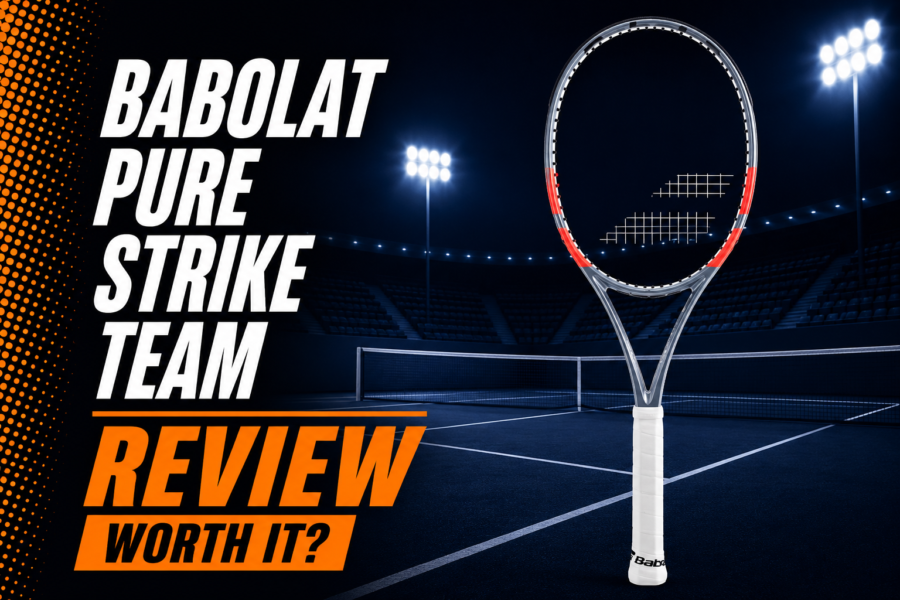
The Babolat Pure Strike Team Gen4 is the 285 g performance entry point in Babolat’s fourth-generation Pure Strike family, introduced in 2024. This review covers only the 100 sq in Team with its 16×19 pattern, not the 300 g standard Pure Strike 100 or the denser 305 g 100 16×20.
The Team is designed for improving intermediates, advancing juniors moving to an adult racket and players who want Pure Strike control in a faster package. Its 32.5 cm unstrung balance places more weight toward the head than the heavier models, helping the finished frame retain useful hitting substance despite the lower static weight.
That balance is central to understanding the racket. The Team is easier to lift and accelerate than the 300 g and 305 g siblings, but its approximate 307 strung swingweight means it is not merely an ultralight frame with no presence behind the ball.
Babolat Pure Strike Team Gen4 Score
| Category | Score |
|---|---|
| Power | 8/10 |
| Spin | 8/10 |
| Control | 7.5/10 |
| Comfort | 8/10 |
These scores are editorial estimates based on the Pure Strike Team Gen4’s verified specifications, construction, intended player profile and position in the current racket market. Finished setup, production tolerance and technique can change its response.
Babolat Pure Strike Team Gen4 Specifications
| Specification | Details |
|---|---|
| Head size | 100 sq in / 645 cm² |
| Length | 27 in / 68.5 cm |
| Unstrung weight | 285 g ±7 g / 10.2 oz, official |
| Strung weight | Approximately 303 g / 10.7 oz, retailer/lab measurement; string-dependent |
| Unstrung balance | 32.5 cm ±0.7 cm / 12.8 in, official |
| Strung balance | Approximately 34 cm / 13.4 in, 1 pt HL, retailer/lab measurement |
| Swingweight | 275 kg·cm² unstrung, official; approximately 307 kg·cm² strung, retailer/lab measurement |
| Stiffness | 69 RA ±3, official target; approximately 64 RA, retailer/lab measurement |
| Beam width | 21 mm / 23 mm / 21 mm |
| String pattern | 16×19 |
| Composition | Graphite with NF²-Tech flax and SMAC material |
| Recommended tension | 46-55 lb / 21-25 kg |
| Grip | Babolat Syntec Team |
Babolat’s official page confirms the Gen4 identity, unstrung dimensions and targets, graphite composition, recommended range and grip. The approximate strung weight, balance, swingweight and independent stiffness measurement are retailer or lab figures; strings, manufacturing tolerance, grip size, overgrips, dampeners and other accessories affect the finished racket.
Design, Materials and Technologies
Head Size, Beam and Frame Geometry
The 100 sq in head gives the Team a practical contact area for developing timing and defending under pressure. It offers more geometric forgiveness than the 97 or 98 sq in Pure Strikes without becoming oversized.
The 21 mm / 23 mm / 21 mm hybrid beam combines narrower ends with a wider middle. That profile preserves the control family’s defined response while adding enough structural rebound to keep a 285 g frame from becoming unnecessarily low-powered.
Standard 27 in length supports familiar timing and adult reach. Accessibility comes from the lower static weight and open pattern rather than an extended lever or very broad beam.
Weight, Balance and Swingweight
At 285 g unstrung, the Team is 15 g lighter than the standard Pure Strike 100 and 20 g lighter than the 100 16×20. The lower scale weight helps with preparation, serves and quick exchanges, particularly for players not ready to repeat a 318 g or 323 g finished swing.
Its 32.5 cm unstrung balance is more forward than those heavier siblings. Once strung, retailer measurements place it near 34 cm and only 1 point head light, so the hoop retains meaningful presence rather than feeling extremely handle weighted.
Babolat publishes an official 275 unstrung swingweight, while a retailer’s finished sample measured approximately 307. That strung inertia is manageable but not negligible, illustrating why light static weight does not automatically equal the lowest possible swingweight.
Materials and Construction
The Team uses graphite construction with the Gen4 Pure Strike material package. Babolat’s exact product description places natural flax fibers in the handle and SMAC patches at 3 and 9 o’clock to tune selected vibration and impact sound.
The official stiffness target is 69 RA ±3, but an independent retailer sample measured approximately 64 RA. Production tolerance and method can contribute to the gap, and overall RA does not represent torsional stiffness or the stiffness of the installed string bed.
The lighter frame will not respond exactly like the heavier Gen4 models even when technologies share names. Static mass, balance and swingweight change how much the racket deflects or twists during actual contact.
String Pattern
The 16×19 bed is more open than the 16×20 patterns used by the Pure Strike 100 16×20 and 97. It supports easier net clearance, depth and main-string movement for a player developing racket-head speed.
This does not make every 16×19 equally lively. Babolat’s FSI Control arrangement uses tighter spacing than a maximally open spin frame, so the Team remains intended to deliver a predictable Pure Strike trajectory.
String material, gauge and tension can move the response from crisp and contained to lively and high launching. Main-string movement may also increase notching as the setup ages, especially for frequent topspin hitters.
Technologies
Control Frame Technology combines square and elliptical cross-sections. Babolat associates the square geometry with stability and the elliptical geometry with a more dynamic response, producing the hybrid 21 mm / 23 mm / 21 mm beam.
NF²-Tech uses flax in selected construction areas to filter certain vibration and alter impact sound. Babolat’s product copy for the Team distinguishes flax in the handle from SMAC patches in the hoop, so that exact placement should not be copied from the 100 16×20.
The SMAC viscoelastic component is intended to tune feedback at 3 and 9 o’clock. It can influence the character of impact but cannot make off-center contact or a firm, old string setup behave like clean contact on fresh strings.
FSI Control Pure Strike 24 combines tighter pattern spacing with Woofer frame-string interaction to pursue a controlled launch and longer ball-string interaction. These are manufacturer design claims, and their practical effect remains dependent on the whole setup and player.
Babolat Pure Strike Team Gen4 Performance
Comfort and Feel
The independent 64 RA measurement, narrow-ended beam, flax and SMAC components suggest a more moderated response than the official 69 target alone might imply. The graphite construction should still provide clear feedback, especially because the finished mass is lower than the heavier Pure Strikes.
Independent evaluations describe the fourth-generation Team as more settled and pocketing than a simple stiff lightweight frame. Contact near the perimeter can transmit more instability because less static mass is available to resist twisting.
Comfort is subjective and depends on technique, timing, grip size, string material, tension and age. Vibration-tuning materials cannot ensure comfort for every player or compensate for consistently late contact.
Comfort score: 8/10
Power
The 100 sq in head, 23 mm center beam, open pattern and nearly even finished balance provide accessible depth. The forward weight distribution helps the hoop carry through contact despite the 285 g unstrung weight.
Independent evaluations place its power above the denser or smaller Pure Strike options but below thick-beamed power specialists. Players with compact-to-medium swings should receive workable assistance, while faster swings still have enough control to accelerate.
The lower static mass limits mass-based pace compared with the standard 100 or 100 16×20. Power is easiest when contact is central and the player continues through the ball rather than relying on a passive block.
Power score: 8/10
Control
The hybrid beam, FSI spacing and standard-length geometry keep the Team connected to the Pure Strike control identity. Its manageable swingweight can help a developing player arrive on time and stabilize the face through technique.
The 16×19 bed and more forward balance create a livelier launch than the 100 16×20. Independent evaluations generally find useful directional response, but not the same containment or stability available from the heavier siblings.
Control ultimately comes from repeatable mechanics and string setup. A powerful, low-tension string can raise launch, while contact outside the central bed may reduce directional confidence.
Control score: 7.5/10
Spin
The 16×19 pattern, 100 sq in head and low static weight support quick acceleration and string movement. Players with developing modern swings should find it easier to create racket-head speed than with the 332 g Pure Strike 97.
The approximate 307 swingweight provides enough hoop presence to drive a shaped ball without becoming cumbersome. FSI Control keeps spacing from being as open as a dedicated high-launch spin frame, giving the Team a balanced rather than extreme spin profile.
Technique remains decisive, and worn or notched strings reduce snapback. An open pattern only creates useful rotation when the player supplies speed and an appropriate contact path.
Spin score: 8/10
Maneuverability
The 285 g unstrung weight makes the Team substantially easier to lift and reposition than the other adult performance Pure Strikes. It supports quick preparation, rapid grip changes and overhead acceleration for players still building strength or timing.
The more forward balance and approximate 307 swingweight stop it from feeling as head light as its low mass might suggest. That added hoop presence is useful through contact, but players seeking maximum hand speed may prefer an even lighter and more head-light frame.
Stability
The hybrid beam, near-even finished balance and SMAC-equipped hoop give the Team reasonable support for its weight class. Central contact should retain more substance than a very head-light 285 g frame with a much lower swingweight.
Heavy incoming pace and peripheral contact reveal the limitations of lower static mass. Adding weight can improve resistance to twisting, but it also changes swingweight, balance and the primary reason to choose the Team.
Performance by Shot
Groundstrokes
The Team is accessible from the baseline because it accelerates readily and provides a forgiving 100 sq in contact area. Its 16×19 pattern supports topspin net clearance, while the hybrid beam supplies enough control for flatter drives from a developing full swing.
Independent evaluations describe it as a user-friendly route into Pure Strike response. Defensive groundstrokes benefit from speed and a more forward hoop, though strong incoming pace can expose less stability than in the standard 100.
Two-handed backhands and compact forehands should be easier to prepare than with the 305 g models. Players who already swing very fast may find the lively launch and lower mass less precise unless the string setup is controlled.
Serves
Low static weight supports racket-head acceleration on flat, slice and kick serves. The 16×19 bed helps access spin, and the 100 sq in face provides more margin than the Pure Strike 97.
The approximate 307 swingweight supplies useful momentum but less mass-based pace than the heavier models. Servers who rely on fluent speed may benefit most, while those wanting maximum weight behind a flat serve may prefer the standard 100.
Volleys and Net Play
The Team changes direction quickly in doubles exchanges and provides a broad enough face for reflex volleys. Its open bed offers a responsive touch window, while the hybrid beam helps keep punch volleys from becoming uncontrolled.
Against heavy passing shots, lower static mass can allow more twisting or deflection near the edge. Clean preparation and contact remain important even though the racket is easier to position.
Returns
The lower weight helps shorten preparation against fast serves and makes aggressive swings on second serves accessible. Its more forward finished balance gives compact blocks some depth when contact is central.
The frame is less stable than the heavier Pure Strikes against forceful first serves. A player who routinely faces high pace and can manage more mass may benefit from the standard 100 or 100 16×20.
String and Setup Considerations
Multifilament or synthetic gut can suit developing players who want elasticity, accessible depth and a broad response. Natural gut is another responsive option, while a hybrid can combine liveliness with a more controlled component.
Polyester may help a fast swinger manage the 16×19 launch, but it should be chosen for a real need such as snapback or durability. A full bed is not automatically the best choice for a lighter performance racket, and an old polyester setup can become less responsive.
The open pattern may notch strings faster than the denser 16×20 siblings for heavy topspin players. Thicker gauges can improve durability and lower launch, while thinner strings can add pocketing and response but may wear sooner.
Babolat officially lists 46-55 lb / 21-25 kg for the Team, which differs from the 48-57 lb range on the heavier adult Pure Strikes. The Tennis String Finder can help compare materials, and the Tennis String Tension Calculator can establish a general starting point for discussion with a stringer.
Comfort depends on the complete setup as well as technique, timing and grip size. Keeping records of string, gauge, reference tension and playing time makes it easier to identify useful changes.
Build Quality and Durability
The graphite frame has an upper bumper and grommet strips that protect the hoop and strings during routine play. Grommets should be checked at each restring for splitting, sinking or sharp edges.
The lower frame mass does not make careful inspection less important. Repeated court scraping can eventually wear through the bumper, and replacement before graphite becomes exposed is preferable.
Paint chips, light scratches and bumper scuffs are normally cosmetic. Cracks, exposed fibers, soft sections or lasting deformation can indicate structural damage and should be evaluated before further play or stringing.
Replacement parts must be specified for the Pure Strike Team Gen4. Grommets from the standard 100, 100 16×20, 97 or an earlier Team generation should not be assumed compatible, and usage conditions prevent any exact lifespan promise.
Who Should Use It?
The Pure Strike Team Gen4 best suits improving intermediates, advancing juniors transitioning to an adult frame and experienced players who specifically prefer a lighter racket. Compact-to-medium swings receive easier acceleration, while developing full swings can use the open pattern for spin.
It is particularly relevant to all-court players and doubles players who prioritize preparation speed. Baseliners who face moderate pace can benefit from the forward balance without carrying the static mass of the heavier Pure Strikes.
The player should still be comfortable with a nearly even approximate strung balance and 307 swingweight. Those figures give the Team substance but distinguish it from an extremely head-light ultralight model.
Who Should Avoid It?
Advanced hitters facing heavy pace may find the 303 g approximate finished weight insufficiently stable. A 300 g or 305 g Pure Strike provides more mass and a more head-light performance balance.
Players who want the lowest launch and most precise trajectory should consider the 100 16×20 or 97. The Team’s 16×19 bed is easier to use but less contained.
Anyone seeking maximum effortless power may prefer a wider-beamed power frame, while anyone needing the absolute quickest possible racket might prefer a lower swingweight model. The Team aims for balanced accessibility rather than either extreme.
Pros and Cons
| Pros | Cons |
|---|---|
| 285 g unstrung weight supports quick preparation | Less stable against heavy pace than heavier Pure Strikes |
| 100 sq in head and 16×19 bed provide accessible margin | More forward balance may surprise ultralight-frame users |
| Approximate 307 swingweight adds useful hoop substance | Livelier launch offers less precision than 16×20 models |
| Gen4 flax and SMAC package tunes impact response | Low static mass limits mass-based pace and plow-through |
Babolat Pure Strike Team Gen4 Compared With Similar Rackets
The standard Pure Strike 100 Gen4 adds 15 g unstrung, uses the same 100 sq in head and 16×19 pattern, and has a more head-light 32 cm balance with an approximate 324 swingweight. It is more stable and powerful through mass, while the Team is easier to accelerate; the Babolat Pure Strike 100 Racket Review covers that exact fourth-generation model.
The Pure Strike 100 16×20 Gen4 is 20 g heavier unstrung, balanced 1.5 cm farther toward the handle and uses a denser pattern. It supplies better trajectory control and resistance to pace but demands more complete preparation, as detailed in the Babolat Pure Strike 100 16×20 Racket Review.
The Pure Strike 97 Gen4 is 25 g heavier unstrung, has a smaller 97 sq in head, a 16×20 bed and a natural leather grip. It is far more specialized and precise, while the Team prioritizes margin and speed for developing performance players; see the Babolat Pure Strike 97 Racket Review.
The Babolat EVO Strike Gen2 uses a larger 102 sq in head and a slightly heavier 290 g unstrung specification, but targets a less advanced player with broader margin and a more accessible response. The Team is the smaller-headed, competition-oriented route, while the Babolat EVO Strike Review explains the progressive alternative.
Final Verdict
The Babolat Pure Strike Team Gen4 is a legitimate lighter performance model, not a copy of the standard 100’s specifications. Its 285 g unstrung weight, 32.5 cm balance, 100 sq in head, 16×19 bed and approximate 307 swingweight combine fast handling with enough hoop presence for developing strokes.
Its main strengths are maneuverability, accessible spin and a useful balance of power and control. Lower stability and a livelier trajectory than the heavier Pure Strikes are the tradeoffs, making it best for a progressing player who benefits more from on-time preparation than maximum mass.
Frequently Asked Questions
What generation is the Babolat Pure Strike Team?
This review covers the fourth-generation Team introduced in 2024. Its specifications and technologies should not be copied from the third generation or from another Gen4 weight.
How heavy is the Pure Strike Team when strung?
Independent retailer measurements place it at approximately 303 g / 10.7 oz. Babolat’s official unstrung target is 285 g ±7 g, and strings plus accessories affect the finished figure.
Is the Pure Strike Team head light?
Babolat officially lists a 32.5 cm unstrung balance, while a retailer sample measured approximately 34 cm strung, or 1 point head light. It therefore carries more weight toward the hoop than the heavier Pure Strike models.
Is the Pure Strike Team suitable for beginners?
It can suit an athletic beginner developing complete strokes, but it is more naturally aimed at improving intermediates and advancing juniors. A true beginner who needs maximum effortless depth may prefer a broader, more power-focused frame.
Does the Pure Strike Team generate spin?
Its 16×19 pattern, 100 sq in head and low static weight support strong spin potential when the player accelerates. Technique, swing path and string condition still determine actual rotation.
Is the Pure Strike Team comfortable?
The Gen4 frame uses flax and SMAC material, and an independent sample measured approximately 64 RA. Comfort remains personal and depends on technique, grip size, strings, tension and string age.
Should a player choose the Team or standard Pure Strike 100?
Choose the Team when quick handling and lower static weight are priorities. Choose the standard 100 when greater stability, mass-based pace and a more head-light finished response justify the extra weight.