
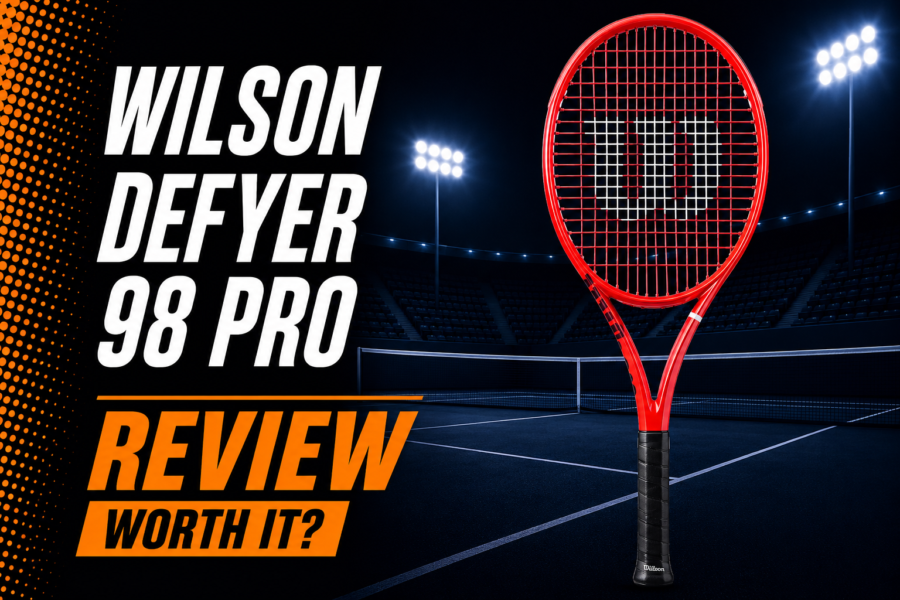
The Wilson Defyer 98 Pro V1 is the 305 g control model in Wilson’s first-generation Defyer family, released in 2026. This review covers only the 98 sq in Pro with its 16×20 pattern, not the Defyer 100, 100L or 100UL.
Wilson positions Defyer as a power-and-spin line for aggressive baseline play, but the 98 Pro is the most precise and demanding adult frame in the range. Its small head, head-light balance and controlled pattern target advanced players who create their own racket-head speed and want to shape a heavy ball without moving to an oversized or ultralight frame.
The Pro designation matters because this is not simply a Defyer 100 with a smaller face. It has a 305 g unstrung weight, 31.5 cm unstrung balance, 16×20 bed and 290 official unstrung swingweight, creating a distinct blend of speed, directional control and useful finished-frame inertia.
Wilson Defyer 98 Pro V1 Score
| Category | Score |
|---|---|
| Power | 8/10 |
| Spin | 8.5/10 |
| Control | 9/10 |
| Comfort | 8/10 |
These scores are editorial estimates based on the Defyer 98 Pro V1’s verified specifications, construction, intended player profile and position within the wider racket market. Strings, tension, technique and production tolerances can materially change its response.
Wilson Defyer 98 Pro V1 Specifications
| Specification | Details |
|---|---|
| Head size | 98 sq in / 632 cm² |
| Length | 27 in / 68.6 cm |
| Unstrung weight | 305 g / 10.8 oz, official |
| Strung weight | 320 g / 11.3 oz, official nominal; approximately 323 g / 11.4 oz, retailer/lab average |
| Unstrung balance | 31.5 cm / 12.4 in, official |
| Strung balance | Approximately 32.4 cm / 12.75 in, 6 pts HL, retailer/lab measurement |
| Swingweight | 290 kg·cm² unstrung, official; approximately 319 kg·cm² strung, retailer/lab measurement |
| Stiffness | Approximately 64 RA, retailer/lab measurement |
| Beam width | 22 mm / 23.5 mm / 22 mm |
| String pattern | 16×20 |
| Composition | Graphite/carbon-fiber frame with DirectConnect carbon-fiber handle construction |
| Recommended tension | 47-57 lb / 21-25 kg |
| Grip | Wilson Pro Performance |
Wilson’s official Defyer pages confirm the V1 identity, 98 sq in head, length, unstrung weight and balance, 16×20 pattern, unstrung swingweight and core technologies. The approximate 323 g finished weight, 32.4 cm balance, 319 swingweight and 64 RA stiffness are independent retailer or lab averages; actual frames vary with manufacturing tolerances, strings, grip size, overgrips, dampeners and other accessories.
Design, Materials and Technologies
Head Size, Beam and Frame Geometry
The 98 sq in head gives the Pro a more compact contact area than every 100 sq in Defyer. It supports precise face placement and rewards centered contact, but it offers less geometric margin when preparation or spacing breaks down.
Wilson uses a dual-taper 22 mm / 23.5 mm / 22 mm beam rather than a thin constant control beam. The wider middle section is intended to contribute rebound and structural support, while the slimmer ends keep the geometry from becoming as uniformly powerful as a thick-beamed recreational frame.
Standard 27 in length preserves conventional timing and reach. The Defyer’s distinctive shaft and aerodynamic bumper pursue acceleration through shaping rather than through an extended handle or unusually low static weight.
Weight, Balance and Swingweight
At 305 g unstrung, the 98 Pro has enough static mass for an advanced-player specification without entering a traditional 315 g or 320 g category. Its official 31.5 cm balance places substantial weight toward the handle, which helps the frame change direction despite its finished mass.
Wilson publishes a 290 unstrung swingweight, while retailer testing places a typical strung sample near 319. Those figures are not interchangeable: strings add mass primarily around the head, so a meaningful increase after stringing is expected.
An approximate 319 strung swingweight is relatively quick for a 323 g finished racket. It favors acceleration and spin shaping, but players facing very heavy pace may find less automatic plow-through than in a 98 sq in frame with swingweight in the high 320s or 330s.
Materials and Construction
The frame uses graphite/carbon-fiber construction, and DirectConnect extends a carbon-fiber handle to the end cap. Wilson says the direct structural connection is intended to improve torsional stability and create a more connected impact response.
An independent stiffness measurement near 64 RA places the racket in a moderate range rather than at either flex extreme. That number does not describe every part of the frame, which is relevant because SI3D intentionally combines a more flexible hoop with a stiffer throat.
Elite Spec Control is Wilson’s tighter tolerance program for this line, with stated production targets of ±5 g in weight, ±0.5 cm in balance and ±5 kg·cm² in swingweight. Those tolerances still allow two legal frames to play differently, so competitive users matching several rackets should measure finished specifications.
String Pattern
The 16×20 pattern adds one cross compared with a conventional 16×19 bed. In a 98 sq in face, that layout can create a more contained launch and predictable trajectory while retaining more main-string movement than an 18×20 pattern.
String count alone does not determine spin. Spacing, drilling, head speed, contact angle and the strings’ ability to slide and recover all matter, and the Defyer’s pattern remains open enough to support heavy rotation from a technically fast swing.
The extra cross and compact head may improve control and distribute wear more evenly than a very open spin pattern. Aggressive topspin players can still notch or break strings, especially after the surface loses its ability to snap back.
Technologies
Torq Shaft is the sculpted throat and shaft design at the center of the Defyer concept. Wilson says it transfers swing energy efficiently into the hoop to add speed and action, while the geometry also reasonably contributes to the racket’s distinctive balance of leverage and torsional behavior.
SI3D describes differentiated stiffness through the frame. Wilson specifies a flexible hoop to support ball interaction and a stiffer throat to support power and spin, which helps explain why one overall RA measurement cannot fully represent the impact response.
The Airfoil Bumper gives the upper guard a streamlined profile intended to reduce airflow resistance. It cannot create racket-head speed by itself, but minimizing unnecessary drag is consistent with the Pro’s relatively quick measured swingweight.
Parallel Drilling aligns selected grommet paths to promote a more uniform string-bed response and enlarge the effective hitting area. Dual Taper Beam supplies the variable beam height, while DirectConnect strengthens the path from handle to end cap.
Click-and-Go is Wilson’s replaceable bumper-and-grommet system, designed for accurate fit and simpler servicing. These technologies provide clear construction details, but manufacturer claims about power, feel and sweet-spot size remain design intentions rather than guarantees for every player.
Wilson Defyer 98 Pro V1 Performance
Comfort and Feel
The approximate 64 RA stiffness and flexible-hoop element of SI3D suggest a more moderated impact than the Defyer’s power-and-spin positioning might imply. The 323 g approximate finished mass can also make centered contact seem more settled than it would in a much lighter frame.
Independent evaluations generally describe a connected, controlled response rather than a rigid or hollow one. The 98 sq in face remains less forgiving of contact near the edge, and the feedback should be expected to become firmer or less stable when the ball misses the central string bed.
Comfort is subjective and depends on timing, technique, grip size, string material, tension and string age. A moderate RA figure and vibration-oriented construction do not ensure that every setup will suit every player.
Comfort score: 8/10
Power
Power comes from the dual-taper beam, stiffer-throat component of SI3D and enough finished swingweight to transfer useful momentum. The 23.5 mm middle section gives the frame more assistance than a uniformly thin 20 mm or 21 mm player’s beam.
The 98 sq in head and 16×20 pattern keep that assistance controlled. Independent evaluations find useful pace when the racket is accelerated, but the 98 Pro does not replace the need for a full swing or centered contact.
This is best understood as controllable power for an advanced player, not automatic depth for a short swing. Players who contact late or simply block from the baseline may leave the ball shorter than they would with a larger, thicker, more head-forward racket.
Power score: 8/10
Control
The compact head, 16×20 bed and head-light balance create a strong platform for controlling face angle and trajectory. A player who arrives on time can accelerate through a narrow target without the unusually high launch associated with some open 100 sq in spin frames.
The wider middle beam and power-focused throat mean this is not a low-powered traditional frame. Control comes from the player’s ability to use spin, net clearance and face discipline, not from the racket removing pace from every swing.
Independent context places targeting among the Pro’s strongest qualities, especially from the baseline. Off-center contact and tired preparation can still change direction or depth, so the 98 sq in face rewards precision rather than manufacturing it.
Control score: 9/10
Spin
The 16×20 pattern preserves mobile mains, and the approximate 319 swingweight helps an advanced player create head speed. Torq Shaft and the Airfoil Bumper are specifically designed around acceleration and shot shaping, which aligns with Wilson’s spin positioning.
The launch should be more controlled than a very open 16×19 bed, allowing players to swing upward without automatically producing an excessively high trajectory. That combination is particularly relevant for penetrating topspin rather than only high, looping rotation.
Spin still depends on technique, contact speed and a string bed that can slide and recover. A worn, notched setup or tentative swing reduces the practical benefit of any spin-oriented geometry.
Spin score: 8.5/10
Maneuverability
The 31.5 cm unstrung balance and approximate 319 strung swingweight make the Pro faster to reposition than its 323 g finished weight might suggest. Independent evaluations emphasize its speed on baseline swings, serves and quick net reactions.
It is not an ultralight racket, and repeated acceleration still requires conditioning and early preparation. The relevant test is whether the player can maintain timing through a long match, not whether one practice swing seems quick.
Stability
Static mass, the variable beam, DirectConnect and the stiffer throat all support resistance to unwanted movement. Central contact should have enough substance for redirecting pace, while the head-light balance prevents that stability package from becoming cumbersome.
The approximate 319 swingweight leaves room below many heavier tour-style frames, so very forceful incoming balls may expose less plow-through near the upper hoop. Customization can add stability, but any added hoop mass also raises swingweight and changes the carefully head-light setup.
Performance by Shot
Groundstrokes
The 98 Pro is built for assertive baseline swings that combine racket-head speed with deliberate direction. Its 16×20 bed supports a controlled launch for flatter drives, while mobile mains and aerodynamic handling allow modern topspin forehands and backhands to clear the net safely.
Independent performance context suggests that the racket is particularly effective when the player takes a full cut and uses spin to drive through the court. It supplies more beam-assisted depth than an extremely thin control frame but is less helpful on defensive contact stretched far from the body.
One-handed and two-handed backhands can both benefit from the head-light balance. The compact face still asks for accurate spacing, and late contact can expose the difference between the 98 Pro and a more forgiving 100 sq in sibling.
Serves
The standard length, aerodynamic bumper and moderate swingweight support acceleration through the service motion. The 16×20 pattern is versatile enough for slice and kick while retaining a predictable target window for flatter first serves.
The dual-taper beam and finished mass can contribute useful pace when timing is complete. Players seeking effortless speed from abbreviated service mechanics may find a lighter or wider-headed model more productive.
Volleys and Net Play
Head-light balance makes the face quick to set for reflex exchanges and helps the player change between forehand and backhand volleys. The compact head and controlled bed also suit deliberate angles, low volleys and punch placement.
The 323 g approximate finished weight provides substance on central contact, but the modest swingweight can be less commanding when the ball reaches the outer hoop. Doubles players should decide whether the speed advantage outweighs the smaller margin compared with the Defyer 100.
Returns
Against first serves, the Pro can be prepared with a short movement and use its static mass to redirect pace. Its control-oriented pattern supports compact blocks, provided contact stays near the center.
Against second serves, the aerodynamic handling makes a fuller, spin-shaped attack practical. A player who needs a larger contact window when rushed may prefer a 100 sq in frame despite the Pro’s quick balance.
String and Setup Considerations
The 16×20 bed and moderate stiffness support several string directions. A control-oriented polyester can help fast swingers maintain trajectory and snapback, while multifilament, synthetic gut or natural gut can add elasticity and easier depth.
A hybrid can combine a more responsive main or cross with a lower-powered component, depending on the player’s priorities. Material placement matters, so the same two strings can produce different launch, durability and feel when their main and cross positions are reversed.
The compact head and extra cross should produce a more contained response than many 16×19 spin rackets. Thinner strings can increase pocketing and access to movement but may wear sooner, while thicker gauges can add durability and lower launch at the cost of some liveliness.
Wilson’s listed 47-57 lb / 21-25 kg range is a broad frame guideline, not a personalized prescription. The Tennis String Finder can narrow material choices, and the Tennis String Tension Calculator can provide a general starting point to discuss with a qualified stringer.
Comfort depends on the entire setup plus technique, timing and grip size. Players should record string, gauge, reference tension and hours of use, then change one variable at a time rather than assuming the frame alone controls the response.
Build Quality and Durability
The graphite frame uses a full upper bumper and grommet system to separate the strings from the drill holes. Wilson’s Click-and-Go design is intended to make compatible bumper and grommet replacement more straightforward while retaining a precise fit.
The Airfoil Bumper is both protective and aerodynamic, but repeated scraping can eventually wear through any guard. Grommets should be inspected during every restring for splits, sharp edges or sinking that could expose the string to graphite.
Gloss paint can show court scrapes, chips and fine surface marks, and these are generally cosmetic. Cracks, exposed fibers, soft areas or permanent deformation can indicate structural damage and should be inspected before continued use or restringing.
Replacement parts must match the Defyer 98 Pro V1. Components for the 100, 100L or 100UL should not be assumed compatible simply because the rackets share a family name, and no specific frame lifespan can be promised.
Who Should Use It?
The Defyer 98 Pro V1 best suits advanced players, strong intermediates moving into a smaller head, and competitive baseliners with medium-to-full, fast swings. It rewards players who generate pace and spin through acceleration but want more beam assistance than a very low-powered traditional 98.
Aggressive counterpunchers can use the head-light balance to redirect pace and the 16×20 bed to control launch. All-court players may also value its serve speed, quick net handling and compact targeting.
The player should be comfortable managing roughly 323 g and a swingweight near 319 for an entire session. Good preparation and consistent central contact are more important than the broad label printed on the frame.
Who Should Avoid It?
Beginners and players with short, tentative strokes may find the 98 sq in head too exacting and the power too dependent on acceleration. A lighter 100 sq in model with a broader contact window is likely to provide easier development and defensive depth.
Players who want maximum plow-through from a high-swingweight frame may find the Pro too quick or light through the hoop. Conversely, anyone who struggles with a 323 g finished racket should not assume its head-light balance removes the repeated-swing demand.
Those seeking a very dense, low-launch bed may prefer an 18×20 control frame. Players who want a high, easy launch and maximum forgiveness should look toward an open 100 sq in power or spin racket instead.
Pros and Cons
| Pros | Cons |
|---|---|
| 98 sq in head and 16×20 bed support precise targeting | Smaller contact window demands accurate preparation |
| Approximate 319 swingweight promotes fast acceleration | Less automatic plow-through than heavier 98 sq in frames |
| Dual-taper beam adds useful power without an open launch | Short swings may not receive enough effortless depth |
| Replaceable aerodynamic bumper supports servicing and speed | Exact V1 replacement parts are model-specific |
Wilson Defyer 98 Pro V1 Compared With Similar Rackets
The Defyer 100 V1 is 5 g lighter unstrung but uses a larger 100 sq in head, a more open 16×19 pattern and a higher official 295 unstrung swingweight. It offers greater launch and margin, while the Pro supplies a more compact trajectory and advanced-player precision; see the Wilson Defyer 100 Racket Review for that exact V1 sibling.
The 2026 Blade 98 16×19 V10 shares a 98 sq in head and 305 g unstrung weight but uses a tapered 21.5 mm / 21.5 mm / 20.5 mm beam and an approximate 61 RA response. Its thinner, more flexible profile emphasizes pocketing and traditional Blade control, while the Defyer’s wider beam and 16×20 bed pursue faster, more powerful spin; the Wilson Blade 98 16×19 Review covers the V10.
The Babolat Pure Strike 100 16×20 Gen4 also weighs 305 g unstrung and uses a 16×20 pattern, but it has a larger 100 sq in head and an approximate 320 strung swingweight. It provides more contact margin with a similarly controlled pattern, while the Defyer is slightly quicker and more compact; the Babolat Pure Strike 100 16×20 Racket Review explains the 2024 fourth-generation model.
The Pure Strike 97 Gen4 is 310 g unstrung, uses a smaller 97 sq in head and has a thinner 21 mm / 22 mm / 21 mm beam plus a leather grip. It is more traditional and exacting, whereas the Defyer provides more beam-driven help and a faster spin-oriented shape; see the Babolat Pure Strike 97 Racket Review for that exact Gen4 alternative.
Final Verdict
The Wilson Defyer 98 Pro V1 is a distinctive first-generation player’s racket rather than a reduced Defyer 100. Its 98 sq in head, 305 g unstrung weight, 31.5 cm balance, 16×20 pattern and approximate 319 strung swingweight combine controlled launch with notably quick handling.
Its strongest qualities are precision, spin shaping, acceleration and a useful level of beam-assisted power. The tradeoffs are a smaller contact window and less automatic plow-through than some heavier control frames, making it best for an advanced player who consistently supplies speed and central contact.
Frequently Asked Questions
What generation is the Wilson Defyer 98 Pro?
This is the Defyer 98 Pro V1, the first generation released in 2026. Its specifications must not be mixed with those of the Defyer 100, 100L or 100UL V1.
Is the Defyer 98 Pro a 16×19 racket?
No. The exact 98 Pro V1 uses a 16×20 pattern, while the Defyer 100 V1 uses 16×19.
How heavy is the Defyer 98 Pro when strung?
Wilson lists a nominal 320 g / 11.3 oz strung weight, while a major retailer’s measured average is approximately 323 g / 11.4 oz. Strings, grip size, production tolerance and accessories change the finished figure.
Is the Defyer 98 Pro powerful?
Its dual-taper beam and SI3D construction provide useful assistance for a 98 sq in control racket. It still depends on a medium-to-full swing and clean contact more than a larger, thicker power frame.
Does the Defyer 98 Pro produce spin?
The mobile mains, manageable swingweight, Torq Shaft and aerodynamic bumper support strong spin potential. Actual rotation depends on racket-head speed, swing path, contact and string condition.
Is the Defyer 98 Pro comfortable?
Its approximate 64 RA measurement and flexible-hoop construction suggest a moderate, controlled response, and independent evaluations describe useful connection. Individual comfort still depends on strings, tension, technique, timing and grip size.
Who is the Defyer 98 Pro best for?
It is best for advanced players and strong intermediates with fast, repeatable swings who want a compact control head with modern spin and some beam-assisted pace. Beginners or players needing maximum margin should generally consider a lighter 100 sq in alternative.