
The National Tennis Rating Program, or NTRP, groups players from 1.5 beginners to 7.0 touring professionals. Most USTA League competition is offered from 2.5 through 5.0, with ratings published in 0.5 increments.
The chart describes overall playing ability, not one isolated shot. A player with a strong serve but unreliable movement and groundstrokes should not rate themselves from the serve alone.
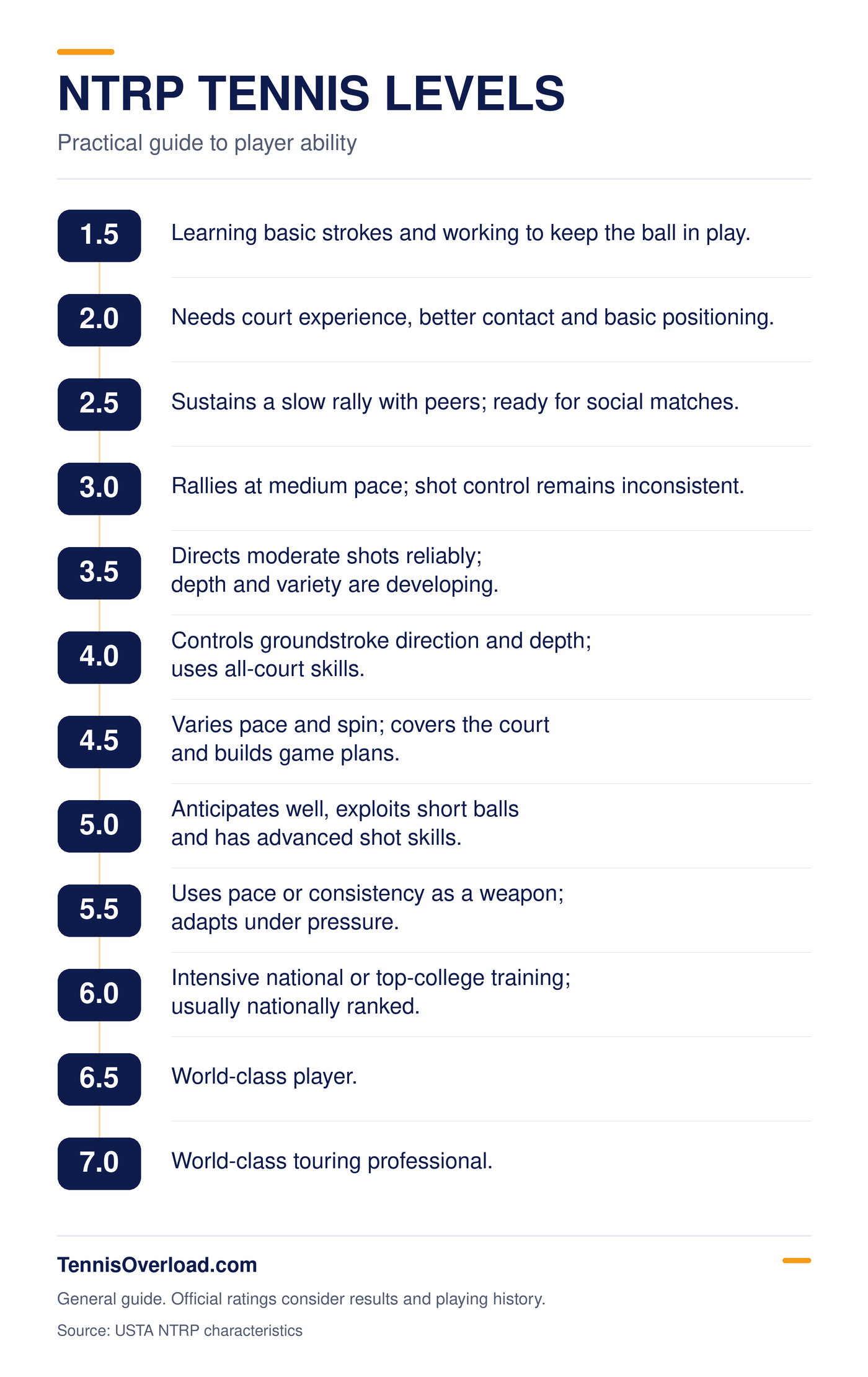
These descriptions are summaries of general characteristics. The official system considers match results and player history, while a self-rating questionnaire may set minimum levels for experienced players.
Current USTA NTRP descriptions begin at 1.5. Some older charts and informal club conversations use 1.0 for a complete newcomer, but that is not a current formal level to select for league registration. The guide to starting tennis covers equipment, lessons and early practice in a practical order.
NTRP 1.5: Limited Experience
A 1.5 player has some experience but is still developing basic strokes and trying to keep the ball in play. They are not normally ready for formal competition.
The main goals are consistent contact, simple movement and an understandable service motion. Scoring can be introduced gradually through the tennis scoring guide.
NTRP 2.0: Developing Basic Positions and Contact
A 2.0 player needs more on-court experience and often struggles to find the correct contact point. Singles and doubles positioning are still unfamiliar, and the serve may be incomplete.
Practice should include cooperative hitting, recovery to a useful position and points started with a controlled feed or simplified serve. Match play is valuable when it creates repetitions rather than long periods without contact.
NTRP 2.5: Ready for Social Matches
A 2.5 player is learning to judge the incoming ball and choose an appropriate swing. They can sustain a slow backcourt rally with a similar player and are beginning to develop recognizable strokes.
Movement and recovery may still be inefficient, while grips, the serve and transition play remain common limitations. This is a normal entry level for social matches, lower-level tournaments and some leagues.
Practicing alone can still be useful between matches. The best ways to practice tennis alone include wall work, serves, footwork and target-based drills.
NTRP 3.0: Consistent at Medium Pace
A 3.0 player can rally with reasonable consistency at medium pace but does not control direction, depth, height or pace reliably. Shots outside the preferred contact zone often expose technical limitations.
Net play may feel uncomfortable, and doubles commonly uses a one-up, one-back formation. At this level, improving the second serve, return and recovery position often produces more match value than learning low-percentage winners.
Review the complete tennis rules guide before league play so procedural uncertainty does not distract from tactics.
NTRP 3.5: Dependable Moderate-Pace Strokes
A 3.5 player has dependable strokes and can direct moderate balls, but depth and variety remain inconsistent. Lobs, overheads, approach shots and volleys are developing rather than complete.
Court awareness and doubles teamwork are improving. Players begin to use concentration, patterns and opponent weaknesses instead of treating every ball as an isolated technical test.
This level contains a wide range of ability because a published 3.5 can represent a finer internal rating from 3.01 through 3.50. Two players with the same visible level can therefore produce a one-sided score.
NTRP 4.0: Dependable All-Court Skills
A 4.0 player can control direction and vary depth on both groundstroke sides during moderately paced play. Lobs, overheads, approach shots and volleys are used successfully, and the second serve is generally dependable.
These players recognize chances to finish points but may lose points through impatience. Doubles teamwork, positioning and planned combinations become clearly visible.
Understanding terms is useful as tactics become more specific. The tennis terminology glossary explains common shot, score and strategy language.
NTRP 4.5: Varied Pace, Spin and Game Plans
A 4.5 player can vary pace and spin, control depth and cover the court effectively. They can identify strengths and weaknesses, then adjust patterns rather than relying on one fixed style.
The first serve has meaningful pace and placement, while the second serve can be directed with more confidence. Players at this level often handle the net aggressively in doubles and punish routine short balls.
Consistency under pressure separates the stronger 4.5 player from someone who merely produces advanced-looking shots in practice.
NTRP 5.0: Advanced Competitive Player
A 5.0 player has strong anticipation, reliable advanced skills and usually a significant weapon around which points can be built. They regularly convert short balls and can execute volleys, overheads, lobs, half volleys and drop shots with purpose.
The second serve has dependable depth or spin, and tactical adjustments happen during the match. Errors still occur, but they are less likely to result from not understanding the correct response.
NTRP 5.5: Advanced Skills Under Pressure
A 5.5 player uses pace, consistency or both as major strengths. They can adapt their tactics and playing style during competition, while maintaining dependable shot execution and reliable first and second serves under pressure.
This rating reflects a high competitive standard across the player’s overall game. Occasionally beating a 5.0 player or matching their pace in a cooperative rally is not enough to establish a 5.5 level.
NTRP 6.0 to 7.0: Elite and Professional Levels
A 6.0 player typically has intensive training for national tournaments or top-level college competition and has achieved a national ranking. Their playing background reflects sustained experience in demanding competitive environments.
USTA describes both 6.5 and 7.0 players as world-class, with 7.0 representing the touring professional standard. At these levels, established competitive history and results are essential to assessing playing ability.
What Is the Difference Between a Rating and a Ranking?
An NTRP rating indicates playing ability and helps group players into suitable competition. A tournament ranking shows a player’s relative position on a points list based on tournament performance.
A high ranking within one age group or region does not automatically change the NTRP level. The two systems answer different questions.
What Is a Dynamic NTRP Rating?
The USTA calculates a dynamic rating after eligible league results. It is measured to the hundredth, can change after each match and is not published to the player.
The algorithm compares the actual score with an expected result based on the players’ dynamic ratings. That means winning does not guarantee a rating increase, and losing does not guarantee a decrease.
Published year-end levels appear in 0.5 increments. A 3.5 label can represent any internal point from 3.01 to 3.50.
Common NTRP Rating Letters
The letter beside a level indicates how the rating was generated:
- C: computer or year-end rating
- S: self-rating
- A: appealed rating
- M: mixed-exclusive rating
- T: tournament rating
- D: disqualified rating after dynamic disqualification or an upheld grievance
Eligibility and appeal rules can vary by division and current USTA regulations. Check the official registration system for the status that applies to a specific event.
How Do You Self-Rate?
A player without a valid computer rating generally completes the USTA self-rate process before entering adult league play. The questionnaire considers tennis background, including previous competitive experience.
Use the level descriptions honestly and evaluate your complete game. If singles and doubles ability differ, rating decisions should not be based only on the weaker format.
One practice set is not enough evidence. Compare results against several established players and consider how you perform when serving, returning, moving and handling pressure.
How Many Matches Produce a Year-End Rating?
The USTA states that a minimum of three valid qualifying matches is needed to generate a year-end rating. A valid match generally requires at least six completed games.
Year-end ratings are published annually and are used for eligibility in the following season. Which tournament and league results count can depend on the section and division.
Can You Play Above Your NTRP Level?
Many league formats allow players to compete above their listed level, subject to the event’s rules and team requirements. Playing up can provide useful challenge, but repeated one-sided matches may reduce meaningful point play.
The best competitive level produces rallies and decisions under pressure without making the outcome nearly predetermined. Use stronger practice partners as one part of development, not the only measure of progress.
How to Find a Fair Tennis Match
Start with your published NTRP level or honest self-rating, then look for a USTA division, club ladder, flex league or organized social group built around that band. Tell the organizer whether you mainly play singles or doubles and how recently you have competed, because two players with the same label can have different strengths and current form.
Judge the match quality across several opponents rather than one score. A fair level should produce repeated neutral rallies, meaningful serve and return exchanges, and enough close games for both players to make tactical decisions. If every result is one-sided in the same direction, ask the organizer about moving one band rather than changing your self-rating after a single unusually good or poor day.
NTRP vs UTR and World Tennis Number
NTRP, UTR and World Tennis Number are separate systems with different calculations, scales and data. There is no perfect universal conversion.
Conversion charts are estimates and can be misleading near level boundaries. Use the rating required by the competition you plan to enter rather than translating from a different system and treating the result as exact.
How to Improve to the Next NTRP Level
Identify the repeatable limitation that loses the most points. For many 2.5 to 3.5 players, that is second-serve reliability, return depth, recovery position or handling balls outside the strike zone rather than a lack of spectacular shots.
Use match notes to choose one technical and one tactical priority. The three-step tennis footwork guide provides a simple base for preparation and recovery, while an experienced tennis coach can help identify whether the main issue is technical, tactical or physical.
Improvement is not always reflected by an immediate published change. A player can move substantially within the hundredth-based range and remain at the same half-point level at year end.
Frequently Asked Questions
What NTRP level is an intermediate tennis player?
The label varies, but 3.0 to 4.0 is commonly treated as a broad recreational intermediate range. NTRP uses specific characteristics and results, so a generic label should not replace the official process.
Is a 3.5 tennis player good?
A 3.5 player has dependable moderate-pace strokes and developing tactics, variety and net skills. It is a meaningful club level, although players within the 3.5 range can differ substantially.
What NTRP level do most leagues use?
USTA League generally offers competition from 2.5 through 5.0, although local divisions and combined formats vary.
Can a beginner be rated 2.5?
Yes. A 2.5 player is still developing but can sustain a slow rally with similar players and is ready for social competition. A complete newcomer who cannot yet put the ball in play is closer to the current 1.5 beginner description.
Does doubles have a separate NTRP rating?
NTRP can include results from eligible singles and doubles play. A player who participates only in mixed doubles may receive a mixed-exclusive rating, but that is different from maintaining a personal doubles skill label outside the official system.