
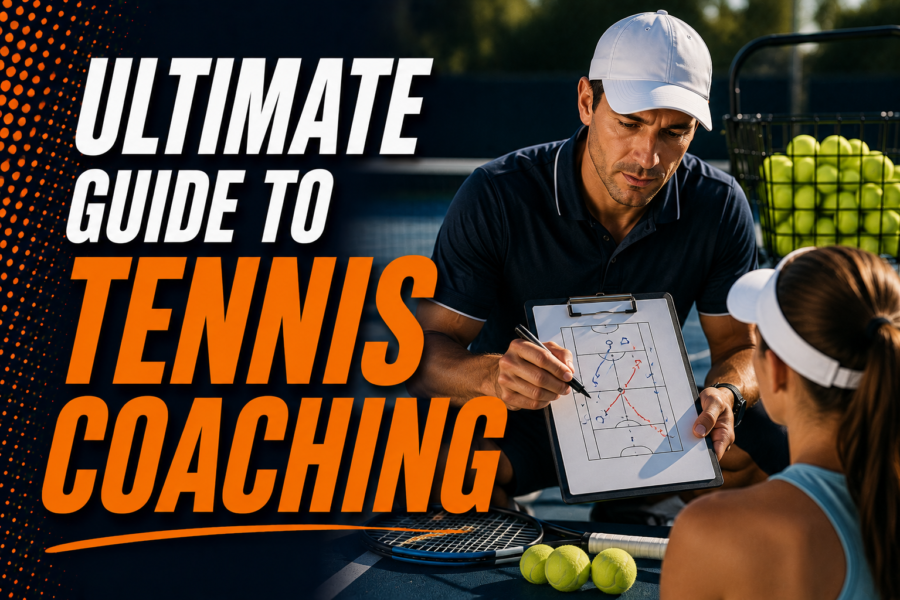
Tennis coaching is a structured process for improving a player’s technique, movement, tactics, practice habits, and competitive decision-making. The right format depends on the player’s goal: a beginner may need clear fundamentals and a welcoming group, while a tournament player may need individualized planning, match analysis, and coordination with physical and medical professionals.
This guide has two routes. Players and parents can use it to choose coaching and build a development plan. Prospective coaches can use it to understand the role, education pathway, safeguarding responsibilities, and common work settings.
Choose Your Coaching Route
| If you are… | Start with… | Main decision |
|---|---|---|
| A new player | Goals, lesson formats, and coach selection | Which environment makes learning clear and sustainable? |
| A recreational improver | Assessment, practice plan, and progress measures | Which limitation matters most in actual points? |
| A competitive player | Individual plan, match analysis, and support team | Does training transfer to target events? |
| A parent | Junior environment, communication, and safeguarding | Is the program appropriate for the child’s stage and needs? |
| An aspiring coach | Local qualifications, supervised experience, and safeguarding | What does the national association or employer require? |
| An established coach | Continuing education, specialization, and program design | Which player group and work model fit your strengths? |
Coaching is not only ball feeding. The guide to the role of a tennis coach examines the wider technical, tactical, planning, communication, and duty-of-care responsibilities.
What Tennis Coaching Should Accomplish
Effective coaching should help a player understand what to change, why it matters, how to practise it, and how to recognize progress. A session that produces attractive strokes but no independent decision-making has limited transfer to a match.
A useful coaching process normally includes:
- a clear description of the player’s goal
- an assessment based on relevant play, not appearance alone
- priorities narrow enough to practise deliberately
- feedback the player can understand and apply
- exercises that progress toward realistic points
- a plan between formal sessions
- periodic review and adjustment
Not every lesson needs all seven elements in equal depth. Across a block of coaching, however, the player should see how each session connects to the larger goal.
Set a Goal Before Choosing a Coach
“Get better at tennis” is too broad to guide a coaching decision. Define the result and the context.
| Broad wish | More useful coaching goal |
|---|---|
| Improve the serve | Start a higher percentage of second serves without losing intended shape |
| Become more consistent | Maintain neutral depth from both groundstroke sides during rally patterns |
| Win more matches | Improve return position and first-ball decisions against common opponents |
| Learn tennis | Serve, rally, score, and play an independent recreational set |
| Help a junior progress | Build age-appropriate skills and competition habits without rushing specialization |
| Return after time away | Rebuild timing and movement at a manageable workload |
Goals should be revised when evidence changes. A player who thinks the forehand is the main problem may discover that late recovery or poor shot selection causes more lost points.
Types of Tennis Coaching
Private lessons
Private coaching gives one player the coach’s direct attention. It is well suited to assessment, a specific technical change, individualized serve or return work, and preparation for a known competition need.
Its limitation is reduced interaction with varied opponents. A private lesson can also become an expensive ball-feeding session if the player receives no plan or match transfer. The article on whether private tennis lessons are worth it covers the full cost-and-value decision.
Semi-private lessons
Two players share the session. This format can combine individual feedback with live rallying and point patterns, especially when their levels and goals are compatible.
The coach has less time for each player than in a private lesson. A large ability or motivation gap can also make the pairing inefficient.
Group lessons and clinics
Groups create social interaction, varied ball contacts, and more realistic movement against other players. They often suit beginners, recreational adults, juniors, and tactical themes that require multiple positions.
Individual feedback is naturally limited as the group grows. The coach must organize rotations so players spend more time learning than waiting. The group lessons vs private coaching comparison provides the dedicated format decision.
Team practice
School, club, college, and league teams use shared sessions to develop lineups, doubles combinations, tactical identity, and competitive habits. Team coaching must balance collective priorities with individual differences.
Selection pressure and limited court time can reduce technical attention. Players may need a separate individual session for a major stroke change.
Junior programs
Junior coaching should fit the child’s physical, cognitive, emotional, and competitive stage. Appropriate court size, ball type, racket size, task length, and game format help a child learn rather than merely copy an adult session.
A strong program develops movement, rally skills, serving, receiving, scoring, and decision-making. Results should not be the only measure of progress.
Performance coaching
Competitive juniors and advanced players may require integrated planning across technical work, tactics, physical preparation, tournament scheduling, recovery, and match review. One person should not pretend to hold every specialist qualification.
The lead coach may coordinate with a strength and conditioning coach, physiotherapist, physician, nutrition professional, psychologist, school, and family as appropriate. Clear roles and consent matter when information is shared.
Remote and video coaching
Remote coaching can help with match review, planning, and selected visual observations. It can also improve access for players who live far from an appropriate specialist.
Camera angle, video speed, missing context, and the absence of live interaction limit what can be concluded. A clip should support coaching judgment rather than being treated as a complete diagnosis.
How to Choose the Right Tennis Coach
The best-known coach is not automatically the best fit. Choose for the player’s current goal, stage, communication needs, and training environment.
Check relevant experience
Ask who the coach normally teaches. Experience with adult beginners, red-ball children, wheelchair players, league doubles players, college recruits, and touring professionals is not interchangeable.
Relevant experience does not require the coach to have played at the same level as the student. Playing skill and coaching skill overlap, but they are different abilities.
Verify current credentials
Qualification names and requirements differ by country. Check the relevant national association, venue, or employer rather than relying on an unexplained “certified” label.
Where the role involves children or adults at risk, verify required safeguarding education and background-screening status. First aid, insurance, and continuing-education requirements may also apply locally. The tennis coaching certifications guide explains the country-specific qualification landscape in depth.
Observe communication
A useful coach can explain the same idea in more than one way, ask questions, and adapt feedback to the player. Constant talking is not the same as clear teaching.
Look for a balance of information and active learning. The player should understand the task without becoming dependent on a cue before every ball.
Assess the learning environment
The session should be organized, respectful, and appropriate for the group. For juniors, observe how the coach handles mistakes, behavior, parental communication, and inclusion.
A high-energy lesson is not automatically productive. Check how much time players spend hitting, deciding, recovering, and receiving useful feedback.
Ask how progress is measured
Good answers connect measurement to the player’s goal. A serve goal might use legal first-serve percentage and target location; a tactical goal might use decision quality in a defined point pattern.
Avoid coaches who promise a ranking, scholarship, professional career, or guaranteed result. Development depends on the athlete, time, competition, health, resources, and many factors outside one coach’s control.
Questions to Ask Before Booking
- Which players and goals form most of your current work?
- What qualification, safeguarding, and insurance requirements apply here?
- How would the first assessment work?
- What lesson format do you recommend, and why?
- What should the player practise between sessions?
- How do you review progress?
- What is the cancellation and weather policy?
- Who pays court, ball, travel, or video-analysis costs?
- How do you communicate with parents of junior players?
- When would you refer a player to another professional?
The answers should be specific enough to evaluate. A polished sales pitch without a clear teaching process is not sufficient.
What to Expect From a First Lesson
A first lesson should establish context before major changes begin.
Goal and history
The coach asks about playing experience, current schedule, competition, equipment, relevant limitations, and the result the player wants. Health information should be handled within the coach’s competence and privacy responsibilities.
Observation
The coach watches the player rally, serve, return, move, and play points at an appropriate level. Feeding only one comfortable ball can hide the issue that appears under time or decision pressure.
Priority
The coach identifies one or two useful starting priorities. Trying to rebuild the serve, forehand, backhand, movement, and tactics in one hour usually creates confusion.
Practice task
The player receives a clear exercise, cue, or constraint and enough repetitions to explore it. The task should progress toward an open or point-based situation when appropriate.
Next action
The lesson ends with a brief summary: what changed, what to practise, what success looks like, and when to review it. The player should not need to guess what to do between lessons.
Build a Tennis Development Cycle
A coaching plan works better as a repeating cycle than a list of unrelated drills.
| Stage | Question | Example evidence |
|---|---|---|
| Assess | What is happening in the relevant situation? | Match video, rally pattern, serve chart, player report |
| Prioritize | Which change has the greatest practical value now? | One technical, tactical, or training focus |
| Design | What exercise represents the problem at the right difficulty? | Target task progressing to live points |
| Practise | Can the player repeat and adapt the behavior? | Quality attempts under varied feeds and decisions |
| Compete | Does it appear under score and pressure? | Practice set or tournament observation |
| Review | What improved, held, or failed to transfer? | Updated notes and next priority |
The review may show that the plan was wrong. Changing course based on evidence is a strength, not a failure of coaching authority.
Coaching Priorities by Player Stage
Beginners
Beginners need a playable version of tennis: rally, serve, return, move, score, and start points independently. Technique should support those functions rather than delay actual play until strokes look ideal.
Modified balls and courts can make the task appropriate for children and some new adults. The goal is not to keep every player on modified equipment indefinitely, but to progress when control and movement justify it.
Intermediate recreational players
Intermediate players often need better links between strokes. Recovery, depth, second-serve reliability, return position, and neutral-ball decisions may matter more than learning another isolated shot.
Match evidence helps distinguish a true technical limit from a tactical or movement problem. Training should include serves, returns, and point starts rather than only cooperative baseline rallies.
Advanced and competitive players
Advanced coaching becomes increasingly individual. Small changes must be evaluated against the player’s established strengths, schedule, physical load, and competitive identity.
Opponent patterns, surface, scoring pressure, and tournament sequence become more relevant. A technically sound change that cannot be integrated before an important event may need different timing.
Competitive juniors
Junior plans should consider long-term development, education, growth, family logistics, rest, and the child’s own motivation. More tournaments and more hours do not automatically mean better development.
Coaches and parents should agree on communication and decision roles. The child needs space to learn independence rather than receiving instructions from multiple adults during every match.
How Often Should You Take Lessons?
There is no universal frequency. The useful interval depends on the goal, practice access, budget, age, competition calendar, and how quickly the player can consolidate feedback.
| Situation | Reasonable structure to consider | Main condition |
|---|---|---|
| New recreational player | Regular lesson plus simple independent practice | Enough repetition to remember the task |
| Specific stroke adjustment | Short focused block with review | Avoid stacking new changes before the first settles |
| League player | Periodic lesson plus match play | Review patterns that occur in competition |
| Competitive junior | Integrated weekly program | Coordinate load, school, recovery, and events |
| Advanced competitor | Individualized plan around tournaments | Adjust volume and focus by phase |
The table describes structures, not a prescription. A high lesson frequency with no independent practice may create dependence, while long gaps can make a complex change difficult to retain.
Practise Between Coaching Sessions
Formal lessons are only one part of development. Between sessions, a player can:
- repeat one clearly defined technical task
- use targets to measure direction or depth
- play constrained points that reward the intended decision
- record a short relevant video from an agreed angle
- keep brief notes on what held up under score
- play opponents with different styles
- recover rather than adding low-quality volume when fatigued
Independent practice is valuable when the task is understood. The article on improving without a tennis coach examines when self-directed learning works well and where outside feedback becomes useful.
Measure Progress Without Chasing Perfect Numbers
Use a small number of measures tied to the goal.
| Goal | Useful measure | Limitation |
|---|---|---|
| More reliable serve | Legal serves made to a defined target | Practice percentage may not transfer under score |
| Better return | Returns started and depth category | Opponent serve quality changes the result |
| Improved consistency | Neutral balls before an error in a set pattern | Long rallies alone do not prove good tactics |
| Better point construction | Correct decision in a chosen scenario | Judgment needs agreed criteria |
| Improved movement | Recovery position reached before opponent contact | Camera angle may hide court depth |
| Competition progress | Performance against comparable opponents | Rankings and wins can lag behind development |
Numbers need interpretation. A lower rally count can be positive if the player is learning to attack the correct ball rather than extending every neutral exchange.
Common Coaching Problems
Too many cues
Several body-part instructions at once overload attention. Use the smallest cue or task that changes the intended outcome.
Technique without a ball problem
A movement should solve a practical task such as height, direction, time, spin, or recovery. Cosmetic imitation can remove a player’s effective adaptation without creating a better result.
Drills that never become points
Closed repetition can introduce a change, but tennis requires reading and choosing. Progress toward variable feeds, live rallying, serve-plus-one, return-plus-one, and scored play.
Winning every practice
Players need an appropriate challenge. If every drill is easy enough to produce perfect results, it may not prepare the player for uncertainty.
Ignoring the serve and return
Every point begins with these shots. A program dominated by groundstroke feeding leaves a major gap in match preparation.
Confusing workload with progress
More balls, hours, and tournaments can raise fatigue without improving the target skill. Training quality, recovery, and progression matter alongside volume.
When to Change Coaches
Changing coaches can be reasonable when goals or circumstances change. Consider a transition if:
- the coach lacks relevant experience for the next stage
- communication has repeatedly broken down
- the plan has no clear priority or review
- the environment is disrespectful or unsafe
- boundaries or safeguarding expectations are not followed
- the player needs a specialist outside the coach’s competence
- scheduling and travel make the relationship impractical
One difficult session or temporary performance dip is not automatically a reason to leave. Discuss the concern and agreed next step first when it is safe and appropriate.
A Pathway for Aspiring Tennis Coaches
Coaching requirements are national and role-specific. The ITF supports national associations through coach-education curricula, but successful candidates normally receive certification through the relevant national association rather than one universal license that overrides local rules.
A sensible pathway is:
- Identify the national association and local employer requirements.
- Complete the appropriate entry course or assistant pathway.
- Satisfy safeguarding, screening, first-aid, and insurance requirements where applicable.
- Work under observation with suitable beginner or junior groups.
- Receive feedback on session planning, communication, and player care.
- Progress to qualifications appropriate for intermediate, advanced, or performance players.
- Continue professional development and renew required credentials.
The ITF’s current education framework distinguishes courses for starter players, beginner and intermediate players, advanced players, and high-performance players. National associations decide how those frameworks operate in their own systems.
The guide to becoming a tennis coach covers the complete career-entry sequence. This hub keeps the route concise so it does not duplicate application steps.
Coaching Qualifications Are Not Interchangeable
The United States, Great Britain, Australia, Canada, and other countries use different organizations, course names, accreditation rules, background checks, and continuing-education systems. A credential accepted by one employer may require review before another venue recognizes it.
Check current primary guidance. In the United States, USTA coach resources distinguish Safe Play approval and recognized professional certification. In Britain, LTA qualification and Coach Accreditation are separate concepts with role-dependent requirements.
A certificate also does not prove fit for every player. Confirm the coach’s scope, current status, relevant experience, and ability to refer beyond that scope.
Where Tennis Coaches Work
| Setting | Typical focus | Important tradeoff |
|---|---|---|
| Public park or community program | Access and introductory participation | Weather and shared-court limits |
| Tennis club | Members, teams, ladders, and lessons | Club policies and court allocation |
| Academy | Structured junior or performance program | High schedule and travel demands |
| School or college | Team development and competition | Academic calendar and eligibility rules |
| Resort | Guest lessons and short programs | Seasonal demand and varied player commitment |
| Independent business | Private, group, camp, and online services | Coach carries client and operating responsibilities |
| Touring role | One player’s competition and development | Extensive travel and uncertain engagement length |
Compensation differs sharply among these models. Salary, gross lesson rate, business revenue, and take-home income are not the same measure, so the dedicated coach-income guide should control that decision.
Final Coaching Framework
For a player, the decision sequence is goal, format, coach fit, assessment, plan, practice, competition, and review. For a prospective coach, it is local requirements, education, safeguarding, supervised experience, suitable work, and continuing development.
The relationship works when both sides know what they are trying to improve and how they will evaluate it. Credentials, reputation, and technology can support that process, but clear teaching, appropriate challenge, ethical practice, and evidence from actual play remain central.
Frequently Asked Questions
Is tennis coaching worth it?
It can be when the coach matches the goal, provides usable feedback, and connects lessons to independent practice. Value depends on outcomes and fit, not lesson price alone.
Are private lessons better than group lessons?
Neither is universally better. Private lessons maximize individual attention, while groups offer interaction, varied opponents, and social learning. Many players benefit from combining them.
Does a great player automatically make a great coach?
No. Playing experience can add insight, but coaching also requires observation, communication, planning, adaptation, and duty of care.
Can adults start tennis with a coach?
Yes. Adult beginners can learn a playable game through an appropriate ball, court, pace, and lesson format. Coaching should match the adult’s goals and physical context.
How quickly should a player improve?
There is no honest universal timeline. The starting level, goal, practice frequency, quality of feedback, competition, and individual learning rate all affect progress.
Should parents watch junior lessons?
Venue and coach policies vary. Parents should understand safeguarding and communication arrangements, while allowing the coach and child enough space for independent learning.
Do professional players still need coaches?
Many do, but the role changes. At advanced levels, coaching may emphasize planning, opponent analysis, small technical adjustments, communication, and coordination across a wider support team.