
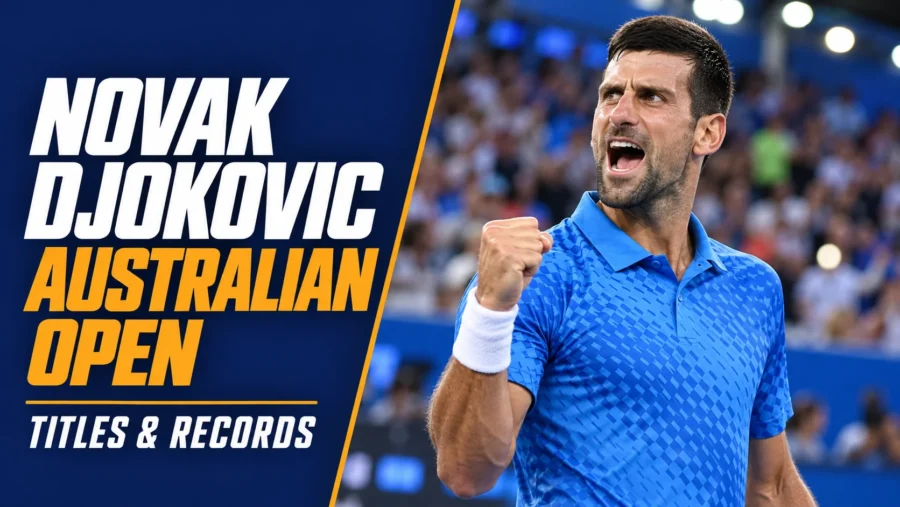
Novak Djokovic has won a record 10 Australian Open men’s singles titles. He captured the championship in 2008, 2011, 2012, 2013, 2015, 2016, 2019, 2020, 2021 and 2023, winning his first 10 finals at Melbourne Park before finishing runner-up to Carlos Alcaraz in 2026.
Through the 2026 tournament, Djokovic owns an Australian Open match record of 104 wins and 11 losses. His 104 victories are the most by any player, man or woman, in the tournament’s history.
Novak Djokovic’s Australian Open Record at a Glance
| Record | Total |
|---|---|
| Men’s singles titles | 10 |
| Finals | 11 |
| Finals record | 10-1 |
| Match record through 2026 | 104-11 |
| Main-draw appearances | 21 |
| First title | 2008 |
| Most recent title | 2023 |
| Most recent final | 2026 |
Djokovic’s Melbourne record is extraordinary even within a career defined by major titles. He is the only man to win the Australian Open three consecutive times on two separate occasions, doing so from 2011 to 2013 and again from 2019 to 2021.
All 10 Djokovic Australian Open Titles
| Year | Final Opponent | Final Score |
|---|---|---|
| 2008 | Jo-Wilfried Tsonga | 4-6, 6-4, 6-3, 7-6(2) |
| 2011 | Andy Murray | 6-4, 6-2, 6-3 |
| 2012 | Rafael Nadal | 5-7, 6-4, 6-2, 6-7(5), 7-5 |
| 2013 | Andy Murray | 6-7(2), 7-6(3), 6-3, 6-2 |
| 2015 | Andy Murray | 7-6(5), 6-7(4), 6-3, 6-0 |
| 2016 | Andy Murray | 6-1, 7-5, 7-6(3) |
| 2019 | Rafael Nadal | 6-3, 6-2, 6-3 |
| 2020 | Dominic Thiem | 6-4, 4-6, 2-6, 6-3, 6-4 |
| 2021 | Daniil Medvedev | 7-5, 6-2, 6-2 |
| 2023 | Stefanos Tsitsipas | 6-3, 7-6(4), 7-6(5) |
Four of those victories came against Andy Murray. Djokovic also beat Rafael Nadal twice in Melbourne finals, although the two matches could hardly have been more different.
The 2012 final lasted five hours and 53 minutes and became one of the longest and most physically demanding major finals ever played. The 2019 final was a controlled straight-sets performance in which Nadal won only eight games.
Djokovic’s Australian Open Results by Year
| Year | Result | Player Who Ended His Run |
|---|---|---|
| 2005 | First round | Marat Safin |
| 2006 | First round | Paul Goldstein |
| 2007 | Fourth round | Roger Federer |
| 2008 | Champion | None |
| 2009 | Quarterfinal | Andy Roddick, retirement |
| 2010 | Quarterfinal | Jo-Wilfried Tsonga |
| 2011 | Champion | None |
| 2012 | Champion | None |
| 2013 | Champion | None |
| 2014 | Quarterfinal | Stan Wawrinka |
| 2015 | Champion | None |
| 2016 | Champion | None |
| 2017 | Second round | Denis Istomin |
| 2018 | Fourth round | Hyeon Chung |
| 2019 | Champion | None |
| 2020 | Champion | None |
| 2021 | Champion | None |
| 2022 | Did not play | Not applicable |
| 2023 | Champion | None |
| 2024 | Semifinal | Jannik Sinner |
| 2025 | Semifinal | Alexander Zverev, retirement |
| 2026 | Runner-up | Carlos Alcaraz |
The table shows how quickly Melbourne changed from a difficult early stop into Djokovic’s most productive major. After first-round losses in 2005 and 2006, he reached the second week in 2007 and won his first major title one year later.
His 2008 Breakthrough
Djokovic arrived at the 2008 Australian Open as an established young contender but had not yet won a Grand Slam. He defeated defending champion Roger Federer in straight sets in the semifinal, ending Federer’s run of 10 consecutive major finals.
In the final, Djokovic recovered after losing the opening set to Jo-Wilfried Tsonga. The four-set victory made the 20-year-old Serbia’s first male Grand Slam singles champion and began his long connection with Melbourne Park.
The 2011 to 2013 Three-Peat
The 2011 title opened the most dominant phase of Djokovic’s career. He beat Federer in the semifinal and Murray in the final, then carried that momentum into one of the strongest seasons in men’s tennis history.
His 2012 defense required two exceptionally demanding matches. Djokovic beat Murray in a five-set semifinal before overcoming Nadal in the five-hour, 53-minute final, completing nearly 11 hours of tennis across the two rounds.
In 2013, he became the first man in the Open Era to win three consecutive Australian Open titles. A five-set fourth-round victory over Stan Wawrinka, finished 12-10 in the deciding set, was the defining escape of that run.
Two More Titles in 2015 and 2016
Djokovic returned to the championship match in 2015 and again defeated Murray. The first two sets were split through tiebreaks, but Djokovic took control of the final two sets.
The 2016 final produced the same matchup and another Djokovic victory. By then he had won six Australian Open titles, drawing level with the former men’s record shared by Roy Emerson.
Tournament results carry major weight in the professional standings. This guide to how the tennis world ranking works explains why a Grand Slam title has such a large effect on a player’s season.
The 2019 to 2021 Three-Peat
Djokovic entered 2019 after two Australian Opens without a title and delivered one of his clearest final performances. He defeated Nadal 6-3, 6-2, 6-3 to become the first man to win seven Australian Open singles championships.
The 2020 final was less straightforward. Dominic Thiem led by two sets to one, but Djokovic recovered to win in five sets and secure title number eight.
In 2021, Djokovic defeated Daniil Medvedev in straight sets for a ninth championship. The tournament was played in February rather than its usual January window because of pandemic-related scheduling changes.
The 2023 Title
Djokovic did not compete in 2022, then returned in 2023 and won the tournament without losing a match. He managed a hamstring issue during the event and defeated Stefanos Tsitsipas in the final.
That victory was his 10th Australian Open title and temporarily brought him level with Rafael Nadal on 22 major men’s singles titles. It also preserved his perfect record in Melbourne finals at 10 wins from 10 appearances.
What Happened in 2024 and 2025?
Jannik Sinner ended Djokovic’s 33-match Australian Open winning streak in the 2024 semifinal. Sinner won in four sets and went on to claim his first Grand Slam title.
Djokovic returned to the semifinal in 2025 after defeating Carlos Alcaraz in the quarterfinal. An injury then forced him to retire after losing the first set of his semifinal against Alexander Zverev.
The length and physical demands of major matches can vary dramatically, especially in men’s best-of-five-set competition. The guide to how long tennis matches last provides context for the endurance required over seven rounds.
The 2026 Final and His First Loss in a Melbourne Final
At age 38, Djokovic made another historic run in 2026. He recorded his 100th Australian Open win, became the first player to reach 400 Grand Slam singles victories and passed Roger Federer for the most match wins in Australian Open history.
The run included a five-set semifinal victory over two-time defending champion Jannik Sinner. Djokovic then faced Carlos Alcaraz in the final and won the opening set before Alcaraz recovered to win 2-6, 6-2, 6-3, 7-5.
It was Djokovic’s first defeat in 11 Australian Open finals. He also became the oldest man in the Open Era to contest the Melbourne final.
Why Djokovic Has Been So Successful in Melbourne
The Australian Open is played on a hard court, a surface that rewards Djokovic’s movement, balance and ability to redirect pace. His return of serve also reduces the advantage of big servers, while his control from the baseline allows him to defend and attack without making a major positional change.
The speed of a hard court is not determined by the surface label alone. Acrylic system, weather, balls and court preparation all matter, as explained in this comparison of how tennis court surfaces differ.
Djokovic has also repeatedly managed the tournament’s distinctive challenges. Melbourne can produce extreme daytime heat, cooler night conditions and long matches that finish after midnight, requiring tactical and physical adjustments throughout the fortnight.
Djokovic’s Biggest Australian Open Records
Most Men’s Singles Titles
Djokovic’s 10 titles place him four ahead of Roger Federer and Roy Emerson, who each won six. Margaret Court won 11 women’s singles titles, although seven came before the Open Era.
Most Australian Open Match Wins
His 104 victories through 2026 moved him past Federer’s 102. Djokovic is also the only player with at least 100 singles wins at three different Grand Slam tournaments: the Australian Open, Roland Garros and Wimbledon.
Two Separate Three-Peats
Djokovic won three consecutive titles from 2011 to 2013 and from 2019 to 2021. No other man has completed two separate runs of three successive Australian Open championships.
Ten Consecutive Final Victories
He won each of his first 10 Australian Open finals. Alcaraz ended that perfect record in 2026, leaving Djokovic with a 10-1 finals record.
A 33-Match Winning Streak
Djokovic won 33 consecutive Australian Open matches from 2019 through the 2024 quarterfinals. Sinner ended the streak in the 2024 semifinal.
Where His Melbourne Record Stands
The Australian Open is one of the four events at the top of the tennis tournament structure. This explanation of the different types of tennis tournaments shows how Grand Slams differ from regular ATP and WTA events.
Djokovic’s 10 titles, 104 match wins and two separate three-peats make him the most successful men’s singles player in Australian Open history. The 2026 runner-up finish changed his perfect finals record, but it also added another milestone by taking him to an 11th final more than 18 years after his first title.