
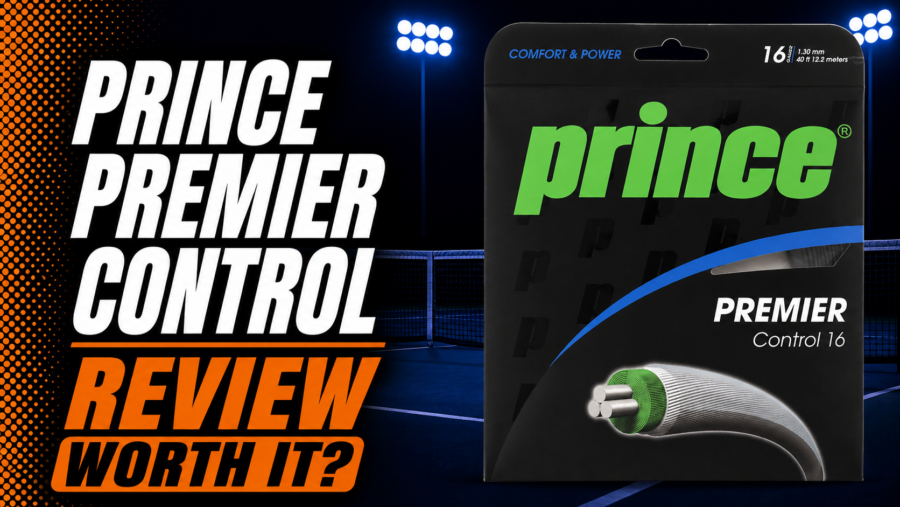
Prince Premier Control is a control-oriented multifilament tennis string designed for players who want a softer alternative to polyester without the highly elastic response associated with many premium multifilaments. Its Tri-Core construction gives it a firmer and more predictable character than Prince Premier Power or Premier Touch.
The name describes its position accurately. Premier Control still supplies more rebound and comfort than a firm co-polyester, but Prince uses three interlaced central cores to restrict excessive stretching. The surrounding filaments soften the response while the central structure helps stabilize trajectory.
This balance makes Premier Control relevant to intermediate and advanced players who value comfort but do not want an overly lively stringbed. It is also a practical option for recreational players who prefer a controlled multifilament at a relatively accessible price. The Tennis String Finder can help compare it with other materials.
Prince Premier Control Rating
| Category | Rating |
|---|---|
| Power | 7/10 |
| Spin | 7/10 |
| Comfort | 9/10 |
| Control | 8.5/10 |
These ratings place Premier Control within the broader tennis-string market. It is comfortable and moderately powerful overall, but its defining advantage is the additional control it provides relative to softer, livelier multifilaments.
Prince Premier Control Specifications
| Specification | Details |
|---|---|
| String type | Control-oriented multifilament |
| Composition | Nylon-based multifilament with Tri-Core construction |
| Central structure | Three interlaced cores surrounded by soft filaments |
| Profile | Round and smooth |
| Common gauges | 16 / 1.30mm and 17 / 1.25mm |
| Common colors | Natural and Black |
| Set length | Approximately 12.0m to 12.2m |
| Reel length | Approximately 200m, depending on market |
Gauge, color and package availability can vary between regions. The 16 / 1.30mm version is the most widely documented option.
Material and Construction
Premier Control is a multifilament string, but its internal design differs from a uniform bundle of very fine fibers. Prince places three interlaced central cores inside a surrounding bed of softer, pliable filaments. This design is marketed as Tri-Core construction.
The central structure is intended to limit excessive elongation during impact. Reducing uncontrolled stretch helps the stringbed return a more consistent launch angle when swing speed increases. The softer outer filaments provide pocketing and help keep the response more forgiving than a polyester monofilament.
The string has a round, smooth exterior. It does not use geometric edges to grip the ball, and Prince does not consistently document a separate spin coating for the current product. Its spin potential therefore comes from dwell time, string movement and the player’s racket-head speed rather than a shaped profile.
Premier Control was previously sold in some markets as Premier Attack. That history can explain older packaging and reviews, but buyers should use the current product name and confirm the gauge printed on the package.
Prince Premier Control Performance
Power
Premier Control supplies useful power, especially when compared with co-polyester. Its nylon-based multifilament construction stretches and returns energy more readily than a firm monofilament.
The response is deliberately restrained for this category. The three central cores limit some of the trampoline effect found in highly elastic multifilaments, making depth easier to manage during fuller swings.
Players with moderate swing speeds should still receive meaningful assistance. Those seeking maximum free pace may prefer Premier Power, natural gut or a more elastic premium multifilament.
The 17 / 1.25mm gauge is generally the livelier choice. The thicker 16 / 1.30mm version feels more stable and can help calm the launch in open string patterns.
Power rating: 7/10
Spin
Spin potential is good for a smooth multifilament but is not the product’s specialty. The controlled response lets confident players accelerate through contact, which can help them create rotation through technique.
The surface does not provide the sharp bite of Prince Vortex or Vortex Triad. Multifilament mains can also become notched and remain displaced as the outer material wears, reducing efficient snapback.
The thinner 17 gauge can improve ball interaction and spin access, particularly in a dense string pattern. That benefit comes with faster fraying and reduced resistance to breakage.
Players who produce moderate topspin and slice should find enough versatility. Heavy-spin string breakers are better served by a shaped co-polyester or a carefully selected hybrid.
Spin rating: 7/10
Control
Control is Premier Control’s defining performance quality. Tri-Core construction is intended to reduce excessive stretching and give the stringbed a more predictable response during faster swings.
The result should not be confused with the very low-powered control of firm polyester. Premier Control remains a resilient multifilament, but its launch is less lively than Prince’s power-focused alternatives.
This balance works well for flatter groundstrokes, directional changes, returns and volleys. Players can receive useful pocketing without the ball leaving the strings as quickly as it may with a firmer synthetic gut.
Control will change as tension falls and the outer filaments wear. The rating reflects the string when fresh and during its useful playing period, not an unlimited ability to maintain the original trajectory.
Control rating: 8.5/10
Comfort and Feel
Comfort is a major strength. The soft surrounding filaments cushion impact, while the central cores keep the response from becoming excessively vague.
The feel is plush but more defined than Prince Premier Touch. This makes Premier Control suitable for players who appreciate multifilament pocketing but want clearer feedback on volleys, slices and placement shots.
It is substantially softer than a typical full bed of co-polyester. Racket stiffness, tension, technique and previous injuries still affect overall comfort, so no string should be treated as a solution to persistent arm pain.
Players who want the softest and most muted Prince multifilament may prefer Premier Touch. Those who prioritize a firmer connection and trajectory control are more likely to prefer Premier Control.
Comfort rating: 9/10
Durability and Tension Maintenance
Premier Control offers moderate physical durability for a multifilament. The Tri-Core center gives the construction stability, but the surrounding filaments can fray and notch where the mains and crosses intersect.
The 16 / 1.30mm gauge has more material and is the better choice for players who break thinner multifilaments quickly. Heavy topspin, open string patterns and contact with a shaped polyester can shorten its lifespan.
Physical resistance to breakage is not the same as useful playability duration. Premier Control may remain intact after tension loss and permanent string movement begin changing launch and feel.
Its controlled construction generally supports respectable tension stability for the category. Replace it when fraying becomes deep, the stringbed develops inconsistent response or the mains no longer return to position, even if the string has not snapped.
Choosing the Right Gauge
The two common gauges allow players to adjust response without changing string families.
| Gauge | General characteristics |
|---|---|
| 16 / 1.30mm | Greater resistance, stability and trajectory control |
| 17 / 1.25mm | Greater feel, pocketing and spin access, with shorter physical life |
The 16 gauge is the safer starting point for open patterns, frequent players and anyone concerned about breakage. The 17 gauge suits denser patterns and players who prioritize sensitivity over lifespan.
Full Bed or Hybrid Setup
Full Bed
A full bed presents Premier Control’s intended balance most clearly. It maximizes comfort while retaining a more disciplined launch than many power-focused multifilaments.
This is the logical setup for players leaving polyester because of firmness and for club players who want one consistent material throughout the stringbed.
Prince Premier Control in the Mains With Softer Crosses
Premier Control mains preserve its controlled multifilament response. Pairing them with natural gut or an even softer multifilament can add pocketing and power, although the difference may be modest and the setup can become expensive.
This arrangement is mainly useful for fine-tuning feel. It is not the best route to maximum durability because both strings remain relatively soft.
Softer Mains With Prince Premier Control in the Crosses
Natural gut or a very elastic multifilament in the mains emphasizes power and feel. Premier Control crosses can restrain the response slightly and cost less than using the premium main string throughout the bed.
Premier Control can also serve as the softer cross beneath polyester mains. That configuration reduces the amount of polyester but remains much firmer than a full multifilament bed, and the polyester can saw through the outer filaments.
General Tension Guidance
Premier Control can begin around the middle of the racket manufacturer’s recommended nylon range. It should not automatically use the lower reference associated with a firm co-polyester.
Players who want more pocketing and depth can make a modest reduction. Those who find the launch too lively can increase slightly or select the thicker gauge before making a large tension change.
Open patterns and powerful rackets can amplify launch, while dense patterns may benefit from the thinner gauge or a slightly lower reference. Adjust one variable at a time and remain within the frame’s approved range.
The Tennis String Tension Calculator can provide a structured starting point based on material, gauge and racket characteristics.
Who Should Use Prince Premier Control?
Premier Control is best suited to:
- Intermediate and advanced players seeking a controlled multifilament
- Recreational players who want comfort without maximum trampoline effect
- Flatter hitters and all-court players who value predictable targeting
- Players moving away from a firm polyester setup
- Players who want more softness than synthetic gut
- Hybrid users seeking a controlled multifilament component
Who Should Avoid Prince Premier Control?
Premier Control is less suitable for:
- Players seeking the easiest possible power from a multifilament
- Heavy topspin hitters who frequently break soft strings
- Players who want sharp geometric bite and strong polyester snapback
- Users who prefer the crispest solid-core synthetic-gut response
- Players expecting polyester-level resistance to notching
- Anyone seeking the lowest-cost basic nylon option
Pros and Cons
| Pros | Cons |
|---|---|
| Excellent comfort | Less free power than many multifilaments |
| Strong control for its category | Moderate resistance to fraying and notching |
| Tri-Core design supports a predictable launch | Smooth surface is not specialized for spin |
| More defined feel than very soft multis | Mains can remain out of position with wear |
| Two useful gauges | Not as durable as polyester for heavy hitters |
| Suitable in full beds and hybrids | Availability varies by market |
Prince Premier Control Compared With Other Strings
Premier Control vs Prince Premier Power
Prince Premier Power uses more than 900 flexible fibers and emphasizes easy depth, dwell time and a livelier response. Premier Control sacrifices some power to provide firmer feedback and better trajectory management.
Premier Control vs Prince Premier Touch
Prince Premier Touch uses twisted polypropylene ribbons to imitate aspects of natural-gut structure. Premier Touch is softer, more muted and more powerful, while Premier Control feels firmer and more precise.
Premier Control vs Tecnifibre Triax
Tecnifibre Triax combines multifilament fibers with co-polyester material for greater control and abrasion resistance. Triax has a firmer, more polyester-influenced response, while Premier Control remains a traditional comfort-focused multifilament.
Premier Control vs Prince Synthetic Gut Duraflex
Prince Synthetic Gut Duraflex uses a solid nylon core and is crisper, simpler and less expensive. Premier Control provides more pocketing and comfort through its multifilament construction.
Final Verdict
Prince Premier Control fills a useful gap between lively multifilaments and firm polyester. Its three interlaced central cores limit excessive stretch, while the surrounding soft filaments preserve the comfort and pocketing expected from the category.
It is not the Prince string for maximum free power or aggressive shaped-string spin. Its appeal lies in providing a controlled, defined response without requiring players to accept the stiffness of a full co-polyester bed.
For intermediate and advanced players who want a comfortable string with manageable power, Premier Control is a strong value. The 16 / 1.30mm gauge offers the best general balance, while 17 / 1.25mm provides additional feel for players who can accept faster wear.
Frequently Asked Questions
What type of string is Prince Premier Control?
It is a nylon-based multifilament with Prince’s Tri-Core central construction.
What does Tri-Core mean?
Prince uses three interlaced central cores to restrict excessive stretching and improve consistency, then surrounds them with softer filaments for comfort.
Is Premier Control a low-powered string?
It is lower powered than many premium multifilaments, but it still provides more rebound than a firm control polyester.
Is Premier Control comfortable?
Yes. Comfort is one of its main strengths, although the overall setup also depends on the racket, tension and player.
Does Premier Control provide good spin?
It offers adequate to good spin for a smooth multifilament. It does not have the shaped edges or snapback specialization of Vortex polyester.
Which gauge should most players choose?
The 16 / 1.30mm version is the most balanced starting point. The 17 / 1.25mm version favors feel and response over lifespan.
Can Premier Control be used in a hybrid?
Yes. It can be used as a main or cross, including as the softer component with polyester, but polyester contact can accelerate fraying.