
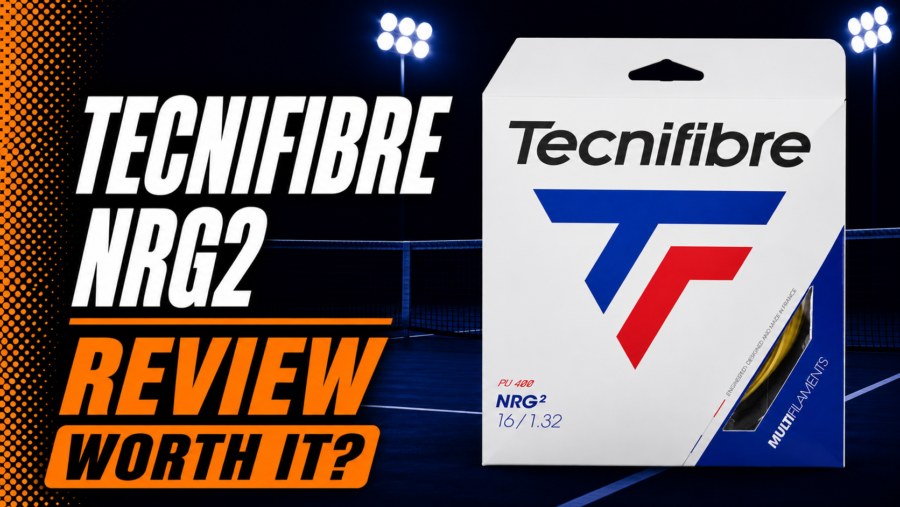
Tecnifibre NRG2 is a premium multifilament tennis string designed to maximize power, comfort and dynamic response. It is the most power-focused string in Tecnifibre’s current premium multifilament range and has remained a major reference point in the category for more than two decades.
NRG2 uses more than 1,200 Elastyl microfilaments impregnated throughout with highly elastic PU 400 polyurethane. Tecnifibre finishes the string with its SPL anti-abrasion treatment to improve smoothness, resistance and main-string return.
The string targets beginners, recreational players, doubles specialists and experienced competitors who want easy depth and plush feel rather than polyester control. The Tennis String Finder can help compare it with natural gut and firmer multifilaments.
Tecnifibre NRG2 Rating
| Category | Rating |
|---|---|
| Power | 9/10 |
| Spin | 7/10 |
| Comfort | 9/10 |
| Control | 7/10 |
These ratings reflect official positioning and independent playtesting. Power and comfort are outstanding, while control and spin vary considerably with swing speed, gauge and stringbed condition.
Tecnifibre NRG2 Specifications
| Specification | Details |
|---|---|
| String type | Premium multifilament |
| Main fibers | More than 1,200 Elastyl microfilaments |
| Matrix | PU 400 liquid polyurethane impregnation |
| Surface | SPL anti-abrasion finish |
| Profile | Round and smooth |
| Common gauges | 18 / 1.18mm, 17 / 1.24mm and 16 / 1.32mm |
| Common colors | Natural and Black, depending on gauge and market |
| Set and reel lengths | Approximately 12m sets and 200m reels |
Tecnifibre produces NRG2 in France. Gauge and color availability varies, and the Black version may feel slightly firmer than Natural according to retailer evaluation.
Material and Construction
NRG2 uses Elastyl, a polyamide material that Tecnifibre identifies as approximately 12 percent more elastic than standard polyamide. More than 1,200 of these microfilaments form the core playing structure.
The fiber bundle is impregnated throughout with PU 400. Tecnifibre describes this polyurethane grade as capable of 400 percent elasticity, allowing the matrix to cushion and return with the fibers.
An SPL final coating creates a smooth, anti-abrasion surface. It helps reduce surface wear and supports string return, but it does not make a multifilament behave exactly like a low-friction polyester monofilament.
The string is round and does not use geometric edges. Its performance comes from elasticity, dwell time, smoothness and the player’s technique.
Tecnifibre NRG2 Performance
Power
Power is NRG2’s defining quality. Tecnifibre positions it as the engine of the racket, and independent playtesting gave it an exceptionally high power score.
The Elastyl fibers and PU 400 matrix stretch readily, helping players achieve depth from compact and moderate swings. Defensive replies and serves receive substantial assistance.
Fast swingers may find the response difficult to restrain, especially in an open pattern or powerful frame. The 16 / 1.32mm gauge provides more stability than the thinner versions.
Natural gut remains more efficient and stable over time, but NRG2 offers accessible synthetic power with a familiar multifilament response.
Power rating: 9/10
Spin
NRG2 provides adequate to good spin for a multifilament. Independent testers had mixed results, with some generating effective rotation and others wanting more bite.
The SPL finish helps the mains return while fresh, and the 1.18mm and 1.24mm gauges interact more easily with the ball. Neither feature creates shaped-string edges.
As the surface frays and intersections notch, the mains can remain displaced. Spin and control may decline even while comfort remains high.
Players with moderate topspin and all-court variety should find enough versatility. Heavy-spin baseliners are better served by polyester or a hybrid.
Spin rating: 7/10
Control
NRG2 offers workable control at moderate swing speeds, but its power can challenge aggressive hitters. Independent testers reported both manageable targeting and difficulty restraining the launch.
Control improves when gauge, racket power and reference tension are matched carefully. The thicker 16 gauge and dense patterns help produce a calmer trajectory.
The string’s long dwell time supports touch, volleys and controlled placement. It does not provide the low-powered swing freedom of co-polyester.
Tension loss and fraying can raise launch over time. Players should assess useful playability separately from whether the string remains intact.
Control rating: 7/10
Comfort and Feel
Comfort is outstanding. Independent testing found a pillowy response even outside the sweet spot, consistent with the flexible fiber and polyurethane construction.
The feel is plush, lively and slightly muted. It provides deep pocketing and is particularly effective on touch shots, compact volleys and defensive contact.
NRG2 is substantially softer than polyester. It should not be marketed as injury protection, because racket stiffness, technique and existing conditions remain important.
Players who want crisper premium-multifilament feedback may prefer X-One Biphase. NRG2 prioritizes softness and rebound.
Comfort rating: 9/10
Durability and Tension Maintenance
NRG2 has moderate physical durability. SPL protects the surface, but the numerous fine fibers can fray and eventually separate under repeated friction.
The 16 / 1.32mm version provides the greatest resistance. The 18 / 1.18mm version maximizes feel and response but is unsuitable for frequent breakers.
Independent laboratory and playtesting information place NRG2’s tension maintenance near the top of the multifilament category. This does not prevent all response change or string movement.
Physical resistance and useful playability are separate. Some players may break NRG2 while it still feels good, while others may notice a higher launch before breakage. Replace it when fraying is deep, control declines or the mains remain displaced.
Choosing the Right Gauge
NRG2’s three gauges allow substantial tuning.
| Gauge | General characteristics |
|---|---|
| 16 / 1.32mm | Greatest stability, control and physical resistance |
| 17 / 1.24mm | Balanced power, feel and lifespan |
| 18 / 1.18mm | Maximum response, pocketing and spin access, with the least resistance |
Most players should begin with 16 or 17 gauge. The 18 gauge suits dense patterns and players who rarely break strings.
Full Bed or Hybrid Setup
Full Bed
A full bed maximizes NRG2’s power, comfort and plush pocketing. This is the clearest setup for beginners, recreational players and anyone leaving a firm polyester bed.
The thicker gauge can prevent a powerful racket from becoming excessively lively.
Tecnifibre NRG2 in the Mains With Softer Crosses
NRG2 mains preserve its dynamic response. Natural-gut crosses can improve tension stability and crispness, but using gut away from the mains is expensive and may provide limited value.
An all-multifilament hybrid is possible for fine-tuning feel, though it does little to improve resistance.
Softer Mains With Tecnifibre NRG2 in the Crosses
Natural gut mains with NRG2 crosses emphasize gut’s power and feel while using a less expensive soft cross. Friction between two soft materials may eventually restrict movement.
NRG2 is also a comfortable cross beneath polyester mains. Polyester can saw through the fibers, and the setup remains firmer than a full bed of NRG2.
General Tension Guidance
NRG2 can begin near the middle of the racket manufacturer’s recommended nylon range. Players should not copy the lower reference used for firm co-polyester without accounting for NRG2’s power.
Those seeking maximum depth and comfort can move modestly lower. Players who find the launch too lively can increase slightly or select a thicker gauge.
Open patterns and powerful frames often favor 16 gauge. Dense patterns can work well with 17 or 18 gauge.
Use the Tennis String Tension Calculator for a structured starting point, then adjust in small steps within the frame’s approved range.
Who Should Use Tecnifibre NRG2?
NRG2 is best suited to:
- Beginners and intermediate players seeking easy depth
- Recreational players who prioritize comfort
- All-court and doubles players who value touch
- Players moving away from firm polyester
- Users with compact or moderate swings
- Hybrid users seeking a powerful soft component
Who Should Avoid Tecnifibre NRG2?
NRG2 is less suitable for:
- Frequent string breakers
- Advanced hitters seeking maximum control
- Heavy-spin players who depend on shaped edges
- Users who dislike a lively, plush response
- Players expecting natural-gut tension stability
- Anyone seeking the lowest-cost synthetic gut
Pros and Cons
| Pros | Cons |
|---|---|
| Exceptional power | Can be difficult to control on fast swings |
| Outstanding comfort | Moderate physical durability |
| More than 1,200 Elastyl microfilaments | Frays under repeated friction |
| PU 400 creates dynamic pocketing | Smooth profile lacks geometric bite |
| SPL finish supports resistance and movement | Strings may remain displaced with wear |
| Three useful gauges | Premium multifilament price |
Tecnifibre NRG2 Compared With Other Strings
NRG2 vs Tecnifibre X-One Biphase
Tecnifibre X-One Biphase combines Elastyl and H2C fibers with a pre-stretch process. It feels crisper and more controlled, while NRG2 is softer and more power focused.
NRG2 vs Tecnifibre Multifeel
Tecnifibre Multifeel adds a firm central core for control and value. NRG2 is more elastic, powerful and premium.
NRG2 vs Wilson NXT Power
Wilson NXT Power is another power-focused premium multifilament. Both provide easy depth, with construction and preferred feedback determining the better match.
NRG2 vs Luxilon Natural Gut
Luxilon Natural Gut provides superior tension stability, resilience and broad performance. NRG2 is a synthetic alternative with excellent comfort but more fraying and movement.
Final Verdict
Tecnifibre NRG2 is a benchmark power multifilament. More than 1,200 Elastyl fibers, PU 400 impregnation and an SPL finish produce easy depth, outstanding comfort and a lively plush feel.
Independent testing confirms its strengths and tradeoffs. It is powerful and soft, but fast swingers may want more control and heavy-spin players may wear through it quickly.
For beginners, recreational competitors and comfort-focused all-court players, NRG2 remains a premium option. The 17 / 1.24mm gauge provides a balanced starting point, while 16 / 1.32mm adds stability and resistance.
Frequently Asked Questions
What is Tecnifibre NRG2 made from?
It uses more than 1,200 Elastyl polyamide microfilaments impregnated with PU 400 polyurethane and finished with SPL.
Is NRG2 natural gut?
No. It is a synthetic multifilament designed to provide some gut-like power and comfort.
Is NRG2 powerful?
Yes. Tecnifibre positions it as the most power-focused string in its premium multifilament range.
Does NRG2 provide strong spin?
It offers adequate to good multifilament spin, but less specialized bite and snapback than suitable polyester.
Which gauge should most players choose?
The 17 / 1.24mm version balances response and lifespan. The 16 gauge is more resistant, and the 18 gauge is more sensitive.
Is the Black version identical in feel?
The construction is the same family, but independent retailer descriptions identify Black as slightly firmer than Natural.
Can NRG2 be used in a hybrid?
Yes. It can serve as a soft main or cross, but contact with polyester can accelerate fraying.