
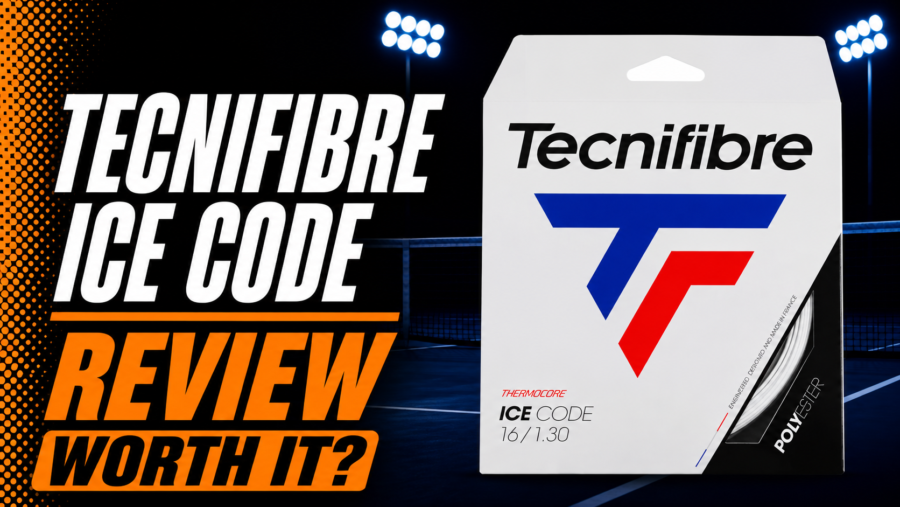
Tecnifibre Ice Code is a round co-polyester tennis string designed to combine control and resistance with more power than the firmer strings in Tecnifibre’s CODE range. The manufacturer positions it as the most powerful string in that family, not as the most powerful string across all material categories.
Ice Code uses Tecnifibre’s Thermocore production method and an H.C.D. process intended to improve flexibility. Its smooth round profile provides a versatile response based on pocketing and snapback rather than shaped edges.
The string targets strong intermediates and advanced players who want a controlled monofilament with enough rebound to avoid a completely dead response. The Tennis String Finder can help compare it with firmer control polyester and softer alternatives.
Tecnifibre Ice Code Rating
| Category | Rating |
|---|---|
| Power | 6.5/10 |
| Spin | 7.5/10 |
| Comfort | 6.5/10 |
| Control | 8.5/10 |
These ratings place Ice Code in the broader string market. It is lively for Tecnifibre’s CODE range but remains a control-oriented polyester compared with natural gut and multifilament.
Tecnifibre Ice Code Specifications
| Specification | Details |
|---|---|
| String type | Co-polyester monofilament |
| Composition | Blend of co-polyester materials |
| Manufacturing processes | Thermocore and H.C.D. |
| Profile | Round |
| Surface | Smooth, with no separately named coating in the official specification |
| Common gauges | 18 / 1.20mm, 17 / 1.25mm and 16 / 1.30mm |
| Common color | White |
| Set and reel lengths | Approximately 12m sets and 200m reels |
| Made in | France |
Gauge and package availability can differ between markets and retailers.
Material and Construction
Ice Code uses a single co-polyester filament made from a blend of polyester materials. This construction provides the control, resistance and low string movement associated with performance monofilaments.
Thermocore applies staged heating and cooling during manufacture to add flexibility to polyester’s naturally rigid structure. Tecnifibre also identifies H.C.D. as a process that further improves flexibility.
The string has a round cross-section. It does not use geometric edges to grip the felt, making its spin dependent on string movement, snapback, ball pocketing and the player’s swing speed.
No separately named exterior coating appears in the current official specification. The smooth surface and round geometry make Ice Code versatile in full beds and hybrid crosses.
Tecnifibre Ice Code Performance
Power
Ice Code provides moderate power for a control polyester. Tecnifibre calls it the most powerful string in its range, and independent retailer evaluation describes enough rebound for experienced players to attack without the response becoming uncontrolled.
The range claim needs context. Ice Code still supplies less easy depth than a multifilament, synthetic gut or natural gut. It works best when a fast swing activates the stringbed.
Players coming from a very rigid poly may notice extra pocketing and pace. Players coming from NRG2 or X-One Biphase will experience a much more restrained launch.
The 1.20mm gauge provides the easiest response. The thicker versions reduce rebound and improve stability.
Power rating: 6.5/10
Spin
Ice Code offers good spin for a round monofilament. Its smooth surface supports main-string sliding and snapback while the stringbed remains fresh.
The controlled response also allows accomplished players to accelerate upward confidently. This indirect contribution to spin can be as important as geometric bite.
The 1.20mm and 1.25mm gauges interact with the ball and move more easily than 1.30mm. The thicker gauge is better suited to open patterns and frequent breakers.
Players seeking the strongest direct grip should consider a shaped string. Ice Code is better suited to players who combine topspin with flatter drives, serves and all-court variation.
Spin rating: 7.5/10
Control
Control is one of Ice Code’s strongest qualities. The co-polyester construction limits excessive launch and lets fast swingers direct pace with confidence.
Independent retailer evaluation emphasizes precise targeting and a predictable response on full swings. The moderate power prevents the string from feeling completely dead while retaining a clear control bias.
The round profile provides consistent feedback across different shot shapes. It can suit players who alternate between topspin, flat attacking shots, returns and volleys.
Control can decline after tension loss or reduced snapback. The string should be replaced when trajectory becomes erratic even if the monofilament remains intact.
Control rating: 8.5/10
Comfort and Feel
Ice Code has moderate comfort for polyester. Thermocore and H.C.D. are intended to add flexibility, and retailer evaluation describes useful pocketing and feel for a firm monofilament.
Individual responses vary. Some players find Ice Code relatively forgiving for poly, while others experience a distinctly firm impact. Racket stiffness, gauge and tension explain part of this variation.
The feel is controlled and connected rather than plush. It offers more give than the hardest monofilaments but remains far firmer than a multifilament.
Players with arm sensitivity should not use the flexibility claims as a guarantee. A non-polyester string is normally the safer category to investigate.
Comfort rating: 6.5/10
Durability and Tension Maintenance
Ice Code has strong physical resistance because it is a co-polyester monofilament. Tecnifibre recommends it for demanding players and heavy breakers, with 1.30mm providing the greatest resistance.
Independent retailer evaluation describes above-average playability duration for the category. The smooth round profile can also reduce some of the localized edge wear associated with sharply shaped strings.
No polyester maintains its original elasticity indefinitely. Ice Code may remain unbroken after its response becomes firmer, livelier or less consistent.
Physical durability and useful playability duration must be assessed separately. Replace the bed when launch, comfort or snapback changes materially rather than waiting only for breakage.
Choosing the Right Gauge
Ice Code is available in three standard diameters.
| Gauge | General characteristics |
|---|---|
| 18 / 1.20mm | Greatest response, feel and spin access, with the least physical resistance |
| 17 / 1.25mm | Balanced power, control, feel and durability |
| 16 / 1.30mm | Maximum stability and resistance, with a lower and firmer launch |
The 17 / 1.25mm version is the most versatile starting point. Frequent breakers and very open patterns may prefer 16 gauge.
Full Bed or Hybrid Setup
Full Bed
A full bed provides Ice Code’s intended balance of control, moderate polyester power and smooth snapback. It suits experienced monofilament users with fast swings.
The setup remains firmer and less powerful than a full bed of natural gut or multifilament.
Tecnifibre Ice Code in the Mains With Softer Crosses
Ice Code mains preserve control and physical resistance. Natural gut or a multifilament cross adds power, pocketing and comfort.
The round mains are less aggressive than sharply shaped polyester, but they can still notch and cut through a soft cross over time.
Softer Mains With Tecnifibre Ice Code in the Crosses
Natural gut or multifilament mains emphasize power, touch and comfort. Ice Code’s smooth round profile makes it a logical control cross that should allow better sliding than many shaped strings.
The polyester cross still adds firmness and can abrade the soft mains. The result is more forgiving than a full Ice Code bed but not identical to a complete soft-string setup.
General Tension Guidance
Ice Code should generally begin below the reference used for nylon or multifilament because the polyester material already provides firmness and control.
Players moving from another co-polyester can begin near their established reference. Those coming from a very low-powered string should account for Ice Code’s additional category-relative rebound.
The appropriate setup depends on racket stiffness, pattern, gauge, swing speed and desired launch. Professional numbers are not transferable recommendations.
Use the Tennis String Tension Calculator for a general starting point, then make small changes within the frame manufacturer’s approved range.
Who Should Use Tecnifibre Ice Code?
Ice Code is best suited to:
- Strong intermediates and advanced players
- Aggressive hitters who want controlled power
- Players who prefer a round monofilament
- All-court players mixing spin and flatter shots
- Frequent hitters who need physical resistance
- Hybrid users seeking a smooth control cross
Who Should Avoid Tecnifibre Ice Code?
Ice Code is less suitable for:
- Beginners seeking easy depth
- Players with slow or compact swings
- Users who need multifilament-level comfort
- Players with current arm sensitivity
- Heavy-spin specialists who depend on shaped edges
- Anyone who plans to keep polyester installed until it breaks
Pros and Cons
| Pros | Cons |
|---|---|
| Strong control and precise targeting | Firm compared with soft-string categories |
| More power than firmer CODE strings | Less free depth than multifilament or gut |
| Smooth round profile supports snapback | No direct geometric bite |
| Thermocore and H.C.D. improve flexibility | Comfort varies substantially by setup |
| Strong physical resistance | Playability can decline before breakage |
| Useful in full beds and hybrids | Best suited to developed swings |
Tecnifibre Ice Code Compared With Other Strings
Ice Code vs Tecnifibre Razor Code
Tecnifibre Razor Code is the firmer, more deformation-resistant control option. Ice Code places more emphasis on power and flexible response within the CODE family.
Ice Code vs Tecnifibre Razor Soft
Tecnifibre Razor Soft adds polyurethane to high-modulus co-polyester for pocketing and comfort. Ice Code uses Thermocore and H.C.D. to create a lively, versatile CODE response.
Ice Code vs Wilson Revolve
Wilson Revolve is another round co-polyester built around control and snapback. Both work well for players who prefer smooth-string spin rather than shaped edges.
Ice Code vs Luxilon Element
Luxilon Element is a softer-feeling monofilament with greater emphasis on muted comfort. Ice Code provides a firmer, more control-focused response with three standard gauges.
Final Verdict
Tecnifibre Ice Code is a versatile round co-polyester for experienced players who want control without the deadest possible response. Thermocore, H.C.D. and a smooth profile support moderate polyester power, useful pocketing and consistent snapback.
Its official power claim applies within Tecnifibre’s range and should not be confused with multifilament or natural-gut power. Ice Code remains a firm performance string that requires developed technique.
For strong intermediates and advanced players seeking a lively round control poly, Ice Code is a solid option. The 17 / 1.25mm gauge provides the broadest balance of power, precision and resistance.
Frequently Asked Questions
Is Tecnifibre Ice Code a shaped string?
No. It has a round profile and produces spin through movement, snapback and player-generated racket-head speed.
Is Ice Code a powerful string?
It is the most powerful string in Tecnifibre’s referenced CODE range, but it remains less powerful than natural gut or most multifilaments.
What technologies does Ice Code use?
Tecnifibre identifies Thermocore and H.C.D. processes, both intended to improve polyester flexibility.
Which Ice Code gauge should most players choose?
The 17 / 1.25mm gauge provides the best general balance. The thinner gauge adds response, while 16 / 1.30mm adds stability and durability.