
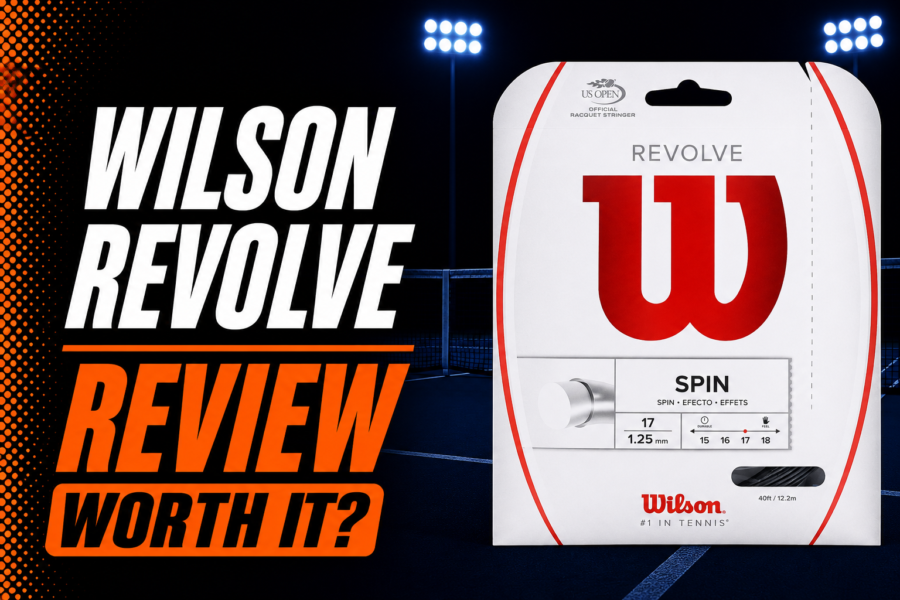
Wilson Revolve is a round co-polyester tennis string designed for players who want low-powered control, strong snapback and above-average polyester comfort. Its smooth surface and low-friction formulation allow it to generate substantial spin without using geometric edges.
Revolve replaced Wilson RipSpin in the range, but it should not be treated as a simple name change. Independent comparison found Revolve livelier, more pocketing and more spin-friendly than RipSpin, indicating a distinct playing response.
The string is best suited to intermediate and advanced players with long, fast swings who create their own pace. Players unsure whether a low-powered monofilament fits their game can use the Tennis String Finder to compare it with softer and more powerful materials.
Wilson Revolve Rating
| Category | Rating |
|---|---|
| Power | 6/10 |
| Spin | 9/10 |
| Comfort | 7.5/10 |
| Control | 9/10 |
These ratings assess Revolve against the complete tennis-string market. Its power score is low because polyester supplies less free depth than nylon and natural gut, while its spin and control are genuine strengths.
Wilson Revolve Specifications
| Specification | Details |
|---|---|
| String type | Co-polyester monofilament |
| Composition | Crosslink ester polymer with low-friction additive |
| Construction | Tri-polymer formulation |
| Profile | Round |
| Surface | Smooth, low-friction UHMW treatment |
| Common gauges | 17 / 1.25mm, 16 / 1.30mm and 15 / 1.35mm |
| Colors | Black, Orange and White |
| Set length | Approximately 12.2m |
| Reel length | Approximately 200m |
Gauge, color and package availability can differ between regions and retailers.
Material and Construction
Revolve is a single co-polyester monofilament made with a crosslink ester polymer formulation. Wilson describes a tri-polymer structure with additives intended to improve elasticity and feel compared with a basic polyester.
Its defining surface feature is a low-friction ultra-high-molecular-weight treatment, commonly abbreviated UHMW. This reduces resistance where the mains and crosses slide against one another.
The string is round and smooth. It does not use sharp sides to grip the ball. Spin comes mainly from lateral deflection and snapback, supported by the player’s racket-head speed and swing path.
The low-friction treatment should not be described simply as a coating that creates spin by itself. It helps preserve movement, but tension, pattern, gauge and surface wear all influence the installed response.
Revolve followed RipSpin in Wilson’s range. Although some listings call it “formerly RipSpin,” independent side-by-side feedback found meaningful differences. The safer description is that Revolve replaced and developed the concept rather than being an identical renamed string.
Wilson Revolve Performance
Power
Revolve is low powered across the complete tennis-string market. Independent testing found a restrained response that allowed fast swingers to accelerate without fearing an uncontrolled launch.
The string offers some pocketing and feels livelier than the earlier RipSpin, but it still expects the player to create pace through technique. Beginners and compact swingers may struggle to achieve comfortable depth.
The thinner 1.25mm gauge is the most responsive option, while 1.35mm emphasizes stability and control. Color can also produce subtle feel differences, although those impressions should not be treated as a universal specification.
Players seeking easy rebound should choose synthetic gut, multifilament or natural gut. Revolve’s purpose is to restrain powerful strokes, not supply effortless speed.
Power rating: 6/10
Spin
Spin is one of Revolve’s strongest qualities. Independent testing recorded excellent rotation from the combination of low friction, snapback and the confidence to swing quickly.
The response shows that a round string can be highly spin-friendly without sharp edges. Its mains can slide across the crosses and return toward position, adding rotational energy when the stringbed is fresh.
The controlled launch also encourages aggressive upward acceleration. A player who trusts the trajectory can create more practical spin than one who shortens the swing to manage a lively string.
Snapback declines when the surface wears or the intersections notch. Players should monitor whether the mains continue returning rather than assuming physical survival means full spin remains.
Spin rating: 9/10
Control
Revolve provides excellent control for developed swings. Its low free power and predictable response let aggressive players attack the ball while maintaining confidence in direction and depth.
Independent testers compared its control favorably with established firm polyesters while noting a softer, more pocketing feel. This makes Revolve relevant to players who want precision without the most rigid impact.
Control is strongest when the stringbed has stabilized after its initial tension drop. Once tension and elasticity decline further, trajectory and feel can change even if the strings remain intact.
The string is not automatically accurate for every player. A compact swinger may experience short balls rather than useful precision, and poor contact remains less forgiving than it is with nylon.
Control rating: 9/10
Comfort and Feel
Revolve is comfortably firm within the polyester category. Its additives and pocketing reduce the board-like response associated with some traditional monofilaments.
Independent testers reported no excessive impact shock and found the string softer than several control-polyester comparisons. The feel is slightly muted rather than crisp, which some players will appreciate and others may find less direct.
Category context remains essential. Revolve is still far less elastic than multifilament or natural gut and should not be described as broadly arm-friendly simply because it is comfortable for polyester.
Players with recurring elbow, wrist or shoulder discomfort should approach a full bed cautiously. Persistent pain should be assessed by a qualified healthcare professional.
Comfort rating: 7.5/10
Durability and Tension Maintenance
Revolve offers strong physical resistance to breakage. Its monofilament construction and three practical gauges can withstand repeated impact better than most nylon multifilaments and natural gut.
Independent testing also found very good playability duration for a performance polyester. Revolve experienced an initial tension drop and then stabilized, retaining a consistent response longer than the testers expected.
Physical durability is not the same as indefinite playability. The string can remain intact after elasticity, snapback or comfort has declined. A player should not wait for breakage if the trajectory has materially changed.
The UHMW surface helps reduce frictional wear, but it does not prevent notching. Heavy topspin, open patterns and frequent use still accelerate the decline.
Players should replace Revolve when the mains stop returning, control becomes inconsistent or the response feels substantially harsher or less lively.
Choosing the Right Gauge
Revolve is available in three common gauges that cover response, balance and maximum resistance.
| Gauge | General characteristics | Best suited to |
|---|---|---|
| 17 / 1.25mm | More response, feel and spin with less physical resistance | Dense patterns and players seeking easier acceleration |
| 16 / 1.30mm | Balanced control, spin and durability | Most intermediate and advanced Revolve users |
| 15 / 1.35mm | Firmer launch and maximum resistance | Open patterns and frequent string breakers |
The thickest version can feel demanding. Players who do not have a breakage problem will normally obtain a more responsive result from 1.25mm or 1.30mm.
Full Bed or Hybrid Setup
Full Bed
A full bed gives Revolve its maximum control, snapback and durability. It suits experienced polyester users with long, fast swings.
The setup remains low powered and can feel firm in a stiff racket. The 1.25mm gauge and a cautious tension can make it more accessible without changing its basic category.
Revolve in the Mains With Softer Crosses
Using Revolve in the mains preserves most of its control and spin. Natural gut, multifilament or synthetic gut crosses can add power, pocketing and comfort.
The round, low-friction profile is less abrasive than a sharply shaped main, but polyester can still notch a softer cross. The hybrid does not guarantee longer physical life.
Softer Mains With Revolve in the Crosses
Natural gut or multifilament mains supply most of the power and comfort, while Revolve crosses add control and create a low-friction surface for main-string movement.
This is one of Revolve’s most logical hybrid roles. Its round profile and UHMW treatment are well suited to preserving snapback compared with a rough or sharply shaped cross.
General Tension Guidance
Revolve generally works best at a lower tension than the same player would use for synthetic gut or multifilament. Its co-polyester construction is less elastic, and copying a nylon setup can create unnecessary firmness.
Players seeking more pocketing, depth and comfort can begin toward the lower portion of the racket manufacturer’s recommended range. Players seeking a firmer trajectory can make a modest upward adjustment if the response remains comfortable.
Gauge, head size, pattern density and hybrid orientation all change the result. The 1.35mm version may need more caution than 1.25mm because of its substantial construction.
The Tennis String Tension Calculator can help organize these factors. Final changes should be small and based on actual launch and comfort.
Who Should Use Wilson Revolve?
Revolve is best suited to:
- Intermediate and advanced players with fast swings
- Players seeking low-powered control and strong snapback
- Topspin players who prefer a round string
- Polyester users who want more pocketing than a rigid control mono
- Frequent hitters who value physical durability
- Hybrid users seeking a smooth, low-friction cross
Who Should Avoid Wilson Revolve?
Revolve is less suitable for:
- Beginners who need easy power and forgiveness
- Players with compact or slow swings
- Players seeking multifilament or natural-gut comfort
- Anyone with recurring arm discomfort who has not been advised that polyester is suitable
- Players expecting an identical replacement for RipSpin
- Players who leave polyester installed after snapback and comfort decline
Pros and Cons
| Pros | Cons |
|---|---|
| Excellent control for fast swings | Low powered across the complete market |
| Strong spin from low-friction snapback | Less bite from geometry than shaped strings |
| Above-average comfort within polyester | Still substantially firmer than nylon or gut |
| Very good physical durability | Initial tension drop before stabilization |
| Three useful gauge options | Muted feel may not suit crisp-string fans |
| Effective as a full bed or hybrid cross | Useful playability ends before breakage |
Wilson Revolve Compared With Other Strings
Revolve vs Wilson Revolve Spin
Wilson Revolve Spin adds a five-sided profile and a firmer, lower-powered response. Spin supplies more geometric bite and control, while round Revolve is softer and more versatile in hybrids.
Revolve vs Luxilon ALU Power
Luxilon ALU Power provides a crisper, more connected response. Revolve feels more muted and emphasizes low-friction movement, while ALU Power offers the more distinctive direct feel.
Revolve vs Babolat RPM Blast
Babolat RPM Blast uses an octagonal profile and slick surface for bite and snapback. Revolve is round and more pocketing, while RPM Blast provides stronger geometric interaction.
Revolve vs Volkl Cyclone
Volkl Cyclone is a shaped control polyester with a crisper response. Both offer strong spin and precision, but Revolve relies more on movement than edges.
Revolve vs Luxilon ECO Power
Luxilon ECO Power is another round performance polyester with a livelier response and recycled feedstock. Revolve is the more established low-friction control option.
Final Verdict
Wilson Revolve is a strong example of a round spin-oriented polyester. Its low-friction construction produces excellent snapback, while restrained power gives fast swingers the confidence needed to attack the ball.
It is more comfortable and pocketing than many firm control strings but remains a demanding polyester. Beginners and players needing easy depth should choose a more elastic material.
For intermediate and advanced players seeking spin, control and durability from a smooth profile, Revolve is a well-balanced option. It is particularly useful as a full bed for fast swingers or as a low-friction cross beneath natural gut or multifilament mains.
Frequently Asked Questions
Is Wilson Revolve the same as RipSpin?
Revolve replaced RipSpin in Wilson’s range, but independent comparison found a livelier and more pocketing response. It should not be treated as an identical rename.
What shape is Wilson Revolve?
It is round and smooth. Its spin comes mainly from low-friction movement and snapback rather than sharp edges.
Is Revolve powerful?
It is low powered across the complete tennis-string market. It performs best for players who generate their own pace.
Is Revolve comfortable?
It is comfortable within polyester but much firmer than multifilament or natural gut.
Which Revolve gauge should I choose?
Choose 1.25mm for response, 1.30mm for balance or 1.35mm for maximum resistance and control.
Is Revolve suitable as a hybrid cross?
Yes. Its round, low-friction surface makes it a logical cross beneath natural gut or multifilament mains.
How long does Revolve remain playable?
There is no universal lifespan. Replace it when snapback, launch, control or comfort changes materially, even if it remains unbroken.