
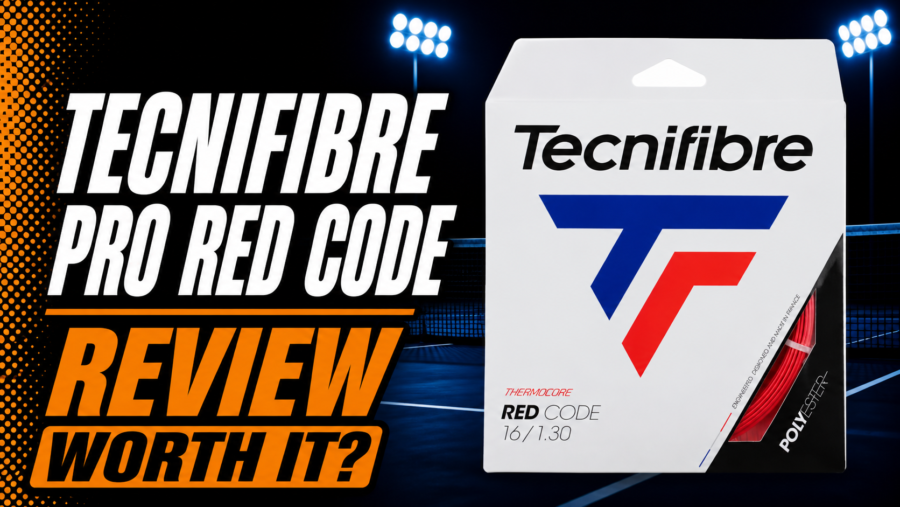
Tecnifibre Pro Red Code is a round co-polyester tennis string designed for control, physical durability and a crisp response. It belongs to Tecnifibre’s CODE family of monofilaments and represents the traditional, versatile control option rather than a soft or heavily shaped spin string.
The standard Pro Red Code reviewed here should not be confused with Pro Red Code Wax, a related product with a wax additive intended to improve sliding and snapback. Standard Pro Red Code uses Tecnifibre’s Thermocore process, but it does not have the Wax version’s named surface treatment.
Pro Red Code targets advanced players and strong intermediates who generate their own pace, swing quickly and break softer strings too often. Players comparing it with livelier or more forgiving options can also use the Tennis String Finder.
Tecnifibre Pro Red Code Rating
| Category | Rating |
|---|---|
| Power | 5/10 |
| Spin | 7.5/10 |
| Comfort | 6/10 |
| Control | 9/10 |
These ratings place Pro Red Code within the full tennis-string market. Its comfort is acceptable for some experienced polyester users, but it remains much firmer than multifilament or natural gut.
Tecnifibre Pro Red Code Specifications
| Specification | Details |
|---|---|
| String type | Co-polyester monofilament |
| Profile | Round |
| Surface | Smooth, with no Wax additive in the standard version |
| Manufacturing process | Thermocore |
| Common gauges | 18 / 1.20mm, 17 / 1.25mm and 16 / 1.30mm |
| Color | Red |
| Set length | Approximately 12m |
| Reel length | Approximately 200m |
| Made in | France |
Gauge and package availability can vary by region. Tecnifibre also sells related CODE strings, so the full product name should be checked before buying.
Material and Construction
Pro Red Code uses a single co-polyester filament. This construction creates a consistent response and high resistance to breakage, but it is naturally firmer and less elastic than nylon multifilament or natural gut.
Tecnifibre applies its Thermocore manufacturing process to the string. The process uses controlled heating and cooling stages to add some flexibility to a rigid polyester material. Thermocore does not make Pro Red Code a soft string across the wider market. It remains one of the firmer, more traditional control strings in Tecnifibre’s range.
The cross-section is round. Pro Red Code therefore does not use sharp edges to grip the ball. Its spin potential comes primarily from the player’s racket-head speed, string movement and snapback.
The standard version has a smooth red exterior and no separately named coating in the current official specification. Claims about a wax additive apply to Pro Red Code Wax and should not be transferred to this product.
Tecnifibre Pro Red Code Performance
Power
Pro Red Code is low powered. Independent playtesting found that it provides less free depth than many modern co-polyesters, allowing strong hitters to accelerate without an excessively lively launch.
That controlled response works best for players who already create pace. In a powerful racket, it can reduce the stringbed’s tendency to send the ball long. In a flexible, low-powered frame, the same string can feel demanding and may require too much effort from a compact swinger.
Thinner gauges add some response and pocketing, while the 1.30mm version is more restrained. Even in 1.20mm, Pro Red Code should not be treated as an easy-power string.
Power rating: 5/10
Spin
Pro Red Code offers useful rather than exceptional spin. Its round profile lacks the direct edge-assisted bite of Tecnifibre 4S, Solinco Tour Bite or another sharply shaped polyester.
The string’s low power still encourages fast swings, and its smooth intersections can support snapback while fresh. Independent evaluations found adequate spin for topspin and slice, but less ball bite than leading shaped alternatives.
Players with developed mechanics can produce heavy rotation with it. Players choosing a string specifically for maximum geometric bite should consider a shaped model instead.
Spin rating: 7.5/10
Control
Control is Pro Red Code’s strongest quality. Its firm construction and low power produce a predictable trajectory on full swings, particularly for aggressive baseliners and flatter ball strikers.
Independent testing gave it an excellent control score and highlighted the confidence it provides when attacking. The round profile also creates a uniform response across flat drives, serves and volleys.
Control depends on a suitable gauge, tension and racket. Installing a thick version too tightly in a dense pattern can make the stringbed unresponsive rather than more accurate.
As the string loses elasticity, it may remain physically intact while becoming less connected or predictable. That change should guide replacement timing.
Control rating: 9/10
Comfort and Feel
Pro Red Code feels firm, crisp and direct. Thermocore adds category-relative flexibility, but the string still has the clean, controlled character associated with traditional polyester.
Independent testers who regularly use firm polyester found acceptable comfort and valued the connected feedback. That result should not be generalized to beginners or players accustomed to soft nylon strings.
Off-center contact can feel unforgiving, especially at high tension or in a stiff racket. Players with current arm discomfort should choose a genuinely softer construction rather than relying on the Thermocore name.
Comfort rating: 6/10
Durability and Tension Maintenance
Physical durability is excellent. The co-polyester monofilament and firm round profile resist notching and breakage, with 1.30mm providing the greatest material volume and stability.
Independent playtesting also found good playability duration for a polyester. The response remained controlled for a useful period, although some loss of feel appeared before the string broke.
Break resistance and useful life are not the same. A durable polyester can remain installed after its elasticity, tension and snapback have declined. Pro Red Code should be replaced when it feels excessively rigid, stops returning to position or produces an inconsistent trajectory.
Choosing the Right Gauge
| Gauge | General characteristics |
|---|---|
| 18 / 1.20mm | Most responsive, easiest spin access and lowest break resistance |
| 17 / 1.25mm | Balanced control, feel and durability |
| 16 / 1.30mm | Maximum stability and physical durability with the lowest launch |
The 17 / 1.25mm version is the most versatile starting point. Frequent breakers and players with open patterns may prefer 1.30mm. A dense pattern or a player seeking more response may suit 1.20mm.
Full Bed or Hybrid Setup
Full Bed
A full bed delivers the clearest version of Pro Red Code’s firm control and physical durability. It is best suited to experienced polyester users with long, fast swings.
Players moving from multifilament or synthetic gut should expect a substantial reduction in power and comfort.
Tecnifibre Pro Red Code in the Mains With Softer Crosses
Pro Red Code mains preserve control and resistance while natural gut, multifilament or synthetic-gut crosses add pocketing and easier depth.
The polyester mains will eventually notch a softer cross. This setup can still be more forgiving than a full bed while retaining much of the main string’s direct response.
Softer Mains With Tecnifibre Pro Red Code in the Crosses
Soft mains make power, comfort and feel the priorities. Pro Red Code crosses reduce launch and add durability without the abrasion of a sharply shaped cross.
The firm cross still affects the overall stiffness. Players seeking maximum comfort should use a full bed of soft string instead.
General Tension Guidance
Pro Red Code is normally installed below a player’s nylon or multifilament reference because its construction already supplies substantial firmness and control.
Experienced polyester users can begin near their familiar range. Lower tension adds pocketing and response, while higher tension further reduces launch but can make the bed unnecessarily harsh.
Racket stiffness, head size, pattern and gauge all matter. The Tennis String Tension Calculator offers a broad starting point. Adjust one variable at a time within the racket manufacturer’s range.
Who Should Use Tecnifibre Pro Red Code?
Pro Red Code is best suited to:
- Advanced players and strong intermediates
- Aggressive hitters who create their own pace
- Frequent string breakers
- Players who prefer a crisp, direct response
- Flatter hitters who want a uniform round profile
- Hybrid users seeking a firm control component
Who Should Avoid Tecnifibre Pro Red Code?
Pro Red Code is less suitable for:
- Beginners seeking easy depth
- Players with compact or slow swings
- Anyone prioritizing plush comfort
- Players with current arm sensitivity
- Users seeking maximum shaped-string bite
- Players who leave polyester installed until it breaks regardless of performance
Pros and Cons
| Pros | Cons |
|---|---|
| Excellent control on full swings | Low free power |
| Very strong physical durability | Firm and unforgiving compared with nylon strings |
| Crisp, direct feedback | Less spin bite than leading shaped polyesters |
| Three useful gauges | Requires developed racket-head speed |
| Smooth round profile works well in hybrids | Useful playability can end before breakage |
| Thermocore adds some category-relative flexibility | Standard version does not include the Wax treatment |
Tecnifibre Pro Red Code Compared With Other Strings
Pro Red Code vs Tecnifibre Razor Code
Tecnifibre Razor Code is another round control monofilament. Razor Code has a more modern, somewhat livelier response, while Pro Red Code feels more traditional, restrained and durability focused.
Pro Red Code vs Tecnifibre 4S
Tecnifibre 4S uses a square profile for more direct ball bite. Pro Red Code is round and more neutral for flat hitting, while 4S places greater emphasis on shaped spin.
Pro Red Code vs Solinco Revolution
Solinco Revolution is a firm shaped co-polyester with stronger edge-assisted spin. Pro Red Code provides a cleaner round-string response and similarly control-oriented intent.
Pro Red Code vs Luxilon Big Banger Original
Luxilon Big Banger Original is another durable, low-powered string for powerful ball strikers. Both are demanding, but their material formulations and impact feel differ.
Final Verdict
Tecnifibre Pro Red Code is a dependable control string for players who value consistency and break resistance more than easy power or plush comfort. Its round co-polyester construction and Thermocore process produce a crisp, predictable response for full swings.
Independent testing supports its strongest claims: control and physical durability are excellent, while spin is useful without matching the bite of leading shaped strings. Its old-school firmness is an advantage only when the player has the swing speed and tolerance to use it.
The 17 / 1.25mm version offers the best general balance. Frequent breakers can move to 1.30mm, while players seeking more pocketing can consider 1.20mm.
Frequently Asked Questions
Is Tecnifibre Pro Red Code shaped?
No. The standard string has a round profile. It generates spin through swing speed, string movement and snapback rather than sharp edges.
Is Pro Red Code the same as Pro Red Code Wax?
No. They are related but distinct products. The Wax version includes a named wax additive, while standard Pro Red Code does not.
Is Pro Red Code comfortable?
It provides acceptable comfort for some experienced polyester users, but it remains firm across the wider string market. Multifilament and natural gut are substantially softer.
Which gauge should most players choose?
The 17 / 1.25mm version provides the most balanced starting point. Use 1.30mm for more resistance or 1.20mm for more response.
Does Pro Red Code hold tension well?
It has good playability duration for a traditional polyester, but its response still changes before breakage. Replace it when control, elasticity or snapback declines.